

Buying SEO articles is straightforward until you try to compare quotes, at which point you discover that $0.08 a word and $0.45 a word are both real prices for something described as an SEO article. The difference is not usually quality of prose. It is whether keyword research, briefing, optimisation, internal linking and publishing are included, or whether you are buying text and doing the rest yourself.
This list covers fifteen options across four models, quotes the prices vendors publish, and starts with the question most of these lists never ask: whether you should be buying articles by the piece at all. Our guide to choosing an SEO content writing service covers the questions worth asking before anyone quotes. The software answer to that same question is our AI content writer, which is priced per month rather than per article.
How we checked this list
Every service below was loaded on its live site in August 2026 and screenshotted. Two candidates that appear on other lists in this category did not survive the check: Godot Media and Growth Machine both timed out repeatedly and are not listed.
One rebrand was caught. Crowd Content now redirects permanently to Stellar Content, so it appears here under its current name rather than the one older lists still use.
Prices are quoted only where the vendor publishes them. Several agencies at the premium end quote per project after a call, and the entry says so rather than inventing a figure. For the wider market beyond articles, see our comparison of content creation services.
The four models, and what each really costs
| Model | Typical price | You still do | Best for |
|---|---|---|---|
| Marketplace, self-serve | $0.05 to $0.15 per word | Research, briefs, optimisation, publishing | Volume on a budget |
| Managed writing service | $0.15 to $0.30 per word | Strategy, publishing | Most small businesses |
| Full-service content agency | $500 to $3,000 per article | Very little | Funded companies |
| Software you run yourself | Flat monthly | Editing and oversight | Agencies and repeat volume |
The fourth row is the one that changes the arithmetic, and it is where this list starts.
1. Distribb, the reason you might not need to buy articles at all

Distribb is software, not an agency, and that distinction is the entire point of putting it first rather than a claim to be a better writing service. Nobody at Distribb writes your article by hand. The software category that sits behind that distinction is covered in our roundup of SEO article writer software.
What it does is run the whole pipeline yourself: keyword research, drafting, publishing to WordPress, Webflow or Shopify, and internal linking, on a schedule you set once. For an agency, it can be white labelled so the output goes out under your own brand, which is the specific case where buying articles per piece stops making sense.
The case for it over a writing service: there is no per-article fee that climbs with volume, so the tenth article a month costs the same as the first. There is no turnaround queue and no waiting on a writer's availability. If you are an agency, you keep the client relationship and the margin instead of passing both to a subcontractor. What running an AI SEO article writer looks like day to day is covered in our step-by-step guide.
The case against it, and this is real: you get no strategist. Nobody joins a client call, nobody interviews your subject matter experts, nobody does the manual technical work or cleans up local citations. If your client needs a person on a monthly call, or the content depends on original interviews, an agency is the correct purchase and the services below are where to look. Accelerator is $495 per month with a 7-day free trial.
2. Verblio, the managed service most people should start with
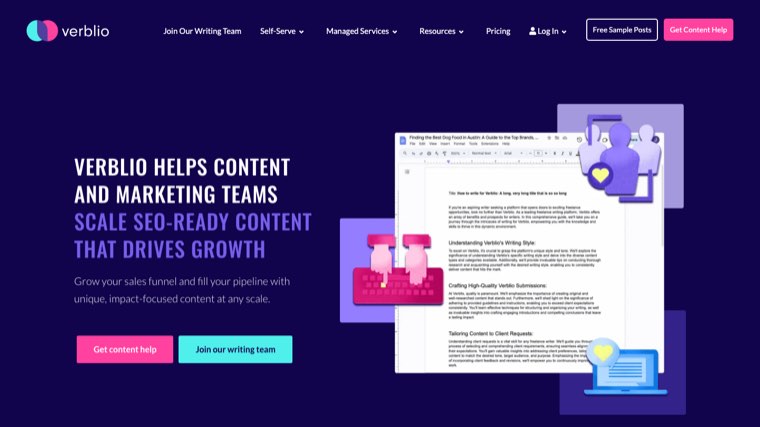
Verblio sits in the middle of this market and does it well: a large vetted writer pool, SEO-aware briefs, and a model where several writers can pitch on your topic so you pick the take you prefer.
It handles the awkward middle case of needing consistent quality without an agency retainer, and the agency-facing programme makes it a common white label choice for resellers.
Honest limit: priced above the marketplaces, and quality still varies by writer until you find the ones who understand your business. Budget a few pieces to calibrate.
3. WriterAccess, the deepest talent pool

WriterAccess lets you filter and hire writers by star rating, industry experience and specialism, then keep working with the ones who perform. That control is the product.
The platform side, briefs, workflow, approvals, is stronger than most marketplaces, which matters if you are running several pieces a month.
Honest limit: you are managing writers. It gives you a better roster and a better tool for doing that, not freedom from doing it.
4. Stellar, formerly Crowd Content

Stellar is the rebranded Crowd Content, offering managed content production at scale with a large writer network and tiered quality levels.
It suits ecommerce and multi-location businesses producing hundreds of similar pages, which is a genuinely different job from producing twelve strong blog posts.
Honest limit: at the volume end, output is competent rather than distinctive. That is the correct trade for product descriptions and the wrong one for thought leadership.
5. Textbroker, the transparent marketplace

Textbroker has run a star-rated marketplace for years, with clear price tiers by writer level and both self-serve and managed options.
The pricing transparency is the reason to use it. You know exactly what a 3-star versus a 5-star word costs before you commit.
Honest limit: at the lower star levels you are buying words, not SEO. Research, briefing and optimisation are all yours.
6. Scripted, now built around AI plus humans

Scripted has repositioned around agentic AI content intelligence with human writers in the loop, aimed at businesses that want volume without abandoning editorial control.
The subscription model makes monthly costs predictable, which purchasing departments prefer to per-piece billing.
Honest limit: the positioning has moved considerably in two years. Ask directly what proportion of your deliverable is human-written before signing, because the answer determines what you are actually buying.
7. BKA Content, the steady agency option

BKA has been producing SEO content and blog management for a long time, with managed monthly plans rather than one-off orders.
The managed blog service, where they handle topics, writing and scheduling, is the useful product for a business that wants the blog to happen without thinking about it. If you would rather run that yourself, our guide to choosing an AI blog writing tool covers the alternative.
Honest limit: more traditional and less flexible than the newer platforms. Good if you want a steady arrangement, less good if your needs change monthly.
8. The Urban Writers, volume and long-form

The Urban Writers covers SEO content alongside longer formats including books, which makes it a fit for businesses producing substantial assets rather than only blog posts.
Pricing is competitive for the length of content produced.
Honest limit: the breadth means SEO is one of several things they do rather than the only thing. For technical SEO content, brief them tightly.
9. Content Whale, the low-cost end done openly

Content Whale publishes per-word pricing openly and operates at the budget end of the market with a large output capacity.
For businesses that need volume and have someone in-house to edit and optimise, the economics work.
Honest limit: at budget rates, expect to edit. Treat the output as a solid draft rather than a finished page, and price your own time into the comparison.
10. Contentellect, content and links together
Contentellect combines content writing with link building for agencies and businesses, which is unusual in this list and useful because the two jobs are normally bought separately. The writing craft that sits under any of these arrangements is covered in our guide to content writing for SEO.
For an agency that wants one supplier for both halves of an SEO programme, the consolidation saves real overhead.
Honest limit: bundling means neither half is the deepest specialist available. Judge each side on its own.
11. Animalz, the premium B2B SaaS agency
Animalz is at the top end: strategy-led content for B2B SaaS, with senior writers, original thinking and a reputation built on pieces people actually cite.
If your content has to establish authority in a competitive category rather than capture existing search demand, this tier is what that costs.
Honest limit: retainer pricing well above everything else here, quoted after a conversation. Not a fit for a business needing twenty pages of category content.
12. Siege Media, content plus links at agency level
Siege Media pairs content production with digital PR and link acquisition, which is the model that works for competitive SERPs where content alone does not move.
Their published work in data-led and visual content is the evidence to judge them on.
Honest limit: full agency engagement and pricing, quoted per project. Overkill for a small site.
13. Omniscient Digital, growth-focused content
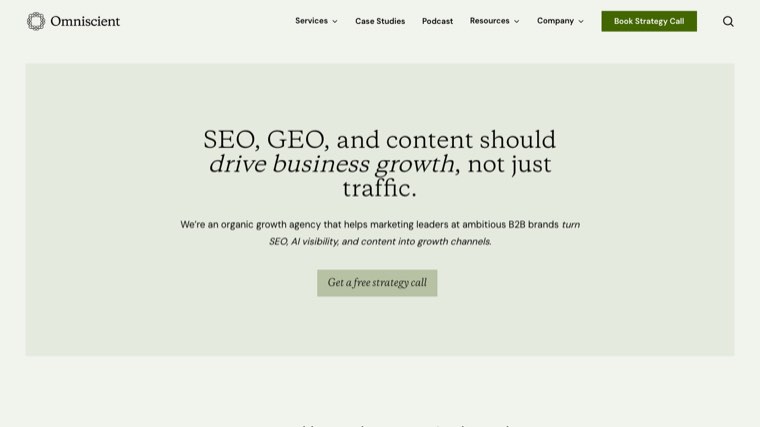
Omniscient works with B2B and SaaS companies on content tied to pipeline rather than traffic, with strategy as a first-class part of the engagement.
The distinction they push, that traffic is not the goal, is the right one for most companies buying content.
Honest limit: agency pricing and a selective client fit. They are not a per-article vendor.
14. FatJoe, the reseller default
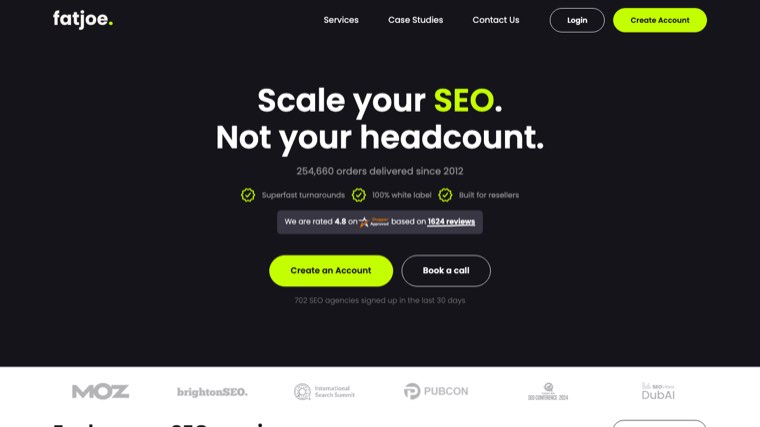
FatJoe is built for agencies reselling: white label, published pricing, predictable turnaround across content writing, blogger outreach and link building.
The published price list is the main advantage. You can quote a client margin without a discovery call.
Honest limit: volume-oriented and generic by design. It is a fulfilment supplier, not a content partner.
15. The HOTH, the other reseller default
The HOTH offers a similarly broad white label menu with transparent pricing across content, links and local SEO, aimed squarely at agencies.
Long-established, with reporting built for passing to a client.
Honest limit: the same trade as FatJoe. You are buying predictable fulfilment, and the ceiling on quality reflects that.
What a word should cost you
The market splits roughly into three bands: entry writers at $0.05 to $0.10 a word, experienced SEO writers at $0.15 to $0.30, and specialists at $0.50 and above.
For a 1,500 word article, that is $75 to $150 at the bottom, $225 to $450 in the middle, and $750 or more at the top. The middle band is where most businesses should be, and paying at the bottom while expecting the middle is the most common source of disappointment in this category.
The arithmetic worth doing before you buy
Start with your monthly article target and multiply it by your quoted per-article price. At eight articles a month at $250, that is $2,000 monthly, and the figure does not fall as you scale because per-piece pricing never does.
Compare that against a flat software cost plus your own editing time. Below about four articles a month, buying is usually cheaper and simpler. Above eight, the arithmetic reverses, and for an agency billing several clients it reverses much earlier. That is the case for white labelling the software rather than subcontracting each article. The software half of that comparison is in our list of the best AI content creation tools.
The comparison is only honest if you include the editing either way, because you will edit both. Our white label SEO agencies breakdown covers the reseller side, and best white label link building services covers the link half of the same decision.
Which to choose
If you need strategy and interviews: Animalz, Siege Media or Omniscient Digital. Expensive, and there is no cheap version of what they do.
If you need reliable articles without managing writers: Verblio or BKA Content. Our separate list of blog writing services covers the vendors that only do blog content.
If you want to control the roster: WriterAccess or Textbroker.
If you are an agency reselling: FatJoe or The HOTH for one-off fulfilment, or run the software yourself under your own brand if the volume justifies it.
The honest summary
If you buy fewer than a handful of articles a month, a writing service is the right answer and the list above is where to look. Nothing about software changes that.
If you are producing content every week, or reselling to several clients, the per-piece model is the expensive part and it gets worse as you grow. Distribb is software you run under your own brand with a flat cost and no queue, and it does not give you a strategist or a person on a client call, which is the trade. There is a 7-day free trial if the volume arithmetic above describes you. Running it in-house has its own process, which our nine-step guide to AI SEO writing sets out.