
Most guides on this topic stop at the finding. They give you ten places to collect phrases, and you end up with four hundred keywords in a spreadsheet and no idea which of them deserve an article.
Finding long-tail keywords is the easy half. Google will hand you hundreds for free in an afternoon. The hard half is deciding which ones have a page behind them worth writing, and that is the part almost nobody covers.
So this page does both. Twelve methods, a table showing what each one actually returns, then the validation and prioritisation steps that turn a list into a publishing plan. It also includes something the other guides on this query leave out, which is what happened to long-tail traffic over the last two years and what that means for the pages you are about to write.
What a long-tail keyword actually is
A long-tail keyword is a search query with low individual search volume, usually more specific and usually longer than the head terms in the same topic. "Coffee" is a head term. "Why does my espresso taste sour" is long tail.
The length is a symptom, not the definition. What makes a query long tail is that few people search it, not that it has five words in it. "Ahrefs pricing" is three words and is long tail relative to "SEO tools". Plenty of five-word queries are competitive and expensive.
The name comes from the shape of the demand curve. A small number of queries get enormous volume, and then there is a very long, very flat tail of queries that get almost none. Most of the searches that happen on any given day are in that tail, which is the whole reason this exercise is worth doing.
The three kinds of long-tail keyword, and why it changes your method
This distinction matters more than any tool choice, and only one of the pages currently ranking for this query makes it.
Supporting long tail. A rarely searched variation of a topic that a broader page already covers. "Best running shoes for flat feet size 13" sits under "best running shoes for flat feet". These usually do not need their own page. You rank for them by covering the variation inside a page that targets the parent term.
Topical long tail. A specific subject with its own low search volume that no broader page covers properly. "How to fix sour espresso" is its own topic. These deserve their own page, and they are the ones you are actually hunting.
Conversational long tail. Full questions and sentences, increasingly typed into AI assistants rather than search boxes. These have grown fast and they behave differently from the other two, which the section on zero-click covers below.
If you skip this classification you will write forty pages targeting supporting long tail, and they will compete with each other and with your own parent page. That is the single most common way this exercise fails.
Why long-tail keywords are worth the effort
Three reasons hold up, and one commonly repeated reason does not.
They are less competitive. A query with 40 monthly searches rarely has anyone building links at it, so a genuinely good page can rank without much authority behind it.
They convert better on commercial intent. Someone searching "invoice software for freelance translators" is further along than someone searching "invoice software". This is true for commercial queries and much weaker for informational ones, which is a distinction most guides blur.
There are far more of them. The tail is where the volume actually lives in aggregate, so a hundred small pages can out-earn one big one.
The reason that does not hold up is the claim that long tail is easy. It is cheaper per page, not easier. You still need the page to be better than what ranks, and you need a lot of pages for the aggregate to matter.
The honest part: what happened to long-tail traffic
This is the section the other four pages ranking for this query do not have, and it changes how you should pick keywords.
Ranking for a long-tail informational query no longer reliably produces a click. Many of these queries now get answered directly on the results page, in an AI overview or a featured snippet, and the user never leaves. You can hold position 5 and receive nothing.
We can put numbers on this from our own site rather than quoting someone else's study. Across a recent 90 day window, 71% of the articles we had published earned no clicks at all. A cluster of conversational queries on this domain accumulated roughly 14,000 impressions at an average position of 8.5 and produced zero clicks. Position 8.5 is page one. It still produced nothing.
The lesson is not to abandon long tail. It is to weight commercial and problem-solving queries above definitional ones. "What is a long-tail keyword" gets answered on the results page. "Long tail pro vs ahrefs" does not, because the searcher wants to compare before spending money, and that comparison needs a page.
When you build your list, mark every keyword as definitional, commercial or problem-solving. Write the commercial and problem-solving ones first.
12 ways to find long-tail keywords
Methods 1 to 4 are free and need no account. They are also where most people should start, because they return the phrasing real searchers use rather than a tool's guess at it.
1. Google Autocomplete
Type your head term into Google and read the suggestions without pressing enter. Then append each letter of the alphabet after it, one at a time, to force different branches out of the index. "Espresso a", "espresso b", and so on.
These are real queries with real volume behind them. Autocomplete does not suggest phrases nobody searches.
2. People Also Ask
Search your head term and open the People Also Ask box. Every time you expand one question, Google loads more. Ten minutes of expanding produces fifty question-format long-tail keywords, and questions are the format most likely to be a topical long tail with its own page behind it.
3. Related searches
Scroll to the bottom of the results page. Take one of those related searches, search it, and read its related searches. Three levels deep and you are into genuinely obscure territory that no tool database has properly indexed.
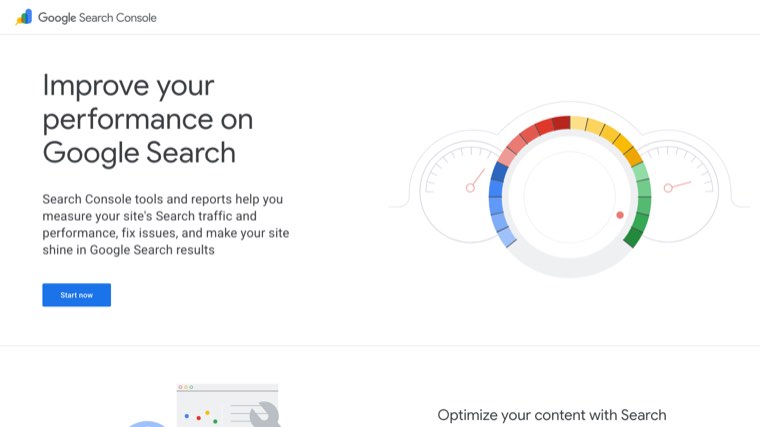
4. Your own Search Console query report
This is the highest-value method on the list and it is the one most people skip.
Open Search Console, go to the performance report, and filter queries by impressions with a position between 8 and 30. These are queries you already rank for, on pages you already have, without ever having targeted them. They are pre-validated: Google has already decided your site is relevant.
Sort by impressions and look for queries where you sit on page two or three. Those are the cheapest wins available to you, because the page exists and only needs to be better. If you are doing this on a small site with a thin query report, our guide to keyword research for a small business covers how to work with less data.
5. Ahrefs Keywords Explorer

Enter a seed term, open the Matching terms report, and set a word count filter of four or more. Then filter keyword difficulty below 20 and volume above 10. The step below covers the full workflow, because a large share of the people searching this query are specifically asking how to do it in Ahrefs.
6. Semrush Keyword Magic Tool
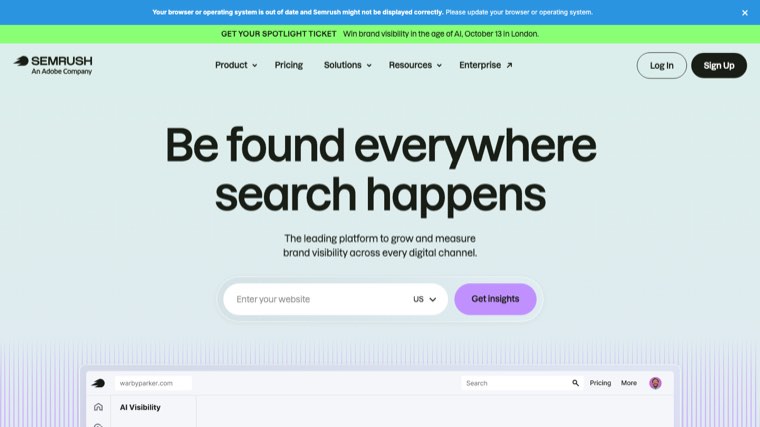
Same idea, different index. Enter a seed, switch to the Questions tab, and set the word count filter. Semrush and Ahrefs return meaningfully different long-tail sets from the same seed, so if you have access to both it is worth running both. If you have neither, methods 1 to 4 and 8 to 12 cost nothing.
7. Google Keyword Planner
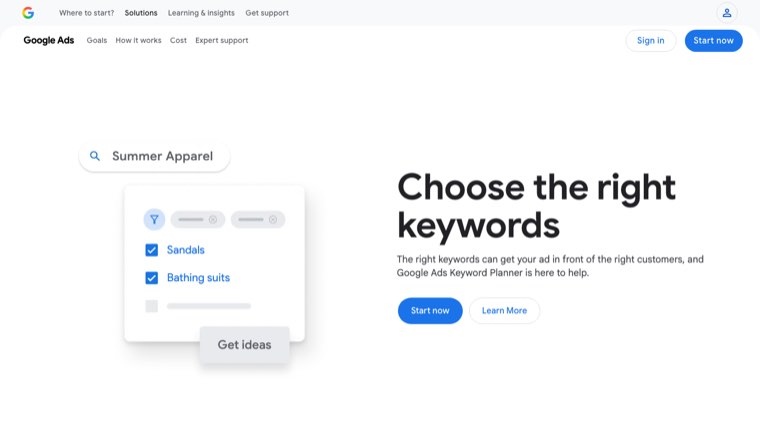
Free with any Google Ads account. It groups volume into wide ranges rather than giving exact figures unless you are spending, which makes it poor for prioritisation and fine for discovery. Its advantage is that the data is Google's own.
8. AnswerThePublic

Enter a seed and it returns question-format queries organised by question word: who, what, when, where, why, how. The visualisation is the selling point and the CSV export is the useful part. Free tier is limited to a few searches a day.
9. AlsoAsked
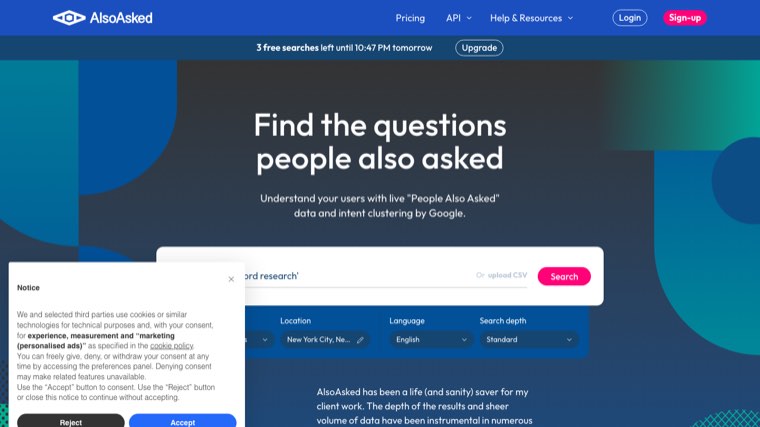
This automates method 2. It expands the People Also Ask tree several levels deep and shows you the branches as a map, which surfaces the relationship between questions rather than just the list. Useful when you are planning a cluster rather than a single page.
10. Keyword Tool and Keywords Everywhere
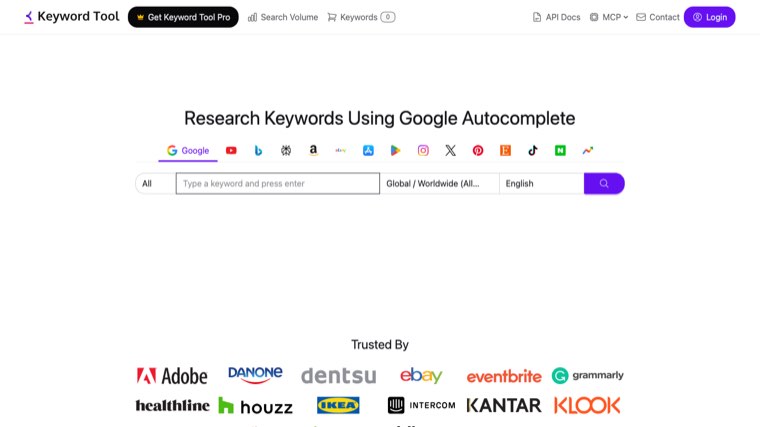
Keyword Tool scrapes autocomplete across Google, YouTube, Amazon and a few others, which matters if your audience searches somewhere other than Google. Keywords Everywhere is a browser extension that shows volume inline while you browse normal search results, so you gather data as a side effect of searching. For finding the terms competitors rank for and you do not, our comparison of keyword gap analysis tools covers that specific job.

11. Google Trends
Trends will not give you absolute volume, so it is not a discovery tool in the usual sense. What it does give you is the rising queries list, which surfaces long-tail terms that are growing before the tool databases have enough data to report them. That timing advantage is the whole reason to use it.
12. Forums, Reddit and your own support inbox
The last method has no tool and returns the best raw material.
People in forums and subreddits ask questions in their own words, including the awkward phrasings that never make it into a keyword database. Your support inbox is better still, because those questions come from people who already chose your category. Search Reddit with site:reddit.com plus your topic and read the question titles.
Soovle is a lightweight way to do a version of this across several engines at once, including Wikipedia and Amazon, which is handy for spotting how a topic is phrased outside Google.
Which method should you actually use
None of the four pages currently ranking for this query compares the methods, so here is the comparison. "Volume data" means the method tells you how often the keyword is searched, which is what you need to prioritise rather than just to discover.
| Method | Cost | Volume data | Typical yield | Best for |
|---|---|---|---|---|
| Google Autocomplete | Free | No | 30 to 60 | Real phrasing, fast start |
| People Also Ask | Free | No | 40 to 80 | Question-format topics |
| Related searches | Free | No | 20 to 50 | Adjacent topics |
| Search Console report | Free | Yes, your own | 50 to 500 | Pre-validated quick wins |
| Ahrefs | Paid | Yes | 500 to 5,000 | Depth and difficulty scoring |
| Semrush | Paid | Yes | 500 to 5,000 | Question filtering |
| Keyword Planner | Free | Ranges only | 100 to 1,000 | Discovery on a budget |
| AnswerThePublic | Freemium | Limited | 100 to 300 | Question mapping |
| AlsoAsked | Freemium | No | 50 to 200 | Cluster planning |
| Keyword Tool | Freemium | Paid only | 100 to 750 | Non-Google platforms |
| Google Trends | Free | Relative only | 5 to 20 | Rising terms, early |
| Forums and inbox | Free | No | 10 to 40 | Language nobody else has |
If you only ever use two, use Search Console and one paid tool. Search Console tells you what you can already win, and the paid tool tells you how hard everything else will be.
How to find long-tail keywords in Ahrefs, step by step
A large share of the search demand behind this topic is specifically about doing it in Ahrefs, so here is the actual sequence rather than a general description.
1. Open Keywords Explorer and enter two or three seed terms for your topic, not one. Different seeds surface different branches. 2. Open the Matching terms report. This gives every keyword containing your seed. 3. Set Word count to a minimum of 4. This is the crude long-tail filter and it is the one most people stop at. 4. Set Keyword Difficulty to a maximum of 20, and Volume to a minimum of 10. Below 10 searches a month you are usually writing for nobody. 5. Switch to the Questions tab and repeat. Questions behave differently and are worth reviewing as their own set. 6. Open the Traffic potential column, not just Volume. Traffic potential estimates what the top-ranking page actually receives across all its queries, which is a far better signal than the volume of the single keyword. 7. Export to CSV and move to the validation step below. Do not skip to writing.
Step 6 is the one that separates a useful Ahrefs workflow from a bad one. A keyword with 30 searches a month whose top page pulls 900 visits is a good target. A keyword with 300 searches whose top page pulls 310 is a worse one, because it means the query does not fan out. If the Ahrefs subscription is the sticking point, our comparison of KWFinder vs Ahrefs for long-tail research covers which parts of this workflow survive on the cheaper tool.
How to validate a long-tail keyword before you write
You now have a list. Most of it is not worth writing. Four checks, in this order, and each one is fast.
Search it and look at what ranks. If the first page is all product pages and your plan is a blog post, you have a format mismatch and you will not rank no matter how good the writing is. If the first page is forum threads, that usually means no one has written a decent page yet, which is the best signal on this list.
Check whether an AI overview answers it completely. If the answer fits in two sentences and the results page gives those two sentences, ranking will produce impressions and no clicks. Definitional queries fail this check constantly.
Check whether you already have a page for it. Search site:yourdomain.com plus the keyword. If a page of yours already ranks in the top 30 for it, improve that page instead of writing a new one. Publishing a second page for a query you already rank for is how sites end up competing with themselves, and it is the most expensive mistake in this whole process.
Check that it is a topical long tail, not a supporting one. Ask whether the query needs its own page or whether it is a variation of something you have already covered. If a broader page of yours would satisfy the searcher, add a section to that page instead.
A keyword that passes all four is worth an article. In our experience roughly one in five does, so a list of 400 becomes a plan of about 80.
How to prioritise what survives
Rank the survivors by a rough expected value rather than by volume, because volume is the weakest of the three inputs.
Score each keyword on intent first. Commercial and problem-solving queries above definitional ones, for the zero-click reasons above. Then on existing position, because a keyword you already rank at 12 for is far cheaper than one you rank nowhere for. Then on traffic potential rather than raw volume.
Group what is left into clusters of five to ten related keywords before you write anything. A cluster gets you one strong page plus supporting pages that link to it, and that structure ranks better than the same ten pages published independently. Our write-up on keyword research automation covers how to run that grouping step repeatedly without doing it by hand each month.
How to use long-tail keywords once you have them
For a topical long tail, write the page that targets it directly. Put the keyword in the title, the H1 and the first paragraph, then stop thinking about placement and answer the question completely. Long-tail pages rank on being the best answer, not on density.
For a supporting long tail, add a section or an FAQ entry to the page that already owns the parent topic. The parent page gains coverage and you avoid creating a competitor to yourself.
For a conversational long tail, write in the question-and-answer shape and put a direct, quotable answer immediately under the question heading. Assistants extract answers, and an answer buried in the fourth paragraph of a section does not get extracted.
Where Distribb fits, and where it does not
We build Distribb partly for this job. It pulls keyword ideas with search volume and difficulty, groups them into topic clusters, and feeds the survivors into a content calendar so the list you built in January is still driving what gets published in June. The part it handles best is the prioritisation and follow-through, which is where most keyword research dies.
The honest limitation: our keyword index is not as deep as Ahrefs or Semrush, and we do not give you backlink profiles or historical volume trends for individual queries. If your job is a rigorous competitive analysis of a difficult commercial term, use a dedicated research suite for that part. If your job is deciding what to publish next and then actually publishing it, that is the workload we built for.

The reason we are first here is that this page is about the whole loop, from finding a keyword to shipping the page, and that loop is the product. If you only need a keyword list and never intend to publish against it, one of the free methods above will do.
How we tested this
Every tool named here was loaded in a browser at 1440x900 in August 2026 and captured, so the screenshots show the current interface rather than a stock image. Tools that failed to load, redirected to a parked domain or hid their core feature behind a sales call were left out.
The method comparison table comes from running the same three seed terms through each method and recording the number of usable long-tail keywords returned, which is where the yield ranges come from. Yields vary by topic, so treat them as orders of magnitude.
The zero-click figures are our own Search Console data for this domain across a 90 day window, not an industry study. They describe one site in the SEO software category, and your ratio will differ. The wider shift behind those numbers, with buyers starting in chat rather than search, is covered in our report on where B2B software buyers now begin vendor research.
Common questions
How many words makes a keyword long tail? There is no threshold. Length correlates with low volume, it does not define it. Judge by search volume and competition, not by word count, and use the four-or-more-words filter only as a rough first pass.
Do long-tail keywords still work in 2026? For commercial and problem-solving queries, yes. For definitional queries, much less than they used to, because those answers are increasingly delivered on the results page. Weight your list accordingly rather than dropping the strategy.
How much volume is too little? Below about 10 searches a month a keyword rarely justifies its own page, unless the intent is strongly commercial or it fits into a cluster you are building anyway. Check traffic potential before dismissing a low-volume term, because some of them fan out into many related queries.
Can I find long-tail keywords without a paid tool? Yes. Methods 1 to 4 plus forums will get you a serviceable list for free, and Search Console is both free and the best single source you have. What you lose is difficulty scoring, which means you will spend some effort on keywords that turn out to be harder than they looked.
Should each long-tail keyword get its own page? No. Only topical long-tail keywords need their own page. Supporting variations belong inside a page that targets the parent topic, and treating every variation as a separate article is the fastest way to build a site that competes with itself. Deciding which variations group together is exactly what our roundup of keyword clustering tools is about.
How long until a long-tail page ranks? On a site with some existing authority, weeks. On a new domain, months, and the first pages you publish will move slowest. This is why the Search Console method matters so much: improving a page that already sits at position 12 pays back far sooner than a new page does.
Where to start
If you have a site with any history, open Search Console, filter for positions 8 to 30, and work that list first. It is free, it is pre-validated, and it is the shortest path from research to traffic. Watching whether those pages then move is a separate job, covered in our guide to tracking keyword rankings.
If you are starting from nothing, run methods 1 to 3 for an hour to learn the language of your topic, then use a paid tool to attach difficulty scores to what you found. Validate with the four checks, cluster what survives, and publish against the clusters rather than the individual keywords.
When you want that loop to run every month without rebuilding the spreadsheet each time, that is what we built Distribb to do. You can also compare the dedicated research tools in our breakdown of the best keyword research tools, or read our head-to-head of Long Tail Pro against Ahrefs if you are choosing between the two.