

A plumbing business does not compete on Google the way a software company does. Almost all of the money is in the map pack, the searches happen at the worst possible moment for the customer, and the radius that matters is measured in miles.
This lists 11 tools that do real work for a plumbing company, what each one costs, and the part most buying guides avoid: how few of them you actually need. Every product here was opened in a browser in August 2026.
Correction to an earlier version of this page
An earlier version of this article recommended four tools that do not exist. If you read this page before August 2026 and went looking for PipeRanker AI, FlowBoost AI, DrainGenius AI or LeakTracker AI, that is why you could not find them.
We are saying so rather than quietly replacing the list, because anyone who spent time on those names deserves to know what happened. Every product on the current list was loaded live before publication.
How we picked these
We started from what actually moves a plumbing company's phone: map pack position for emergency and service-plus-city queries, review volume and recency, and service area page coverage. Then we asked which tools measurably help with those three things.
Anything that helps a national ecommerce brand and does nothing for a five truck operation was left out, no matter how well known. Pricing was read from each vendor's own page on the day of writing and will drift.
What actually decides plumbing rankings
Three things, in this order.
Proximity to the searcher. The single largest factor in the map pack, and the one you cannot buy. A customer three miles away sees a different top three than one across town, which is why "we rank first" is a meaningless claim without a location attached.
Reviews, in volume and recency. A steady flow beats a big number from two years ago. This is the lever most plumbing companies underuse and the one with the fastest payback.
Relevance signals. Your Google Business Profile categories, services and photos, plus real pages for each service and each area you cover. A single page listing 30 towns does not rank for any of them. Deciding which service and area terms deserve their own page is a different exercise from national research, and keyword research for local SEO covers how to do it.
Everything else, including most of what SEO tools measure, sits below those three.
1. Distribb

We put ourselves first here because the two jobs a plumbing company never gets to are the two we run: publishing the service and area pages that make you relevant, and keeping the Google Business Profile active. Distribb writes and publishes the pages, manages the profile including posts and public review replies, and runs a backlink exchange so the site earns links without anyone doing outreach.
The reason that combination matters for a trade specifically is that the work is continuous and small. A weekly post, a reply to each new review, another service area page. None of it is hard and all of it stops happening the week you get busy, which is every week.
The honest limitation: we do not do map pack grid tracking. If you want to see your position from 49 points across your service area, you need Local Falcon or BrightLocal alongside us. We are also not a field service or dispatch system and do not replace one. For the wider field, including the tools that do grid tracking, see our local SEO software comparison.
See Distribb or the local SEO side specifically.
2. Google Business Profile
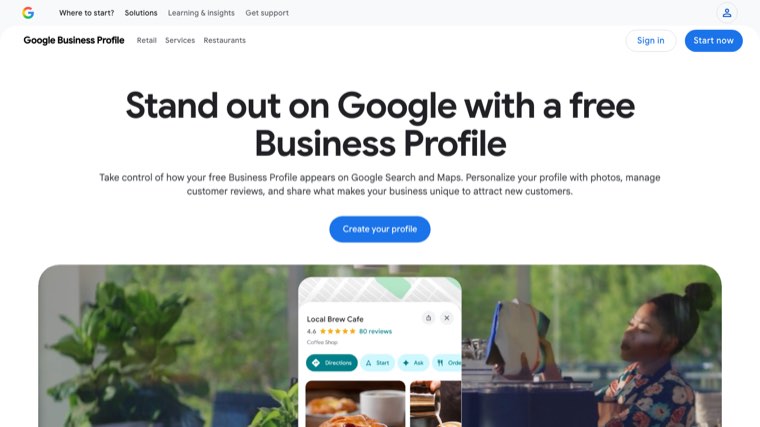
Free, and more important than everything else on this list combined. If you only do one thing, do this one properly.
The work that matters: complete every field, pick the most specific primary category available, list your services individually, set service areas rather than a fake address, upload real job photos regularly, answer the Q&A section yourself, and post weekly. Then reply to every review, good and bad.
Most plumbing profiles are set up once and abandoned. The gap between a maintained profile and an abandoned one in the same postcode is usually larger than anything a paid tool will get you.
Cost: nothing. Time: about 20 minutes a week, and that is the actual reason people do not do it.
3. BrightLocal
The most complete local SEO platform for a business of this size. Map pack rank tracking from a grid of points, citation building and cleanup, review monitoring across sites, and reporting that a non-technical owner can read.
The citation audit is the part worth the money in year one. Old listings with a previous address or a disconnected number actively hurt, and finding them by hand across 40 directories is a job nobody finishes.
It is a lot of product for a one truck operation and the reporting is more useful to an agency than an owner. Two or more trucks is where it starts paying.
From around $39 a month. BrightLocal offers a free trial.
4. Local Falcon
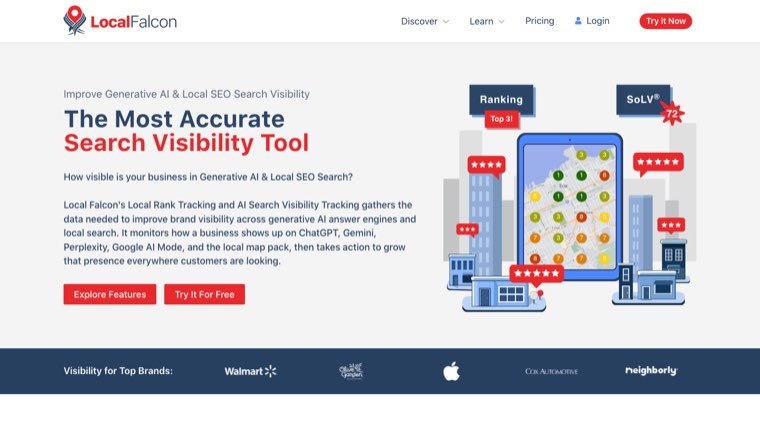
Does one thing better than anything else: shows your map pack position on a geographic grid, so you can see the exact streets where you appear and where you vanish.
For a plumbing company this is genuinely actionable rather than interesting. If you rank in the top three within two miles and disappear at four, you know whether to open a second location, add service area pages, or accept the radius and buy ads outside it.
It only tracks. It fixes nothing and it will not tell you why the boundary sits where it does.
From around $25 a month, with pay-as-you-go scans available.
5. Whitespark
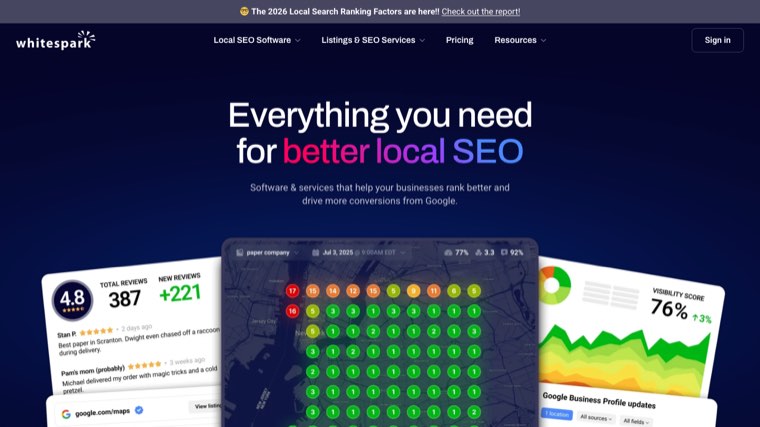
The citation specialists, and the ones agencies quietly use. Their local citation finder shows which directories your competitors are on that you are not, which is a much better starting list than a generic top 50.
They also do the building as a service if you would rather not spend evenings filling in forms. For a trade business that is usually the right call.
Citations matter less than they did five years ago. This is maintenance and consistency work, not a growth lever, and treating it as one wastes money.
Tools from around $17 a month, done-for-you citation packages priced per project.
6. Localo
Built specifically for small local businesses and the easiest thing here to actually use. It gives you a prioritised task list for your Google Business Profile and tracks your map position without any setup work.
The interface assumes you are not an SEO, which for most plumbing company owners is exactly right. Tasks are phrased as actions rather than metrics.
The depth is limited. Once you know what you are doing, you outgrow it, and it is not a reporting tool for anyone managing multiple locations.
From around $19 a month.
7. Birdeye
Review generation at scale, which for a plumbing company is the automation with the biggest payoff. It requests a review by text after a job closes, routes unhappy customers to you privately first, and monitors what appears across sites.
The text-message request is the whole product. Email review requests from a trade business get ignored; a text sent while the technician is still in the driveway does not.
It is priced for multi-location businesses and the entry cost is high for a small shop. Cheaper alternatives cover the same core job.
Custom pricing, typically from around $300 a month.
8. Moz Local
Listing distribution and management across the major aggregators, with duplicate suppression. Simple, reliable, and cheaper than the alternatives.
Best for the specific case of having moved premises or changed phone number, where wrong data is scattered across dozens of sites and needs correcting at the source.
It does listings and nothing else. No rank tracking, no reviews, no content.
From around $14 a month per location.
9. Google Search Console
Free, and the only place you see the real queries bringing people to your website. Not the map pack, which is a separate report inside your Business Profile, but everything on the organic side.
The useful pattern for a trade: look for city and service combinations you get impressions for but rank badly on. Each one is a service area page you have not written yet, and it is a better keyword list than any paid tool will sell you.
It only covers your own site and the data is delayed by a couple of days.
Cost: nothing. Set it up before you buy anything else.
10. Semrush
The full research suite. For a plumbing company the relevant parts are the competitor analysis and the site audit, not the ninety percent of the product built for enterprise content teams.
Worth it if you are in a competitive metro with several well-funded plumbing companies and you need to see exactly what they rank for and where their links come from.
Serious overkill for a single truck in a small town, and priced accordingly. Most trades do not need this.
From around $140 a month.
11. Yext
Enterprise listing management. Real time updates pushed everywhere at once, which matters when you have twenty locations and holiday hours to change.
Genuinely useful at multi-location scale, and genuinely not worth it below that. A single location gets the same usable outcome from Moz Local for a tenth of the price.
Subscription-based, and if you stop paying, the listings it created can revert.
Custom pricing, typically from around $199 per location per month.
Side by side
| Tool | Main job | Entry price | Worth it at |
|---|---|---|---|
| Google Business Profile | Everything in the map pack | Free | Day one, always |
| Google Search Console | Real query data for your site | Free | Day one, always |
| Distribb | Service pages, GBP management, links | Paid plans | 1 truck up |
| Localo | Guided GBP tasks and simple tracking | ~$19/mo | 1 truck |
| Local Falcon | Map pack grid tracking | ~$25/mo | 1 truck up |
| Whitespark | Citations, competitor listing gaps | ~$17/mo | Year one cleanup |
| Moz Local | Listing distribution | ~$14/mo | After a move or number change |
| BrightLocal | Full local platform | ~$39/mo | 2 trucks up |
| Semrush | Competitive research | ~$140/mo | Competitive metro only |
| Birdeye | Review generation by text | ~$300/mo | 5 trucks up |
| Yext | Multi-location listings | ~$199/location/mo | 10 locations up |
How much should a plumbing company actually spend?
One truck. Nothing, for the first three months. Google Business Profile and Search Console, done properly, plus asking every customer for a review. If you want one paid tool after that, make it Local Falcon or Localo at around $25 a month.
Two to five trucks. Around $60 to $100 a month. BrightLocal or Local Falcon for tracking, plus something handling the content and profile work you no longer have evenings for.
Five or more. $300 to $600 a month is defensible, mostly on review generation and content production. Above that you are buying an agency, and should evaluate it as one.
The overpayment trap in this trade is buying a research suite before doing the free work. A $140 a month subscription telling you your Business Profile is incomplete is an expensive way to learn something you could have checked yourself.
Your first 30 days, in order
1. Claim and complete the Google Business Profile. Primary category, every service listed, service areas set, 20 real photos, hours correct. 2. Set up Search Console and connect it to the site. It starts collecting data from the day you verify, not retroactively. 3. Ask your last 30 customers for a review. By text, with a direct link. This is the highest-return two hours available to you. 4. Write one page per service and one per town you cover. Real pages with real content, not a list of place names on the homepage. Our guide to local SEO for electricians covers the same page structure for a neighbouring trade. 5. Post to the profile weekly. A completed job with a photo is enough. 6. Only then buy a tool, and buy it to answer a question you have already found you cannot answer for free.
The wider version of this for any local business is in our guide to AI powered local SEO, and the general small business tool list is in the best SEO tools for small business.
Frequently asked questions
Do plumbers really need SEO tools? Not at the start. The two highest-value things, a properly maintained Google Business Profile and a steady flow of recent reviews, both cost nothing but time. Buy tools when you have done those and want to know why you rank in one part of town and not another.
What is the fastest way to rank higher in the map pack? Reviews, consistently, from customers in the areas you want to serve. Then completing every field on your profile and posting weekly. Both work faster than anything you can do on your website.
Why do I rank first at my shop and not two miles away? Proximity. The map pack results change with the searcher's location, so your position is a range rather than a number. This is exactly what Local Falcon's grid shows, and it is why a single "we rank first" report from anyone should be treated with suspicion.
Are AI SEO tools useful for a plumbing business? For producing service and area pages, yes, and that is a real bottleneck for a trade with no marketing staff. For deciding strategy, no. The decisions that matter, which towns to target and which services to push, come from your job data, not from a tool.
Should I hire an agency instead? If you have five or more trucks and no one internally who will do this weekly, probably yes. Below that, an agency charging $1,500 a month for work that is mostly profile maintenance is poor value. Ask any agency to show you map pack grid movement, not traffic charts.
How long before this shows up in calls? Review and profile work often moves the map pack within four to eight weeks. Service area pages take three to six months to rank. Anyone promising faster is either selling ads or not telling you the truth.