

WooCommerce runs on WordPress, so the search problems it creates are WordPress problems: permalink structures that duplicate every product, variations that spawn near identical URLs, and filter parameters that a crawler will happily follow forever. Most agency pages on this topic sell the service without naming any of that. This page names the work first, then compares six providers that do it.
What a WooCommerce SEO agency actually has to fix
WooCommerce ships with defaults that are fine for a shop with twenty products and expensive for a shop with two thousand. Before you compare providers, it helps to know which of these apply to your store, because the answer changes who you should hire.
- Permalink structure. WooCommerce puts products under
/product/and categories under/product-category/by default. Whether you flatten those paths is a one time decision with a redirect map attached, and it needs doing before you build links. - Product variations. Size, colour, and material variants can each generate a crawlable URL that says almost the same thing as its parent. Someone has to decide which variants deserve their own page and which get canonicalised.
- Layered navigation filters. Filter parameters multiply. A store with six filters can produce more filter URLs than it has products, and crawl budget goes to the combinations rather than the catalogue.
- Duplicate schema. WooCommerce outputs product schema, and so do Yoast and Rank Math. Running both without config gives you two Product blocks on one page, which Google reads as a mess.
- Out of stock and discontinued products. A seasonal catalogue needs a rule: keep the page and mark availability, redirect it, or let it 404. Picking one at random across a catalogue is how stores lose accumulated rankings.
- Cart, checkout, and account pages. These should not be in the index, and on a default install they often are.
- Speed. WooCommerce is a plugin on a plugin stack. Time to first byte is usually a hosting and plugin bloat question rather than an image compression question.
Ask any provider on this list which of those seven they handle in month one. The answers separate the specialists from the general SEO shops fast.
1. Distribb.io
Distribb.io is the software several agencies run behind their own branding. You connect the store once and it does the recurring work on its own: keyword research, writing, publishing, backlink building through its exchange network, and visibility in AI search. If an agency is going to white label a platform and bill you for the output, going straight to the source is cheaper.
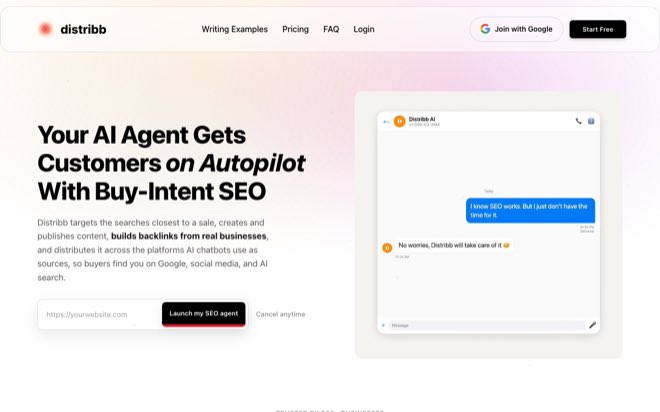
Best for: WooCommerce stores and WordPress agencies that want search work running continuously without hiring for it.
What it does after connection:
- Keyword research: finds the buying-intent terms around your categories and products rather than generic head terms.
- Content: writes the articles and publishes them straight into WordPress through the CMS connection.
- Backlinks: earns links through an exchange network of real businesses instead of bought placements.
- AI search: distributes to the sources that AI assistants cite, so the store shows up in answers as well as in blue links.
Pricing is $97 a month for Pro and $495 a month for Accelerator. Accelerator adds a human who reviews every piece before it goes out, which is the tier stores pick when the catalogue involves regulated products or claims that need a second pair of eyes. Approvals are available on either tier if you want them, and off by default, because the point is that the queue keeps moving whether or not anyone logs in this week.
For the store side of it, see what Distribb runs for ecommerce brands.
The honest limitation: Distribb is a platform, not a bespoke creative agency. If what you want is a named strategist who will sit on your quarterly planning call and rebuild your category taxonomy by hand, one of the five below is a better fit. If what you want is the output, this is the direct route to it.
2. OuterBox
OuterBox is a US ecommerce agency whose WooCommerce page frames the work the way the platform actually behaves. Their own summary is that WooCommerce SEO has to be built around products, categories, filters, speed, schema, feeds, and checkout paths rather than title tags and plugin settings, which matches the list above closely.
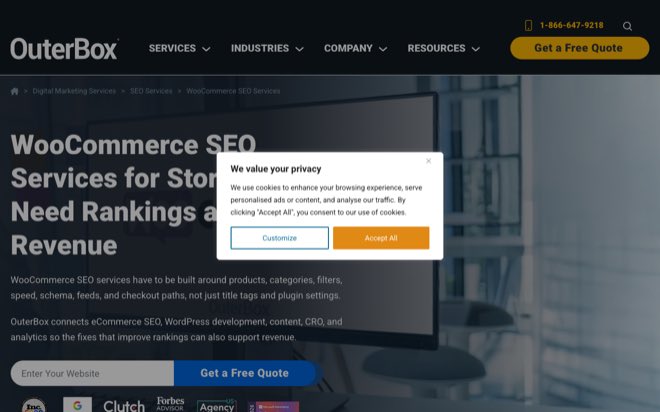
Best for: Established stores that want SEO, WordPress development, CRO, and analytics under one roof.
- Scope: ecommerce SEO joined to WordPress development, content, conversion work, and analytics.
- Signal: a 4.8 average across roughly 870 reviews at the time of writing, which is a lot of reviews for an agency of any size.
- Model: quote based, with a free quote form as the entry point.
The development side is the real reason to shortlist them. A store with a filter problem or a slow theme needs someone who can change the code, not just file a ticket with whoever built the site three years ago.
3. 1Digital Agency
1Digital is the most specific of the six about what it touches on a WooCommerce build. Its service page lists permalink and pagination traps, plugin and script overhead, HPOS compatibility, migrating legacy cart and checkout shortcodes to WooCommerce Blocks, tuning Yoast or Rank Math, and shipping schema graphs alongside an llms.txt file.
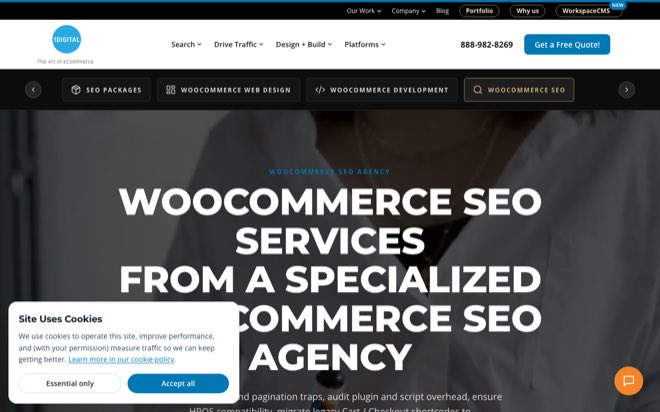
Best for: Stores carrying technical debt from an older WooCommerce install.
- Technical depth: HPOS and the Blocks migration are current WooCommerce concerns, not generic SEO copy, which suggests the team works on these builds regularly.
- AI search: they name Google AI Overviews, ChatGPT Shopping, Perplexity Shop, and Amazon Rufus as surfaces they optimise for.
- Track record: founded in 2012, 15 years of ecommerce focus, 400+ brands cited on the page.
If your store still runs shortcode based cart and checkout pages, this is the conversation to have first. That migration touches templates, caching rules, and every conversion path on the site, and it is not a job for a content retainer.
4. Searchbloom
Searchbloom runs custom WooCommerce campaigns with a full service execution model, and leads with a free action plan rather than a proposal call. Their reviews average 4.9 across around 100 ratings.
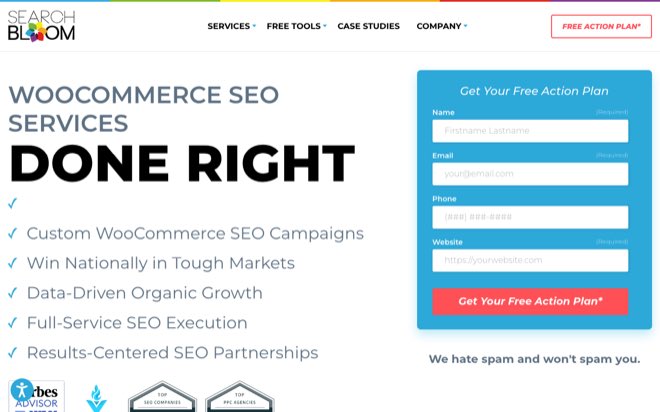
Best for: Stores competing nationally in categories where the incumbents already have authority.
- Entry point: a free action plan, so you see their read on your store before committing budget.
- Positioning: data driven organic growth with execution included rather than recommendations handed back to you.
- Also covers Shopify: useful if you run more than one storefront or expect to replatform.
Take them up on the action plan even if you hire someone else. A second opinion on your filter and variant setup costs nothing and tends to surface whatever the previous agency left behind.
5. Cartiful
Cartiful is the narrowest fit here and states its diagnosis plainly: stores underperform because of slow site speed, messy URL structure, weak on-page work, or missing schema markup. The service is built around product page optimisation, internal linking, and content. For the URL part, the free URL slug generator turns a product name into a clean slug before you touch the permalink settings.
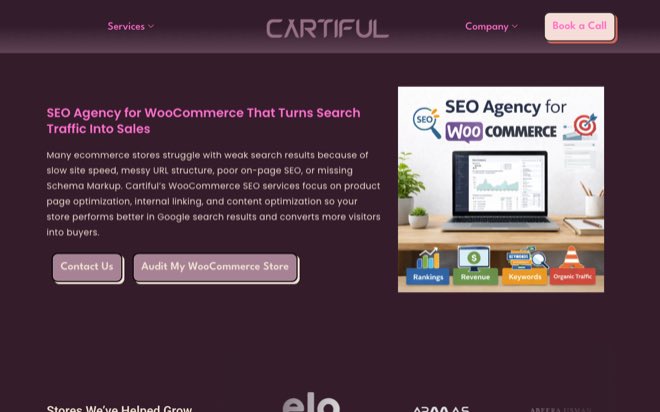
Best for: Smaller catalogues where product pages are the whole business.
- Focus: product pages, internal links, and structure rather than a broad marketing retainer.
- Entry point: a WooCommerce store audit.
- Angle: ties the SEO work to conversion rather than to rankings alone.
Internal linking is the part most stores skip. WooCommerce will not build a sensible link graph between related products and categories on its own, and a store with a thousand products and no internal link strategy is asking Google to guess which pages matter.
6. Canesta
Canesta is a full service shop covering design, SEO, PPC, and email, with a dedicated WooCommerce SEO offer. Reviews average 5.0 across roughly 40 ratings.
Best for: Stores that want search, paid, and email handled by the same team.
- Breadth: design and development sit alongside the marketing channels, so implementation does not stall.
- Entry point: a free quote.
- Trade off: a generalist team means less WooCommerce specific depth than 1Digital or OuterBox.
Channel bundling is worth something when your paid search and organic teams are currently bidding on the same terms without talking to each other. It is worth less if your only real problem is technical.
WooCommerce SEO agency options compared
| Provider | Model | Best fit | Watch for |
|---|---|---|---|
| Distribb.io | Platform, $97 Pro / $495 Accelerator | Continuous content, links, and AI search visibility without hiring | Software plus review, not a bespoke creative agency |
| OuterBox | Agency, quoted | SEO plus WordPress development and CRO together | Larger engagement than a small store needs |
| 1Digital Agency | Agency, quoted | Deep WooCommerce technical debt, HPOS and Blocks migrations | Technical scope can outgrow a content budget |
| Searchbloom | Agency, quoted | Competitive national categories | Start with the free action plan before committing |
| Cartiful | Agency, quoted | Product page and internal link work on smaller catalogues | Narrower scope than a full program |
| Canesta | Agency, quoted | SEO alongside PPC, email, and design | Generalist rather than WooCommerce specialist |
Pricing for the five agencies depends on catalogue size, technical debt, and link scope, and all five quote per engagement. Distribb is the only fixed price option on the list.
How to shortlist a WooCommerce SEO agency
Four questions separate a good fit from an expensive one.
- Who changes the code? If the agency writes recommendations and your developer implements them, add their turnaround time to every estimate you are given.
- What is the plan for variants and filters? A provider that has not asked about your attribute setup before quoting has not looked at your store.
- What happens to a product when it is discontinued? The answer should be a rule that applies to the whole catalogue, not a case by case decision.
- What does month one produce? An audit is not an outcome. Ask what will be shipped, not what will be reviewed.
Also compare the retainer against what the same budget buys as software. If the agency proposal is largely recurring content production, a platform doing that work continuously covers the same ground at a fraction of the monthly cost. Keep the agency for the technical migration and the parts that genuinely need a human.
FAQ
What does a WooCommerce SEO agency do?
A WooCommerce SEO agency fixes the WordPress and WooCommerce specific issues that hold a store back, then builds traffic on top of them. In practice that means permalink and pagination structure, product variant handling, layered navigation filters, schema conflicts between WooCommerce and your SEO plugin, index rules for cart and checkout, site speed, plus the ongoing content and link work every store needs.
Which is the best WooCommerce SEO agency?
It depends on the bottleneck. For deep WooCommerce technical debt, 1Digital Agency is the most specific about the work. For SEO combined with development and conversion, OuterBox. For competitive national categories, Searchbloom. If the real need is continuous content, backlinks, and AI search visibility rather than a one off technical project, Distribb runs that on autopilot from $97 a month and is what several agencies use behind their own branding.
How much does WooCommerce SEO cost?
Agency engagements are quoted against catalogue size, existing technical debt, and how much link work is involved, so there is no single number and every agency on this list quotes per store. Software is the fixed cost end of the range: Distribb is $97 a month for Pro and $495 for Accelerator, which adds a human reviewing every piece.
Do I still need an SEO plugin like Yoast or Rank Math?
Yes, for title and meta control, sitemaps, and index rules. Configure it carefully though. WooCommerce emits its own product schema and so does your plugin, and running both untuned puts two Product blocks on the same page. Pick one source for product schema and switch the other off.
Can an SEO platform replace a WooCommerce agency?
For the recurring half of the work, yes. Keyword research, writing, publishing, backlinks, and AI search visibility all run continuously on a platform without anyone assigning them each week. A one off migration, a taxonomy rebuild, or custom development still needs an agency. Plenty of stores run both, and plenty of agencies run the platform for their clients.
Conclusion
Diagnose before you shop. If your store has a filter and variant problem, hire the agency that talks about filters and variants. If your store is technically sound and simply has no one producing content or building links, a retainer is an expensive way to buy output that runs on its own. Distribb handles that side continuously from $97 a month, and if you want a human reviewing every piece, Accelerator is $495. Related reading: our Shopify SEO agency comparison for the other major platform, and link building for ecommerce for the off page half of the job.