

Shopify SEO has split into two very different buying paths. AI platforms can run much of the work at platform pricing, while traditional agencies may require monthly retainers and revenue minimums. Here are five Shopify SEO agency options, plus the cases where software or a human team makes more sense.
We pulled current pricing from the public pricing page of the AI-powered platform option and from Ryze AI, plus Clutch listings for Coalition Technologies, Ignite Visibility, Searchbloom, and Netalico Commerce. The platform option lists $97 to $495 a month with no revenue floor, and Ryze AI lists $129 to $1,499 a month on a cancel-anytime basis. Coalition Technologies requires $500,000 in annual revenue, Ignite Visibility retainers run $5,000 to $50,000 monthly, and Netalico Commerce spans $2,700 to $10,000 monthly. Searchbloom's $1,000 minimum project is the lowest of the four agencies, yet it still sits above the $97 entry price of the platform option.
1. Distribb.io
Distribb.io is an AI-powered SEO platform for Shopify brands, agencies, SaaS teams, and SEO departments. It is the closest route to the software many agencies use behind the scenes, without paying for a full agency retainer.
The platform connects with a Shopify store, reads its catalog, finds buyer-focused topics, writes product-led articles, and publishes them to the store blog. It also supports automated backlink building through its exchange network. Its Shopify SEO platform is built for stores that want ongoing execution rather than another audit spreadsheet.
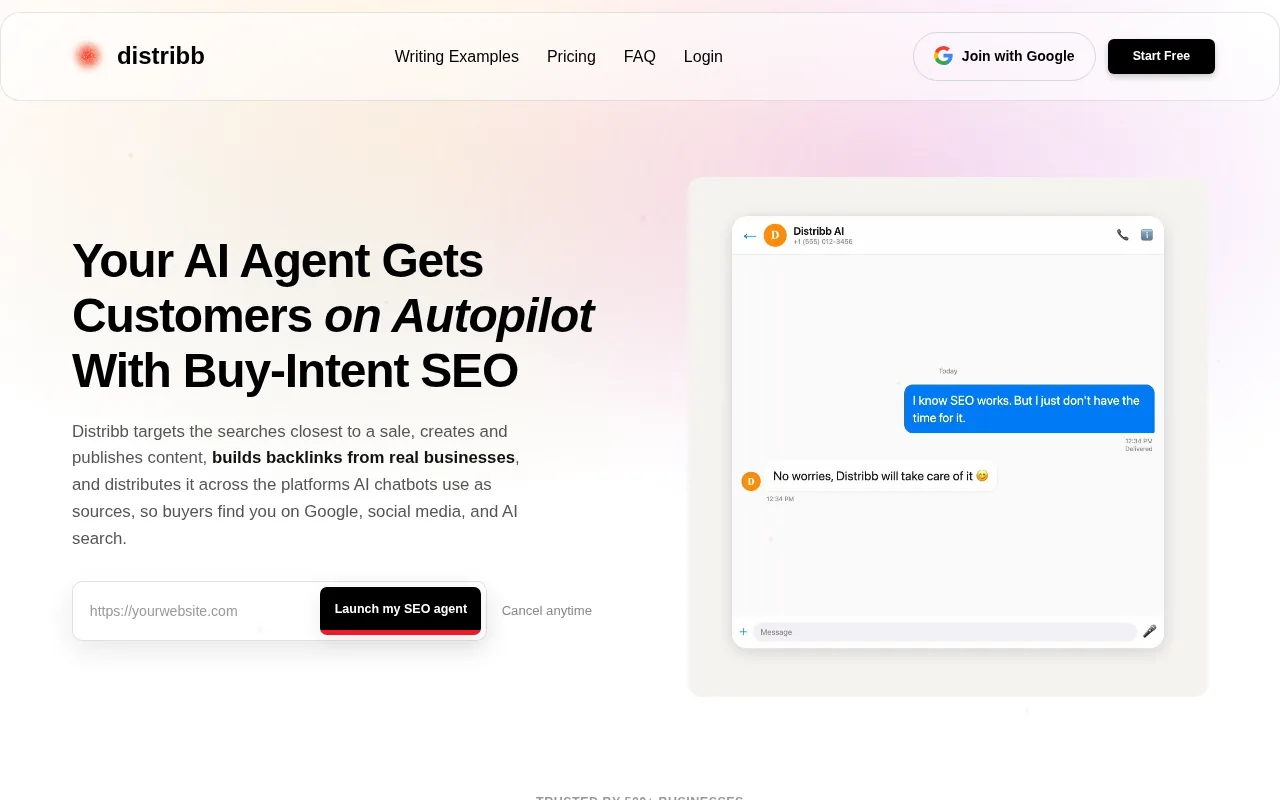
That changes the cost model. Distribb.io lists platform pricing at $97 for Pro, while Accelerator rates are available on request. The work includes automated content, distribution, backlink activity, and reporting. For a growing store, the appeal is easy to see: your team can spend budget on inventory and conversion work instead of paying a large fee for repeated manual tasks.
Distribb.io also fits agencies that want to keep client work moving between strategy calls. An agency can set the direction, then let the platform handle recurring production. Teams that need develo the Distribb.io API documentation before they build it into an internal workflow.
The limitation is clear. Distribb.io is software plus a done-for-you distribution tier. It does not provide a dedicated account manager, custom creative department, or fully human service model. If your store needs a team to own every decision, one of the agencies below may fit better.
Start your Free Trial:See Distribb pricing and test the platform against a small group of collections before moving your full catalog.
What white labeling means in this market
White labeling means an agency resells software-driven work under its own brand. The client may receive a content plan, articles, links, or reports without seeing the system that produced them.
That model is not automatically bad. It can lower delivery cost and speed up production. But ask what happens between the brief and the final URL. You should know who checks facts, who owns the content, where links come from, and whether you keep access to the reports if the contract ends.
2. Ryze AI, Shopify-native audits with GEO capabilities
Ryze AI focuses on Shopify-native technical audits, on-page work, content gaps, schema markup, and generative engine optimization. It suits a store owner who wants classic SEO work tied to visibility in ChatGPT, Perplexity, Claude, or Google AI results.
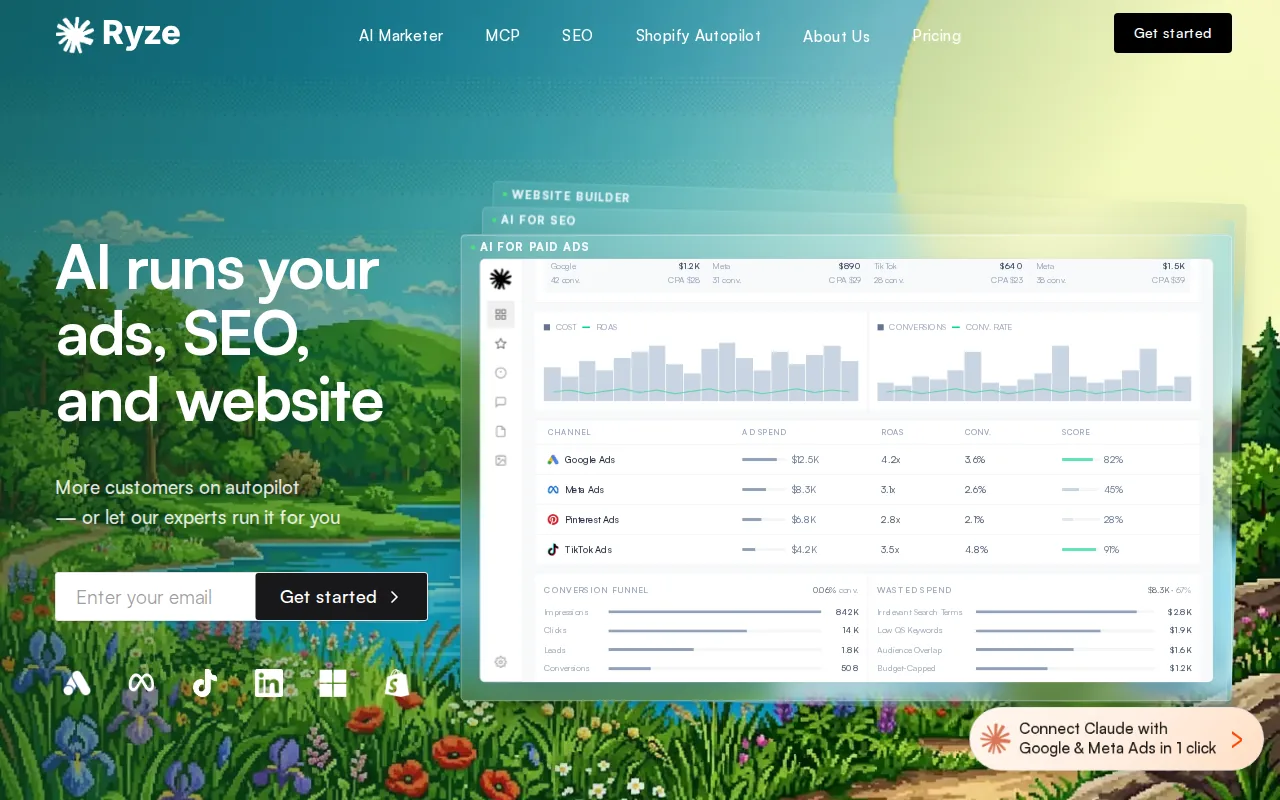
The research behind its Shopify material covers crawl access, AI-readable files, product data, structured markup, internal links, and FAQ content. That wider view matters because a product can rank in a normal result yet fail to appear when a buyer asks an answer engine for a recommendation.
Ryze AI describes a flat-fee model with no lock-in. It also promotes an instant read that does not need a credit card. Those details make it easier to test than a long agency engagement, especially when your team has not yet proved that AI search visibility is a useful channel for your category.
One useful point from its technical guidance is that structured data should match the page. Product price, availability, brand, and review details need clean markup. The broader concept of structured data is widely used in modern SEO, but implementation still needs to be checked against the store theme and apps.
Ryze AI is a better fit for a team that wants technical direction with GEO added to the brief.
3. Coalition Technologies, broad Shopify SEO and development support
Coalition Technologies combines Shopify SEO with development, paid search, site performance work, and theme customization. It suits established ecommerce brands that want one provider to handle both search strategy and changes inside the store.
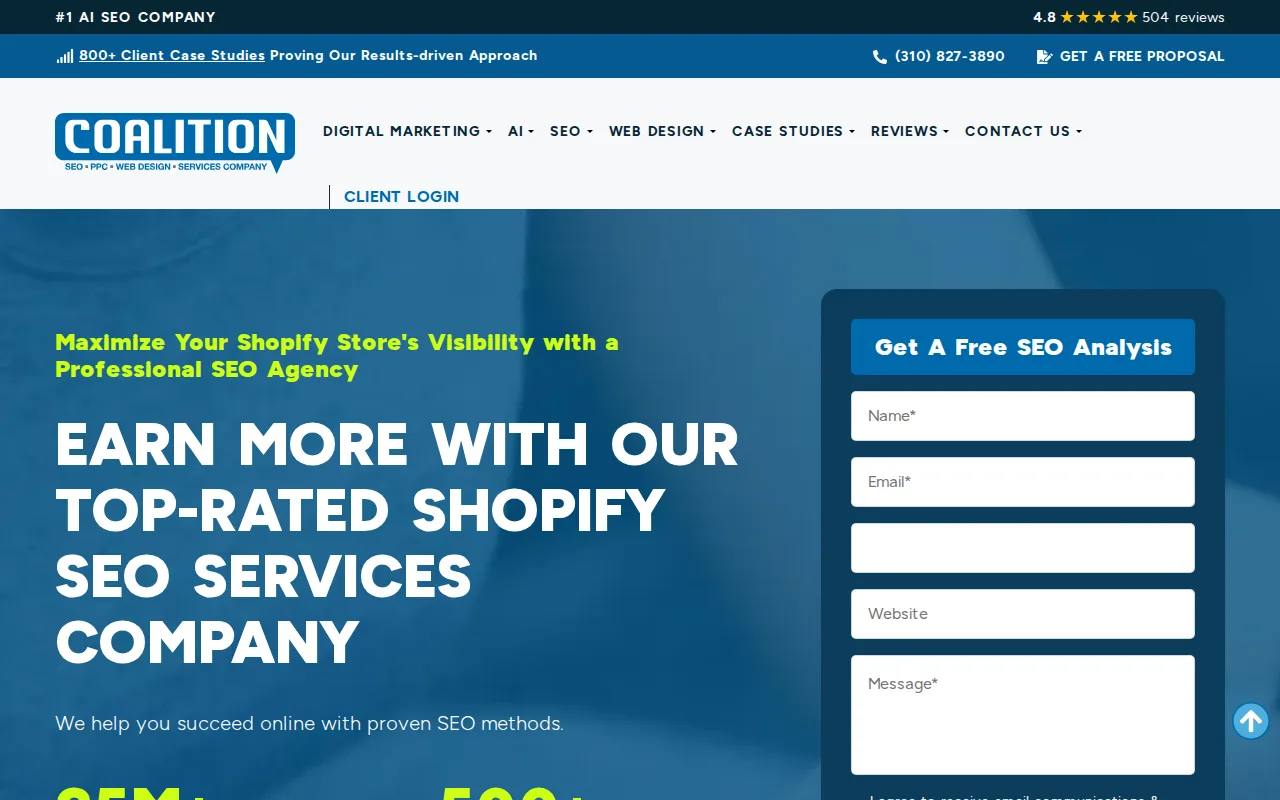
Its Shopify-focused work includes canonical tag audits, collection page optimization, and structured data. Those tasks matter when a large catalog creates duplicate paths or when collection pages compete with one another. A team that can implement theme changes has a shorter path from finding the issue to shipping the fix.
Pricing varies by engagement, and the minimum engagement size makes fit an important consideration. Coalition Technologies is not for stores under $500K/year.
Coalition Technologies has the breadth to support a store where organic search overlaps with paid media and site speed. That can help when the marketing team wants one report tied to several channels rather than separate agency dashboards.
The tradeoff is budget and fit. A store below the agency's likely engagement range may not get the attention or scope it needs. Ask for the minimum engagement, the named delivery team, and the exact development hours included before signing.
4. Ignite Visibility, senior strategy for multi-channel growth
Ignite Visibility is a full-service agency with a Shopify practice, technical auditing, content strategy, authority building, paid media, CRO, analytics, and development. It is best for ecommerce brands that want SEO connected to revenue instead of tracked as a stand-alone traffic channel.
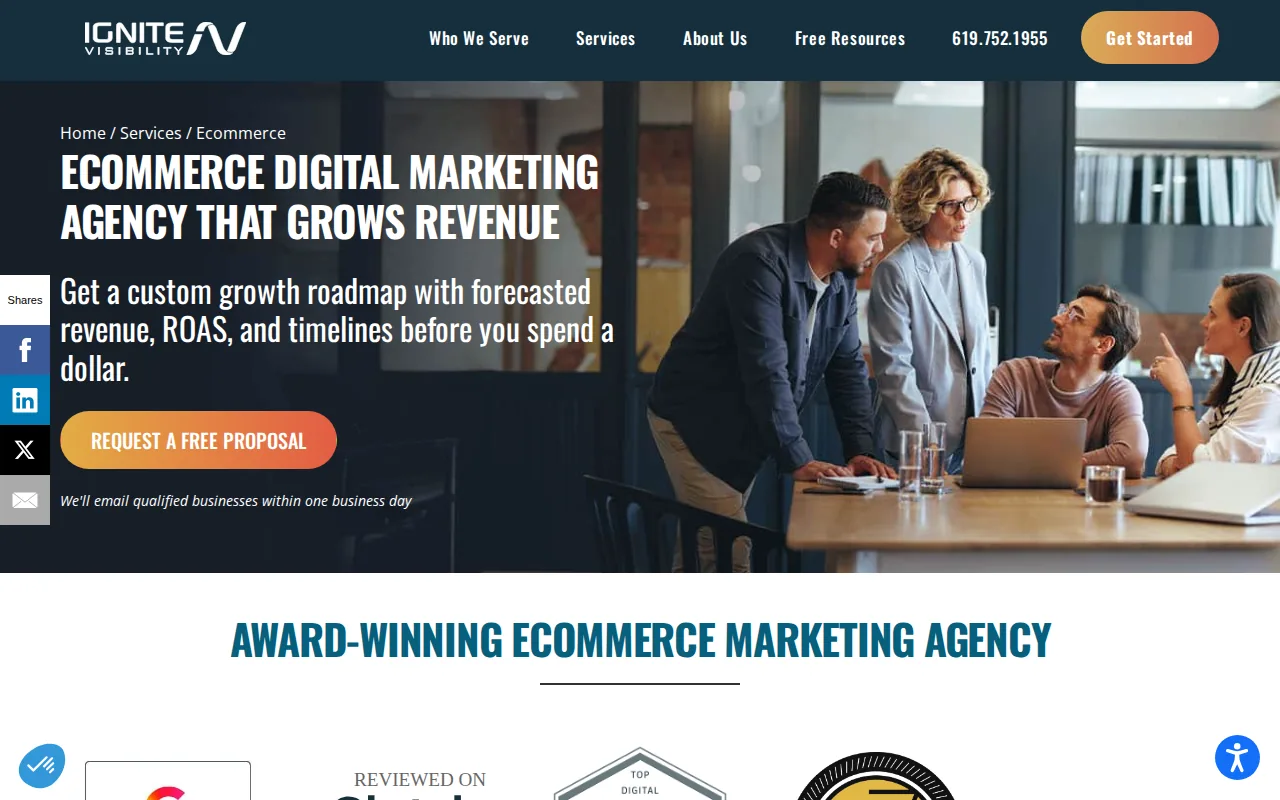
The agency says mid-sized and large engagements receive a dedicated account team with a project manager and channel specialists. Its reporting setup uses analytics, Search Console, Semrush, and custom dashboards. That structure can help a head of ecommerce see whether a content push led to product views, assisted conversions, or sales.
Ignite also includes AI search in its current SEO work. Its audit service reviews crawling efficiency for AI bots, while its content approach focuses on intent, topic groups, authority, and conversion paths. For stores in health or wellness, the team must also understand legal review and privacy controls. If customer or patient data enters a marketing workflow, ask how HIPAA obligations are handled before sharing access.
Ignite offers technical auditing, structured content strategy, and authority building. Those details make Ignite a fit for a brand with several teams that need one operating plan, rather than a narrow provider focused only on blog output.
The weakness is the likely cost and management load. A multi-channel program can become too broad if the store has one clear problem, such as thin collection copy or poor internal links. Set one primary growth goal and define which channels are out of scope.
For a store that wants to connect SEO work with other marketing channels, the broader SEO for Shopify stores guide can help your team define the work before an agency pitch.
5. Searchbloom, flexible month-to-month Shopify SEO support
Searchbloom provides technical auditing, content strategy, authority building, and ecommerce SEO support for Shopify brands. Its strongest buying point is contract flexibility, with month-to-month support.
The reported hourly range is $100 to $149, with a minimum project size of $1,000 or more. Pricing may change with scope, so treat those figures as a starting point rather than a quote. The structure suits a store that wants an agency but does not want to accept a 12-month commitment before the first meaningful work ships.
Searchbloom works across specialty retail, health, home goods, and wellness. That mix can be useful when the store needs both technical cleanup and content that answers buyer questions. It also has a PPC practice, which gives a team a way to compare paid and organic demand in the same planning cycle.
The month-to-month model lowers commercial risk, but it does not remove delivery risk. A short contract can still produce weak work if the agency has no access to developers or if the scope only covers recommendations. Ask for a sample report with personal data removed. Check whether it shows shipped changes, page-level outcomes, and revenue signals.
Searchbloom is a sensible shortlist choice for a mid-market store that wants human support with a clearer exit path. It is less attractive when your main need is high-volume article production at software pricing.
If you are comparing an agency with an AI service, review how your team handles page titles, collection structure, image text, and internal links in the Shopify SEO checklist.
6. Netalico Commerce, code-level SEO for Shopify Plus stores
Netalico Commerce is a development-led Shopify Plus agency that handles code-level SEO fixes alongside strategy. It is best for a large store where the main search problem sits in the theme, app stack, collection structure, or migration plan.

Its stated work includes technical SEO, site speed, collection and product page improvements, content architecture, structured data, and migration SEO. The key distinction is implementation. Netalico says the team that finds the issue can also ship the fix, so an audit does not sit in a backlog owned by a separate developer.
The agency lists monthly SEO retainers from $2,700 to $10,000. Larger replatforming and rebuild projects are priced separately. These figures put Netalico firmly in the enterprise and upper mid-market group.
Netalico's page explains why Shopify stores often need development help. Product URLs can appear under collection paths, filters can produce many crawlable combinations, and apps can add scripts that slow a theme. Those issues rarely disappear because someone publishes another blog post. They need a controlled change in the store code or app setup.
The agency also says it is a Shopify Plus Premier Partner and has completed hundreds of builds.
Which provider fits the constraint?
| Provider | Best fit | Pricing shape | Main weakness to test |
|---|---|---|---|
| Distribb.io | Automated content and backlink distribution | Pricing varies by plan | No dedicated human account manager |
| Ryze AI | Shopify audits plus GEO | Flat fee, quote needed | Less suited to teams that want full human service |
| Coalition Technologies | SEO with development and paid search | Pricing varies by engagement | May be too large for smaller stores |
| Ignite Visibility | Senior multi-channel strategy | Custom engagement | Broad scope may exceed a narrow SEO need |
| Searchbloom | Flexible human SEO support | $100 to $149 hourly range reported | Manual delivery may scale slowly |
| Netalico Commerce | Shopify Plus code and migration work | $2,700 to $10,000 monthly retainers | Enterprise pricing is high for content-only needs |
For a Plus store preparing a migration, Netalico's model is easier to justify because the same team can map URLs, protect redirects, and monitor the launch. For a stable store that mainly needs more useful content and links, the engineering premium may not be the best use of budget.
Questions to ask before signing
- Will the agency implement fixes, or only report them?
- Who owns the articles, briefs, dashboards, and link records?
- Can you see the source and placement of every backlink?
- Does reporting separate rankings from clicks, conversions, and revenue?
- What happens to Shopify access and work files when the contract ends?
Those answers tell you more than a polished pitch deck; they are also part of the evaluation framework in Distribb's guide to choosing the best SEO agency for startups. They also show whether you are buying strategy, labor, software, or a mix of all three.
Agencies often use tools to speed delivery. That is fine. The important point is knowing what the tool does, who checks the result, and what your team can keep after the engagement.
FAQ
What is the best Shopify SEO agency for a growing store?
The best choice depends on the store's main constraint. Distribb.io fits teams that want automated content and backlink distribution at platform pricing. Netalico Commerce fits Shopify Plus stores with code or migration problems. Searchbloom fits brands that want human support with month-to-month flexibility.
How much does Shopify SEO cost?
Shopify SEO can cost under $500 per month with software, while agency retainers may run into several thousand dollars. Distribb.io offers plan-based pricing, Searchbloom at a reported $100 to $149 hourly range, and Netalico retainers from $2,700 to $10,000. Scope matters more than the headline rate.
Do Shopify SEO agencies build backlinks?
Many Shopify SEO providers include authority or link work, but the source quality differs. Ask for sample placements and a record of the sites involved. Distribb.io includes a backlink exchange option, while traditional agencies may use outreach, editorial placements, or other methods. Avoid any provider that will not explain its link process.
Should I hire an agency or use SEO software?
Use SEO software when your team can set direction and review output but needs recurring execution. Hire an agency when you need developers, senior strategy, migration support, or a human team to own the process. A hybrid setup can work well when software handles production and an expert reviews technical changes.
What should a Shopify SEO report include?
A useful report should show work shipped, pages affected, rankings, impressions, clicks, conversions, and revenue where tracking allows. It should also name link sources and separate classic search results from AI visibility. A report that only lists keyword positions cannot show whether the Shopify SEO investment is helping the business.
Conclusion
For most stores comparing cost against output, start with Distribb.io and test it on a defined catalog segment. If the test exposes a theme, migration, or cross-channel problem, bring in a specialist agency for that work. Start with Distribb's Shopify SEO platform, then judge the next investment by shipped work and revenue signals.