
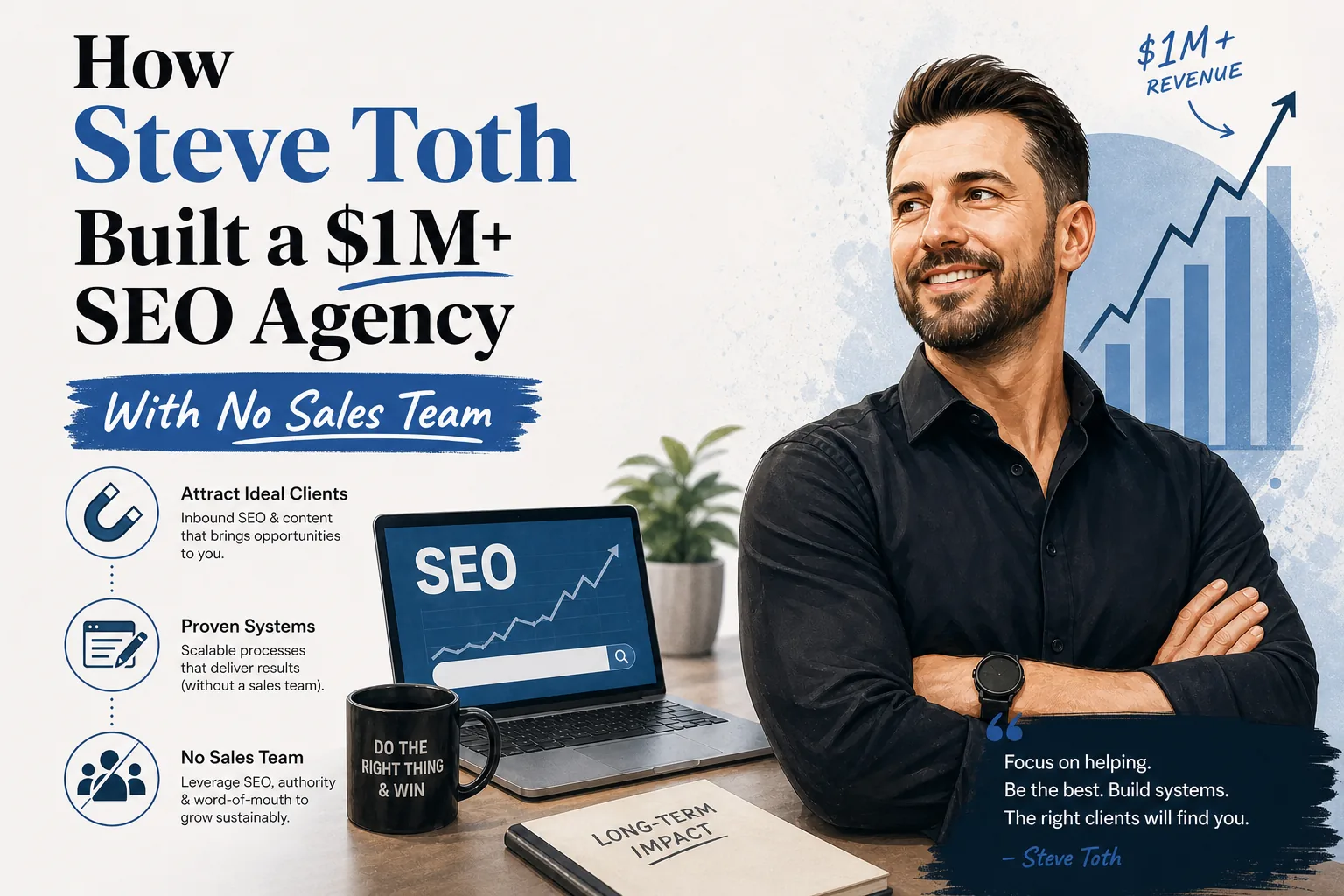
Steve Toth runs Notebook Agency: 25 people, seven figures a year in revenue, and clients like Royal Bank of Canada and Porter Airlines.
He has never had a sales team. 99% of his leads come inbound.
Before that he was an SEO manager at FreshBooks on a $75,000 salary. When his pages started driving $50,000 a week in traffic value, he got a $5,000 raise.
I watched his full interview on the Ahrefs channel and took a lot of notes, because his story answers a question every SEO freelancer and agency owner asks at some point: how do you get clients when you hate selling? Here is the whole story, with the real numbers.
We pulled the entry-level per-client monthly price listed today on five white label SEO providers, including our own plan. SEOReseller.com lists $499, SEOResellerUSA lists $350, SEO Brothers lists $299, AgencyPlatform lists $178, and our entry plan lists $97. That is a $402 spread between the cheapest and priciest entry plan for handling one client's SEO delivery. Notebook Agency needed 25 employees to handle that same delivery work in house, at prices far above any of these five plans.
Table of Contents
- The first blog post that outranked Seth Godin
- One keyword, 110 pages, $50,000 a week
- The LinkedIn post he wrote while waiting for an Uber
- He kept his job until it cost him money
- His first full-time day was March 2, 2020
- The 3-minute call that doubled his price
- The Go-Giver system behind the inbound leads
- The ridiculous hourly rate, and how he got to 25 people
- How to delegate delivery without hiring 25 people
- Why 90% of his leads now ask about AI search
- What I'm taking from Steve
- Watch the full interview
- FAQ
- If you run an agency, start with the delivery
The first blog post that outranked Seth Godin
Steve started in 2010 as a copywriter at a web development company. The first blog post he wrote for them was about when to redo your website. The logic was simple: the company rebuilt websites, so he wrote for people who were thinking about rebuilding theirs.
The post ranked number one. It outranked an article from Seth Godin on the same topic. That was the moment he caught the SEO bug.
He still had to learn SEO for real. A year later he took a job at an agency as a social media manager, and his desk happened to be next to the SEO manager. He asked that guy questions for two years. He also started blogging about everything he learned, almost from day one.
One detail I liked: he asked a colleague who to follow on Twitter, and the colleague took his laptop and followed everybody for him. That was his SEO education. Sit next to someone good, ask questions, follow the right people, write down what you learn.
→ He was sharing what he learned in public years before it paid him anything.
One keyword, 110 pages, $50,000 a week
After a second agency job, Steve got hired as the SEO manager at FreshBooks, the accounting software company. He says it was the turning point of his career.
His team noticed that "invoice template" had around 300,000 searches a month, with hundreds of long-tail keywords attached to it. FreshBooks was already paying for that keyword in Google Ads, it was their primary paid keyword. So the math was easy. If they ranked for it organically, the ROI would be huge.
They built the main page, then 110 more pages around it to cover the long-tail searches. At its peak the main page ranked number one, and the whole group was driving $50,000 in traffic value per week. Traffic value is the Ahrefs metric that estimates what the same clicks would cost in Google Ads.
A year later they published 650 blog posts, and those were earning 50,000 clicks a day. The SEO department was two people. Steve says the data scientists at FreshBooks were looking over their shoulders, wondering what these two were doing to bring in that much revenue.
If you want to copy the play, the process is not complicated:
- Look at the keywords you already pay for in ads. Those are proven to convert.
- Pick the one with the most long-tail variations around it.
- Build one strong main page, then one page per variation, and link them all together.
This is a classic topic cluster strategy, applied to a keyword the company already knew was worth money.
His reward for all this was a raise from $75,000 to $80,000.
→ When you create $50,000 a week for someone else and get $5,000 a year for it, you start thinking about working for yourself.
The LinkedIn post he wrote while waiting for an Uber
When the page hit number one for "invoice template", Steve posted about it on LinkedIn. He didn't plan it. He was waiting for an Uber to go to an escape room and wrote the post on his phone to kill time.
When he came home that night, the post had around 200 likes and there was a message in his inbox from someone who wanted to hire him. That message became a $5,000 a month client.
The part that matters for agency owners is what it changed in his head. Steve is an introvert. He always assumed that if he started an agency, he would need a sales guy to close deals while he kept his head down doing the actual SEO. That one post showed him he didn't have to be a salesperson. He could share what he knew, share his wins, and people would contact him.
→ One post about a real result brought him a client he never pitched.
He kept his job until it cost him money
Steve didn't quit after that first client. He kept freelancing on the side and saved about $100,000 while still at FreshBooks. His reasoning: if he fell flat on his face, he would be fine for a year.
He stayed employed until the job was costing him money. The way I read it: the hours at FreshBooks had become worth less than the client work he was turning down.
The runway did something more important than pay the bills. It gave him pricing power. His first ever client paid him $1,200 a month. By the time inbound leads were coming in, he quoted $5,000 a month without stress, because if they said no he still had a salary.
His warning to freelancers: if you quit with no plan, you will charge less and say yes to clients you should refuse.
→ The savings account is what let him quote the higher number with a straight face.
His first full-time day was March 2, 2020
Steve's first day as a full-time entrepreneur was March 2, 2020. Two weeks later the world went into lockdown.
He had four sales calls on the Friday the lockdown started. None of them went anywhere for a couple of months. A couple of his clients, including his first one, CarPages, cut their budgets in half.
By the summer it turned. One of those stalled leads signed. He took on a big project with BrainStation that ended up earning $700,000 in traffic value. He helped launch Signaturely, which grew to 400,000 organic visits and ranked number one for "online signature", his second 300,000-search keyword.
In his words: "I was suddenly making $50,000 a month."
→ He survived the worst possible quarter to start a business because he had a runway and because his results were public.
The 3-minute call that doubled his price
In January 2021, a guy contacted him on LinkedIn for a consultation. There was almost nothing about him online, but he owned the domain cryptowallet.com, which is not a cheap domain. So Steve tried charging $500 for the call.
The call lasted three minutes. The guy said he liked what Steve was doing on LinkedIn and for his other clients, and that he wanted to hire him. Steve asked if there was anything else he wanted to know. The answer was no, and he hung up.
At the time Steve charged $5,000 a month, and it was his busiest month ever for inbound leads. He decided to test $10,000. The proposal was accepted with no questions. The company didn't even have a product yet.
He kept the $10,000 price from that day and kept raising it after.
→ He only found out what he was worth by asking for it, and he could only ask because he had more leads than time.
The Go-Giver system behind the inbound leads
The engine behind all those leads started as a personal habit. Steve kept every SEO tactic he came up with in Evernote. Once he had 10 to 15 of them cataloged, he had an idea: what if he emailed one of these notes out every week?
He bought the domain for SEO Notebook for $750, started an email list, and announced it on LinkedIn. The site itself is almost nothing: his name, a few lines about him, and a form. He didn't let the design delay the launch.
Someone in his comments told him this all sounded like the book The Go-Giver. He hadn't read it. When he did, it matched what he was already doing. The five ideas as he explains them:
- Give more in value than you take in payment.
- Give away everything you know, for free.
- Give it away at scale. One-to-many, never one-to-one. This is the hard part at the beginning.
- Tell people how they can help you: subscribe, book a consultation, invite you to speak, become a client.
- Be open to receiving.
He also points to Kevin Kelly's old essay, 1,000 True Fans. You don't need the biggest name on LinkedIn or the biggest email list to build a six or seven figure business. You need a thousand people who really care about what you put out, and the consistency to keep showing up for them.
The interviewer asked him why he gives away the exact tactics he sells. His answer goes back to the book: share what you know for free and at scale, and good things come back. He also uses the replies as a compass. When someone walks up to him at a conference to talk about one specific note, he knows what his audience wants more of.
→ His newsletter is his sales team. It works every week and it doesn't take a commission.
The ridiculous hourly rate, and how he got to 25 people
The second rule comes from Naval Ravikant: set yourself a ridiculous hourly rate, then delegate everything that falls under it.
For Steve, that meant paying someone to build an advanced spreadsheet for planning internal links, even when the invoice felt like a lot of money to him. It would have taken him a lot of time. He calls this his real secret to scaling.
In September 2024 he launched Notebook Agency as a proper agency brand. It has since grown to 25 people, and 99% of leads come through the website.
→ Steve does the two things only he can do, strategy and sharing. Everything else is done by someone else.
How to delegate delivery without hiring 25 people
This is the part of the story most agency owners get stuck on. Steve's content brings the clients in. But every client you sign needs keyword research, articles, links, and reporting, every single month. If you are the one doing all of it, you hit a ceiling at five or six clients, and you have no time left to write the content that brings the next ones.
Steve solved it by hiring. That works, but it took him years and a payroll of 25.
The other way is to white label the delivery. That is what we built Distribb's white label SEO for. You add each client site, connect their CMS, and Distribb runs their SEO under your agency's brand:
- Keyword research for each client, based on their site and their Search Console data.
- Up to 90 articles a month per site, written in the client's voice and published to their CMS automatically.
- Real backlinks through Distribb's backlink exchange, a network of real businesses that link to each other's content, plus link outreach to the "best of" lists your clients should be on.
- Distribution of their best articles to YouTube, Instagram, Medium and Quora, so they get picked up by AI answers too.
- Reporting from Search Console and an AI visibility tracker, so you can show the client what moved.
The client never sees our name. You bill them your own rate and keep the margin. It costs $97 a month per client site on Pro, or $495 on Accelerator, where a human on our side reviews everything before it goes out. The price per site drops as you add more: 10% off from 2 sites, 20% off from 6, 30% off from 10. No setup fee and no contract.
Put it next to Steve's numbers. He charged $5,000 then $10,000 a month per client. If the delivery of the content and links costs you $97 to $495 a month, you keep nearly all of it, and your own hours go to strategy and to the LinkedIn posts that bring the next client.
If you are comparing options first, we also reviewed the white label SEO tools agencies use the most.
Why 90% of his leads now ask about AI search
When ChatGPT launched, Steve had what he calls an existential crisis. He had built an agency on Google clicks. What if AI answers took the clicks away and the whole business with them?
He didn't wait to find out. He banked six or seven weeks of SEO Notebook issues so the newsletter would keep going out on schedule, and he put all his energy into a second newsletter, AI Notebook, about getting brands mentioned by LLMs. This was before most people in SEO were talking about AEO or GEO.
His view of search in 2026: in a zero-click world, the job is to influence the decision, and chasing top-of-funnel traffic to your site matters less than it used to.
The bet paid off. Around 90% of the leads coming to Notebook Agency now want to talk about AEO. And a growing share of them found the agency by asking an LLM, on top of the newsletter readers and LinkedIn followers. If you want to do the same for your own site, we wrote a step-by-step guide on how to optimize for AI search.
→ He became known for AI search early, and now AI search sends him clients.
What I'm taking from Steve
I run Distribb, and agencies are some of the customers who stay with us the longest. These are the lessons I would apply if I were starting an SEO agency today.
Post your results where your buyers are. One LinkedIn post about a real win brought Steve $5,000 a month. It took him a few minutes on his phone. The result behind it took months, and that is why it worked.
Build the runway before you jump. $100,000 saved meant he could quote $5,000 when his previous price was $1,200. Desperate freelancers discount.
Give it away one-to-many. A weekly email with one tactic. His site says close to 28,000 SEOs have joined. It is slow at the start and then it never stops working.
Test your price when you are busiest. He doubled his rate in his best month for leads, on a client who had already decided. That is the moment you have the least to lose.
Delegate everything under your rate. He hired people. You can also white label the delivery and stay small. Either way, the founder's hours should go to strategy and to the content that brings clients in.
Move early on the next thing. He started on AI search when it looked like a threat to his business. It is now where most of his leads come from.
Watch the full interview
The full interview is 16 minutes and worth watching, especially the part where Steve explains why he does all of this (his parents were both teachers, and it shows).
FAQ
Who is Steve Toth?
Steve Toth is an SEO and the founder of Notebook Agency, a 25-person agency doing seven figures a year. He was previously the SEO manager at FreshBooks, where he ranked number one for "invoice template". He writes two newsletters, SEO Notebook and AI Notebook.
How did Steve Toth get SEO clients without a sales team?
He shared his results and his tactics in public. One LinkedIn post about ranking number one for "invoice template" brought his first $5,000 a month client. After that, his weekly SEO Notebook newsletter and his LinkedIn posts generated the leads. Today 99% of Notebook Agency's leads are inbound.
How much did Steve Toth charge his SEO clients?
His first client paid $1,200 a month. Once inbound leads started coming, he charged $5,000 a month. In January 2021, during his busiest month for leads, he sent a $10,000 a month proposal to a crypto company, it was accepted without questions, and he kept raising his price from there.
What is the Go-Giver approach to getting clients?
It comes from the book The Go-Giver. Give more value than you take in payment, give your knowledge away for free and at scale (one-to-many), tell people how they can help you, and be open to receiving. For Steve, that meant a free weekly newsletter with one SEO tactic per issue.
Can you run an SEO agency without hiring a delivery team?
Yes. You can white label the delivery. With Distribb's white label SEO, keyword research, articles, backlinks and reporting run under your agency's brand for $97 to $495 a month per client site, with volume discounts from the second site. You keep the client relationship and the margin.
What is traffic value in SEO?
Traffic value is an Ahrefs metric. It estimates how much you would pay in Google Ads to get the same clicks your pages get organically. When Steve says his FreshBooks pages drove $50,000 a week in traffic value, it means buying those clicks would have cost about $50,000 every week.
If you run an agency, start with the delivery
Steve grew because he always found the time to share what he knew, even with client work piling up. If you want that time back, see how white label SEO with Distribb runs the delivery for every client under your brand, and spend your week on the posts that bring the next client in.