
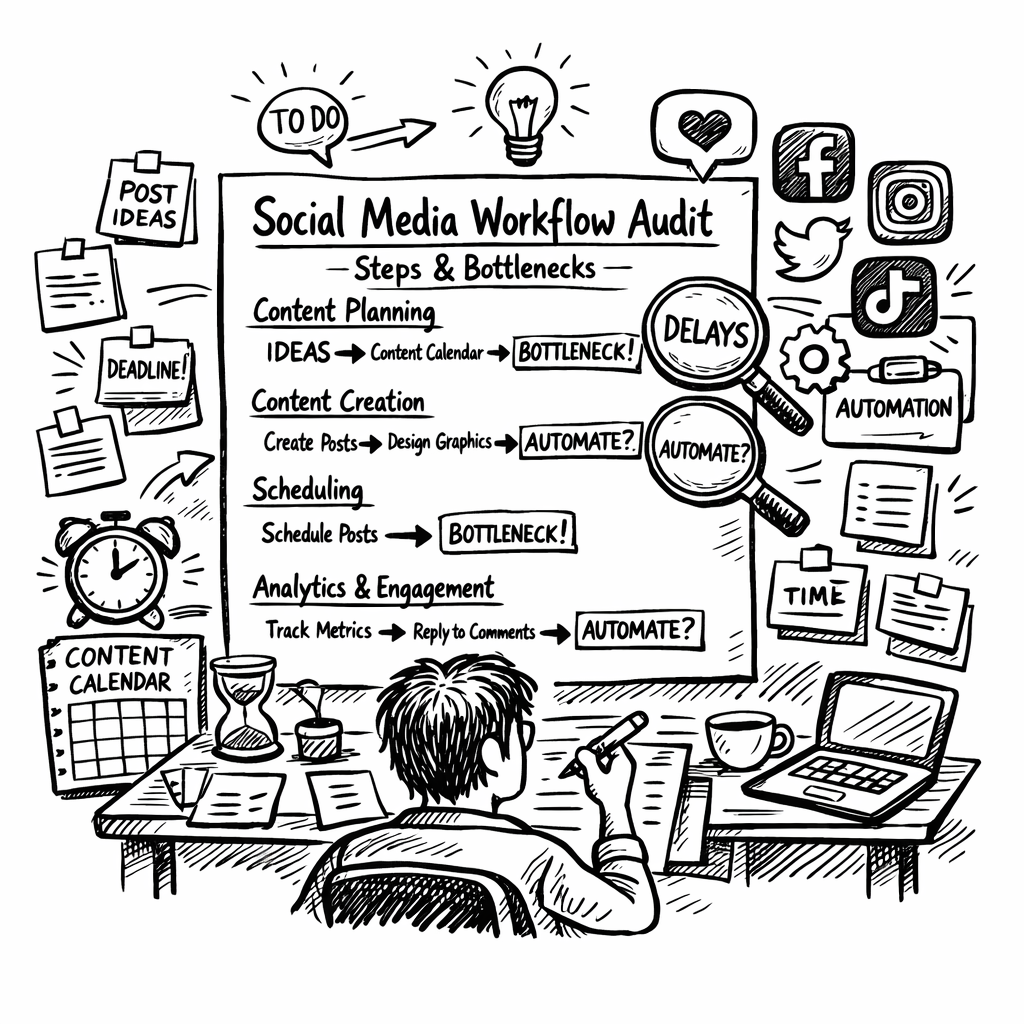
Automating social media fails in a predictable place. The scheduling gets set up, the first fortnight gets queued, and then the queue empties because nothing was feeding it.
A pipeline solves that and a scheduler does not. This is how to build one: where the raw material comes from, what happens at each stage, and which parts should never be automated.
The pipeline, in one view
Every durable social setup has the same five stages, whatever tools sit inside it.
- Source. Something that already exists and is worth talking about.
- Transform. That source turned into platform-specific posts.
- Review. A human check before anything goes out.
- Schedule. Posts placed into a repeating slot structure.
- Feedback. What performed feeds back into what gets sourced next.
Most people automate stages two and four and leave one, three and five undone. That is exactly the configuration that runs dry in six weeks.
Stage 1: source material, the part everyone skips
The single question that determines whether this works: what are you producing anyway that social content can be made from? The platforms built to take that source material and run with it are collected in our roundup of content automation platforms.
Good sources, roughly in order of usefulness: articles you publish, questions customers actually ask, product changes and releases, calls and demos you record, data you collect, and things you have an opinion about in your field.
Bad sources: a content calendar generated from trending topics, an AI asked to "write posts about marketing", and industry news you have no particular view on. All three produce content indistinguishable from everyone else's.
If you have no source, fix that before buying any tool. A business publishing one article a week has enough raw material for five posts a week; a business publishing nothing has a writing problem rather than an automation problem.
Stage 2: transform, where automation earns its keep

This is the stage software is genuinely good at. Taking one article and producing the LinkedIn version, the X version, a carousel outline and a short-form video script is mechanical work with a checkable result.
Rules that keep the output usable:
- One idea per post. A post that summarises a whole article says nothing memorable.
- Rewrite per platform, do not resize. The same text everywhere is the most visible tell of an automated feed.
- Lead with the specific thing. The number, the mistake, the finding. Generic openers are where reach dies.
- Keep the link handling deliberate, since link placement affects reach differently on each platform.
Our guide to repurposing content for social media covers the transformations in detail, and our roundup of AI content generators for social media compares the tools that do it.
Stage 3: review, the stage that cannot be removed
Every post gets read by a person before it goes out. This is not negotiable and it takes about ninety seconds a post.
You are checking three things: is it true, does it sound like us, and would we be comfortable with it appearing on a bad news day. The third catches more problems than the first two combined.
Batch the review. Twenty minutes once a week beats an interruption every day, and it is the rhythm that survives contact with a busy month.
Stage 4: schedule, with a structure rather than a queue

Build a repeating slot structure first and fill it second. Something like: Monday a lesson from the last article, Wednesday a customer question answered, Friday something you noticed this week.
The structure does the hard part, because deciding what to post is the work and the structure decides it in advance. Tools such as social media content calendar software exist to hold this, and a spreadsheet does the same job at the start.
Two practical points. Schedule two to four weeks out, not three months, because anything further ahead goes stale. And set up alerts for account disconnections, since expired tokens are the most common reason a queue silently stops.
Stage 5: feedback, which almost nobody sets up
Once a month, look at what actually performed and feed it back into stage one. You are looking for topics rather than post formats, because the topic is what you can produce more of.
Track saves, shares and profile visits ahead of likes. Track link clicks with tagged URLs so you can tell social traffic from everything else.
Then change what you source. If posts about pricing consistently outperform posts about features, write more about pricing, both socially and on the site.
What to keep manual, permanently
Replies and DMs. Automated responses to real people are the fastest way to make an account feel like a billboard.
Anything reactive or sensitive. A queue that keeps posting cheerful marketing content through a crisis is an avoidable and entirely self-inflicted problem, and the fix is someone with the ability to pause it.
Your best posts. If something genuinely matters, write and post it yourself. The pipeline exists to keep the account alive between those, not to produce them.
Where this breaks
The queue empties, because stage one was never built. This is the most common failure by a wide margin.
Everything sounds the same, because the transform stage is running on topics rather than on source material.
Nobody reviews, and then one post creates a problem that costs more than the whole setup saved.
The feedback loop is missing, so the same underperforming content type gets produced for a year.
Where Distribb fits
Distribb sits at stages one and two. It does the SEO content programme, and when an article publishes it repurposes that article into posts for the platforms you have connected, which means the source stage is fed by work you were already doing. The AI content writer covers the drafting side on its own.
The honest limitation: we are not a social media management platform. No unified inbox, no listening, no engagement analytics, and the review stage is yours. If social is your primary channel rather than a distribution layer for content, a dedicated social tool is the right purchase and we are not it. If a dedicated generator is what you are after, our guide to using an AI social media content generator covers that route.
For the wider category, our roundup of AI content creation for social media covers what these tools do across the pipeline.
How we approached this
The pipeline described here is the one we run on our own content, and the failure list is what customers describe when they arrive with an abandoned social setup. The recurring cause is always stage one.
We have not ranked tools on this page. Two of our other comparisons already do that, and adding a third list would put our own pages in competition with each other.
Frequently asked questions
How many posts a week does this need to produce? Three to five per platform is a sustainable baseline. Daily posting is worth it only if the source material genuinely supports it.
Can one article really become a week of posts? Yes, if it had several distinct ideas in it. If it did not, that is a signal about the article rather than about the transformation.
Should posts link back to the article? Some of them. A feed where every post is a link is treated as promotional by both readers and algorithms, so mix standalone posts with linked ones.
How long before this shows results? Three to six months for anything meaningful, and consistency matters more than volume across that period.
Is AI-written social content obvious? When it is generated from a topic, yes. When it is generated from real source material and edited by a person, no.
Next step
Start at stage one. Write down what you already produce that could feed a social queue, then build the slot structure, then choose the tool.
If the answer to stage one is "nothing yet", that is the thing to fix first. Distribb publishes SEO content and turns each article into social posts, which gives the pipeline something to run on.