

A photography business gets found through a handful of very specific searches: "[city] wedding photographer", "[venue] wedding photos", "family photographer near me", and increasingly through images and galleries rather than text.
That shapes where the money goes. A photographer needs a site that loads fast despite being full of large images, a complete Google Business Profile, and location and venue content. National keyword strategy is largely irrelevant.
What photography SEO costs in 2026
| Option | Typical cost |
|---|---|
| DIY plugin or tool | Around $99 a year |
| All-in-one content software | Monthly subscription |
| Boutique agency retainer | $275 to $500 a month |
| Full-service agency | $1,500 to $5,000 a month |
| Ongoing content only | $100 to $500 a month |
For most independent photographers, the full-service tier is not the right purchase. The gap between free work you can do yourself and a $300 boutique retainer is where nearly all the return sits. If you want the wider market first, our guide to how much SEO costs per month breaks down retainers, hourly rates and project fees.
How we checked this list
Every tool, platform and agency below was loaded on its live site in August 2026 and captured there. Two candidates were dropped: one blocked automated access and one turned out to be a general agency with no photography specialism. We have deliberately not quoted a monthly price for Distribb's entry plan, because it is not published on their pricing page and we will not repeat a figure we cannot verify.
The queries that actually book work
Location plus service. "[City] wedding photographer" is the money term and it is won mostly through Google Business Profile, reviews and location pages.
Venue names. "[Venue] wedding photos" has low volume and extremely high intent. A post about each venue you have shot at is the highest-return content a wedding photographer can publish.
Near me searches. Won by proximity, profile completeness and reviews. Content does not affect these much.
Style and niche terms. "Documentary wedding photographer", "newborn photographer studio". Lower volume, better fit, less competition.
Price questions. "How much does a wedding photographer cost". High volume, and answering it honestly filters enquiries before they reach your inbox.
1. Distribb, the content layer

A photography site usually has the visual half solved and the text half empty. Galleries rank for almost nothing, because there is nothing on the page for a search engine to read. The searches that bring bookings are text: city plus specialism, pricing questions, what to wear, how long a shoot runs.
Distribb writes and publishes those pages, links them together, and earns links from other real businesses through a backlink exchange. Through its local SEO product it also publishes Google Business Profile posts on a schedule and replies publicly to reviews you have already received, which for a local photographer is often where enquiries start.
The arithmetic is why it leads this list. A boutique retainer at $400 a month is $4,800 a year, and content is a large share of what that buys. A subscription plus twenty minutes a week reviewing drafts covers that share for less.
Pros:
- Targets booking-intent searches rather than gallery traffic, which is the difference between visits and enquiries
- Publishes into the site you already have, including Squarespace, WordPress and Webflow
- Google Business Profile posts and public review replies included, the surface most local enquiries actually come through
- Backlinks from other real businesses, earned through the exchange rather than bought
Cons: It makes no images. It cannot generate, retouch, compress or alt-tag a single photograph, and it will not improve how a heavy gallery loads. On a photography site that is a larger gap than it would be anywhere else, and the visual work stays entirely yours. It also does not generate reviews or clean up citations.
For who: Photographers whose galleries are beautiful and invisible, and who are willing to let software write the text half. Wrong choice if you were hoping for help with the images or with site speed.
Pricing: $97 a month with a 3-day free trial. Accelerator, which adds done-for-you off-site distribution, is $495 a month. Two prices, and no free plan.
2. Squarespace, the default photographer platform

The most common home for a photography site, with templates built around images, sensible technical defaults and a blog that is good enough for venue and shoot posts.
The defaults matter. A photographer on Squarespace rarely has technical SEO problems, which cannot be said for a neglected WordPress install.
Pros:
- Image-first templates that look right without a designer
- Technical basics handled by default, sitemaps, clean URLs and mobile layouts you did not have to configure
- A blog attached to the portfolio, so location and venue posts live on the same domain as the galleries
- Domain, hosting and SSL in the price, with nothing to maintain
Cons: You cannot fix what the platform will not expose. On very image-heavy galleries the load time stays what Squarespace decides it is, and the deeper technical work a competitive local market eventually needs is simply out of reach.
For who: Photographers who want the site to stop being a project. Wrong choice if you already know you will need custom schema, real speed work or unusual URL structures.
Pricing: Basic $25 a month, Core $39, Plus $65 and Advanced $139, each cheaper billed annually, where Basic falls to $19. Fourteen-day free trial.
3. Showit, design freedom for creatives

A web builder aimed at photographers and creatives, with drag-anywhere design and a WordPress blog attached, which is a genuinely useful combination for search.
You get the design control photographers want and a blog engine search engines already handle well.
Pros:
- Drag-anywhere canvas, so the site can look like your work rather than like a template
- A real WordPress blog behind it, which is a far better content home than most builders offer
- Desktop and mobile designed separately, giving genuine control over the phone layout
- A large market of photographer-made templates to start from
Cons: The same freedom makes it easy to build something slow, and because desktop and mobile are separate canvases every content change is two jobs rather than one. The blog also sits on a separate WordPress plan, so the real monthly cost is higher than the headline tier.
For who: Photographers who care about design and will maintain two layouts. Wrong choice if you want to publish a post in ten minutes and move on.
Pricing: From $22 a month billed annually for Showit alone, $27 with the starter blog and $39 with the advanced blog. Monthly billing runs higher at every tier.
4. Pixieset, galleries plus a site
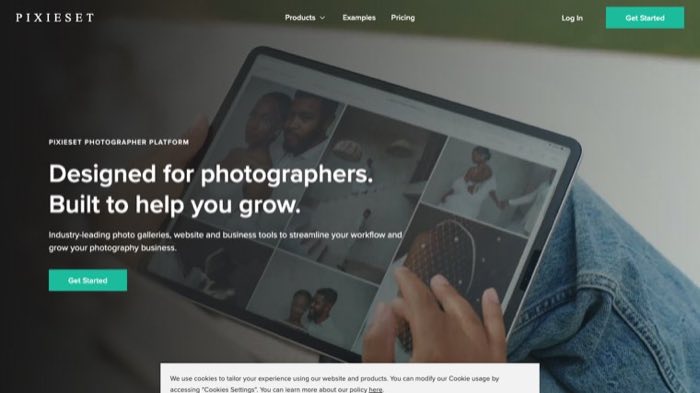
Client galleries, a website, store and CRM in one product built specifically for photographers.
Keeping delivery, sales and the public site in one place removes real work, and the site side is competent.
Pros:
- Delivery, sales and the public site in one subscription, instead of three tools that do not talk
- A genuinely usable free tier, which almost nothing else here offers
- Client galleries that sell, with print and digital ordering built in
- Storage tiers that scale from ten gigabytes to unlimited
Cons: The website is the weakest part of the bundle and the blogging tools are thin, so the pages that would actually earn local rankings are the hardest ones to build here. You are buying it for delivery and getting a site as a bonus.
For who: Photographers whose bottleneck is client delivery and sales rather than search. Wrong choice if the whole point of the exercise is ranking for local searches.
Pricing: Free at $0, then Basic $8 a month billed annually ($10 monthly), Plus $16 ($20), Pro $24 ($30) and Ultimate $40 ($50).
5. Format, portfolio-first
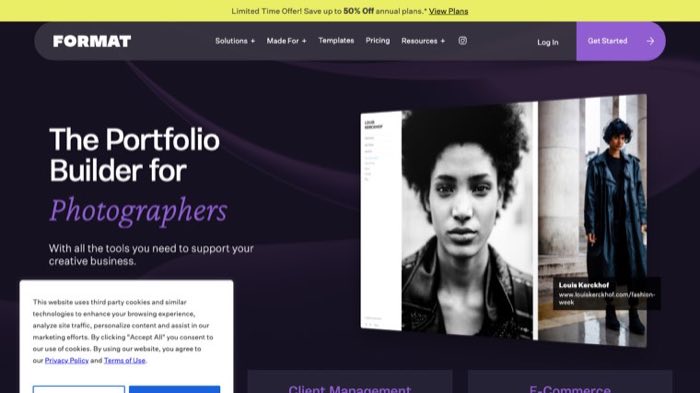
A portfolio platform for photographers with clean templates and straightforward publishing.
Good at the portfolio job specifically, which for some photographers is the entire site.
Pros:
- Portfolio presentation done properly, with templates that get out of the way of the work
- Client galleries and file transfer included on the paid tiers
- The cheapest credible option here once billed annually
- Almost no setup, which suits a photographer who does not want a web project
Cons: Content and blogging are thin, and content is what earns local rankings. A portfolio that ranks for your own name is not a marketing channel, and Format gives you very little to change that.
For who: Photographers who need a beautiful portfolio and get work through referral and social. Wrong choice if search is meant to be a booking source.
Pricing: Basic $10 a month billed annually ($14 monthly), Pro $12 ($24) and Pro Plus $15 ($36). Free trial available.
6. Yoast, if you are on WordPress

Handles titles, meta descriptions, schema, sitemaps and internal link suggestions on a WordPress site, with a free version that covers most of it.
For a photographer running WordPress, this is the cheapest meaningful SEO purchase available.
Pros:
- The free version already does the essentials, titles, meta, sitemaps and basic schema
- Internal link suggestions in the premium version, which is where most photography sites are weakest
- Local SEO add-on for studio address, hours and location markup
- One yearly cost with no seat pricing for a single site
Cons: It configures and it does not create. Nothing in Yoast will write a venue guide, earn a link or bring a booking, and it only works if you are on WordPress at all, which most photographers on Squarespace, Showit or Format are not.
For who: Photographers already on WordPress who want the technical layer handled correctly for very little. Irrelevant on any other platform.
Pricing: Free for the core plugin. Yoast SEO Premium is $118.80 a year excluding VAT for one site, with extra seats at $5 a month each.
7. BrightLocal, seeing your local position
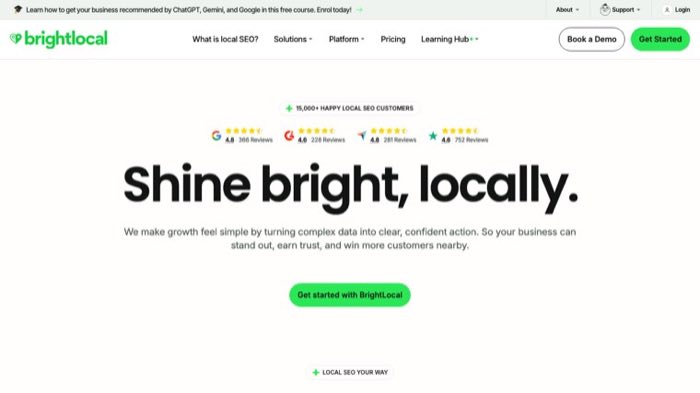
Local rank tracking including the map pack, citation monitoring, review management and Google Business Profile audits.
For a photographer competing in one city, this shows exactly where you stand and what is inconsistent across the web.
Pros:
- Map pack tracking for your city, not just the ten blue links
- Profile audit against local competitors, which usually explains the gap in one screen
- Review monitoring across platforms without a separate subscription
- Fourteen-day trial with no card required
Cons: Much of the toolkit assumes a business the public visits at a fixed address. Photographers working from home or shooting entirely on location often hide the address on their profile, and the citation half of the product becomes partly unusable the moment you do.
For who: Studio photographers with a public address competing in one named city. Weak fit for a home-based or travelling photographer.
Pricing: Track $31 a month billed annually ($369 a year), Manage $40 ($485) and Grow $49 ($584). Citations are billed separately from $2 each.
8. Local Falcon, how far your visibility reaches
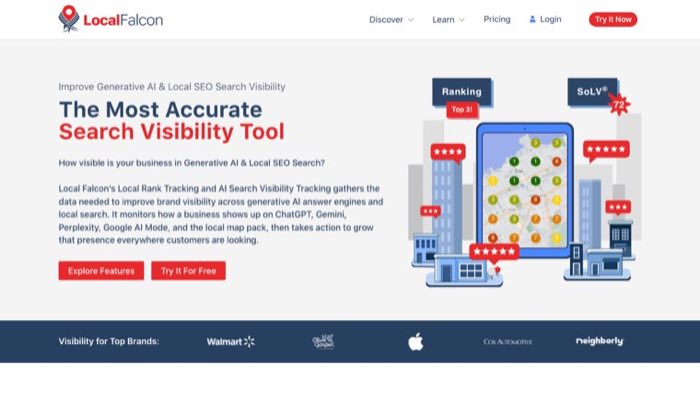
Maps your local ranking across a geographic grid, so you can see how far from your studio you actually appear.
For deciding which neighbouring towns are worth a location page, this is the most direct evidence available.
Pros:
- Shows the real catchment, which decides whether a location page is worth writing
- Cheap enough for a solo photographer at the entry tier
- Repeat scans show movement, so a new location page can be judged rather than guessed at
- Credits carry over, which suits seasonal checking around wedding season
Cons: The grid assumes clients search near where you are, and for wedding and event work they often do not. A red grid two towns out can be a market you already serve perfectly well through venue referrals, so the map is easy to over-read.
For who: Photographers deciding where to invest in location pages, especially portrait and studio work. Less informative for destination and travel-heavy specialisms.
Pricing: Starter $24.99 a month, Basic $49.99, Pro $99.99 and Premium $199.99, with cheaper annual billing. Extra credits are $0.05 each.
9. Semrush, research when you want to go deeper
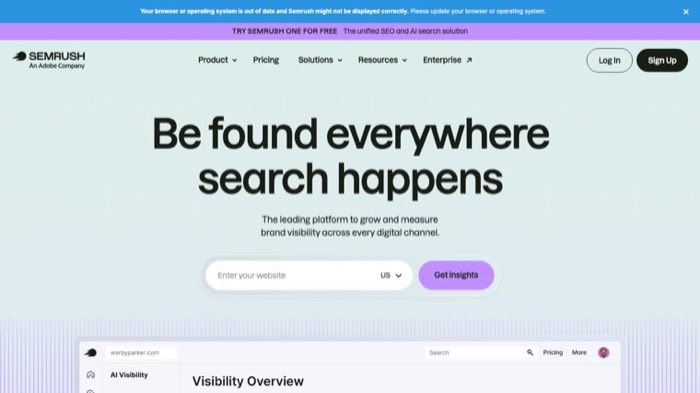
Keyword research, position tracking, site audit and competitor analysis in one platform.
Useful for finding the style and venue terms competitors rank for that you have never written about.
Pros:
- Finds the terms competitors rank for that never occurred to you
- Site audit catches the technical faults a heavy gallery site accumulates
- Position tracking by city, so local movement is visible
- One platform instead of four, if you are going to do this seriously
Cons: It is priced and built for marketing teams, and a solo photographer will use a small fraction of it. Semrush also renamed and repackaged its tiers in 2026, so plan names quoted in older comparisons no longer match what you will be shown.
For who: Photographers with several locations or a studio doing marketing in-house. Overpowered and overpriced for one person with a portfolio site.
Pricing: Plans run from $139 a month to $549 a month, with roughly seventeen percent off on annual billing. Add-on reports start at $10 a month.
10. Ahrefs, the strongest data

The largest backlink index available with strong keyword research on top, including click data showing which searches actually produce a visit.
Worth a single month to build a venue and location content plan, then cancel.
Pros:
- Click data, not just search volume, which kills a lot of pointless keyword ideas
- The best backlink index there is, for seeing which venues link to which photographers
- A free tier for your own site, enough to find broken pages and missing titles
- Starter plan at a solo-friendly price for occasional research
Cons: Its core strength is backlink analysis, and a photographer earns links by shooting for venues, planners and local press rather than by studying a link graph. You can do the outreach that matters without ever opening it.
For who: Photographers doing a one-off research project before committing to a content plan. Not a subscription to keep running month after month at this business size.
Pricing: Starter $29 a month, Lite $129, Standard $249 and Advanced $449, with Enterprise at $1,499 a month on an annual commitment. A free tier covers your own site.
11. Loganix, done-for-you fulfilment

An SEO fulfilment provider offering content, links and local SEO as defined, orderable services rather than a retainer.
Useful when you want a specific piece of work done and finished.
Pros:
- Buy one job, not a relationship, which suits a photographer with one gap to fill
- Fifteen-plus separate services, from citations to content to link building
- Entry prices low enough to test before committing to anything larger
- No monthly commitment if you only need the work once
Cons: You have to know what to order. Productised fulfilment sells execution and not diagnosis, so a photographer who cannot say whether the problem is citations, content or speed will buy the wrong service competently delivered.
For who: Photographers who already know the specific gap and want it closed. Wrong choice if you need someone to work out what is wrong first.
Pricing: Per service rather than per month, with the cheapest services starting at $7. There is no published monthly retainer.
12. SEO.com, a large agency with local depth

A general SEO agency with a substantial local practice and published guidance on what local work costs.
Scale means process and people who have done local work in competitive markets.
Pros:
- Process rather than one person's availability, so work continues through holidays and busy seasons
- Local practice with competitive-market experience
- Published cost guidance before any sales conversation
- Does the citation and technical work that no software on this page will do for you
Cons: The minimum engagement is larger than most independent photographers should be spending on marketing at all. At $1,500 a month you are committing roughly the revenue of two full wedding bookings a year to search alone.
For who: Studios with several photographers and a real marketing budget. Wrong choice for a solo photographer shooting twenty weddings a year.
Pricing: Quote only. Their own published guidance puts professional SEO at $1,500 to $5,000 a month, $100 to $300 an hour, or $5,000 to $30,000 per project.
13. Thrive Internet Marketing Agency

Full-service digital marketing with a local SEO practice covering small service businesses.
Useful if you want paid ads and web work handled alongside search.
Pros:
- Paid and organic in one place, which matters when wedding season needs a push
- Local SEO priced separately from full national programmes
- Web design in-house, so a slow portfolio site can be fixed by the same team
- Published local pricing band, unusual for an agency of this size
Cons: Photography specifics are something you bring to the relationship rather than something you buy. Nobody there knows why an engagement session page converts differently from a corporate headshot page, and you will be the one explaining it.
For who: Photographers who want ads, site and search handled by one vendor and can brief them properly. Wrong choice if you wanted sector expertise included.
Pricing: Quote only. Their own page puts local SEO at $500 to $1,500 a month, with wider SEO programmes from $500 to $10,000 and above.
14. WebFX, reporting-led full service

A large agency with rigorous reporting and attribution across local and national clients.
If you want to see exactly what your spend produced, this is the more measurable end of the agency market.
Pros:
- Attribution back to revenue, not to impressions
- Capacity that does not wobble, with a very large delivery team
- Cost ranges published openly before you speak to sales
- Content and technical work under one roof
Cons: The measurement machinery is a large part of the price, and a photographer taking thirty bookings a year can attribute revenue by asking each client where they found you. You would be paying for a reporting apparatus that answers a question a notebook already answers.
For who: Multi-photographer studios and franchises with spend to justify upward. Wrong choice for a solo or two-person business.
Pricing: Quote only. WebFX's own published guidance puts SEO retainers at $1,000 to $5,000 a month, consulting at $75 to $200 an hour, and projects from $500.
What to do first, in order
Complete your Google Business Profile. Categories, service areas, hours, and a genuine set of recent photos. Free, and the largest single lever.
Ask every client for a review. Photographers get the warmest possible moment for this, at gallery delivery, and most never ask.
Fix image sizes. Photography sites are slow because photographers upload full-resolution files. Compression is free and it moves rankings.
Write one post per venue. Low volume, high intent, almost no competition. This is the single most effective content tactic in the vertical.
Add alt text. Descriptive, honest alt text on portfolio images helps both image search and accessibility, and it takes minutes per gallery.
FAQ
How much should a photographer spend on SEO? Most independents should spend between nothing and $500 a month. The free work, profile, reviews, image compression and venue posts, outperforms most retainers below $1,500. We publish the same cost breakdown for other local businesses, including SEO for dentists and SEO services for law firms, if you want a sense of how these quotes vary by trade.
Is SEO worth it for photographers? Yes, because the intent is exceptionally high. Someone searching "[city] wedding photographer" is going to book someone within weeks.
How long does it take? Three to six months for local movement. Venue posts can rank much faster because competition on those terms is close to zero.
Do I need a blog? Yes, but not a general one. Venue posts, real shoots and pricing questions. Generic photography tips content does nothing for bookings.
Squarespace or WordPress for SEO? Either works. Squarespace has better defaults and less maintenance, WordPress has more control and needs someone to look after it. Neither is a ranking factor by itself.
How do I rank for a nearby town I do not have a studio in? Service area settings on your profile, a genuine page about working in that area, and ideally real shoots there to write about. Fake location pages are transparent and do not work.
Does image SEO matter? For photographers, more than most. File names, compression, alt text and structured data all contribute, and the same principles apply across local verticals as our guide to SEO services for restaurants sets out.
Where to start
Give the free work a fortnight. Google Business Profile, reviews, image compression and three venue posts will do more than the first quarter of most retainers.
When the content becomes the thing you never get to, that is the piece worth handing over. Distribb finds the venue and location queries clients search, writes those pages and publishes them to your site, alongside whatever you use for local and galleries. Three-day free trial.