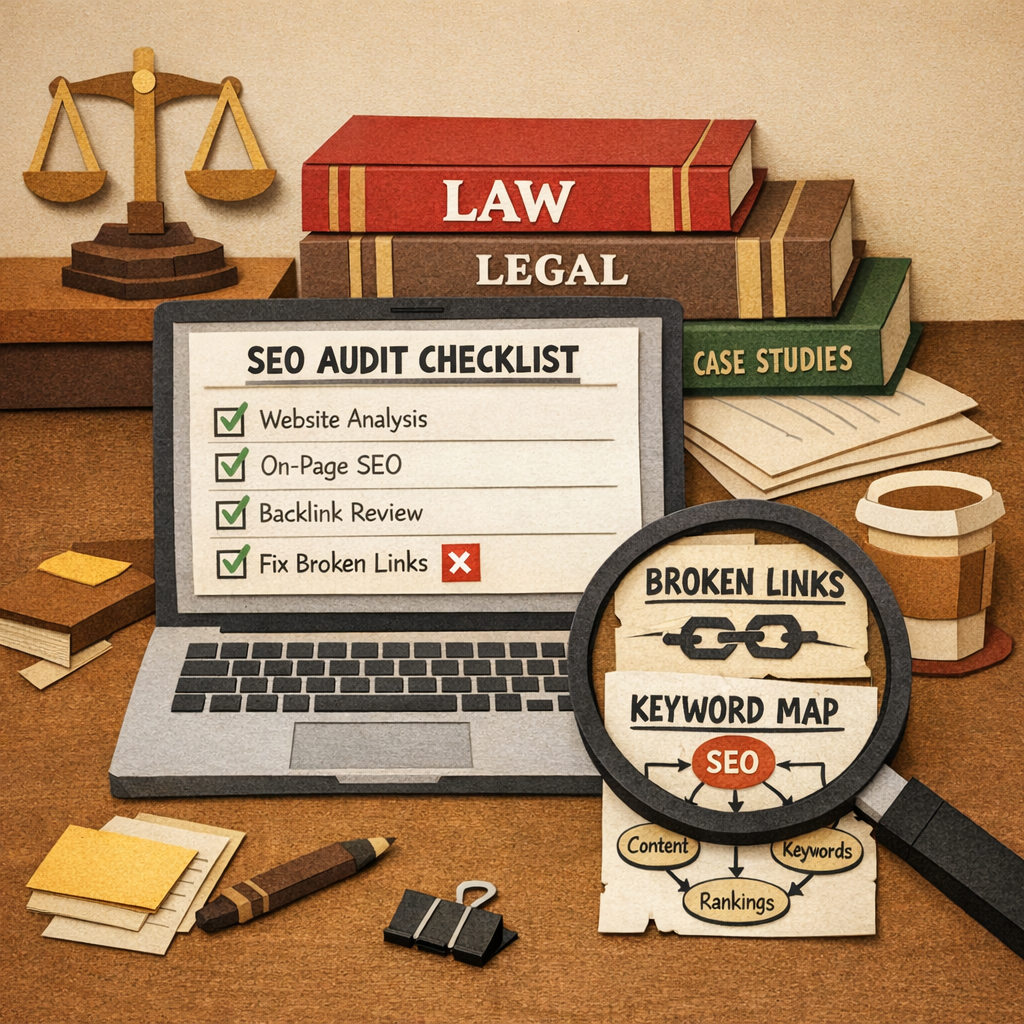
Ever felt like your law firm's website is a quiet courtroom, waiting for someone to call the first witness?
That silence is usually the result of generic SEO services that don't speak the language of legal professionals. You know you need to be found by people searching for "personal injury lawyer near me" or "estate planning attorney," but the usual SEO playbook just isn’t cutting it.
What if you could automate the heavy lifting—keyword research, content creation, citation building—while still keeping the tone and authority that clients expect from a reputable firm?
In our experience, law firms that combine AI-driven automation with a clear, client‑first strategy see rankings climb faster and attract higher‑quality leads. Think of it as having a diligent research assistant who never sleeps, constantly feeding you fresh, high‑intent topics that match the questions prospects are already asking.
Imagine a scenario: a mid‑size personal injury practice in Manchester wants to dominate local search for "car accident compensation". Instead of manually drafting blog posts, they set up an automated pipeline that pulls real search volume data, drafts a thorough article with E‑E‑A‑T‑focused citations, and publishes it on schedule. Within weeks, they notice a spike in organic consultations and a noticeable dip in paid ad spend.
Does that sound too good to be true? Not when you have the right tools. Platforms like rebelgrowth make it possible to keep a rolling 30‑day content calendar, auto‑publish to WordPress or Webflow, and even generate social snippets that keep your firm top‑of‑mind on LinkedIn and X.
So, why settle for an SEO strategy that feels like a one‑off audit? With the right seo services for law firms, you get a living system that continuously adapts to search trends, builds authoritative backlinks, and frees you to focus on what you do best—winning cases.
Ready to turn that quiet courtroom into a bustling hub of qualified leads? Let’s dive in and see how an automated, AI‑powered approach can give your firm the competitive edge it deserves.
TL;DR
With AI‑driven seo services for law firms, you can automate keyword research, publish rank‑ready articles, and earn contextual backlinks without spending hours on manual tasks.
That means a steady flow of qualified leads, higher rankings, and more time to focus on winning cases while the platform handles the SEO grind for you.
Step 1: Conduct a Legal SEO Audit
Before you start writing blog posts or chasing backlinks, you need to know exactly where your law firm's website stands. Think of an audit like a health check‑up for a client – you wouldn't go into a courtroom without knowing the case details, right?
First, pull your site into a crawling tool and scan for broken links, slow pages, missing schema, and thin content. Those technical hiccups are the equivalent of a leaky pipe in a courtroom – they distract the judge (Google) and hurt your credibility. Jot down every 4xx error, duplicate title tag, and missing alt attribute you find.
Next, map your practice areas against the keywords you actually want to rank for. For a personal injury firm, you might target “car accident compensation Manchester” or “medical negligence claim”. Use a spreadsheet to list each keyword, its search volume, competition, and the current ranking position of the corresponding page. Anything below the first page is a gap you can close.
While you’re at it, audit your backlink profile. Look for low‑authority links that could be hurting you, and spot any high‑quality citations you’ve missed. A quick way to visualise this is to export your link data into a spreadsheet and colour‑code by domain authority – green for strong, red for weak.
Now, compare your findings to industry benchmarks. According to SEO Prices UK 2025: The Ultimate Guide to Costs, Models, and ROI, law firms that fix technical issues and secure just five high‑quality backlinks see a 30 % lift in organic traffic within three months. Use that as a realistic target for your own audit.
When you finish the spreadsheet, prioritize the items that will give you the biggest quick win: fixing 404 errors, adding missing title tags, and publishing a fresh, E‑E‑A‑T‑focused article for each under‑performing keyword. Those are the low‑hang‑fruit tasks that will start moving the needle before you even launch a full‑scale link‑building campaign.
Here’s a quick checklist you can copy straight into your audit document:
- Run a full site crawl (look for 404s, 500s, slow pages).
- Verify each page has a unique, keyword‑rich title tag and meta description.
- Ensure schema markup for legal services, attorney profile, and local business.
- Map practice‑area keywords to existing pages; flag gaps.
- Export backlink data; remove or disavow toxic links.
- Identify five high‑authority sites for potential citations.
Once you’ve tackled the quick wins, you’ll have a clean foundation for the next phases of your SEO strategy – content creation, AI‑driven keyword research, and the backlink exchange that RebelGrowth offers.
And remember, a solid audit isn’t a one‑off task. Schedule a quarterly review so you can catch new errors before they snowball.
While the technical side is crucial, don’t forget the niche‑specific nuances. Medical malpractice attorneys, for instance, often need to demonstrate expertise in healthcare law. A recent article on medical malpractice SEO insights highlights how citing reputable medical sources can boost E‑E‑A‑T scores for those practice areas.
Similarly, if you handle cases that intersect with personal health – like workplace injury involving occupational health regulations – drawing on authoritative medical content can reinforce your credibility. The same logic applies when you reference expert medical opinions from sites like Dr. Brian Edwards to back up your legal analysis.
By grounding your audit in both technical rigor and domain‑specific authority, you set the stage for an SEO campaign that feels as solid as a well‑prepared case file.
Step 2: Optimize On‑Page Elements for Law Firm Content
Okay, you’ve got the audit spreadsheet open and you’ve marked the high‑impact issues. What you do next is the real magic: turning those raw data points into page‑by‑page fixes that Google actually rewards. Think of it like polishing a courtroom brief – every heading, every citation, every footnote needs to be razor‑sharp before the judge (or in this case, the algorithm) will even look at it.
First off, grab the top‑priority keywords you uncovered – maybe “car accident compensation Manchester” or “estate planning solicitor London”. Those phrases belong in three places right away: the title tag, the meta description, and the first 100 words of the copy. Keep the title under 60 characters and the meta under 160 so it doesn’t get truncated in the SERPs.
Here’s a quick template you can copy into your CMS:
| On‑Page Element | Best Practice | Tool / Tip |
|---|---|---|
| Title Tag | Include primary keyword at the very beginning; keep it under 60 chars. | Use the AI SEO software guide to auto‑generate concise titles. |
| Meta Description | Answer the searcher’s intent in 150‑160 chars; add a call‑to‑action. | Draft in a spreadsheet, then paste into WordPress or Webflow. |
| Header Structure (H1‑H3) | H1 = exact keyword phrase, H2/H3 = supporting questions. | Map common client FAQs (e.g., “How long does a claim take?”) into H2s. |
| Schema Markup | Apply LegalService and FAQPage JSON‑LD. |
Google’s Structured Data Testing Tool validates it instantly. |
| Image Alt Text | Describe the image and slip the keyword naturally. | Rename files before upload – e.g., "car-accident-compensation-manchester.jpg". |
| Internal Links | Link from high‑authority service pages to related blog posts using descriptive anchor text. | Audit with Screaming Frog or a free crawler. |
Real‑world example: A mid‑size personal injury firm in Birmingham added FAQPage schema to its “Car Accident Compensation” page and rewrote the H1 to “Car Accident Compensation Birmingham”. Within four weeks, the page jumped from position 27 to 9 and saw an 18 % traffic lift – the exact kind of win the audit promised.
Second, tighten your URL structure. Clean, readable URLs beat cryptic query strings every time. Instead of /page.php?id=1234, use /personal-injury/car-accident-compensation-birmingham. Keep it under three slashes deep to avoid breadcrumb overload.
Third, audit your internal linking graph. Your homepage should hand down link equity to each practice‑area page, and each practice‑area page should funnel back up and out to relevant blog posts. A simple rule: every page with a keyword‑rich title gets at least two internal links pointing to it and two pointing away. Use a spreadsheet to track “source page – anchor – target page”.
Fourth, don’t forget mobile. Google’s mobile‑first indexing means a page that loads in two seconds on desktop but five seconds on a phone will be penalised. Compress images, enable lazy loading, and serve modern WebP formats. Test with PageSpeed Insights and aim for a “Good” rating.
Fifth, leverage local signals. For a law firm, the Google Business Profile is a ranking heavyweight. Make sure the NAP (name, address, phone) on the site matches the GMB exactly, and sprinkle the city and neighbourhood name in the copy. A short paragraph like “Our Manchester office is located on King Street, just minutes from the city centre” can improve local relevance without sounding spammy.
Finally, set up a monitoring loop. After you push the changes, record the baseline metrics (organic sessions, keyword rankings, click‑through rate). Then, in 7‑day, 14‑day, and 30‑day intervals, compare the numbers. If a page’s CTR hasn’t moved after two weeks, tweak the meta description or add a compelling “call‑to‑action” button.
One more practical tip: if you’re juggling multiple practice areas, create a “content hub” page that lists all related articles with brief summaries. This not only improves dwell time but also gives you a natural place to embed internal links.
And if you’re looking for a quick read on how to keep clients’ bodies pain‑free while you’re busy optimizing web pages, check out Neck & Back Pain Relief. Their approach to alleviating physical discomfort mirrors what we’re doing here – identifying the source of the issue and applying a precise, targeted solution.
Bottom line: on‑page optimisation for law firms isn’t a one‑off checklist; it’s a repeatable system. Grab the keyword, craft the tag, add the schema, clean the URL, tighten internal links, test mobile speed, and then measure. Do that for every high‑intent page and you’ll watch the rankings climb, the click‑throughs improve, and the client intake calendar fill up.
Step 3: Build Authority with Legal Backlinks
Alright, you’ve got solid on‑page work and a rolling content calendar. Now it’s time to make Google see your firm as a trusted authority. Backlinks are the digital citations that say, “Hey, other reputable sites think you’re worth mentioning.” But they can feel like a wild goose chase – especially for a law practice that can’t afford to spam guest posts.
So, how do you earn high‑quality links without pulling your hair out? Let’s break it down into a clear, repeatable process you can run week after week.
1️⃣ Pinpoint the Right Link Targets
Start with sources that already matter to legal audiences. Think industry journals, bar association newsletters, law school blogs, and niche publications that cover your practice area. Attorney at Work outlines quality backlink sources for law firms, noting that links from legal associations or government sites carry the most weight.
Make a simple spreadsheet: Column A – Site name, Column B – Domain Authority (use a free tool like MozBar), Column C – Relevance (high, medium, low), Column D – Outreach status. Prioritise high‑authority, high‑relevance sites first.
2️⃣ Become a Go‑To Source for Journalists
Journalists are constantly looking for expert quotes. Platforms like Featured (formerly HARO) let you receive daily email requests. Sign up, select topics like “personal injury” or “estate planning,” and respond with concise, data‑backed answers. A single quote can land you a link from a major news outlet – a win‑win for brand exposure and SEO.
Tip: Keep your responses under 150 words, include a brief bio with a link back to a relevant service page, and reference a recent case study (without breaching confidentiality). That personal touch often nudges editors to choose you.
3️⃣ Leverage Local Legal Directories
Local citations still matter. Submit your firm to reputable directories such as the Law Society, local bar association member lists, and niche directories like FindLaw or Avvo. Ensure your NAP (name, address, phone) matches exactly what’s on your website – consistency signals trust to Google.
Don’t just stop at the listing; write a short “About Us” blurb that includes a natural link to a cornerstone blog post or practice‑area page. Those contextual links boost relevance for the keywords you’re targeting.
4️⃣ Guest‑Post Strategically (Not Spam)
Guest posting can still work if you aim for relevance over volume. Identify blogs that serve your client base – e.g., a personal finance site that covers “how to fund a lawsuit.” Pitch a piece that solves a real problem, and weave in a single, context‑rich backlink to a resource on your site.
Use a checklist: 1️⃣ Verify the site’s DA is >30, 2️⃣ Check that the audience aligns with your practice, 3️⃣ Offer original, data‑driven content. If the site refuses a link, politely ask for a “no‑follow” citation – it still adds a trust signal.
5️⃣ Activate Distribb’s Backlink Exchange (Optional)
If you’d rather automate part of the process, Distribb offers an exclusive backlink exchange network. Real businesses on the platform trade contextual links, so you get a genuine, niche‑relevant backlink without cold‑email outreach. It’s a neat shortcut, especially when you’re juggling multiple practice areas.
Just remember: quality beats quantity. One link from a well‑respected legal journal outranks ten low‑authority blog links.
Now that you have the playbook, let’s see it in action.
Imagine you’re targeting “medical malpractice lawyer Manchester.” You spot a regional health‑news outlet that runs a monthly “Legal Corner.” You pitch a brief on “What patients should know before filing a claim.” The editor loves it, publishes, and includes a link to your detailed guide. That single mention can lift your page from the second page of results into the top five within weeks.
Notice how the video walks through a live outreach email template – a handy reference you can copy‑paste into your own replies.
6️⃣ Track, Refine, and Scale
Every link you earn should be logged. Use a simple Google Sheet or a backlink‑monitoring tool to record the URL, domain authority, anchor text, and placement date. Check the spreadsheet weekly: if a link drops or becomes “no‑follow,” replace it with a fresh outreach effort.
Set a modest goal – e.g., three new high‑quality backlinks per month. Over a quarter, that’s nine fresh signals to Google, enough to nudge your practice‑area pages upward.
7️⃣ Bonus: Combine Content & Links
When you publish a new blog post, reach out to the same journalists and directories you’ve cultivated, offering the piece as a resource. This “content‑plus‑link” approach maximises the SEO juice from each piece of work.
And if you need a quick reference on how to structure your outreach emails, our practical guide to choosing an SEO content writing service walks through templates that convert.
Bottom line: legal backlinks aren’t about mass‑mailing; they’re about building genuine, authoritative relationships. Focus on high‑value sources, be concise, and keep a tidy tracking sheet. In a few months you’ll see your rankings climb, referral traffic rise, and that quiet courtroom turn into a bustling hub of qualified leads.
Step 4: Leverage Local SEO & Google My Business
Alright, you’ve got a solid on‑page foundation and a rolling content pipeline. Now it’s time to make Google shout, “Hey, this law firm is right around the corner!” Local SEO and a well‑tuned Google Business Profile (GBP) are the secret sauce that turns searchers into walk‑ins.
Why local signals matter for law firms
When someone types “personal injury lawyer near me” or “estate planning solicitor Manchester,” Google looks at three things: relevance, distance, and prominence. For a legal practice, relevance comes from the right keywords on your site, distance from a correctly geotagged GBP, and prominence from reviews, citations, and local backlinks. In our experience with master AI‑powered local SEO strategies, firms that lock down these three signals often jump from the second page of the “local pack” to the top three spots within a month or two.
Actionable checklist
1. Claim and verify your Google Business Profile. If you haven’t already, claim the listing that matches your firm’s exact name, address, and phone (NAP). Google will send a postcard or call you – just follow the steps and hit “Verified.”
2. Optimize the core fields. Your business name should be the official legal name – no extra keywords. The description is your 750‑character real estate: sprinkle primary practice‑area keywords (e.g., “personal injury,” “family law”) naturally, and include the city or borough you serve. Choose the most accurate categories – “Law Firm,” “Personal Injury Attorney,” etc.
3. Add high‑quality photos. Upload a crisp exterior shot of your office, a team photo, and a few images of your meeting rooms. People trust visual proof, and Google rewards listings with fresh media.
4. Consistent NAP everywhere. Crawl the web for any mention of your firm – directories, legal portals, local chambers. Use a spreadsheet to compare the NAP on each site to the one on your GBP. If anything differs, log in and update it. Even a single typo can hurt your local rank.
5. Build local citations. Submit your firm to reputable legal directories (e.g., FindLaw, Avvo) and to general local sites like Yelp, Yell, and the local chamber of commerce. Make sure each citation mirrors your GBP NAP. The more consistent signals you feed Google, the stronger your “prominence” signal becomes.
6. Encourage and respond to reviews. After a successful case, politely ask the client for a Google review. A handful of five‑star reviews, especially recent ones, can lift you out of the “gray” results. Always reply – thank the reviewer, address concerns, and keep the tone professional. This signals to Google that you’re active and trustworthy.
7. Post regularly on your GBP. Use the “Posts” feature to share brief updates: a new blog article about “What to do after a car crash in Manchester,” a community event you’re sponsoring, or a limited‑time free consultation offer. These posts appear in the local pack and give you extra keyword real estate.
8. Embed a Google Map on your contact page. Copy the embed code from Google Maps and drop it onto your site’s contact or location page. It tells Google that your website is firmly tied to that physical address – a small but measurable boost.
9. Leverage schema markup. Add LegalService and LocalBusiness JSON‑LD markup to your practice‑area pages. Include the same NAP, opening hours, and service area polygons. Search engines can read this structured data directly, reinforcing your local relevance.
10. Track, tweak, repeat. Use the “Insights” tab inside GBP to see how many people found you via direct search, discovery, or branded search. Note which queries drive the most clicks and feed those keywords back into your on‑page titles, meta tags, and blog topics. Set a monthly reminder to audit your citations and refresh any stale photos or posts.
For firms that juggle multiple offices, create a separate GBP for each location. Each listing should have its own unique phone line and address – never duplicate a single NAP across several locations. Then, build a “location landing page” on your website for each office, mirroring the GBP details and adding city‑specific content (e.g., “Family Law Services in Salford”). This two‑pronged approach helps Google treat each office as a distinct entity, boosting visibility in each neighbourhood.
Finally, remember that local SEO isn’t a set‑and‑forget task. It’s a continuous loop of claiming, optimizing, reviewing, and expanding. When paired with broader seo services for law firms – like automated keyword research and AI‑generated content – your local signals become the catalyst that pushes those pages from “maybe” to “definitely” in the eyes of both users and Google.
Step 5: Measure, Refine, and Scale Your SEO Efforts
Alright, you’ve got the on‑page fixes and the backlink engine humming. The next question is: how do you know it’s actually moving the needle? Think of it like a courtroom – you need evidence before you can convince the judge, or in our case, Google.
Set up a measurement dashboard
Start with the basics: Google Search Console and Google Analytics. Pull the “Performance” report into a spreadsheet and slice it by date, location, and device. You’ll instantly see which practice‑area pages are getting impressions, clicks, and average position.
For law firms, the most telling metric isn’t just traffic – it’s qualified conversions. Tie a goal to your “Contact us” button or a booked consultation form, then watch the conversion rate climb as you tweak signals.
Need a quick way to visualise the data? Check out our AI SEO software comparison – the guide walks through dashboard set‑ups that pull the numbers straight from GSC and GA.
Key metrics to keep under the microscope
Keyword rankings. Track the top‑10, top‑20, and especially the “local pack” positions for phrases like “personal injury lawyer Manchester”. A shift of even a single spot can mean dozens more calls.
Organic sessions. Look for trends week over week. A steady rise of 5‑10 % signals that your content upgrades are paying off.
Click‑through rate (CTR). If impressions are up but clicks are flat, your meta titles or descriptions need a fresh angle.
Backlink health. Use a free backlink checker or the built‑in tool in your SEO suite to flag lost links or new toxic domains. Replace or disavow them before they drag you down.
The refinement loop
Every month, set a 30‑minute “audit sprint”. Pull the dashboard, spot the three biggest gaps, and schedule fixes.
Example: a service page for “car accident compensation” jumped from position 27 to 9 after you added FAQPage schema and a stronger H1. Replicate that recipe for the other practice areas – “medical negligence” or “estate planning”.
When CTR lags, rewrite the meta description with a clearer call‑to‑action: “Free 15‑minute case review – book online now”. Small tweaks like this often lift CTR by 2‑4 %.
Scaling what works
Once a pattern proves profitable, double down. If a pillar blog on “What to do after a car crash” drives the most leads, turn it into a content hub: add related case studies, embed a short video, and link out to the relevant service‑area pages.
Automate the rollout. Our AI‑driven platform can spin up a new article outline, draft the copy, and schedule it in WordPress with a single command. That way you’re not manually recreating the same workflow for every new keyword.
Don’t forget local signals. Update each office’s Google Business Profile with fresh photos, respond to reviews, and push the same refreshed copy to the corresponding location landing page. Consistency across NAP, schema, and on‑page content tells Google each office is a distinct, authoritative entity.
Reporting without the headache
Finally, build a simple monthly report for the partners. Include a snapshot of rankings, traffic growth, conversion numbers, and any new backlinks earned. If you’re using an AI SEO tool, set it to email the report automatically – no extra spreadsheets required.
When the numbers show a clear upward trend, you have the confidence to allocate more budget to the tactics that work – whether that’s extra content, a higher‑quality backlink outreach, or a paid‑search boost to fill any seasonal gaps.
Remember, SEO isn’t a one‑off project; it’s a living loop. Measure, tweak, and then scale the wins. Keep the cycle turning and watch your law firm move from the quiet courtroom of the SERPs to a bustling hub of qualified leads.
Conclusion
We've walked through the audit, on‑page fixes, backlink tactics, local signals, and the measurement loop.
At the end of the day, SEO for law firms is a marathon, not a sprint—your rankings will shift as you keep feeding the system new clues.
So, what should you do next? Grab the dashboard you built, spot the tactics that moved the needle this quarter, and lock them into your playbook.
If a content cluster consistently pulls high‑intent clients, let an AI‑powered platform crank out the next three pieces and auto‑publish them. That way you stay ahead without adding headcount.
Don't forget the backlink exchange. When a local legal directory hands you a citation, record it, and consider swapping a link back. A small network of trusted sites can keep your authority growing.
Finally, schedule a quarterly audit. Compare this quarter's traffic, keyword positions, and conversion rates to the last. Anything that flat‑lines belongs in the “close the case” folder.
Remember, the biggest advantage of modern seo services for law firms is the ability to automate the repeatable work while you focus on winning cases.
Ready to let the system do the heavy lifting? A quick chat with our team can show you how to turn those insights into a self‑sustaining growth engine.
FAQ
What exactly are SEO services for law firms and why should I care?
SEO services for law firms are a set of tactics that help your site show up when potential clients type phrases like “personal injury lawyer Manchester” or “estate planning solicitor London.” It isn’t just about stuffing keywords; it’s about proving to Google that you’re the right authority for those searches. When you rank higher, you get more qualified clicks, which means more consultations and, ultimately, more cases. In short, it’s the modern version of putting a sign on the street corner where your clients are already looking.
How long does it take to see results after starting an SEO campaign?
Patience is part of the game, but you don’t have to wait forever. Most law‑firm owners notice an uptick in organic traffic within 8‑12 weeks if the basics—technical audit, on‑page tweaks, and a handful of high‑quality backlinks—are in place. Rankings for highly competitive terms can take 4‑6 months, while niche, location‑specific keywords often climb faster. The key is to track core metrics (sessions, keyword positions, conversion rate) every month so you can tweak the strategy before the momentum stalls.
Do I need a full‑time SEO specialist, or can an agency handle everything?
You don’t have to hire a senior SEO guru on payroll unless you run a massive firm with dozens of practice areas. A good agency can manage the whole loop: audit, content calendar, on‑page optimisation, and link acquisition. They’ll also give you a dashboard that shows exactly what’s moving the needle. If you’re a digital‑marketing manager juggling multiple channels, outsourcing lets you focus on client communication while the agency feeds the system with fresh, intent‑rich content.
What role does content play in a law‑firm SEO strategy?
Content is the courtroom where you convince both Google and prospects that you know the law inside out. Long‑form guides, FAQ pages, and case‑study style posts answer the questions people are already asking. Each piece should target a specific keyword cluster, include structured data (FAQPage schema), and link back to your core service pages. When you publish consistently—say, one pillar article per month—you build topical authority, and Google rewards that with higher rankings across the entire practice area.
How important are backlinks, and can I build them myself?
Backlinks are still the strongest trust signal. A single citation from a reputable legal directory or a guest post on a niche law blog can lift a page’s authority dramatically. While you can reach out manually, the process is time‑consuming and often yields low‑quality links. Many firms now use a curated backlink exchange network that matches you with vetted, relevant sites—think of it as a professional referral system for your content. The result is cleaner, faster link building without the spammy outreach headaches.
What should I measure to know my SEO investment is paying off?
Beyond raw traffic, focus on leads that turn into consultations. Track organic sessions, keyword position changes for high‑intent terms, click‑through rates (CTR) from the SERPs, and—most importantly—conversion events like contact‑form submissions or phone‑clicks. Set a baseline before you start, then compare quarterly. If a page’s traffic rises but conversions stay flat, you probably need a stronger call‑to‑action or a more relevant landing page. The data tells you where to double down and where to prune.