

Choosing a saas content marketing agency now means judging more than writing quality. You need to know how the team handles SEO, AI search visibility, links, and pipeline.
Here are five named options, with Distribb.io first for teams that want software-led SEO execution and four agency models for deeper strategy work.
1. Distribb.io, AI-powered SEO execution for SaaS teams
Distribb.io is an AI-powered SEO platform for SaaS founders, agencies, ecommerce brands, and SEO teams. It brings keyword research, content creation, publishing, backlink building, and AI-search visibility into one workflow.
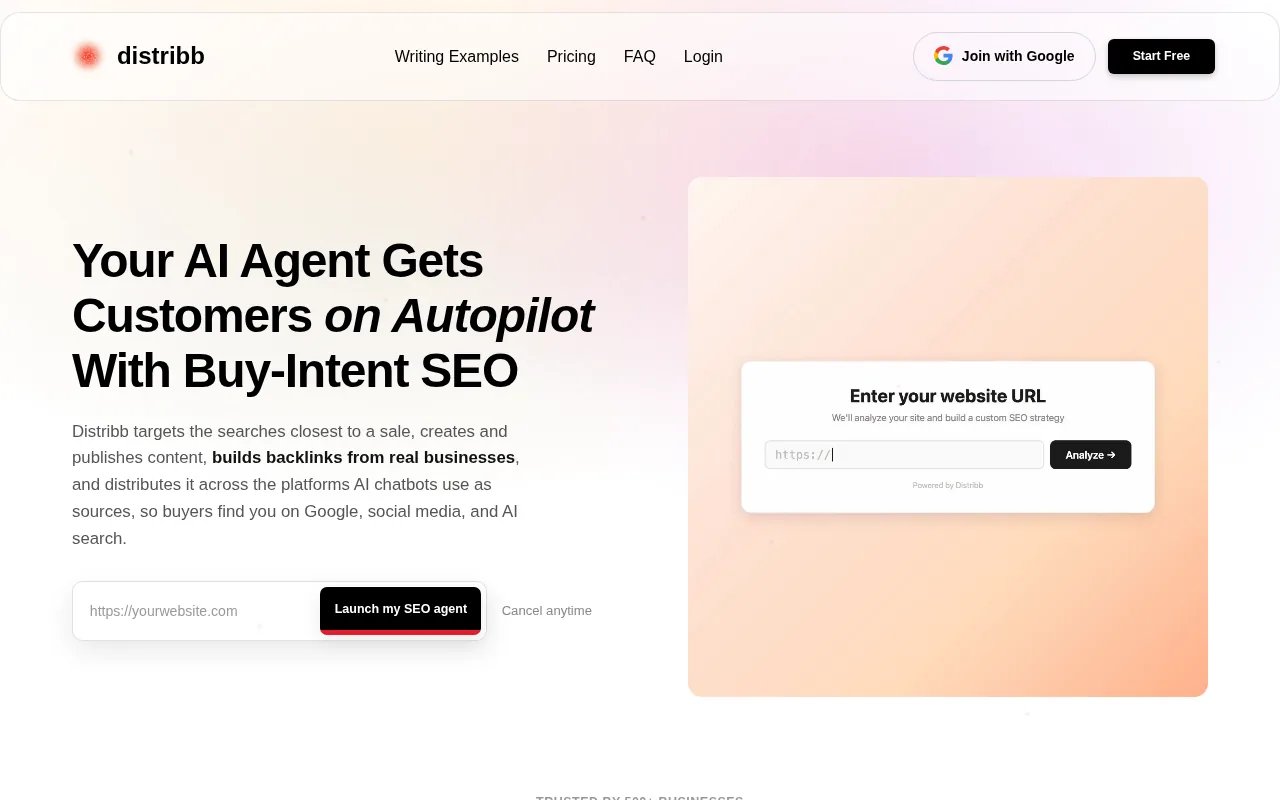
It fits a SaaS team that has a clear market but lacks enough hands to keep its content system moving. A founder can set a target topic, review the planned work, and keep production moving without passing every task through several separate tools.
The main appeal is execution speed with a repeatable process. Distribb.io can help find keyword opportunities, turn them into content, publish the work, and support backlink growth. That makes it a better fit for teams that need a working SEO pipeline than for teams seeking a full brand campaign led by journalists.
AI search adds another reason to consider this model. Search results now include more direct answers, so a page needs clear claims, useful structure, and signals that support trust. A SaaS team can pair its publishing workflow with Distribb's AI Driven Content Marketing guide to set clearer rules for human review and machine-assisted work.
There is a limit. Software won't replace customer interviews, product insight, or a strong point of view. If your company needs a flagship report or executive thought leadership, you may still want an agency beside the platform. Our list of content creation services covers agencies and marketplaces outside SaaS.
Distribb pricing is $97 a month on Pro, or $495 a month on Accelerator, which adds a human reviewing every piece before it goes out. If you sell software, see what Distribb runs for SaaS companies.
2. Campfire Labs, thought leadership and GEO-aware SaaS content
Campfire Labs is a strong fit for SaaS companies that need original stories, expert-led content, and a clearer brand voice. Its work spans content strategy, thought leadership, SEO, ebooks, benchmark reports, newsletters, and social content.
The agency's research-led approach suits a company selling to a careful buying group. Instead of building a blog from keyword lists alone, the team can shape a point of view around customer evidence and subject matter experts.
Campfire Labs has also added GEO-specific work, including AI visibility audits. That matters for SaaS brands whose buyers ask ChatGPT or other answer tools for vendor comparisons before they ever visit a website.
Its service mix is broad enough for a campaign that needs more than blog posts. A benchmark report can become a set of social posts, an email sequence, and sales material. That kind of reuse helps a small content team get more value from one research project.
The tradeoff is scope and cost. The agency's published plans start at $4,900 per month, so a very early startup may need a smaller engagement. You also need internal experts who can make time for interviews and fact checks. Without that access, the strongest part of the model loses force.
Campfire Labs is worth a close look when your goal is authority in a category, not a large batch of generic posts.
3. Siege Media, link-earning content for established SaaS brands
Siege Media is built for established SaaS brands that want content tied closely to link acquisition. Its approach treats the article and the promotion plan as one job, rather than handing them to separate teams.
That model works well when a company already has a base of useful pages but needs stronger authority. A team may have topic ideas and writers in place, yet still struggle to earn links from sites that matter. Siege Media focuses on finding content angles with enough value to attract those references.
The agency is also a fit for brands that can support visual content and larger campaigns. A useful asset might be a data-led guide, visual explainer, or research piece built around a question that many sites need to cite.
The published starting price is about $10,000 per month. That puts Siege Media closer to the mid-market and enterprise end of the agency range. The spend makes more sense when your site already has strong commercial pages and a team ready to turn new authority into qualified demand.
There is a clear caveat. Siege Media is less suited to a founder who needs deep product messaging or a high volume of small updates.
Before hiring a link-focused agency, define what a useful link means for your business. A relevant mention on a trusted industry site may matter more than a large count of low-fit domains. Distribb's guide on using content marketing for backlinks can help your team set that standard before a sales call.
4. Omniscient Digital, research-heavy strategy for growth-stage SaaS
Omniscient Digital is a strong choice for growth-stage SaaS companies that need a serious content strategy before production begins. Its work starts with competitive analysis, content-gap research, and a view of where organic growth is most likely.

This approach helps when traffic is not the main problem. Perhaps the site already attracts visitors, but those visitors do not reach product pages or sales conversations. A research-heavy plan can connect topics to a North Star Metric and the leading signals that support it.
Omniscient Digital's leadership includes operators with experience at SaaS companies such as HubSpot and G2. That background gives the agency a useful lens on product-led growth and organic acquisition. The agency also states that its work is focused on organic content growth rather than every paid and social channel.
The fit is strongest for a mid-market or growth-stage team with enough budget to fund strategy and production. Pricing is custom, and the agency's published positioning places it above the needs of a very early company that only needs a few articles each month.
The main risk is overbuying strategy. If your team has not yet tested basic commercial topics, a large research project may delay useful learning. In that case, start with a narrow set of high-intent pages and measure the result before expanding the brief.
Ask the agency to show how a topic moves through the funnel. A good plan should explain the buyer problem, the page's job, the next action, and the metric that will show progress. A separate guide on measuring content marketing ROI can help your team set those measures before the kickoff.
5. Grow & Convert, high-intent SaaS content built for conversion
Grow & Convert is for SaaS companies that want content tied to sign-ups and sales actions. Its method gives priority to high-intent keywords instead of chasing the largest search volume.
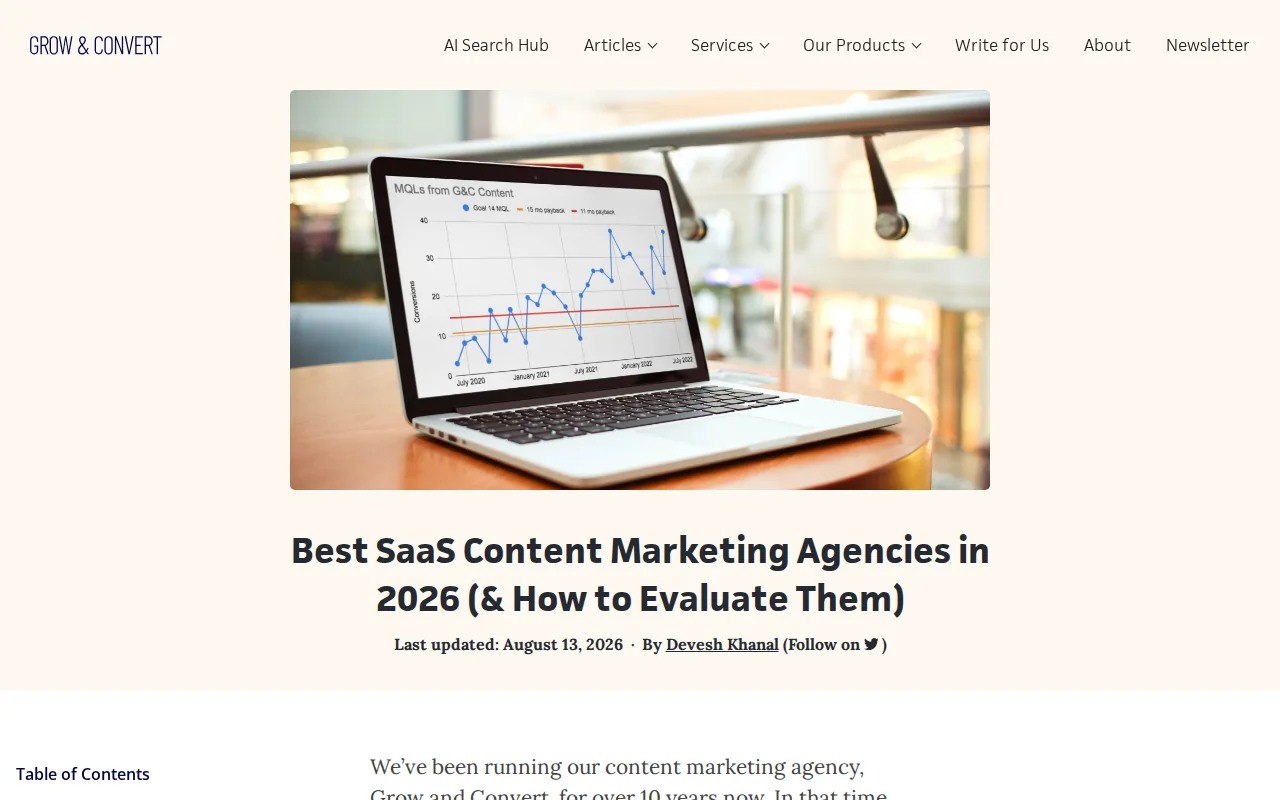
That focus changes the content queue. A broad educational topic may reach more people, but a comparison page or pain-point query may bring readers who are closer to a buying decision. Grow & Convert builds around that second group first.
The agency's listed services include high-intent keyword focus, conversion-oriented content, and SEO. That combination suits a SaaS company whose buyers ask detailed questions before they book a demo.
Grow & Convert uses custom pricing. Its focus may suit a company that wants a focused content program.
| Choose this model when | What to check before signing |
|---|---|
| You need pages close to a buying action | Ask how intent is scored and how conversions are tracked |
| Your product needs expert-level explanation | Confirm access to customer or subject matter interviews |
| You care about AI answer visibility | Ask what evidence supports the GEO plan |
| Your team has limited production capacity | Confirm who owns briefs, edits, updates, and publishing |
The caveat is its bottom-funnel bias. If your company needs broad category education or a large thought leadership program, this model may feel narrow. It is a better match when the next business question is, “Can this page help someone take action?”
Use a content calendar that shows the link between each page and its sales role. Distribb's content calendar template for Google Sheets gives a simple structure for mapping topics, owners, stages, and due dates.
Across the wider market, pricing remains split. SaaS agency retainers commonly run around $5,000 to $10,000 a month, while some providers use per-word rates and others quote custom enterprise work. AI capability is also uneven, so ask for the actual workflow rather than accepting a broad claim about AI.
FAQ
What does a SaaS content marketing agency do?
A SaaS content marketing agency plans and produces content that supports organic growth, demand, or sales. Depending on the provider, the work may include SEO research, thought leadership, link building, conversion pages, or AI search visibility. The right scope depends on whether your main gap is strategy, production, authority, or measurement.
How much does a SaaS content marketing agency cost?
A SaaS content marketing agency may charge by monthly retainer, project, or word. Ask what strategy, editing, promotion, reporting, and publishing work the quoted fee includes.
Should a SaaS startup hire an agency or use SEO software?
A startup should use SEO software when it needs repeatable execution and has someone who can guide product messaging. An agency is a better fit when the company needs research, interviews, or a distinct point of view. Many teams can combine both: software for workflow and an expert partner for high-value campaigns.
What should I ask a SaaS content marketing agency?
Ask how the agency chooses topics, checks facts, measures pipeline, handles expert input, and adapts content for AI search. Also ask who owns publishing and updates after launch. A good answer should describe the weekly workflow, not only promise rankings or traffic.
Is GEO different from SEO for SaaS content?
GEO focuses on making a brand and its claims easier for generative answer systems to find and cite. SEO still covers search visibility, page quality, and technical access. A SaaS content marketing agency should explain how both fit together, then show which pages and evidence support the plan.
Conclusion
Choose the provider that matches your bottleneck. For a repeatable SEO and publishing system, start with Distribb.io: check Distribb pricing and start your free trial. If your next move requires original research, major link assets, or deep strategy, use the shortlist to frame a focused agency brief before requesting proposals.