

Most advice on how to get more patients is a list of 22 tactics in no particular order. The trouble is that a practice rarely has a tactic problem. It has one leak, somewhere between a patient searching and a patient sitting in the chair, and fixing that leak does more than adding ten new channels.
This guide sorts the 12 methods that work into the four stages every new patient passes through, so you can find your leak first and fix it in order. It also covers what changes for a dental practice and for a walk-in clinic.
Step 1: Find where patients are leaking
Every new patient goes through four stages. They find you in a search, a map, an AI answer or a referral. They choose you over the other practices they found. They book, by phone or online. And then they either come back and refer others, or they don't.
Spend 30 minutes checking each stage before you spend a dollar:
- Found: Search your main service plus your town, in an incognito window. Are you in the map pack? On page one? Ask ChatGPT to recommend a practice like yours in your area and see if you come up.
- Chosen: Compare your review count, star rating and most recent review date to the three practices above or below you.
- Booked: Call your own front desk at 12:30 pm and at 5:15 pm. Submit your own web form and time the reply.
- Come back: Pull the share of last year's new patients who had a second visit.
The weakest stage is where your next hour goes. Then work through the methods for that stage below.
Get found: 4 ways
1. Complete your Google Business Profile
For most local searches, the map pack is the first thing a patient sees. Pick the most specific primary category (for example "Pediatrician" rather than "Doctor"), add every service, keep hours current including holidays, and upload real photos of your building, parking and waiting room. Add a Google post when you change something, like a new provider or extended hours. Our guide to local SEO for medical practices covers the setup step by step.
2. Build one page for each service and location
A single "Services" page with a bulleted list won't rank for anything. Patients search for specific needs: "sports physical Plano", "IUD insertion near me", "same day sick visit". Give each important service its own page that says who it is for, what happens at the visit, whether insurance covers it, and how to book. If you have more than one location, give each one its own page too. Our guide to SEO for doctors goes deeper on which pages to build first.
3. Show up in AI answers
BrightLocal's 2026 Local Consumer Review Survey found that 45% of consumers now use ChatGPT or another AI tool for local business recommendations, up from 6% a year earlier. AI tools pull from your website, your listings and what other sites say about you. Keep your practice name, address, phone, specialties and accepted insurance identical everywhere, and write pages that answer patient questions in plain sentences an AI can quote.
4. Use paid search to fill the gaps
Google Ads can put you at the top of the results tomorrow, which is useful for a new practice, a new service or a slow season. Keep campaigns narrow: a short list of high-intent searches, your service area only, and ads running only when someone can answer the phone. We compare the two channels, with real 2026 cost numbers, in Google Ads vs SEO for medical practices.
Get chosen: 3 ways
5. Get more reviews, and recent ones
Reviews decide most close calls between practices. BrightLocal found 97% of consumers use reviews to guide their decisions, and a growing share will only consider businesses rated 4.5 stars or higher. Recency matters too: a practice with 200 reviews and none since last spring looks less active than one with 80 and three from this week.
What works is asking every patient, every time. Send a review request by text within a few hours of the visit, with a direct link to your Google review form. Train the front desk to mention it at checkout. Reply to every review, and keep replies free of any health details, since even confirming someone is a patient can be a privacy issue.
6. Answer the insurance and price question up front
"Do you take my insurance?" is the question that ends most searches. List the plans you accept on your website, on each service page and in your Business Profile. If you have self-pay patients, publish your self-pay prices for common visits. Patients who can't find the answer will call a practice where they can.
7. Show the people
Patients choose a doctor, not a building. Give every provider a real bio with a photo, training, special interests and the languages they speak. A short video of a provider explaining what a first visit is like does more for a nervous patient than any headline on your homepage.
Get booked: 3 ways
8. Stop sending calls to voicemail
A missed call from a new patient is usually a lost patient: they call the next practice on the list. Check your call logs for lunch hours and the first hour after opening, which is when most practices miss calls. Options include staggered lunch breaks, a call overflow service, or an after-hours answering service that can book or at least take details.
9. Offer online booking
Many patients, especially younger ones, would rather book online than call. Put a "Book an appointment" button at the top of every page, not buried on a contact page. If your practice management system supports online scheduling, open at least new patient slots to it.
10. Reply to web inquiries fast
A form that gets a reply the next afternoon has already lost most of its value. Set a target of replying within one business hour during office hours, and send an automatic confirmation that tells people when to expect a call. Keep forms short and don't ask for medical details in an open text field. Our HIPAA compliant marketing guide explains what is safe to collect.
Keep them coming back: 2 ways
11. Run a real recall system
Getting an existing patient back is far cheaper than finding a new one. Send reminders for annual physicals, cleanings, follow-ups and vaccinations by text and email, and make the reminder bookable in one tap. Review the list of patients who are overdue every month.
12. Build referral relationships
Word of mouth is still the channel doctors trust most. In a Sermo survey, 42% of doctors said word-of-mouth referrals were the most important factor in getting new patients. Two kinds matter: patients who recommend you, and other professionals who send patients your way. For professional referrals, pick three to five practices whose patients need what you offer, send a short note on your focus and availability, and send patients back to them promptly with an update after each visit.
How to get more patients into your dental practice
Dental practices face the same four stages, with a few differences worth knowing:
- Emergency searches are gold. "Emergency dentist near me" and "tooth pain dentist open today" come from people who will book today. A dedicated emergency page, same-day slots, and ads that run only during open hours pay off fast.
- Clicks cost more. LocaliQ's 2026 benchmarks put the average dental cost per lead at $72.97, against $40.04 for physicians. That makes SEO and reviews relatively more valuable for dentists.
- Cosmetic and implant patients research for weeks. Before-and-after galleries (with consent), clear financing options and pages that explain the procedure step by step win these patients.
- Recall is most of the business. Six-month cleaning reminders and unscheduled treatment follow-ups fill more chairs than any new marketing channel.
- Membership plans help with uninsured patients. Publish the price and what it covers on your site.
How to get more patients to your clinic
Urgent care, walk-in and specialty clinics win on convenience, so the details that matter are different:
- Show wait times or online check-in. A patient choosing between two urgent cares will pick the one that tells them how long the wait is.
- Keep hours perfect everywhere. Wrong holiday hours on Google send patients to a locked door and produce one-star reviews.
- Build pages for what you treat. "Stitches", "UTI treatment", "sports physicals" and "flu shots" are all searches with a local clinic behind them.
- Work with local employers and schools. Occupational health, pre-employment physicals and sports physicals bring steady volume and repeat visits.
- List your prices. Self-pay patients at walk-in clinics compare prices before they drive over.
Running the search side on autopilot
Methods 1 to 3 are where most practices fall behind, because the work never ends. New service pages, fresh content, consistent listings and links from other sites all need doing every month, and nobody at a busy practice has those hours.
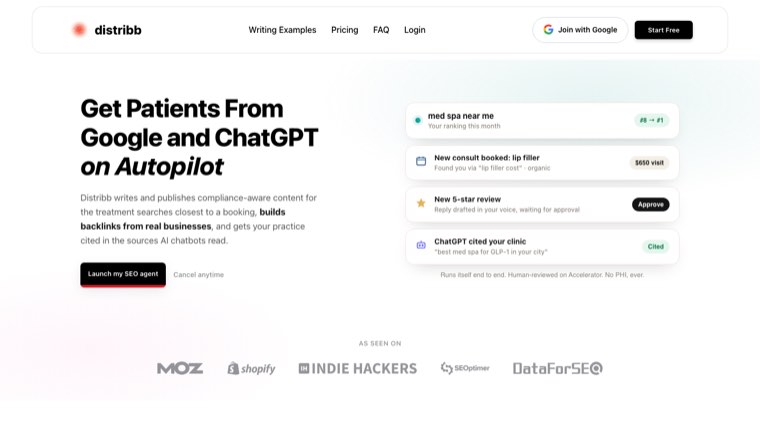
Distribb runs that part on autopilot. Connect your practice website and it does the keyword research, writes and publishes service pages and articles that answer patient questions, builds backlinks from relevant sites, and tracks how often ChatGPT, Perplexity and Google's AI answers mention your practice. Nothing waits on your approval, though you can read pages before they go live if you want to. Pro is $97 a month. Accelerator is $495 a month and adds a human editor who reviews every piece before it publishes, which suits practices that want a second set of eyes on clinical wording. You can see what Distribb runs for healthcare practices.
That leaves your team free for the stages only people can fix: answering the phone, looking after patients and asking for the review.
FAQ
What is the fastest way to get more patients?
The fastest way is usually to stop losing the patients you already attract: answer every call, reply to web forms within an hour, and offer online booking. After that, a narrow Google Ads campaign on high-intent local searches can add new patients within days. SEO and reviews take longer but cost less per patient over time.
How do I get more patients into my practice without spending on ads?
Focus on your Google Business Profile, one page per service and location, a steady flow of recent reviews, and referral relationships with other practices. These cost time rather than ad spend, and they keep working after the effort is done.
How do I get more patients into my dental practice?
Build an emergency dentist page and keep same-day slots open, collect recent reviews, publish clear pricing or membership plans for uninsured patients, and run a reliable six-month recall system. Dental clicks are expensive, so SEO and reviews give dentists more return than they give most specialties.
How do I get more patients to my clinic?
Show wait times or offer online check-in, keep hours accurate on every listing, build pages for each condition you treat, and partner with local employers and schools. Walk-in patients choose on convenience, so remove every reason to doubt you are open and quick.
Do online reviews really bring in more patients?
Yes. BrightLocal's 2026 survey found 97% of consumers use reviews in their decisions, and more of them now expect ratings of 4.5 stars or higher and recent reviews. Reviews also feed your map pack ranking and your visibility in AI recommendations.
Conclusion
Getting more patients starts with finding the stage where you lose them: being found, being chosen, getting booked or bringing them back. Fix that stage first, then work through the rest in order. Most practices find their biggest wins in the unglamorous parts, like answered phones, fast replies and recent reviews. For the search side, which never stops needing work, Distribb runs it on autopilot so your team can focus on the patients who come through the door.