

Every practice owner gets the same pitch twice a month. One agency says Google Ads will fill your schedule next week. Another says ads are a money pit and SEO is the only thing that lasts. Both are selling something, and both are half right.
This guide puts real 2026 numbers on the Google Ads vs SEO question for medical practices: what a click and a lead actually cost in healthcare, how long each channel takes, the HIPAA limits on ad tracking that most comparisons skip, and a simple way to decide which one to start with for your situation.
The short answer
Google Ads buys you patients this month. SEO builds a source of patients you stop paying for per click. Most practices need ads while SEO matures, then shift budget toward organic once rankings arrive.
If you need new patients in the next 30 days, start with a small, tightly targeted Google Ads campaign. If you can wait three to six months, or if your specialty has expensive clicks, put the first dollar into SEO and local search. If you can afford both, run them together and use what the ads teach you to decide which pages to build. Our data on the most expensive keywords on Google shows how high per-click prices run in rehab, legal and finance.
Google Ads vs SEO: how each one brings in patients
Both channels target the same moment: someone typing "pediatrician near me" or "knee pain doctor Denver" into Google. They reach that person in different ways.
Google Ads
You bid on keywords and pay each time someone clicks your ad. Ads appear above the organic results and in Google Maps. You control the budget, the location radius, the hours your ads run and the exact message. The moment you stop paying, the traffic stops.
SEO
You earn a place in the organic results and the local map pack by having pages that answer the search better than competing practices, a complete Google Business Profile, reviews, and links from other sites. You don't pay per click. The work takes months to show up, but the rankings keep sending patients after the work is done.
The part people forget
Patients treat the two differently. Many people skip anything labelled "Sponsored" and go straight to the map pack and the first organic results, because they read those as earned. Others click the first thing they see. Your practice wants to be in both places for the searches that matter most, and that is the real argument for running them together.
Google Ads vs SEO cost for a medical practice
The most useful public numbers for healthcare ad costs come from LocaliQ's 2026 search advertising benchmarks, which break out medical categories:
| Category | Avg. cost per click | Avg. click-through rate | Avg. conversion rate | Avg. cost per lead |
|---|---|---|---|---|
| Physicians & Surgeons | $4.76 | 6.61% | 12.43% | $40.04 |
| Dentists & Dental Services | $8.00 | 5.66% | 10.67% | $72.97 |
| All industries | $5.42 | $66.69 |
Those are averages across all advertisers. Competitive procedures in big cities (implants, cosmetic surgery, orthopedics, weight loss) run far above them, and a rural family practice may pay less.
A worked example
Say a primary care practice wants 25 new patient inquiries a month from ads. At the $40.04 average cost per lead, that is about $1,000 a month in ad spend. A dental practice chasing the same 25 inquiries at $72.97 per lead spends about $1,825. Not every inquiry books. If half of them do, the real cost per new patient is roughly $80 for primary care and $146 for dental, before you pay anyone to manage the account.
Run your own numbers the same way: target inquiries, times your cost per lead, divided by your booking rate. Then compare that to what one new patient is worth to you over a year.
What SEO costs
SEO has no per-click cost. You pay for the work instead: writing service pages, keeping your Google Business Profile current, earning reviews and links, and fixing technical problems on the site. That can be your own time, an agency retainer, or software. The cost is mostly fixed, so the cost per patient falls as rankings grow, where ad costs rise in step with the patients you buy.
The catch is the delay. For the first few months, SEO spend produces few or no patients. That is why cost comparisons that look only at month 12 flatter SEO and comparisons that look only at month 1 flatter ads.
Speed: how fast each one fills the schedule
Ads are much faster. A campaign can be approved and taking calls within a day or two. SEO for a medical practice usually takes three to six months before new pages rank for competitive local searches, and longer in crowded metros or for new domains.
Two things shorten the SEO timeline:
- Local search first. The Google map pack responds faster than organic rankings. A complete Business Profile with the right categories, real photos, current hours and a steady flow of reviews can move within weeks. Our guide to local SEO for medical practices covers the setup in detail.
- Specific pages. "Pediatric allergy testing in Tucson" is far easier to rank for than "pediatrician". Pages built for each service and location rank sooner and convert better.
Google Ads vs SEO for lead generation
For lead generation, the difference is less about volume and more about the kind of lead each channel sends.
Ads send high-intent searchers, but you pay for the curious ones too. Someone searching "urgent care open now" is ready to come in. Someone searching "what causes knee pain" is not, and broad keyword settings will happily spend your budget on them. Tight keyword lists, negative keywords and ad schedules that match your open hours matter more than the bid.
SEO leads arrive already warm. A patient who read your page on what to expect at a first physical therapy visit, then saw your reviews in the map pack, calls with fewer questions and books more often. SEO also captures the research searches that come days before a booking, which ads usually can't afford to chase.
Measure both the same way. Count booked appointments by source, not clicks or form fills. Use call tracking numbers on your ads and on your website, and ask "how did you hear about us?" at booking. Without that, both channels will look better or worse than they are.
The HIPAA problem with ad tracking
This is where medical practices differ from every other advertiser, and where most Google Ads vs SEO comparisons go quiet.
Google Ads is not covered by a Google HIPAA business associate agreement. Paubox's 2026 review found no public change to that as of April 2026. In practice, this means you shouldn't send anything to Google Ads that could identify a patient together with their health condition, including conversion tags that fire on a page like "book your HIV test" or pass form contents back to the ad platform.
Google's own personalized advertising policy adds a second limit: you can't build remarketing audiences or target people based on health conditions. The retargeting playbook that works for ecommerce is mostly off the table.
HHS has also published guidance on online tracking technologies for covered entities, and parts of it were challenged in court in 2024, so get a compliance opinion before you add any tracking pixel to a patient-facing page. Our HIPAA compliant marketing guide walks through what is safe to track.
SEO sidesteps most of this. Ranking a page doesn't require sending patient data anywhere, and you can measure results through Search Console and your booking system instead of ad pixels.
How AI search changes the math
There is a third channel now, and it favors SEO.
BrightLocal's 2026 Local Consumer Review Survey found that 45% of consumers now use ChatGPT or another AI tool for local business recommendations, up from 6% a year earlier. That makes AI tools the third most used source of local recommendations. Google's share of review reading dropped from 83% to 71% over the same period.
You can't buy a Google Ads placement inside a ChatGPT or Perplexity answer. What gets a practice recommended there is the same material that drives SEO: clear pages about each service, consistent practice details across the web, reviews, and mentions on other trusted sites. Every month you put into SEO also builds your visibility in AI answers. Ad spend builds none.
Which to start with, by situation
| Your situation | Start with | Why |
|---|---|---|
| New practice, empty schedule | Google Ads, plus a complete Business Profile | You need patients before SEO can deliver them |
| Established practice with open slots | SEO and local search | You already have reviews and history to build on |
| High-value procedures (implants, cosmetic, bariatric) | Both | One patient covers a lot of clicks, and competitors are on both |
| Expensive keywords in a crowded metro | SEO, with ads only on your best-converting terms | Broad ad campaigns burn budget fast in these markets |
| New service or new location launch | Ads for the launch, SEO pages built at the same time | Ads cover the gap while the new pages rank |
| Small town, few competitors | Local SEO | Map pack rankings come quickly and cost little |
How to run both without doubling the work
Running both channels well used to mean two vendors, two reports and twice the meetings. It doesn't have to.
- Let ads pick your SEO pages. Your Google Ads search terms report shows exactly which searches turn into bookings. Build an organic page for each of the best ones.
- Pull ad spend where you rank. Once a page holds a top-three organic spot for a term, test cutting the ad on that term for a few weeks and watch whether total bookings change.
- Keep ads for what SEO can't cover. New services, new locations, seasonal campaigns, and terms where the competition is too entrenched to overtake soon.
- Put the SEO side on autopilot. The ongoing work behind SEO (keyword research, writing pages, publishing, earning links) is the part practices struggle to keep up. That is the part worth handing off.
Distribb runs that SEO side on autopilot. Connect your practice website and it does the keyword research, writes and publishes service and location pages, builds backlinks, and tracks how often ChatGPT, Perplexity and Google's AI answers mention you. Nothing waits on your approval, though you can read pages before they go live if you want to. Pro is $97 a month. Accelerator is $495 a month and adds a human editor who reviews every piece before it publishes, which suits practices that want a second set of eyes on clinical wording. You can see what Distribb runs for healthcare practices.
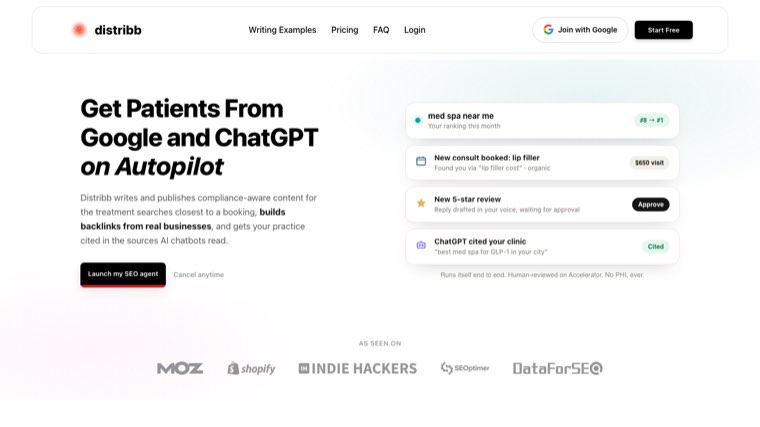
Once the search side runs by itself, your ad budget goes toward the gaps, and you stop paying for clicks you could be getting for free. For the full list of ways to fill your schedule beyond these two channels, see our guide on how to get more patients.
FAQ
Is Google Ads or SEO better for a medical practice?
Neither is better in every case. Google Ads is better when you need patients quickly or are launching a new service. SEO is better for lower long-term cost per patient, for trust, and for showing up in AI search. Most practices get the best result by running ads while SEO builds, then shifting budget toward organic.
What is the difference in cost between Google Ads and SEO?
Google Ads charges per click. LocaliQ's 2026 data puts the average at $4.76 per click and $40.04 per lead for physicians, and $8.00 per click and $72.97 per lead for dentists. SEO has no per-click cost. You pay a mostly fixed amount for the work, so the cost per patient falls as rankings grow.
Which is better for lead generation, Google Ads or SEO?
Google Ads produces leads faster and lets you control volume with budget. SEO produces leads that tend to be warmer, because patients have already read your pages and reviews before calling. Track booked appointments by source for both, not clicks, before deciding which one deserves more budget.
How long does SEO take for a medical practice?
Usually three to six months for new service pages to rank for competitive local searches, and longer in crowded metros or on a new website. Google Business Profile improvements and very specific service and location pages often show results sooner.
Are Google Ads HIPAA compliant?
Google Ads is not covered by a Google HIPAA business associate agreement, so you shouldn't send any data to it that links a person to a health condition. That includes conversion tags on condition-specific pages and form contents. Google's policy also bars targeting people based on health conditions. Get a compliance review before adding tracking.
Conclusion
For most medical practices, the real question in Google Ads vs SEO is what order to run them in. Use ads to get patients in the door now, on a short list of high-intent searches with tracking that respects HIPAA. Build SEO at the same time so that in six months you are paying for fewer clicks and showing up in the map pack and in AI answers. If you would rather not run the SEO half yourself, Distribb does it on autopilot, and you can put your attention on the patients it brings in.