
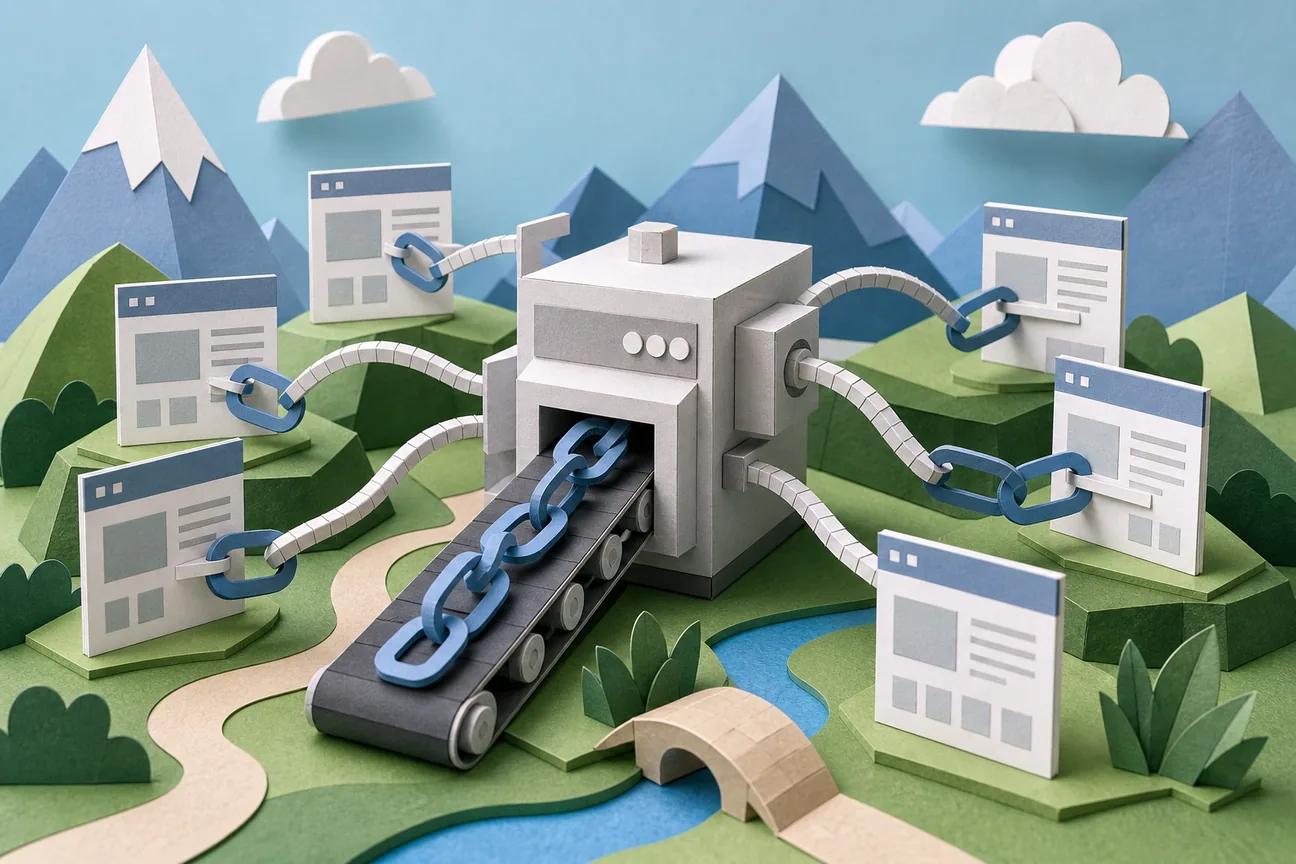
Most automated link building services promise a hands-off path to more authority. The hard part is seeing what each service actually automates, what it costs, and where its limits sit. Distribb.io is our top pick because it covers the full SEO workflow and publishes its operating limits. Here are five named options, plus a clear way to choose and run one. If you are buying at the smaller end, our guide to the best tools for small business link building covers the same question on a tighter budget.
1. Distribb.io (Our Top Pick)
Distribb.io's backlink exchange is part of an AI-powered SEO platform that handles keyword research, content creation, publishing, backlink building, and visibility in AI search. It fits agencies and teams that want one system instead of a separate tool for each part of the work.
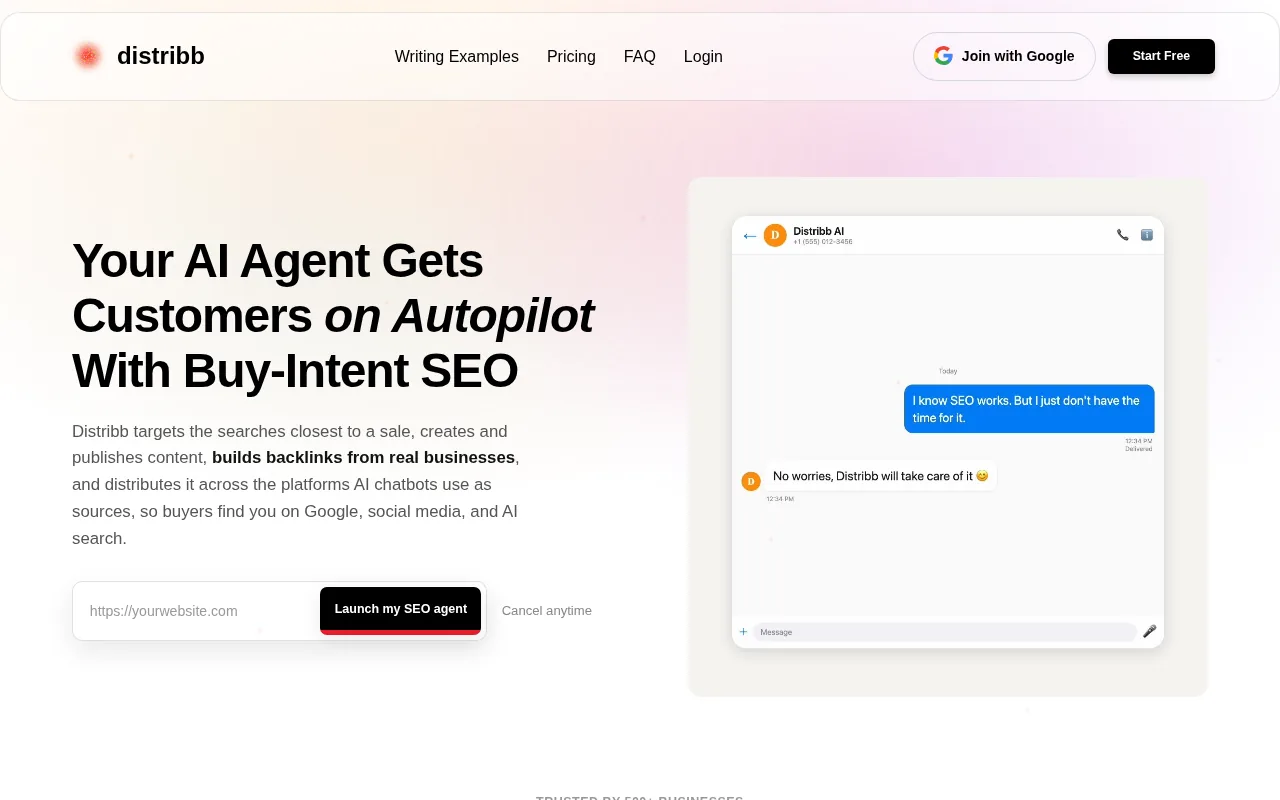
The main strength is the depth of the workflow. A campaign can begin with target terms, move into content production, then continue through publishing and contextual backlink acquisition. AI-search visibility is included in the platform's stated scope, which gives teams one place to review both classic search work and newer answer engines. Running both halves of that workflow together is covered in our guide to how to automate SEO content creation and link building.
That matters in an agency handoff. A strategist can set the target market, a content lead can review planned pages, and a manager can inspect link activity without stitching together several reports. The workflow also gives a client-facing team a clearer story: this page targets a need, supports a cluster, earns links, and is checked over time.
Distribb.io is also the clearest option on limits. Its public material identifies article-per-day caps, API constraints, and update restrictions. Those details help a buyer plan capacity before a campaign starts. A promise of 30 backlink credits means more when the rules behind the credits are visible.
There is a useful market detail here. The surveyed services that disclose backlink credits all list 30 credits per month. That number may sound like a fixed output, but the value depends on relevance, placement, exchange rules, and the service's other limits.
The caveat is scope. A full SEO system needs review. Teams still need to approve brand claims, check important pages, and watch whether the links fit the site. Automation reduces repeat work. It does not remove judgment.
2. Arvow, Automated Content and AI-Powered Backlink Exchange
Arvow combines automated article work with an AI-powered backlink exchange. It is a fit for teams that want content published with link matching built into the same subscription.
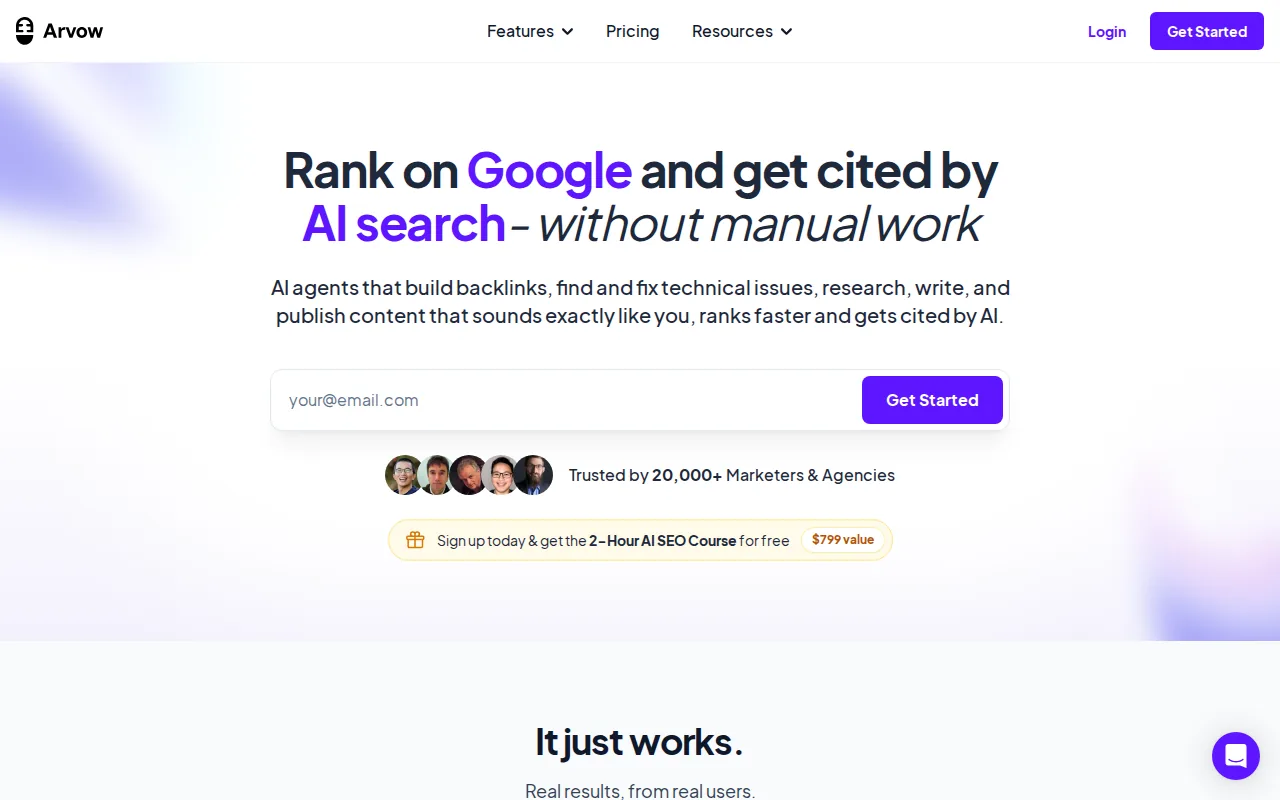
Its stated exchange model connects users with relevant sites in the same niche. Arvow says its matching system reviews content topics, audience, and niche rather than relying only on a domain score. It also says participating sites are checked for domain authority, traffic, and content quality.
The link placement model is specific. Links go inside related article text instead of a footer or sidebar. When one user publishes an article, another relevant site may receive a contextual link. In return, the publisher may link to another site in the network when its own content allows external links.
That exchange structure can reduce the need for cold outreach. It also gives an agency a simple operating model: publish useful content, allow relevant external links, then track incoming links through the service. Arvow says the number of links varies by niche and country.
Arvow's trust position rests on its stated vetting rules. It says the network excludes private blog networks and link farms. Still, an exchange deserves review. Read the linked pages, check topical fit, and inspect the referring domains before you report a campaign as a win.
The price is not disclosed in the research material used for this comparison. That makes a sales or account review important for agencies with fixed client budgets. Ask what counts as a credit, how links are checked, and what happens when a page is removed.
Arvow makes sense when link exchange is the main need. It is narrower than Distribb.io because the research describes less coverage of the full keyword-to-AI-search workflow.
3. Outrank, Daily SEO Content with Automated Link Placement
Outrank is an automated SEO content service with an AI backlink exchange. It suits a business that wants daily ranking content while the service handles much of the repeat publishing work.
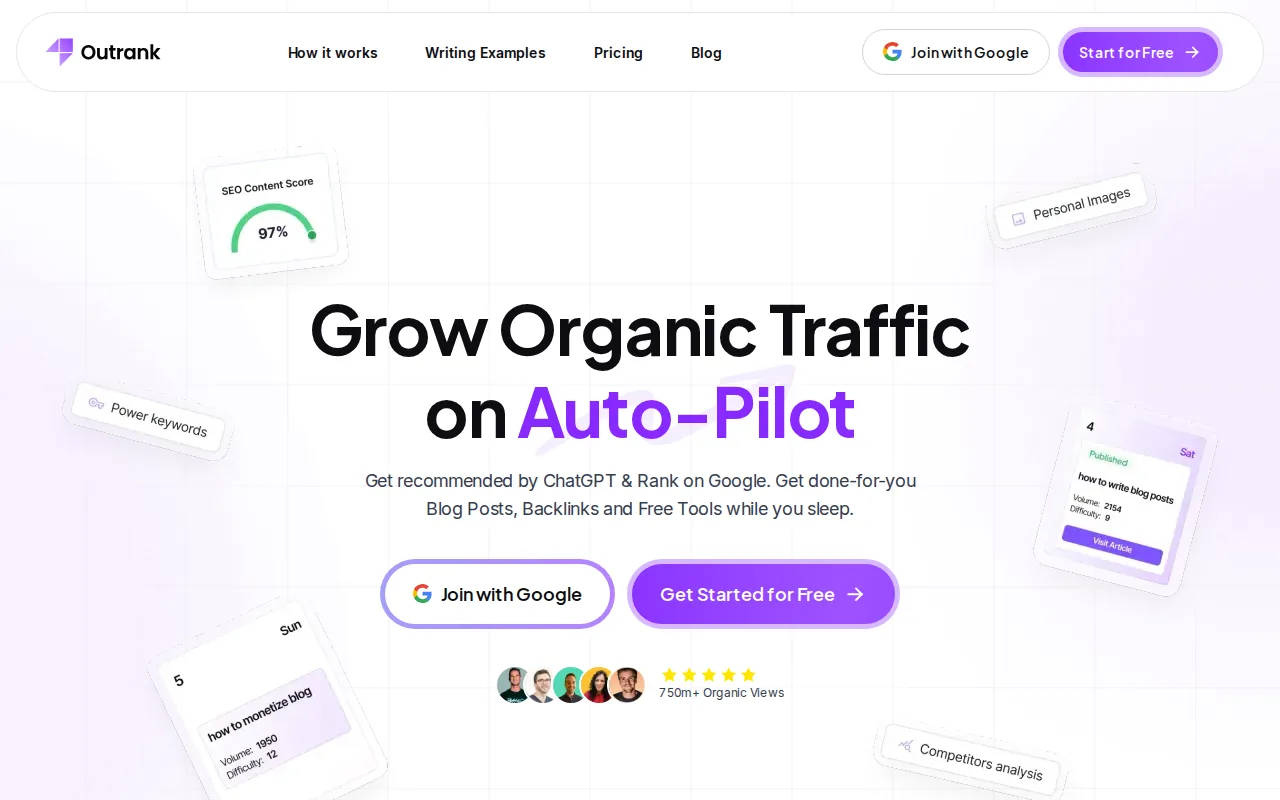
Outrank handles the SEO heavy lifting and creates daily ranking content. Its backlink exchange automatically adds links to a customer's website. That makes the service attractive to a small team that has topics to cover but lacks time for a manual content queue.
The strongest use case is a steady publishing program. A shop with many product categories might need supporting pages each month. A SaaS company might need articles around several feature and use-case terms. In both cases, the appeal is continuity rather than a single outreach burst.
The backlink feature is less fully described in the research than the exchange details for Arvow. Buyers should ask where links are placed, how topical relevance is checked, and how the system handles anchors. Those questions matter because a link that sits on an unrelated page can add noise to a report without helping the reader.
Outrank is one of the two services in this comparison with a disclosed starting price. The research lists plans starting at $99 per month. The same research summary lists 30 backlink credits per month for the services that disclose credit limits, so buyers should confirm how those credits relate to daily content output.
Its limitation is focus. Outrank centers on daily content and automated link placement. It does not provide the same level of public limit detail found in Distribb.io's material. That does not make it a poor fit. It does mean an agency should test one client workflow before rolling it across an account base.
Choose Outrank when publishing volume is your main constraint. Choose a broader system when the campaign needs one view of research, content, links, and AI-search visibility.
4. RankPill, SEO Automation with Monthly Backlink Credits
RankPill is an SEO automation service that covers keyword research, optimization, linking, and publishing. It is best for teams that want a defined credit model and common CMS connections.
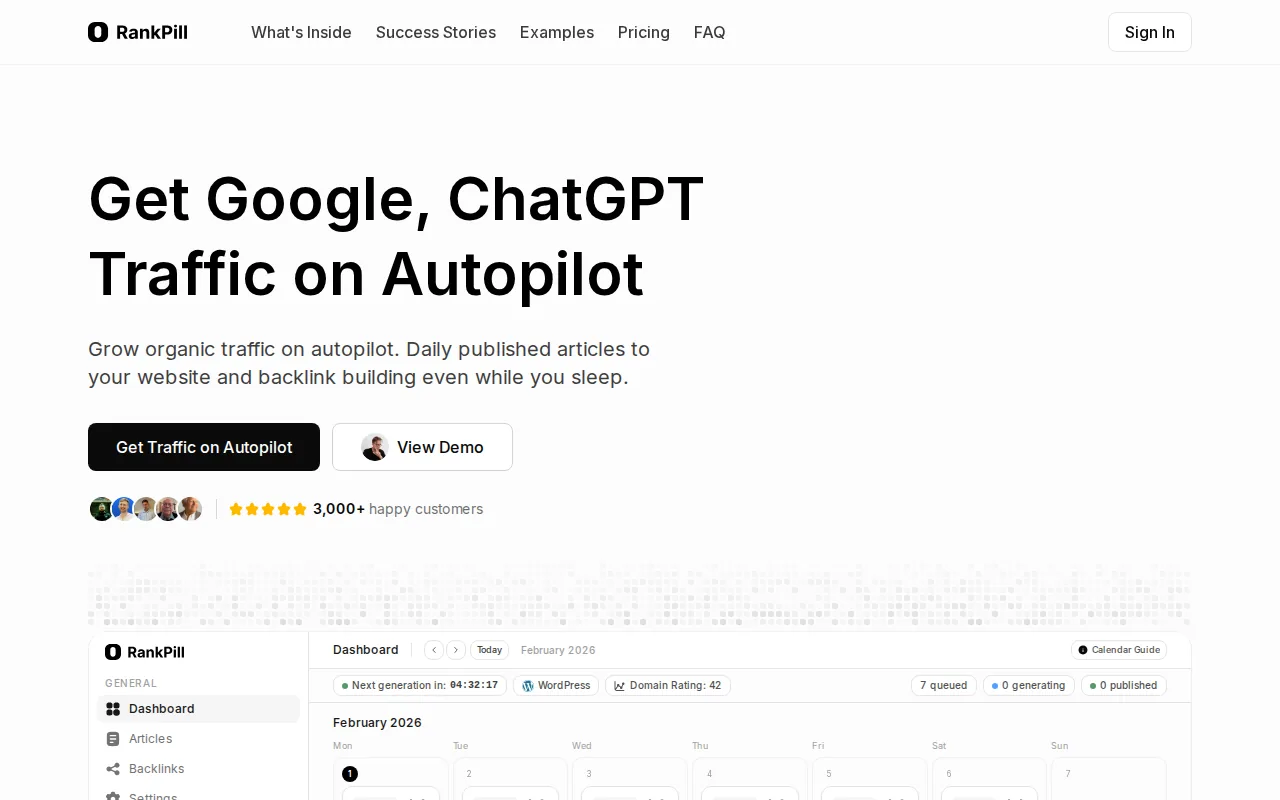
The research lists 30 backlink credits each month. It also names integrations for WordPress, Webflow, and Shopify. Those connections can reduce the work needed to move approved content into a live site, though the exact setup and plan limits should be checked before purchase.
A credit model is easy to explain to a client. You can set a monthly allocation, log the links received, and decide when a campaign needs a review. It also makes scaling less vague than a promise to “build authority” with no stated unit of work.
RankPill is one of the few options here with public price data. The research lists a starting price of $99 per month. That price should be read beside the credit count and the content workflow, not on its own. Two services can share a starting price while giving the team very different review tasks.
Its risk note is about capacity. Thirty credits may be enough for a small site with a focused topic set. It may feel slow for an agency managing many clients or a brand entering a crowded category. A buyer should ask whether unused credits roll over, how a link is approved, and whether links remain after cancellation.
Integration breadth does not separate these services much. The research found similar coverage across major CMS choices, including WordPress, Webflow, Shopify, and Wix. That means the better decision often rests on workflow depth and transparency rather than a logo list.
RankPill is worth a look when monthly credits give your team the control it needs. If you want those credits tied to a wider SEO system, Distribb.io has the stronger stated scope.
5. BabyLoveGrowth, Fully Automated SEO for Growing Businesses
BabyLoveGrowth presents a fully automated SEO and backlink workflow for small and medium businesses. It is aimed at teams that want execution on autopilot, with content and backlink work managed inside one service.
The research describes daily article sharing with partner sites for backlink exchange. It also says exchanged links are checked for relevance and reputable sources. A monitoring layer tracks exchanged links and profile growth, which gives a small business a place to inspect activity without running a manual prospect list.
That hands-off model can fit a founder who has no SEO staff. The setup question is simple: how much control do you need before content goes live? A founder may prefer fewer approval points. An agency handling regulated claims may need to review every page and every link target.
BabyLoveGrowth also positions the service around Google and AI search visibility. The research names small and medium businesses that want to scale SEO and GEO as its best-fit audience. This makes it a sensible option for a lean team that wants one recurring system instead of a part-time outreach task.
The trust note needs care because the research includes customer statements and outcome claims from the vendor page. Those statements are not treated as verified performance data here. Results depend on the site, topic, content quality, link relevance, and how long the campaign runs.
Pricing is not disclosed in the research material used for this article. Ask for the monthly credit count, content volume, approval controls, and link removal policy. The broader market pattern is worth keeping in mind: the competing services that disclose credits list 30 per month, even when their feature sets and prices differ.
BabyLoveGrowth is a reasonable fit for a small team that values low-touch execution. It is less suited to a buyer who wants detailed public limits before signing up. For that buyer, Distribb.io's clearer operating disclosures make the first review easier.
Automated Link Building Service Comparison Table
Use this table to compare the operating trade-offs, not just the feature labels. Pricing is sparse in this market. A missing price or limit is a reason to ask questions, not a reason to assume the service is cheaper or more flexible.
| Provider | Best for | Automation scope | Pricing data | Trust and risk check |
|---|---|---|---|---|
| Distribb.io | Agencies, SaaS founders, e-commerce brands, and SEO teams | Keyword research through content, publishing, backlinks, and AI-search visibility | See public pricing page | Publicly lists caps, API limits, and update restrictions. Confirm campaign capacity. |
| Arvow | Teams focused on automated content and contextual exchange | Article generation, publishing, syndication, updates, and AI backlink exchange | Not disclosed in the research | States that sites are vetted and excludes PBNs and link farms. Review each placement. |
| Outrank | Teams that want daily SEO content | Daily ranking content with automated backlink placement | Starts at $99 per month | Ask about placement rules, credit use, and public limits before scaling. |
| RankPill | Teams that want a credit-based SEO workflow | Keyword research, optimization, linking, and publishing | Starts at $99 per month | Lists 30 monthly backlink credits. Confirm rollover and link retention terms. |
| BabyLoveGrowth | Small and medium businesses seeking low-touch SEO execution | Automated content, publishing, backlinks, and SEO work | Not disclosed in the research | Vendor materials describe relevance checks. Verify review controls and link policy. |
Across the comparison, integrations are close to a tie. WordPress, Webflow, Shopify, and Wix appear across the market, so CMS support alone should not decide the purchase.
The sharper difference is automation depth. Distribb.io states a full workflow. The other four options describe narrower content or exchange-led workflows in the supplied research. If you already have keyword and content systems, that narrower scope may be enough. If you do not, the missing pieces become another set of tools to manage.
A useful guardrail when reviewing any link exchange is whether a service helps you earn relevant links that add value to a page, rather than generate patterns that exist only to manipulate rankings. Our comparison of the main backlink exchange platforms sets out how each one handles topical relevance and anchor rules.
How to Use an Automated Link Building Service
A service can automate repeat work, but the campaign still needs a clear brief and a review loop. Use the following implementation plan after you shortlist a provider.
Set the goal and baseline
Start with one business goal. That might be more qualified visits to a product page, stronger coverage for a topic cluster, or better visibility for a new category. Do not begin with a target number of links alone. A link count can rise while the pages that matter remain weak.
Record the current state before launch:
- Target pages and their current organic visits.
- Important search terms and their present positions.
- Existing referring domains.
- Pages that already earn links.
- Any pages that should not receive automated edits.
Give the provider a short list of competitor URLs and target topics. This keeps the system focused. It also gives your team something to compare when the first report arrives.
Select the service against your workflow
Score each option on the work you need removed from your team. If keyword research is already covered, a content and exchange tool may be enough. If the team lacks a publishing process, choose a service with broader workflow coverage.
Ask these questions before you pay:
- What counts as one backlink credit?
- Where are links placed?
- How is topical relevance checked?
- Can a person approve content or placements?
- What happens when a partner page changes or disappears?
- Do credits roll over?
- What are the daily, API, and update limits?
Public limits deserve extra weight. A service that names its caps lets you plan staffing and client reporting. A service that leaves them out may still work, but you need the answers in writing.
Set up the account and site rules
Connect the site only after you define the safe boundaries. List the approved domains, target countries, business facts, tone rules, and pages that need human approval. Add products or services that require exact wording.
Set exclusions too. These may include legal pages, checkout pages, thin pages, old campaigns, or topics outside the brand's expertise. An automated system needs both an include list and a stop list.
For an agency, create one workspace per client when the service supports it. Keep each client's goals and link rules separate. A mixed account can send the wrong topic or anchor style into a report.
Configure the campaign
Choose a small first group of pages. A useful pilot might include one service page, one product page, and a few supporting articles. The point is to test the workflow before you increase output.
Set the link rules with care:
- Favor page relevance over a high score alone.
- Keep anchor text natural and varied.
- Block unrelated categories.
- Set a review point for every new referring domain.
Do not ask the system to point every link at one money page. Spread attention across pages that help the reader. A balanced campaign is easier to review and less likely to produce a strange link pattern.
Integrate the service with your existing tools
Connect the CMS only after a test page passes review. If the provider supports WordPress, Webflow, Shopify, or Wix, check the permission level it needs. Give the lowest access that still lets the workflow run.
Send status data into the place your team already uses for reporting. Useful fields include target URL, source URL, anchor text, first-seen date, last-checked date, and status. A simple sheet can work for a pilot. A larger agency may want an API or a shared reporting system.
Test one record end to end. Confirm that the content is drafted correctly, the link points to the right page, and the status changes when the page goes live. Fix the handoff before you add more sites.
Teams that need a more detailed operating model can use Distribb.io's step-by-step AI link building workflow as a reference for prospect data, review points, and campaign checks.
Launch and monitor the pilot
Launch with a fixed review window. Check new content each day at first, then move to a less frequent schedule once the output is stable. Look at the actual source page rather than trusting a dashboard label.
Track four layers:
- Delivery: Did the content publish and did the link appear?
- Quality: Is the source page relevant and readable?
- Coverage: Are the right pages receiving attention?
- Business effect: Are target pages gaining useful visits or assisted conversions?
Do not expect a new link to produce an instant ranking change. Review trends over a sensible period and compare them with the baseline. If the source quality is poor, stop the campaign before chasing more volume.
Audit and maintain the link profile
Run a monthly audit. Export new links and mark each one as keep, review, or remove. Check whether the source page still loads, whether the link still points to the right destination, and whether the surrounding article still makes sense.
Watch for patterns that should trigger a pause:
- Many links from pages with no clear topic fit.
- Repeated anchor text across a short period.
- Links placed in sidebars, footers, or thin pages.
- Sudden activity that does not match the content schedule.
Keep a record of removal requests and replaced URLs. Link maintenance is part of the cost of automation. A service that tracks link status saves time, but a person still needs to decide what belongs on the site.
Best practices for automated link building
Personalize the reason for the link. The source page should gain something from pointing to the target page. If the system produces outreach copy, require it to mention the exact page and its use to readers.
Keep the link profile diverse. Use a mix of branded, partial, and plain URL anchors when they fit the sentence. Avoid forcing exact-match text into every placement. Our complete automated link building toolkit goes further into anchor ratios and reporting.
Protect relevance. A modest link from a closely related page is easier to defend than a high-metric link from an unrelated topic. Read the source page. Numbers cannot replace context.
Review content before scale. AI can miss a product change or make a claim that the business cannot support. Use a human checkpoint for key pages, regulated topics, and client-facing statements.
Measure the page, not only the domain. Watch the target URL's impressions, visits, conversions, and position trend. Domain-level scores can help with direction, but they do not tell you whether the campaign helped the page that pays the bills.
FAQ
What is an automated link building service?
An automated link building service uses software to find, match, place, or track backlinks with less manual work. Some focus on outreach, while others use a backlink exchange tied to published content. The main difference is control: check how each service handles relevance, approval, anchor text, and link removal before launch.
Is automated link building safe?
Automated link building can be safer when it focuses on relevant editorial placement and gives you review controls. It becomes risky when the system creates unrelated links, repeats anchors, or uses pages made only for ranking signals. Inspect sample placements and compare the workflow with Google's spam policies before scaling.
How many backlinks do automated services build?
The number depends on the service, niche, country, and available network activity. In the supplied comparison, services that disclose backlink credits list 30 credits per month. That does not guarantee the same number of useful referring domains. Ask what one credit means and how the provider verifies a live placement.
What does an automated link building service cost?
Pricing varies by provider and plan. The research lists Outrank and RankPill with starting prices of $99 per month, while pricing for Arvow and BabyLoveGrowth was not disclosed in the supplied material. Compare the monthly price with credit rules, content output, review time, integrations, and link maintenance.
Which automated link building service is best for agencies?
Distribb.io is the strongest first option for agencies that want one workflow across research, content, publishing, backlinks, and AI-search visibility. Its public material also gives agencies more detail on operating limits. A smaller content-led service may fit a narrow client need, but test it before applying one process across accounts.
Conclusion
Choose Distribb.io if you want backlink automation connected to the rest of your SEO work, not a stand-alone link count. Start with a small campaign, review the limits and sample placements, then see Distribb.io pricing and decide whether it fits your monthly workflow.