
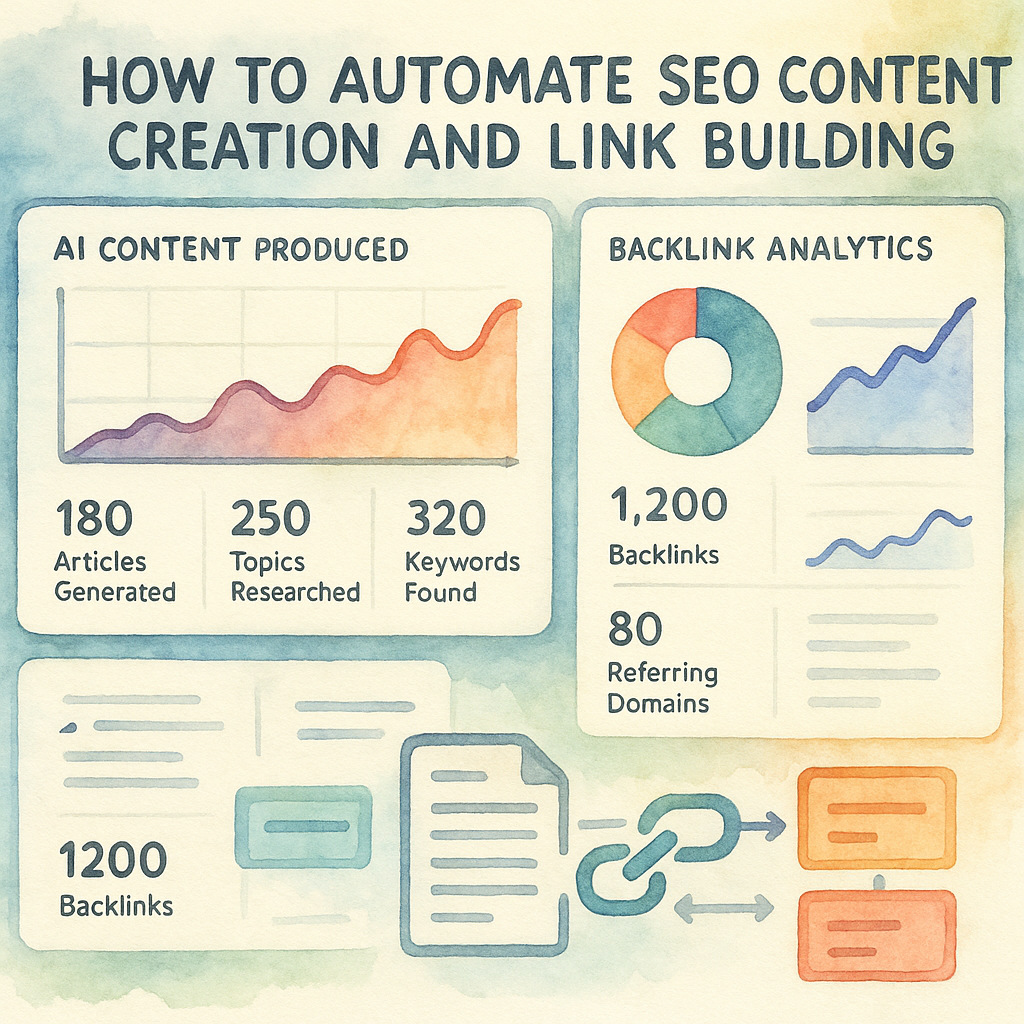
Most guides on this topic automate the content half and wave at the link half, because the content half is a production problem and the link half is a negotiation problem. Software is very good at the first and structurally bad at the second.
This is the version that covers both, says plainly which steps hold up when you take your hands off them, and which ones quietly destroy results the moment you do. Everything here is what we run on our own site and what we have watched break on other people's.
How we put this together
We ran the current top-ranking guides on this query side by side and listed every job they claimed to automate. Then we checked each one against what we actually do at Distribb across roughly 400 published pages and a link exchange network, and against the failures we see in customer accounts.
Where a claim did not survive that check, it is marked as such below rather than dropped quietly. The tooling named was in use in August 2026.
AI-assisted and fully automated are not the same thing
Almost every argument about SEO automation is really two people using one word for two different systems.
AI-assisted means a human starts the job and a machine does the tedious middle. You pick the topic, the tool drafts, you edit and approve. Nothing publishes without someone looking at it.
Fully automated means the system decides and ships on its own. Topic selection, drafting, internal links, publishing, all without a stop. This is the mode that produces the horror stories, and also the only mode that scales past a few articles a week.
The useful position is not one or the other. It is knowing which of the nine jobs below belongs in which mode, and moving a job from assisted to full only after it has run clean for a month.
Audit what you actually do before you automate any of it
Automation applied to a process nobody has written down produces a faster version of a process nobody understands. Spend an afternoon on this first.
List every recurring SEO task you or your team does, with how often it happens and how long it takes. Keyword pulls, briefs, drafting, editing, publishing, internal links, outreach, follow-ups, reporting. Put a real number on each one.
The tasks worth automating first are high frequency and low judgement. A weekly rank pull is a perfect candidate. Deciding which of three topics deserves a page is not, no matter how confidently a tool offers to do it.
The nine jobs, and how much automation each one takes
| Job | Automatable | What breaks if you fully automate it |
|---|---|---|
| Keyword research and clustering | Almost fully | Nothing much. Verify volumes against a second source |
| Topic selection | Assisted only | You publish pages nobody at your company can defend |
| Briefs and outlines | Almost fully | Outlines drift toward whatever ranks, so every page reads the same |
| Drafting | Assisted, or full with a review gate | Factual errors ship. Invented products, invented statistics, dead tools |
| On-page optimisation | Fully | Nothing. This is the safest thing on the list |
| Technical monitoring | Fully | Nothing, as long as someone reads the alerts |
| Internal linking | Fully | Nothing, if the map is built from your real site structure |
| Publishing and scheduling | Fully | Nothing, once the CMS connection is stable |
| Link acquisition | Partly, and the split matters | Covered in its own section below |
The pattern is that mechanical jobs automate cleanly and judgement jobs do not. Drafting sits awkwardly in the middle: the writing is mechanical, the truth of the writing is not.
Automating technical monitoring
This is the cheapest automation on the list and the one that saves the most embarrassment. You are not automating fixes, you are automating the discovery that something broke.
Set a scheduled crawl that alerts you on new 404s, redirect chains, pages that fell out of the index, missing or duplicated titles, and canonical tags pointing somewhere unexpected. Weekly is enough for most sites; daily if you publish daily or run an ecommerce catalogue that changes on its own.
Wire Search Console's index coverage and Core Web Vitals reports into the same alert channel, because the two failure modes that hurt most are pages Google stopped indexing and pages that got slow after a template change. Both are silent otherwise.
The trap is alert volume. A monitor that fires 40 notifications a week gets muted within a month, and then you have automation that is worse than nothing because you believe you are covered. Set thresholds so a normal week produces zero alerts.
Automating the content half, step by step
Research. Pull keyword data on a schedule rather than in bursts. You want volume, difficulty and the current ranking URLs, because the ranking URLs tell you what format the query wants. A query where the top five are all tools does not want your 2,000 word essay.
Clustering. Group queries that share intent into one page each. This is the single highest-value automated step, because it is where cannibalisation gets prevented instead of diagnosed six months later. Two pages targeting the same intent will split their own rankings.
Briefs. Generate the outline from the current top results, then have a person add the one thing none of them have. If you skip that second part, you are producing a slightly worse average of page one.
Drafting. Fine to automate, with two hard conditions. Every product, statistic and tool named in the draft gets checked before publication, and the draft never goes live without a human approving it. We have found invented product names and dead tools in AI drafts often enough that we now open every product homepage in a browser before it ships.
Publishing. Fully automate this. A queue that pushes approved drafts into your CMS on a schedule removes the most common failure in content programmes, which is finished work that never goes live.

We built Distribb to run that chain end to end, from keyword to published page in WordPress, Webflow or Shopify, with the internal links wired at publish time. The honest limitation: it is opinionated about the workflow, so if you already have briefs, writers and an editorial process you like, you will be fitting a pipeline around a process rather than the other way around. Teams with an existing content operation usually get more out of automating the pieces they hate than replacing the whole chain.
Internal linking is the step nearly everyone skips
Every guide on this topic mentions internal linking in a list and then moves on. It deserves more, because it is the one automated step with no downside and the most common silent failure in a scaled content programme.
Publish 100 articles that link to nothing and you have 100 orphans. Google finds them slowly, they inherit no authority from the rest of your site, and the programme underperforms its volume for reasons nobody can see in a rankings report.
The fix is a link map: for every page, which other pages should point at it and with what anchor text. Build it once from your real site structure, then apply it at publish time so a new page ships with inbound and outbound links already in place. Refresh the map monthly, because a blog gaining posts every week decays a static map fast.
Anchor text is the part to get right. Write it from the target page's title and topic, not from whatever query the target happens to rank for, or you end up with links whose anchor describes something the destination does not cover.
Automating link building, honestly
There are three real routes to links. Software changes how each is administered. It does not remove the work from any of them.
Outreach. You find sites, contact people, and some say yes. Automation genuinely handles prospecting, contact discovery, verification, sending, follow-up sequencing and reply tracking. It does not handle the pitch. Templated pitches at volume are the fastest way to burn a domain's sending reputation and get reply rates near zero.
Paid placements. You pay for a link. This is fast, honest about what it is, and against Google's guidelines when undisclosed. Plenty of companies do it deliberately. The mistake is doing it without knowing that is what you bought, which happens constantly with cheap agency packages.
Exchanges. Two businesses agree to link to each other's content. Both sides consent, both links sit on real sites with real readers, and no cold outreach is involved. Matching is the part that automates well, because it is a database problem rather than a persuasion problem.
That third route is the one we run, through our backlink exchange, and it is the only structure we have found where the automation covers the whole path rather than the easy front half. If you want the wider comparison first, we keep a breakdown of the best backlink exchange platforms and where each one fits.
What link building automation cannot do
It cannot make a site want to link to you. That is a content and relevance problem, and no amount of sequencing fixes it.
It cannot write a pitch that a human editor wants to answer. The reply rate difference between a specific first line and a merge field is not small, it is the whole result.
It cannot judge whether a link is worth having. Metrics tell you a domain's rating; they do not tell you whether the page will ever be read, whether the site sells links to anyone with a credit card, or whether the link sits in a footer nobody sees.
And it cannot manufacture consent. Anything producing links without a person on the other side agreeing is building the category Google spends the most effort discounting.
The red lines
Three things reliably cause damage, and all three are sold as automation.
Auto-generated content published without review. Not because it is AI-written, but because nobody checked whether it is true. A page recommending a product that does not exist is a credibility problem before it is a ranking problem.
Automated link placement into sites that did not agree. Comment systems, auto-approved directories, and private blog networks. This is the category the guidelines name directly.
Scaled content with no editorial standard. Volume alone is not the trigger. Volume with nothing behind each page is.
Everything else on the list above is ordinary operational software, and treating it as risky is how teams end up doing mechanical work by hand for no benefit.
Choosing the plumbing

| Option | Best for | Watch out for |
|---|---|---|
| Zapier | Simple two-step links between tools you already pay for | Cost climbs fast with task volume |
| Make | Visual multi-step workflows with branching | The canvas gets unreadable past about 20 modules |
| n8n | Teams with a developer, self-hosting, full control | You now own the maintenance |
| A dedicated SEO platform | Skipping the plumbing entirely | You inherit its opinions about your workflow |
The general rule: build the workflow by hand first and only automate it once you have run it enough times to know what it looks like when it goes wrong. A workflow automated from a whiteboard breaks on its first unusual input, and you find out three weeks later.
Start with n8n or Make for the connective work between tools, and keep the SEO-specific jobs in something that understands SEO. Generic automation platforms are excellent at moving data and know nothing about search intent.
A weekly cadence that holds up
Monday: the keyword pull and cluster refresh run automatically. A person spends 20 minutes deciding which clusters get a page this week.
Tuesday to Thursday: drafts generate against approved briefs. A person reviews each one, with the fact check on every product, number and claim as a non-negotiable step.
Friday: approved drafts publish on a schedule, internal links apply from the map, and the link exchange matching runs on the new pages.
Monthly: rebuild the link map, review which pages gained or lost position, and prune anything that has ranked for nothing in 90 days.
The reason this shape works is that the human time is spent on the two decisions that matter, what to write about and whether the draft is true, and nothing else.
Time and cost, roughly
| Task | Manual, per week | Automated, per week |
|---|---|---|
| Keyword research and clustering | 3 to 4 hours | Under 30 minutes of review |
| Briefs for 5 articles | 2 to 3 hours | 30 to 45 minutes of editing |
| Drafting 5 articles | 10 to 15 hours | 2 to 3 hours of review and fact checking |
| Internal linking | 1 to 2 hours, usually skipped | Zero, applied at publish |
| Link prospecting and outreach admin | 4 to 6 hours | 1 hour, plus the pitch writing |
| Reporting | 1 to 2 hours | Near zero |
Treat these as the shape rather than a promise. The variable that moves them most is how much editing your drafts need, and that depends on how specific your subject matter is. A general marketing blog needs less review than anything technical, regulated, or about your own product.
Measuring whether it is working
Volume published is not a metric, it is an input. Track these instead.
Pages that earn their first impression within 30 days of publishing. If that number is low, the problem is usually internal linking or indexation, not writing quality.
Position change on the target query per page, not sitewide average. Sitewide averages hide the fact that half your pages are moving up and half are sinking.
Links acquired per hour of human time. This is the number that tells you whether the outreach automation is paying for itself, and it is the one nobody tracks.
Pages producing zero impressions after 90 days. That set is your prune list, and letting it grow is how a site's overall quality signal drifts down.
Where these programmes usually fail
They fail at review, not at generation. Teams build the pipeline, get excited by throughput, and quietly drop the human approval gate because it is the slow part. Six months later there are 200 pages nobody has read.
They fail at internal linking, because it is invisible. Nothing errors, nothing looks broken, the pages just never gain traction.
And they fail at the link half, because the outreach automation was bought expecting it to produce links rather than to administer the producing of links. The pitch and the relationship stayed human the whole time and nobody staffed them.
How to start this week
Pick the single task you do most often that involves no judgement, and automate only that. For most teams it is the keyword pull or the publishing step.
Run it for two weeks. When it has not surprised you, add the next one. Build the internal link map before you scale the publishing volume, not after, because retrofitting links across 100 orphaned pages is a much worse job than shipping them wired.
If you would rather not assemble the chain yourself, our backlink exchange network covers the link half with real sites that have agreed to the trade, and the content pipeline runs alongside it. For the deeper version of the content side, see our guide to automating SEO content creation and backlink building.
Frequently asked questions
Can SEO be fully automated? Parts of it, cleanly. Keyword clustering, on-page work, internal linking, publishing and reporting all run unattended without much risk. Topic selection, fact checking and the human half of link building do not, and the programmes that pretend otherwise are the ones that fail.
Will Google penalise automated content? Google's stated position is about quality and intent, not about how text was produced. Automated content that is accurate, useful and reviewed is fine. Automated content published without anyone checking whether it is true is the actual risk, and it is a risk regardless of who wrote it.
How many articles a week can this realistically produce? With a review gate that you keep, most small teams land between five and fifteen a week before the reviewing becomes the bottleneck. Removing the gate raises the number and lowers the value of every page, which is not a trade worth making.
Is automated link building safe? Automating the administration is safe. Automating the placement is not. If a system is creating links without a human on the other side agreeing to them, that is the category that gets discounted.
What should I automate first? Publishing and internal linking. They are the two lowest-risk steps and they fix the most common failure in content operations, which is good work that never ships or ships disconnected from the rest of the site.
Do I need a developer for this? Not for the SEO-specific tools. You need one if you want to self-host n8n or build custom connections between systems that do not integrate natively. Most teams do not need one to start.