

Ahrefs can be a strong source of SEO data, but its API cost and access rules can feel out of scale when you only need a few endpoints. The best ahrefs api alternatives split into two groups: raw data APIs for developers, and SEO automation platforms for teams that want the work done. Here are the seven options and categories worth testing.
Methodology: I compared each option by data coverage, billing model, integration path, automation depth, and the work your team still has to maintain.
The quick comparison, before the detail:
| API | Data | Billing | Free tier | Main constraint |
|---|---|---|---|---|
| Ahrefs API | Keywords, backlinks, rankings | Subscription + credits | No | Enterprise gating, per-row credits |
| DataForSEO | SERPs, keywords, backlinks, crawling | Pay as you go | Starter credits | Async integration work |
| Semrush API | Keywords, domains, backlinks | Business plan + units | No | Gated to the Business tier |
| Moz API | Links, Domain Authority, keywords | Subscription | Yes, light usage | Smaller backlink index |
| Serpstat API | Keywords, rankings, domains | Included in plans | Trial | Daily line limits |
| SerpApi | Live SERPs as JSON | Pay per search | 100 searches/month | No backlink or difficulty data |
| SE Ranking API | Keywords, backlinks, domains, audits, AI search | Credits, top-up or annual | 14-day trial, 100K credits | Annual credits reset each cycle |
| Distribb API | Articles, keywords, GSC, backlinks | Flat with the plan | Trial | Scoped to your own projects |
1. Distribb.io (Our Top Pick)
Distribb.io is an AI-powered SEO platform for agencies, SaaS founders, e-commerce brands, and SEO teams. It fits best when you want to automate your own SEO workflow instead of building a product around a raw web index.
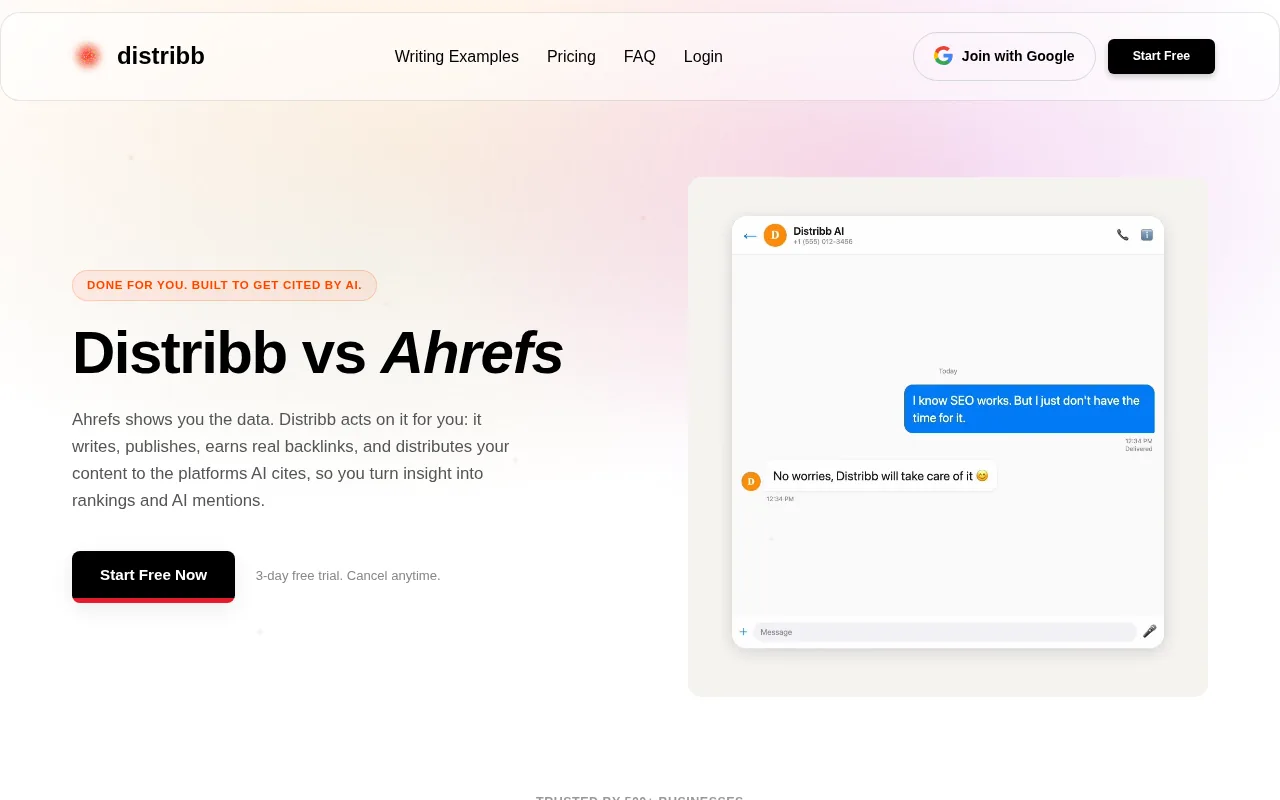
Its API covers project-level SEO work such as articles, keyword research, site performance data, and backlink data. The platform also connects the work around those datasets. It can support keyword planning, content creation, publishing, backlink building, and AI-search visibility inside one operating flow.
That distinction matters. Ahrefs gives teams access to a large SEO dataset and API endpoints, while Distribb.io focuses on moving a project from research toward published work. A marketing agency could use the system to research a topic, prepare an article, publish it through its content workflow, then review project and backlink signals later.
Distribb.io pricing is plan-based rather than priced per returned row. That makes budgeting easier for a team that runs many small tasks each month. You can review Distribb pricing before deciding whether the included usage fits your sites and workflow.
The tradeoff is clear. Distribb.io is an SEO automation platform API, not a raw index of the whole web like Ahrefs. It won't be the right choice if you're building a public data product that needs broad historical backlink records across millions of domains.
It is a better fit when the goal is to reduce the number of handoffs inside an SEO team. A founder may want the system to support content production. An agency may want a repeatable workflow across client sites. An e-commerce team may care more about publishing and ongoing project signals than about downloading every link found on the web.
For readers comparing the wider product question, the Distribb vs Ahrefs comparison covers the platform-level difference. This article stays narrower: what to use when API access and automation are the main concern.
Best for: Teams that want SEO work tied to their own projects, with API access included in a broader automation platform.
Weakness: It isn't a drop-in replacement for a full, public backlink and keyword index.
2. DataForSEO
DataForSEO is the closest thing to a drop-in replacement for teams that want raw SEO data at API scale. It sells SERP, keyword, backlink, on-page and domain analytics endpoints on a pure pay-as-you-go model, so you pay per task instead of per seat.
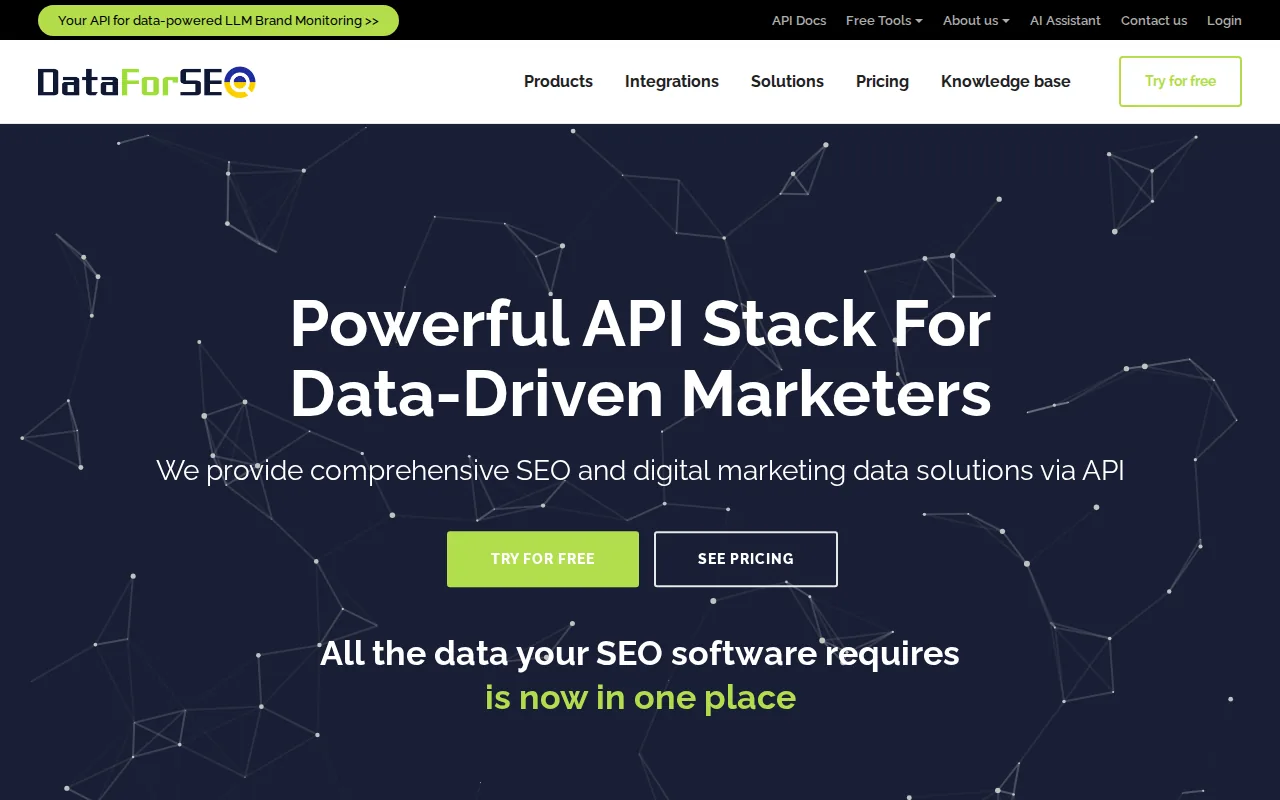
It suits developers building dashboards or data products, and anyone priced out of enterprise API contracts. The honest weakness is the integration work: most endpoints are asynchronous, so your code has to post a task, poll for the result, and handle retries and storage. Budget real engineering time for that.
Pricing is published per endpoint on their site, and you can start small without a contract.
3. Semrush API
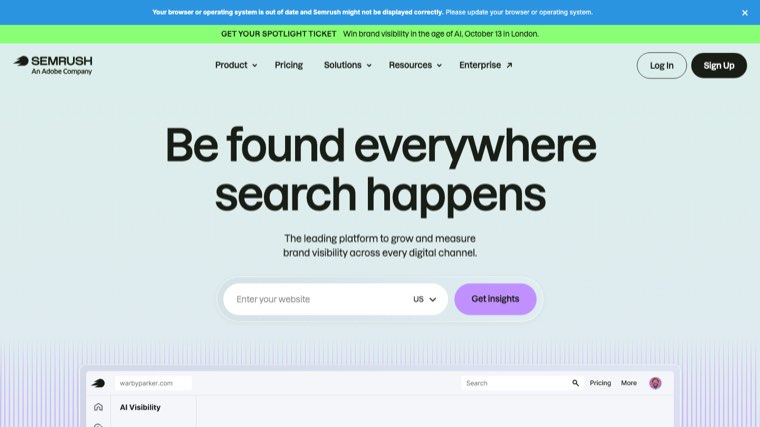
Semrush exposes its keyword, domain and backlink analytics through an API available on its Business tier. If your team already lives in Semrush, the API is the shortest path to pulling the same numbers into your own reporting.
The weakness is the gate: API access requires the Business plan plus API units, which makes it one of the most expensive routes on this list for standalone API use. It fits teams that already pay for Semrush seats, not teams shopping for a data API alone.
Semrush publishes its unit pricing in the API documentation.
4. Moz API
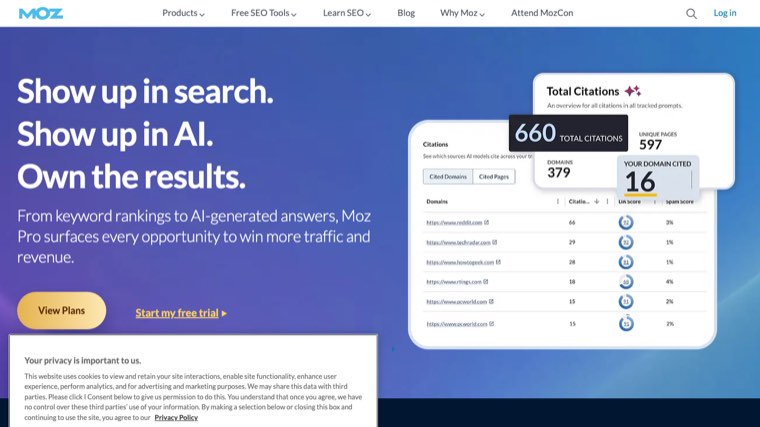
The Moz API serves link data and its Domain Authority metric programmatically, with keyword endpoints alongside. It has a free tier for light usage, which makes it the cheapest way to add authority metrics to an internal tool.
The honest limitation is index size: for backlink discovery, its index is smaller than Ahrefs, so treat it as a metrics API more than a discovery engine. If your workflow is built around DA scoring, it fits exactly.
5. Serpstat API

Serpstat bundles API access into its regular subscription plans, with keyword research, rank tracking and domain analysis endpoints capped by daily line limits per plan.
For budget-conscious teams it is one of the lowest total costs of entry, because the API rides along with the plan you may already want for the UI. The weakness mirrors the price: the index is smaller than Ahrefs or Semrush, so cross-check volumes on your most important keywords.
6. SerpApi
SerpApi does one job: real-time search engine results as structured JSON, with a free allowance of 100 searches a month to prototype against. If what you actually need from the Ahrefs API is rankings rather than backlinks, a SERP API plus your own storage is dramatically cheaper.
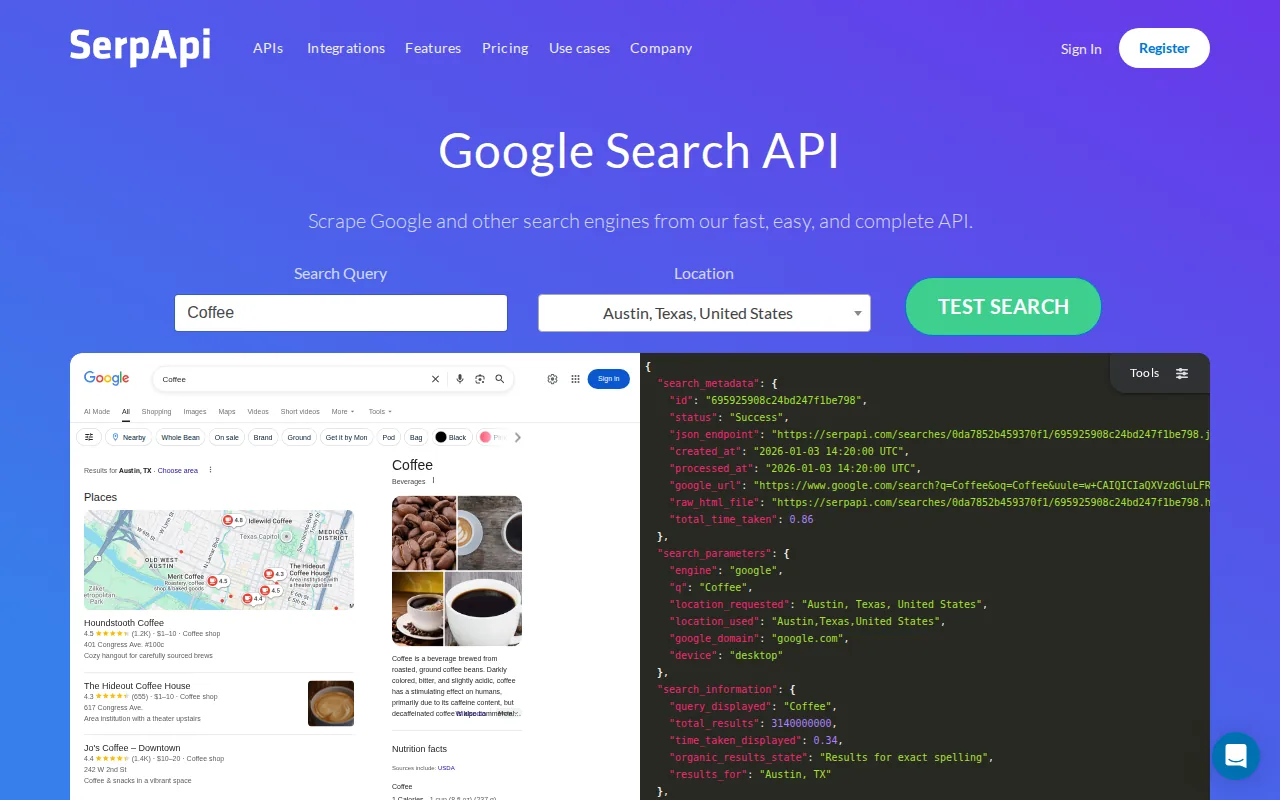
The limitation is scope. There is no backlink or keyword-difficulty index here, so it replaces the rank-tracking slice of Ahrefs, not the research core. Many teams pair it with DataForSEO or Moz for the rest.
7. SE Ranking API
SE Ranking puts six endpoints behind one key: keyword research, backlinks, domain research, website audit, AI search visibility and project management. API access is included in every plan rather than gated to an enterprise tier, and an MCP server ships alongside it, so the same data can be pulled into Claude or Cursor without writing a client first. The 14-day trial opens all six endpoints with 100,000 credits and no card, which is enough to price a real workflow before you commit to one.
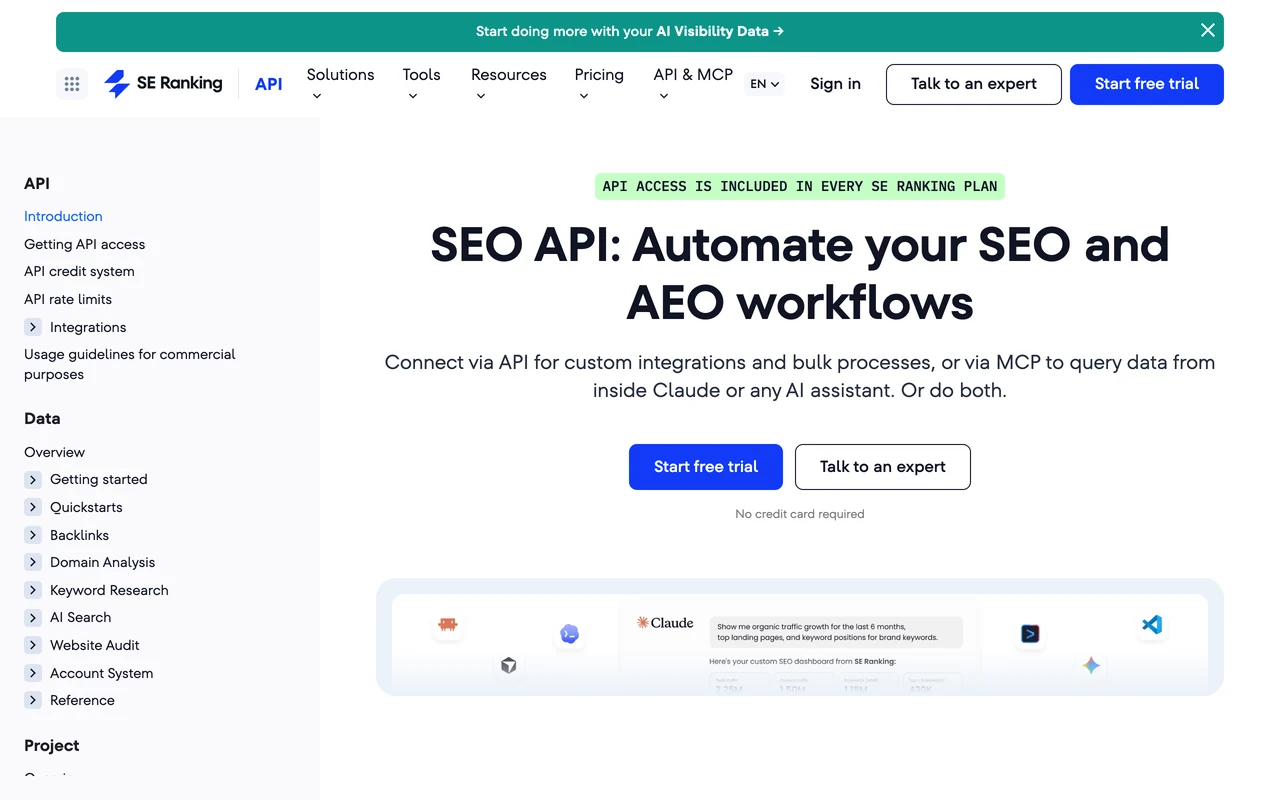
Billing runs on credits, and how you buy them is the part worth modelling. Top-ups bought outright never expire, while the discounted rates are annual commitments whose credits reset at the end of each cycle instead of rolling over. Cost per call also varies by endpoint, fixed for some and charged per record returned for others, so the honest comparison is one full month of your own calls rather than a headline rate.
How to choose between Ahrefs API alternatives
Start with the data your workflow truly needs. A backlink index, a rank tracker, a SERP endpoint, and site performance data solve different problems. The term “SEO API” can hide major gaps between providers. If volumes and difficulty are the only fields you need, our shortlist of the best keyword research APIs narrows the field faster.
- Data freshness: Ask when the data was collected and how often it changes.
- Index scope: Check whether the provider covers your markets, engines, devices, and languages.
- Returned rows: Model the bill using the fields and result depth you will actually request.
- Delivery method: Decide if async tasks and callbacks fit your stack better than live responses.
- History: Confirm who stores past rankings and how long the records remain available.
- Terms of use: Check rules for caching, resale, customer display, and automated collection.
- Human review: Add approval before AI output reaches a CMS or customer report.
Use a small test set before migrating. Pick a few domains, a fixed keyword group, and one reporting cycle. Compare response quality, missing fields, latency, retries, and the time needed to clean the output.
Also separate a tool switch from an API switch. If you want a different dashboard, read the Ahrefs alternative tools comparison. If you want to power your own software, focus on endpoints, limits, data rights, and maintenance.
If what you really want is a different UI tool rather than an API, start with our guide to the best Ahrefs alternatives. If you are comparing authority metrics across providers, Moz DA vs Ahrefs DR explains how the two scales map. And for automating the research side end to end, see our guide to keyword research automation.
FAQ
What is the best alternative to Ahrefs API?
The best alternative depends on the job. Distribb.io is the strongest fit for teams automating their own SEO projects, while a pay-as-you-go data API fits developers building custom products. A managed rank API makes more sense when saved ranking history matters more than backlink coverage.
What is the best Ahrefs API competitor for developers?
DataForSEO is a strong developer-focused option when you need raw SERP, keyword, backlink, crawl, or AI search data. Its usage model can fit variable demand, but your team must handle task scheduling, result storage, retries, and reporting. That engineering work should be part of the cost comparison.
Is there a free Ahrefs API?
There is no free Ahrefs API tier in the supplied comparison. Some alternative services mention trial credits or a small starting balance, but those terms can change. Treat them as a test budget, not as a permanent free plan, and confirm current limits before building around them.
Can an SEO API replace Ahrefs completely?
An SEO API can replace the part of Ahrefs you use, but rarely the whole system at once. A SERP API can replace rank lookups. A backlink API can support link analysis. A content automation platform can replace parts of the research-to-publishing workflow. You need to map each endpoint to a real task.
Is a pay-as-you-go SEO API cheaper than Ahrefs?
A pay-as-you-go SEO API can be cheaper when usage is light or uneven, but it isn't automatically cheaper at scale. Your bill depends on rows, fields, refresh rate, retries, and storage. Compare one complete monthly workflow rather than comparing only the vendor's headline request price.
Conclusion
Choose Distribb.io if your goal is to automate SEO work for your own sites, not build a competing web index. Start with one project, test the keyword and Search Console workflow, then review Distribb's backlink exchange if link acquisition belongs in the same process.