
Is Ahrefs more accurate than Moz? Neither wins outright, because the question has a false premise: Ahrefs Domain Rating (DR) is a 0 to 100 link metric that scores a domain on the number of unique referring domains weighted by their own DR, while Moz Domain Authority (DA) is a 0 to 100 machine-learning prediction of how likely a domain is to rank, trained against real Google results. They are built differently on purpose and disagree by design, so as of September 2026 the honest Moz vs Ahrefs answer is that DR describes a link profile and DA forecasts ranking ability, and Google uses neither.
The useful question is which one is right for the job in front of you. That has a clear answer, and it changes depending on the job.
What each metric actually calculates

Ahrefs Domain Rating (DR) is a link metric. It scores a domain from 0 to 100 based on the number of unique domains linking to it, weighted by the DR of those linking domains and divided across their outbound links. It is a description of a link profile. Nothing else feeds into it. No traffic, no content, no ranking data.
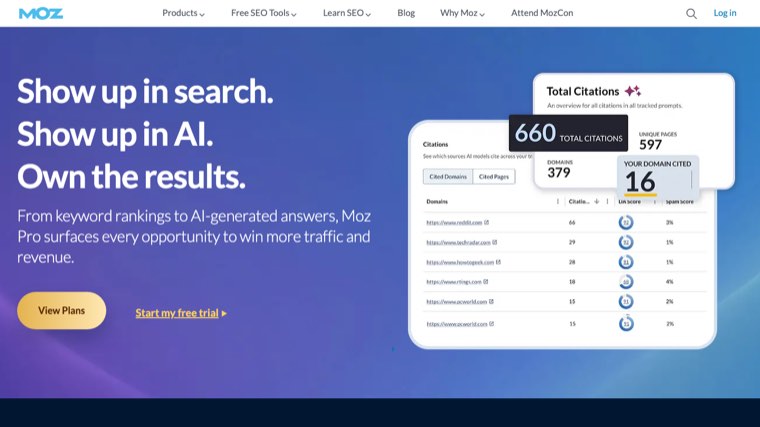
Moz Domain Authority (DA) is a prediction. It is a machine-learning model whose output is an estimate of how likely a domain is to rank, trained against real SERP results using Moz's Link Explorer index as input. Links are the raw material, but the number you see is a forecast, not a measurement.
That difference explains almost every argument people have about these two scores.
| Ahrefs DR | Moz DA | |
|---|---|---|
| What it is | Link profile strength | Predicted ranking ability |
| Scale | 0–100, logarithmic | 0–100, logarithmic |
| Inputs | Referring domains, weighted by their DR | Link Explorer data, fitted to SERP outcomes |
| Changes when | Your link profile changes | Your links change, or Moz retrains the model |
| Page-level twin | URL Rating (UR) | Page Authority (PA) |
| Used by Google | No | No |
That last row is worth sitting with. Neither number appears anywhere in Google's ranking systems. Both are third-party inventions, useful as relative yardsticks and meaningless as absolute truth.
Where they disagree, and why
Two sites with identical DR can have very different DA. It usually comes down to one of three things.
Index size and refresh rate. Ahrefs crawls more and refreshes faster. A site that earned fifty links last month will typically show a DR change before its DA moves. If you are watching a young site grow, DR reacts sooner. Tools that offer comparable link data at lower cost are compared in our roundup of Ahrefs alternatives.
Model retraining. Moz periodically retrains the DA model. When it does, scores shift across the whole web without anyone's links changing. This is the single most common source of "my DA dropped and I did nothing" panic. DR has no equivalent event.
What counts as a good link. DR weights the linking domain's own DR heavily. DA weights whatever the model has learned correlates with ranking, which includes signals DR ignores entirely.
So which is more accurate?
Depends entirely on the question you are asking.
For "how strong is this site's link profile?" Ahrefs DR is more accurate, because that is the only thing it measures. It is a direct description rather than an inference.
For "will this site outrank mine?" Moz DA is closer to the intent, because it is explicitly a ranking prediction. It will still be wrong often, since relevance and content quality carry more weight than any domain-level score, but it is at least aiming at the right target. For a comparison that sits on the publishing side of the same question, see Distribb vs Outrank.
For "should I buy a link from this site?" use DR, and then ignore both. Check the actual referring domains, the traffic, and whether the site publishes anything a human would read. A DR 70 site with no organic traffic is a link farm, and neither metric will tell you that on its own.
The one finding that actually changes your decision
Across the pages currently ranking for this query, one result repeats often enough to be worth acting on: DR tends to correlate better with rankings on commercial queries, DA on informational ones.
That fits how they are built. DR is a raw link-strength measure, and commercial SERPs are more link-driven. DA is fitted to observed ranking outcomes across a broad mix, which skews it toward informational results where content signals carry more weight.
Practically: if you are working on money pages, watch DR. If you are building a content library, DA is the better proxy. If you are doing both, watch DR for the link work and ignore the other number rather than averaging them.
Stability cuts both ways
I called Moz's retraining a downside above. That is only half true.
Because DA moves slowly and is periodically refitted, it is the more stable number for long-term comparison. If you are tracking a client's progress over two years, DA gives you a smoother line. DR reacts to every link, which is what you want during an active campaign and noise when you are reporting quarterly.
Fast and reactive is not automatically better. Match the metric to the reporting cycle.
Moz has one signal Ahrefs does not
Spam Score. Moz flags domains whose profile resembles sites it has seen penalised. It is a heuristic and it produces false positives, so do not treat a high score as proof of anything.
It is still useful as a first filter when you are vetting a list of potential link sources. Ahrefs has no direct equivalent, and if link vetting is a large part of your job that is a genuine reason to keep a Moz seat.
Page-level metrics matter more than most people think
Domain scores get the attention, but links point at pages.
Ahrefs URL Rating (UR) scores an individual page's link strength, internal links included. Moz Page Authority (PA) predicts how likely that page is to rank.
A DR 80 domain with a UR 3 page will not carry much. If you are evaluating a guest post placement, check the page-level number, not just the domain. This is the single most common vetting mistake.
Guidance by job
Pick one and stay with it. The worst outcome is switching between DR and DA depending on which makes a given report look better, because you lose the ability to compare anything over time.
If you already have Ahrefs, use DR and never think about DA again. If you are reporting to clients who have heard of DA, use DA and explain that it is a prediction. If you are choosing fresh, DR is the more honest number for link work, and Ahrefs' index is the larger one. If you need either metric inside your own scripts rather than a dashboard, we compare the alternatives to the Ahrefs API separately, since the billing works differently from seat pricing.
Do not chase either score as a goal. Both are outputs. The input is earning links from real sites in your niche, and if you do that, both numbers move.
If the reason you are weighing the two is that you are choosing between the products behind them, our product comparisons cover the individual matchups, including Distribb against Ahrefs.
Where Distribb fits
Distribb is not a replacement for Ahrefs or Moz, and it would be dishonest to pitch it as one. It has no backlink index and no DR-equivalent metric of its own. If you need to look up any domain's link profile, you need Ahrefs or Moz.
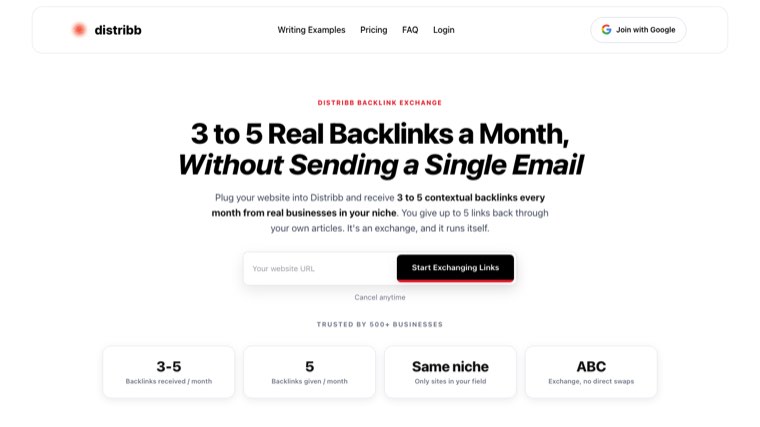
What Distribb does is the other half. Ahrefs and Moz tell you your DR or DA is 12 and that your competitors are at 40. Neither does anything about it. Distribb earns contextual backlinks from real businesses through its exchange network, and publishes SEO content on a schedule so those links point at pages worth ranking.
Teams generally end up running one of each: an analytics tool to measure, and an execution tool to move the number. Which analytics tool matters less than most comparison posts suggest.
Feature comparison
| Ahrefs | Moz Pro | Distribb | |
|---|---|---|---|
| Backlink index | Largest available | Smaller, slower refresh | None |
| Domain metric | DR | DA | None |
| Keyword research | Yes, strong | Yes | Yes, buyer-intent focused |
| Rank tracking | Yes | Yes | Search Console based |
| Site audit | Yes, 170+ checks | Yes | Yes |
| Writes content | No | No | Yes |
| Publishes to your CMS | No | No | Yes, 9 platforms |
| Earns backlinks | No | No | Yes, exchange network |
| Best for | Link research and competitive intel | Agencies reporting DA to clients | Getting content and links actually shipped |
FAQ
Is Ahrefs DR more accurate than Moz DA? For measuring link profile strength, yes, because that is all DR measures. For predicting whether a page will rank, DA is aimed at the right question but is still only a model. Neither is used by Google.
Why did my DA drop when I did not lose any links? Moz retrained the DA model. This happens periodically and shifts scores across the whole index. Check whether competitors in your space moved at the same time. If they did, it was the model, not you.
Why is my DR higher than my DA, or the other way round? Different inputs and different refresh cycles. A gap between them is normal and not a sign that either is broken.
Can I raise DR or DA directly? Only by earning links from other domains. Nothing on your own site changes either number. Internal links, content updates and technical fixes affect rankings but not these scores.
Do I need both Ahrefs and Moz? Almost never. The overlap is large and the cost is not. Pick the one whose interface you prefer and put the difference into actually building links.
Which should I report to clients? Whichever you can explain. DA is more widely recognised outside SEO circles. DR is easier to defend, because you can point at the referring domains that produced it.
Both of these tools will tell you where you stand. Neither will change it.
If your DR or DA is lower than you want, the fix is contextual links from real sites and content worth linking to. Distribb's backlink exchange connects your site with real businesses in adjacent niches and places contextual links in published articles, while the content engine keeps publishing pages for those links to point at. Seven-day free trial.
---