

White label link building pricing varies widely by placement and campaign. The gap comes from link quality, traffic rules, content, approvals, and the work behind each campaign. Here are six named options, plus the pricing models and margin math agency owners need before they buy.
1. Distribb.io (Our Top Pick)
Distribb.io is an AI-powered SEO platform that includes automated content, publishing, backlink building, and AI-search visibility. It fits agencies that want to sell a wider SEO service under their own brand instead of managing separate vendors for each task.
The pricing model is different from a normal link broker. Distribb.io uses a platform subscription with a backlink exchange. Websites join a network of real businesses, then receive contextual links through an ABC structure. That means two sites don't directly swap links with each other.
The effective cost per link can fall as an agency adds more client sites. A per-placement provider charges again for each new link. A platform spreads its cost across the work done for each account, which makes the math easier to manage when you have steady client volume.
Distribb.io's public white label offer lists a Pro plan at $97 per client site each month. The Accelerator plan is listed with per-client monthly pricing, with volume discounts available as the number of sites grows. Check the current Distribb pricing before quoting a client because plan terms can change.
The platform also covers more than backlink placement. Agencies can use one operating layer for keyword research, content production, publishing, and backlink work. That matters when a client asks why a link campaign produced no supporting content, or when your account manager needs one place to review delivery.
There is an honest limit. An exchange can't promise a specific DR-90 placement on demand in the same way a manual outreach vendor can quote a high-authority placement. It suits agencies that value repeatable output and lower operating effort over hand-picking every domain.
For agencies with several active SEO clients, Distribb.io is the strongest fit in this shortlist. It turns backlink work into part of a broader delivery system instead of leaving it as a line item bought one link at a time.
Start your Free Trial if you want to test a branded SEO delivery model before adding more client accounts.
2. OutreachZ, Transparent Packages for Flexible Agency Buying
OutreachZ uses fixed packages and managed per-link buying, so it fits agencies that need a visible rate card for clients with different budgets. Public packages start at $700 for five links, while managed links are listed at $60 for DA20+, $95 for DA30+, and $150 for DA40+.
The package scope is useful when you compare white label link building pricing. OutreachZ says its packages include strategy, prospecting, outreach, content creation, editing, publishing, and reporting. A cheaper vendor may quote only the placement, leaving your team to pay for content or spend staff time on approvals.
Its larger public packages list mixed authority levels. One package includes DA30+, DA40+, and DA50+ placements. Another raises the volume for agencies working in more competitive niches. That structure lets you match the buying cost to the client campaign instead of forcing every account into the same tier.
The stated delivery window is usually two to three weeks for the first links, with full package delivery often taking about four weeks. Publisher calendars and niche difficulty can change that pace. This is important when your client expects a link report on a fixed date.
OutreachZ also describes editorial outreach rather than open link selling. Link schemes made to manipulate ranking signals can create risk, so the process behind a placement deserves as much attention as the authority number.
The caveat is that public prices still don't answer every buying question. Ask how traffic is checked, how a client approves a site, what happens when a placement disappears, and whether content revisions cost extra. The starting price is clear, but your true cost depends on those terms.
Choose OutreachZ when you need package choice and a familiar agency fulfillment workflow. It is less suited to a team that wants all SEO tasks inside one automated platform.
3. FATJOE, Simple Per-Placement Pricing With Full White Labeling
FATJOE uses a productized per-placement model with pricing from $72 per placement. It also offers DR30+ placements, and the service states that its link building work is 100% white label.
This model is easy to explain to a client. If you need ten placements, you can start with the vendor cost, add your account management time, then set a retail price that covers support and profit. The rate card also makes it easier to test a new service without committing to a large monthly retainer.
FATJOE suits agencies that want hands-off ordering. You don't need to build a publisher list or hire an outreach manager before selling the service. That can help a small agency fulfill a link request while its main team stays focused on strategy and client communication.
Its wider service catalog also includes managed packages, with a listed Grow offer starting at $700. That gives an agency a second way to package delivery when a client wants a monthly plan rather than a set number of placements.
Per-placement buying has a clear weakness. Your cost rises with every link, even when the client needs a steady campaign for a year. You also need to check whether the quoted placement includes content, publisher vetting, revisions, and replacement terms.
Use FATJOE when a simple menu price matters more than a unified SEO system. It can work well for project work, smaller client accounts, or agencies that want to buy only when a sale closes.
4. Stan Ventures, Wholesale-Scale Pricing for High-Volume Agencies
Stan Ventures is built for agencies that buy at volume and want pre-approval before publication. Its public fee tiers start at $69 for 50 or more links, with lower service-fee tiers shown at higher volumes. DA30+ placements are part of the stated offer.
The pricing mechanics need close attention. Stan Ventures uses a brokerage-style model in which the publisher fee and service fee can be shown separately. Pricing varies with the publisher selected, so rates are available on request.
That split can help an agency explain its costs. If a client asks why one domain costs more than another, your team has a clear reason to discuss. The tradeoff is that a fixed retail price is harder to set before the target site is chosen.
Stan Ventures also states 100% pre-approval and client-ready unbranded reports. Those features matter for sensitive accounts. Your strategist can send a domain to the client, record the decision, and keep the vendor out of the client-facing exchange.
Volume is the main reason to consider it. A 50-link minimum may suit a reseller with many active accounts. It is a poor fit for an agency that sells one or two links each month and wants a low-entry test.
Before signing, ask whether the traffic floor applies to every placement or only selected tiers. A DA number alone doesn't tell you if readers visit the site. The better question is what quality rule remains in place when you order at scale.
Stan Ventures makes the most sense when your agency can use its wholesale structure. If you need a small test order, another option may create less waste.
5. The HOTH, Bulk-Friendly Pricing and White Label Reporting
The HOTH combines per-link products with broader reseller services. Manual Link Outreach starts at $175 per link for DR20+ sites, while higher tiers rise with the authority target. The company also lists managed products and says its reseller program includes wholesale pricing, bulk buyer bonuses, and white label reporting.
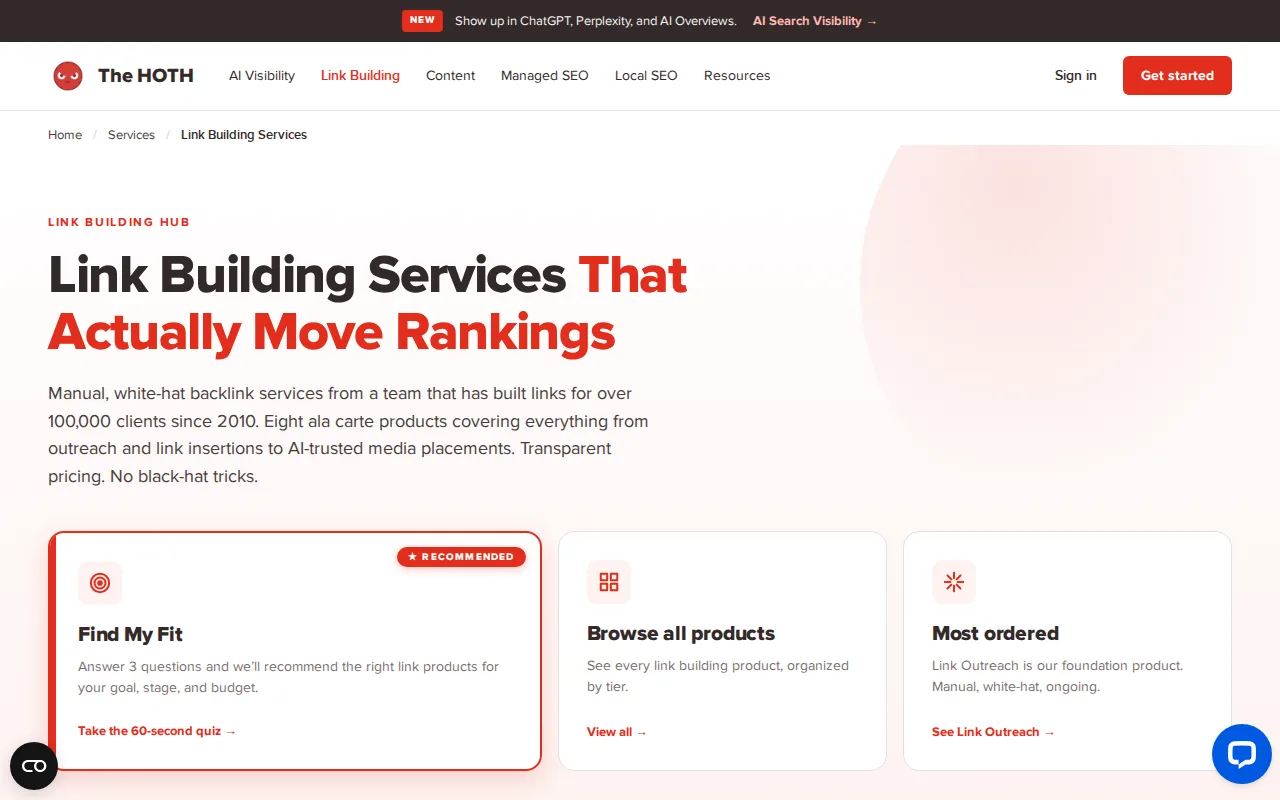
This option fits agencies that want more than one link product. A team can start with outreach, then use link insertions or premium editorial products when a campaign needs a different placement type. The HOTH lists eight a la carte products, so the buying decision is based on campaign role rather than one generic backlink package.
The reseller program is built around agency operations. Reports are described as unbranded, and the dashboard tracks orders and campaign progress. That can reduce the number of spreadsheets your account manager keeps open during a monthly client review.
The company states that most resellers see 40% to 60% margins. Treat that as a vendor claim, not a guarantee. Your margin will change after sales labor, strategy time, payment fees, revisions, client churn, and replacement work.
The HOTH says its manual outreach work does not use private blog networks or automated placements. That claim aligns with the need to avoid cheap inventory that has no clear editorial reason for existing. A clear quality baseline matters when a vendor promises fast volume at a very low price.
The main limitation is breadth. A smaller agency may find the catalog harder to price than a single per-link service. A highly specialized campaign may also need more direct control over the exact publisher shortlist.
Pick The HOTH when you want a broad reseller operation with reporting and volume incentives. It is a better match for a team that expects to sell several SEO deliverables under one brand.
6. SEO Discovery, Low-Entry Monthly Pricing for Cost-Conscious Campaigns
SEO Discovery lists a low-entry monthly package of $300 for ten guest posts with DA40+ placements. The offer also states white label reporting and a ten-day turnaround, which makes it attractive to agencies competing on price.
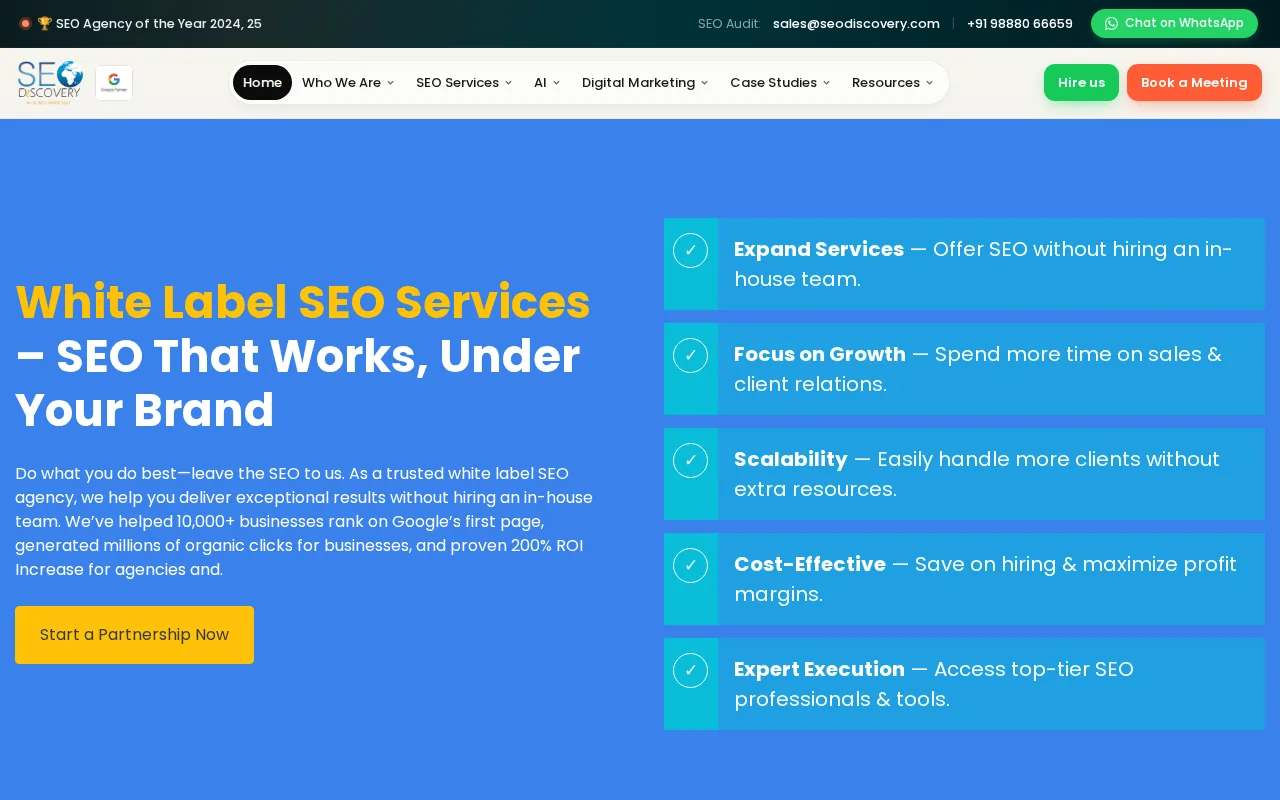
The simple math is appealing. At the listed starting rate, the package works out to $30 per guest post before you account for your own account work. Per-link rates for manual outreach campaigns vary by vendor and campaign.
But a low unit price needs more questions, not fewer. Ask how the sites are checked for organic traffic, whether the posts are written for the niche, and what happens when a page is removed. You should also confirm if all ten placements meet the stated authority level.
A ten-day turnaround can help when your client wants visible movement before a report date. It can also be a warning if the vendor promises instant delivery without showing how publisher review works. Good placements depend on site availability and editorial decisions, so speed should have a clear process behind it.
SEO Discovery is best for a cost-conscious agency that needs a defined monthly package. It is less suitable for a client that requires detailed domain approval, strong traffic floors, or a bespoke outreach plan for every target page.
The price may improve your sales margin, but only if the links hold up under review. A cheap report that creates a client complaint is expensive in staff time and trust.
White Label Link Building Pricing Comparison
The table below compares the buying model rather than pretending every link is equal. Public data is incomplete across the market. In the research set, only 13 of 19 providers listed a starting price, and just three listed a monthly link volume. For a vendor-by-vendor view of who each provider suits, read our roundup of the best white label link building services.
| Option | Buying model | Published starting point | Best fit | Main pricing risk |
|---|---|---|---|---|
| Distribb.io | Platform subscription | $97 per client site monthly | Agencies scaling automated SEO delivery | Specific high-DR placements aren't promised on demand |
| OutreachZ | Package or per link | $700 for five links | Flexible campaign buying | Final cost changes by authority and scope |
| FATJOE | Per placement | From $72 | Simple fulfillment orders | Cost rises with every added link |
| Stan Ventures | Wholesale fee plus publisher cost | From $69 service fee at 50+ links | High-volume agency buying | Final unit price varies by publisher |
| The HOTH | A la carte or managed | From $175 for DR20+ outreach | Broad reseller catalogs | Several products make quoting harder |
| SEO Discovery | Monthly package | $300 for ten guest posts | Price-sensitive campaigns | Low price needs deeper quality checks |
Typical market pricing falls into three broad groups. Per-link buying varies substantially when authority, traffic, niche difficulty, and content requirements rise. Monthly retainers commonly sit around $1,000 to $5,000 for a set link pace. Platform subscriptions use a different measure because links may be included rather than metered.
Google's spam guidance also matters when comparing a $50 placement with a $400 placement. The number alone doesn't prove quality, but a vendor should explain the site's relevance, traffic checks, editorial process, and replacement policy.
What drives the price of a white-label link?
Domain Rating or Domain Authority is only one input. Organic traffic minimums tend to raise the cost because they remove sites built mainly to sell placements. A difficult niche can also cost more because fewer publishers want to cover the topic.
Content is another major variable. Some vendors include research, writing, editing, and publishing. Others quote only the placement. If your team spends two hours fixing every article, the low vendor price may not be low after all.
A worked margin example for agencies
Imagine an agency buys a placement for $150. It sells a client package at $300 per placement. The gross spread is $150, or 50% of the client price before account labor, tax, payment fees, and replacement work.
If the agency wants a 40% gross margin on the retail price, it must charge at least $250 for a $150 cost. That leaves $100 before overhead. A 2x markup is easy to state, but margin and markup are different numbers.
- Vendor cost:$150
- Client price:$300
- Gross profit:$150
- Gross margin:50%
For a monthly package, include account management time in the same calculation. If a $1,000 vendor retainer takes six hours of strategy and reporting, add the value of those hours before you decide the retail price. Agencies often lose money by pricing only the vendor invoice. The same math applies to every service you resell, and our guide to SEO reseller programs works through the wholesale and retail sides together.
Red flags in cheap link pricing
A low price is not automatically bad. It becomes risky when the vendor refuses to explain what you are buying. Watch for these signs:
- No minimum for organic traffic.
- Sites that accept every niche without review.
- Private blog network or link-farm inventory.
- Instant delivery for placements that should need editorial approval.
- No replacement term when a link disappears.
- Reports that show only DA or DR without the live URL and page context.
- Content that is spun, generic, or unrelated to the target page.
Cheap links can also create a client handoff problem. If your strategist can't explain why a publisher was chosen, the client may question the whole campaign. Price should reduce waste, not remove accountability.
Buyer checklist before you sign
Ask every provider the same questions. A written answer is more useful than a sales call promise.
- What authority range does the price cover?
- Is there a minimum organic traffic level?
- Does the fee include content and revisions?
- Can my team approve domains before publication?
- Are reports fully unbranded?
- What happens if a link is removed or changed to nofollow?
- Is there a minimum order or long contract?
- Can the vendor avoid contacting my client directly?
- Which links are included in the monthly fee?
- What work remains with my agency?
These questions help you compare effective cost instead of headline cost. They also show where a platform subscription may beat a per-link vendor for an agency with many client sites. If links are only one part of what you sell under your own brand, ask the same questions of the private label SEO services on your shortlist.
FAQ
How much does white label link building cost?
White label link building pricing varies by provider and campaign, or roughly $1,000 to $5,000 monthly for ongoing campaigns. The final price depends on authority, organic traffic, niche difficulty, content, approvals, and replacement terms. Platform subscriptions use a different model because backlinks may be included with the account rather than charged one at a time.
What is the best SEO reseller pricing model?
The best SEO reseller pricing model depends on client volume. Per-link pricing works for small or irregular campaigns. A retainer works when clients need a steady monthly pace. A platform subscription can suit agencies with several sites because the effective cost per link may fall as usage grows.
How much do agencies pay for links?
Agencies may pay varying rates depending on placement quality and editorial strength. Public examples in this market include $72 placements, $150 DA40+ managed links, and $175 DR20+ outreach links. Compare the site's traffic and relevance before treating the unit price as a bargain.
What margin should an agency add to link building?
Many agencies aim for a 30% to 60% gross margin on resold link building, but the right figure depends on account labor and risk. A $150 vendor cost sold at $300 creates a 50% gross margin before overhead. Add strategy time, reporting, payment fees, revisions, and replacement work before setting your retail rate.
Is white label link building safe?
White label link building is safer when the provider uses relevant sites, manual outreach, clear quality checks, and transparent reports. No provider can remove every SEO risk. Avoid PBNs, link farms, instant placements, and vendors that refuse to show the live page or explain why the domain fits the client's niche.
Conclusion
For agencies that need repeatable delivery across several client sites, Distribb.io is the strongest starting point because its platform combines SEO automation with a real-business backlink exchange. If you need a specific authority tier on demand, compare a manual outreach provider as well. Review your client count, calculate labor beside vendor cost, then test the white label workflow before making a larger commitment.