

Physical therapist marketing used to mean keeping the orthopedic surgeons down the road happy. Referrals still matter, but the ground has moved. As of 2025 every US state allows patients to see a PT without a referral in some form, patients check reviews and ask ChatGPT before they call, and most clinics lose more revenue to patients who stop coming than they ever lose to competitors.
This guide covers the channels that bring PT patients in, in the order most clinics should work on them: where patients come from, referrals, direct access, local search, content, retention, paid ads and measurement. Each section is written for a clinic owner who treats patients all day and has little time left for marketing.
We read the 6 top-ranking guides for physical therapist marketing today, from WebPT, Sprypt, Coremedicalgroup, EmpowerEMR, E-rehab and Seconddoor, and checked each for four specific topics. Only 1 of the 6 mentioned AI answer tools such as ChatGPT for local provider search, and none of the 6 addressed HIPAA guidance on ad tracking pixels for booking pages. Direct access appeared in 3 of the 6, and patient reactivation in 5 of the 6, but no single guide covered all four. Clinics reading only one of those pages are missing at least half of what shapes 2026 patient acquisition.
Where PT patients come from in 2026
A typical outpatient clinic gets new patients from five places. The mix differs a lot between an insurance-heavy clinic next to a hospital and a cash-pay sports clinic, so start by pulling the referral source field from your EHR for the last six months.
- Physician and provider referrals. Orthopedists, primary care, chiropractors, OB-GYNs and podiatrists. Still the biggest source for most insurance-based clinics.
- Direct access patients. People who search for help with back pain or a running injury and book without seeing a doctor first.
- Past patients and their families. Returning with a new problem, or sending a spouse or a teammate.
- Community partners. Gyms, running clubs, school athletic programs, employers and senior living communities.
- Search and AI answers. Google's map pack, your website, and now AI tools. BrightLocal's 2026 Local Consumer Review Survey found 45% of consumers use ChatGPT or similar tools for local recommendations, up from 6% the year before.
If one source provides more than half of your new patients, that is your biggest risk. A single referring surgeon who retires or joins a hospital system with in-house therapy can cut a clinic's intake overnight.
Build a one-page marketing plan
You don't need a 40-page plan. You need answers to four questions on one page:
- Which two or three service lines do you want more of? Post-surgical rehab, sports injuries, pelvic health, vestibular, dry needling, workers' comp. Pick the ones with capacity and good margins.
- Who is the patient, and who decides? A 68-year-old after a knee replacement arrives through the surgeon. A 34-year-old runner with a sore Achilles books directly. They need different channels.
- What is the goal in completed evaluations? "Twelve more new evaluations a month for pelvic health" is a goal you can track. "More awareness" is not.
- What can you spend in time and money? Be honest. Two hours a week and $500 a month rules out some channels and makes others the obvious choice.
Then pick channels with this table:
| Channel | Best for | Time to results | Main cost |
|---|---|---|---|
| Physician referrals | Post-surgical, insurance-based care | 2-6 months per relationship | Owner or clinician time |
| Google Business Profile and reviews | Every clinic | Weeks | Setup plus a steady review habit |
| Website and SEO content | Direct access and cash-pay services | 3-6 months | Writing and publishing time |
| Retention and reactivation | Every clinic, fastest return | Immediate | Front desk process |
| Community partnerships | Sports, pediatrics, older adults | 1-3 months | Events and relationships |
| Google Ads | Cash-pay services, new locations | Days | Ad spend |
Grow physician and community referrals
Referral marketing works when a busy provider trusts that their patient will be looked after and that they'll hear back. Most clinics lose referrals on the second part.
Choose referral partners on purpose
List the 20 providers within a reasonable drive whose patients match your strongest services. A sports clinic should look at orthopedic and sports medicine practices and podiatrists. A pelvic health program should look at OB-GYNs, urologists and midwives. Note who refers to you now, who used to, and who never has.
Make communication your marketing
Send a short, readable progress report after the evaluation, at key milestones and at discharge. For Medicare patients this is also a compliance step: APTA explains that since January 2025, a signed referral can satisfy plan of care certification as long as the plan of care is sent to the referring provider within 30 days of the initial evaluation. Clinics that send clean, fast reports get remembered when the next patient needs therapy.
Visit, teach and follow up
- Offer a 20-minute lunch session for a practice's medical assistants on a topic that saves them time, such as which back pain patients to send straight to PT.
- Give each partner office a simple referral pad or fax cover with your services, locations, insurance accepted and how fast you can see new patients.
- Track referrals by provider every month. If a regular referrer goes quiet, call and ask why.
Community referrals
High school athletic trainers, CrossFit and running club owners, youth sports leagues, and HR teams at local employers all see people with musculoskeletal problems before a doctor does. Free injury screens at a club, a talk at a senior center on fall prevention, or a pre-season screening day for a school team build the kind of trust that turns into direct bookings.
Market direct access to patients
Direct access is the biggest change in PT marketing in a generation. According to the American Physical Therapy Association's State of Direct Access report (June 2025), patients in all 50 states, the District of Columbia and the US Virgin Islands can now see a physical therapist for evaluation and treatment without a physician referral, though many states still attach conditions such as time or visit limits.
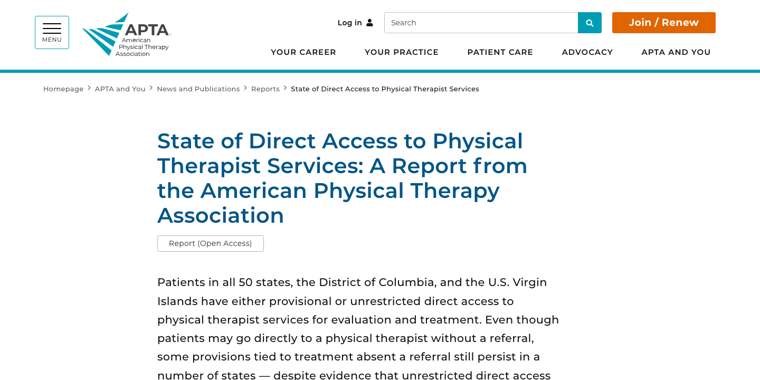
Most patients still don't know this. Many assume they need a doctor's note first and wait weeks for an appointment they didn't need. That creates a clear marketing message for your clinic.
- Check your state's rules and your main payers' rules. A state can allow direct access while an insurer still requires a referral for payment. Know both before you advertise.
- Add a "No referral needed" page that explains, in plain language, who can book directly, what your state allows, and what happens with insurance.
- Say it everywhere patients look. On your homepage, your Google Business Profile description, booking pages and intake forms.
- Train the front desk. A caller who asks "do I need a referral?" should hear a confident answer, not "let me check".
- Offer a short screen. A free 15-minute injury screen is a low-commitment first step for someone unsure whether PT is right for them.
Get found in local search and AI answers
When a direct access patient searches "physical therapy near me" or "PT for sciatica [town]", the map pack and the first few results decide who gets the call. The essentials:
- Google Business Profile. "Physical therapist" as the primary category, secondary categories only where accurate, every service listed, correct hours, real photos of the gym floor and treatment rooms, and one profile per location.
- Reviews. BrightLocal found 47% of consumers won't use a business with fewer than 20 reviews. Add your review link to the text your EHR sends after each visit. Our guide on how to get more patient reviews has the scripts and the HIPAA-safe reply templates.
- Condition and service pages. One page each for the problems you treat most (low back pain, ACL rehab, rotator cuff, vertigo, pelvic floor) saying who it helps, what a visit involves, and how to book.
- Consistent listings. Same name, address and phone on Google, Apple Maps, Healthgrades, your EHR's directory and insurer directories.
AI tools pull from the same signals: a clear website, consistent listings, reviews and mentions on other sites. For the full technical and content side, including a 90-day plan, see our guide to SEO for physical therapists.
Content, video and social that bring in patients
PT is one of the easiest specialties to market with content, because patients search for their symptoms long before they search for a clinic.
Answer the questions patients ask
Ask each therapist for the five questions they hear most at evaluations. "Should I rest or keep running on a sore knee?", "How long does PT take after a knee replacement?", "Is PT or a chiropractor better for back pain?". Each is an article that can bring in a local patient, and each should link to the matching service page.
Short video
A therapist explaining one exercise in 60 seconds, a walk-through of what happens at the first visit, or a clinic tour builds trust faster than text. Film on a phone in the clinic. Get written consent before any patient appears on camera, and never share anything about their condition.
Social media and email
Social works best for community clinics with a local following: sports teams you support, a new therapist, a patient milestone shared with consent. A monthly email to past patients with one useful tip and one clinic update keeps you in mind for the next injury, and costs almost nothing.
Retention and reactivation
Marketing brings patients to the first visit. Retention decides whether that marketing pays. WebPT's guide to patient retention cites Strive Labs data showing only 30% of outpatient PT patients attend all the visits their insurer authorizes, and a Strive Labs case where lifting retention from 85% to 88% across a 14-site clinic added $150,000 in revenue.
That is why most clinics should fix retention before spending more on getting new patients:
- Book the plan of care at the evaluation. Schedule the next several visits before the patient leaves, not one at a time.
- Explain the plan in the patient's terms. "Six weeks to get you back to playing with your grandkids" keeps people coming more than "strengthening and ROM".
- Watch visit three. Early drop-off is common once the first relief arrives. A therapist check-in at visit three about progress toward the patient's goal catches it.
- Follow up on every cancellation the same day, with an offer to rebook.
- Offer a next step at discharge, such as a maintenance or wellness program, or a check-in call at 30 days.
- Reactivate past patients. Once or twice a year, contact discharged patients who haven't been back in 12 months. People re-injure themselves and would rather return to a clinic they know.
Paid ads for PT clinics
Google Ads makes the most sense for cash-pay services (dry needling, sports performance, pelvic health, concussion programs) and for a new location that needs patients before its organic presence builds up. Keep campaigns tight: a small radius around each clinic, keywords with clear intent such as "physical therapy near me" or "dry needling [town]", and a landing page for each service rather than your homepage.
Be careful with tracking. HHS guidance on online tracking technologies has warned healthcare providers about sharing patient information with ad platforms through pixels on booking and patient portal pages. A federal court narrowed that guidance in 2024 for public pages, but pixels on pages where patients log in or book remain a risk. Ask your website and booking vendors how tracking is configured before running ads.
Judge every campaign on completed evaluations, not clicks or form fills. A campaign that reports 40 conversions and produces six evaluations costs far more per patient than it appears.
Measure from first contact to completed care
Track a patient's path in stages, and define each one so the numbers mean the same thing every month:
- Source (referral provider, Google, AI answer, past patient, event, ad)
- Inquiry (call, form, online booking request)
- Scheduled evaluation
- Completed evaluation
- Visits completed against the plan of care
The monthly numbers that matter most are new evaluations by source, the share of inquiries that book, arrival rate for first visits, average visits per episode of care, cancellation and no-show rate, and cost per completed evaluation for any paid channel. Make "How did you hear about us?" a required field at intake with a short fixed list, and spot-check it monthly against what patients say.
Running the search side on autopilot
Referral visits, front desk training and retention need people in the clinic. The search side doesn't, yet it is the part most clinics let slide: condition pages, articles that answer patient questions, fresh Google Business posts, links from other sites and a presence in AI answers all need attention every month.
Distribb runs that part on autopilot. Connect your clinic website and it does the keyword research for the conditions and services you treat, writes and publishes pages and articles, builds backlinks from real businesses, and tracks whether ChatGPT, Perplexity and Google's AI answers mention your clinic. With your Google Business Profile connected it also turns new articles into Google posts and drafts replies to new reviews. You can read pages before they publish if you want to, but nothing waits on you. Pro is $97 a month. Accelerator is $495 a month and adds a human editor who checks every piece before it goes live. You can see what Distribb runs for healthcare practices.
That leaves your team's marketing hours for the referral lunches, the community screens and the visit-three check-ins that only a therapist can do.
FAQ
What is the best marketing strategy for a physical therapy clinic?
Start with retention, because keeping the patients you already have is the fastest return. Then make sure your Google Business Profile, reviews and condition pages are strong enough to catch direct access patients, and build a short list of referral partners you communicate with well. Add paid ads last, for specific cash-pay services.
How do physical therapists get more patients without referrals?
Use direct access. Every US state now allows patients to see a PT without a referral in some form, so explain that clearly on your website and Google profile, rank for the conditions you treat, collect reviews steadily, and offer free injury screens through gyms, running clubs and employers.
How much should a PT clinic spend on marketing?
There is no fixed rule, but set the budget from your goal rather than a percentage. Work out what a completed episode of care is worth to you, decide how many more you need a month, and fund the channels that can deliver them. Many small clinics get more from time spent on referrals and retention than from ad spend.
Should physical therapists use social media?
Yes, as a support channel. Short exercise videos, clinic updates and community involvement build trust with people who already know you. Social rarely replaces local search or referrals as a source of new evaluations, so track it by inquiries rather than views.
How long does physical therapist marketing take to work?
Retention changes and a better Google Business Profile can show results within weeks. Google Ads bring calls within days. Referral relationships take two to six months each, and SEO content usually takes three to six months to bring in steady patients, but it keeps working without ongoing ad spend.
Conclusion
Good physical therapist marketing is mostly consistency. Pull your referral sources, fix the drop-off after visit three, tell patients they can book without a referral, and keep your profile, reviews and condition pages current. Then measure completed evaluations by source every month and put your next hour into whichever channel is producing patients.