
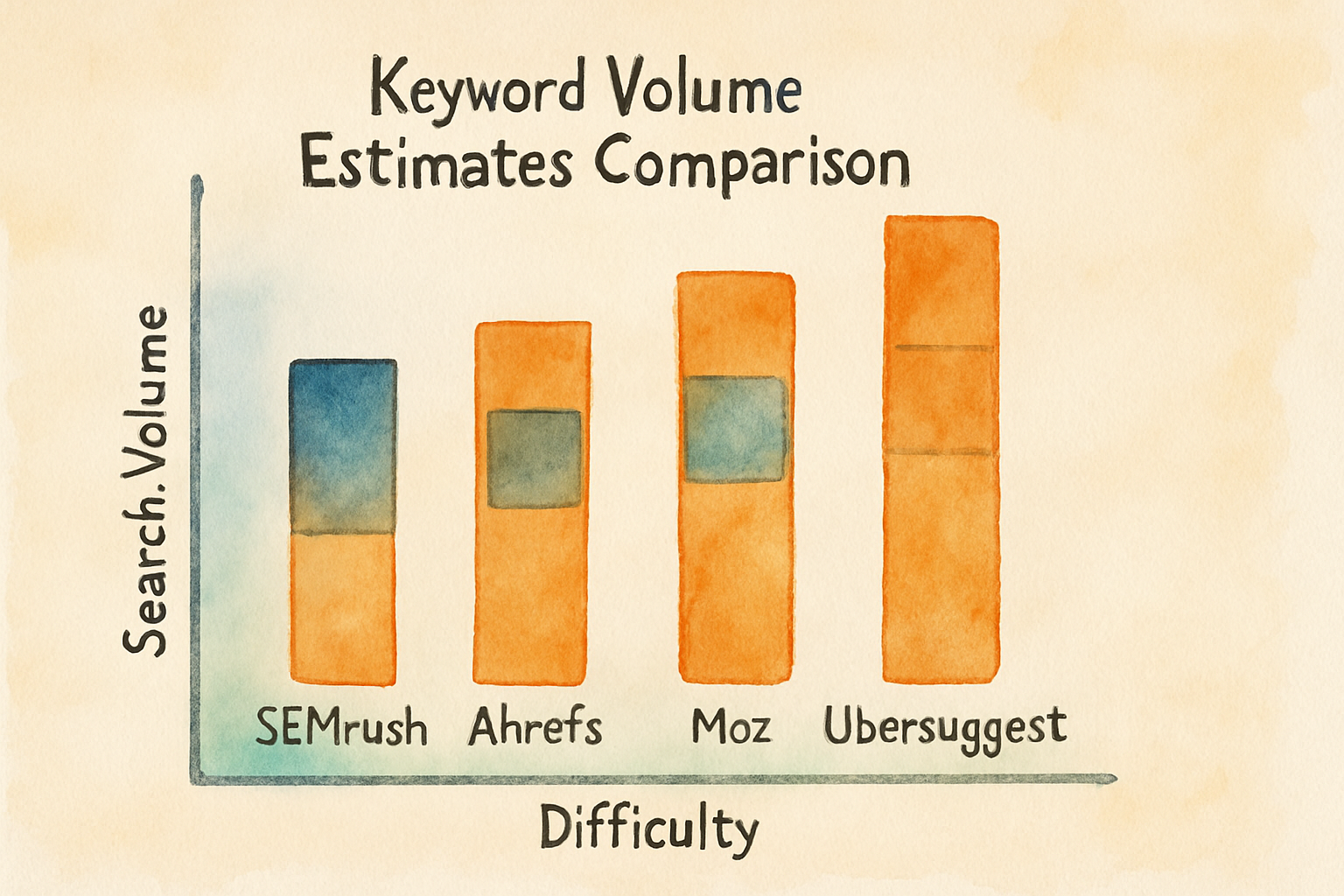
"Is Semrush accurate" is the wrong question, because Semrush reports about eight different kinds of number and their reliability is not remotely the same.
Some are close to fact, some are modelled estimates, and some are proprietary scores that do not exist outside the tool. This goes through them one at a time and finishes with how to sanity check the ones that matter.
The short answer
Accurate enough to make decisions with, if you know which number you are looking at.
Position data and SERP features are close to reality. Keyword volumes are useful for comparing terms and unreliable as absolute numbers. Traffic estimates are models, and Semrush says so. Difficulty and Authority scores are Semrush's own inventions and mean nothing to Google.
The mistake that costs people money is treating an estimate as a measurement, usually a traffic estimate in a pitch deck.
Where the numbers come from

Semrush builds its traffic data from a clickstream panel, which by their own description covers more than 200 million anonymised users across 190 plus countries, sourced through a set of data providers. Machine learning is then used to strip anomalies out of that sample, and the result is cross-checked against their backlink and SERP position databases.
This matters because it tells you where the error comes in. A panel is a sample, so accuracy scales with how much of your audience the panel happens to contain, which is why big sites in big markets are estimated well and small sites in small markets are not.
Semrush is fairly open about this. Traffic Analytics shows an "Estimated Accuracy" indicator that varies with domain size, sample size and the filters you apply, and their own documentation positions the toolkit as a complement to analytics rather than a replacement.
Keyword search volume
This is the number people trust most and should trust conditionally. It is a monthly average, usually over the preceding twelve months, drawn from Google's own data and modelled on top.
What that means in practice: seasonal terms look wrong all year, since a term that gets 12,000 searches in December and nothing else shows as 1,000 a month. Newly popular terms lag. Very low volume terms get rounded into meaninglessness.
Use volumes to compare terms against each other, which they are good for, and not to forecast traffic, which they are not. A term at 2,400 is genuinely bigger than one at 300; whether it delivers 2,400 anything is a separate question.
Keyword Difficulty and Authority Score
Both are Semrush's own metrics. Google does not use them, does not know about them, and no other tool computes them the same way, so a KD of 46 in Semrush is not a KD of 46 in Ahrefs.
They are still useful, as long as you use them the way they work: as a relative sort within one tool. Filtering a list of 500 keywords by difficulty to find the reachable ones is a good use. Reporting "we target keywords under KD 30" as a strategy is a number pretending to be a plan.
Authority Score has the same property. It is a reasonable proxy for how strong a domain looks, and it is not PageRank, not a Google metric, and not something to buy links against.
Traffic Analytics for competitors
This is the most modelled number in the product and the one most often quoted as fact.
For a large, well-known site in a major market it will usually land in the right order of magnitude and often much closer. For a small B2B site with 4,000 visits a month, it can be out by a large multiple in either direction, because the panel simply contains too few of that site's visitors.
The honest way to use it: for relative comparison and trend direction between competitors, never as an absolute figure in a client report. If you must quote it, quote it as an estimate and say which tool produced it.
Backlink data
Semrush's backlink index is large, updated frequently, and different from Ahrefs' index, which is also large and updated frequently. Neither is wrong. They crawl different parts of the web at different times.
Expect disagreement of tens of percent on referring domain counts for the same site. If one tool says 340 referring domains and another says 290, both are plausible and the gap tells you nothing about which to trust.
For link building, the useful data is not the total. It is which specific domains link to a competitor and not to you, and that list is reliable in both tools.
Position tracking

This is the most accurate part of Semrush, with an important caveat: it measures a searcher who does not exist. Position tracking checks from a specified location with no personalisation and no search history.
Your real average position, across every device, location and logged-in user who saw you, comes from Search Console and nowhere else. The two will disagree, and both are correct about different things.
Use tracking to see movement on specific terms and Search Console to see what actually happened to your traffic.
Where Semrush is least accurate
- Small sites, where the clickstream sample is thin, which is most B2B and local businesses.
- Non-English and smaller markets, for the same reason.
- Very new pages and terms, since indexes and volume averages both lag by weeks.
- Branded and direct traffic, which panels model poorly.
- Anything behind a login, which is invisible to clickstream by definition.
If your site is in more than two of those categories, treat every estimate as a rough signal and lean harder on your own data.
How to sanity check it
Cross-check against Search Console for anything about your own site. It is free, it is measurement rather than modelling, and it settles most disagreements immediately.
Cross-check against a second tool for anything about a competitor. Where two independent estimates agree, you can act; where they diverge widely, the answer is that nobody knows.
Watch the trend rather than the level. Estimates carry consistent bias, so the direction and the relative change are far more reliable than the absolute number.
Never build a business case on a single estimated figure. If a decision turns on whether a competitor gets 40,000 or 90,000 visits, you need a different kind of evidence.
When to trust which number
| Metric | Trust level | Use it for |
|---|---|---|
| Position tracking | High | Movement on specific terms |
| SERP features and competitors ranking | High | What the SERP actually looks like |
| Keyword volume | Medium | Comparing terms, not forecasting |
| Backlink domain list | Medium to high | Finding link prospects |
| Backlink totals | Low to medium | Rough scale only |
| Traffic Analytics | Low to medium | Relative comparison and trends |
| Keyword Difficulty | Relative only | Sorting a keyword list |
| Authority Score | Relative only | Rough vendor screening |
Where Distribb fits
We built our platform on Search Console rather than on third party estimates, because for your own site the measured data is free and the modelled data is not better. Distribb reads your Search Console, finds the pages already earning impressions without clicks, and writes and publishes the updates for them.
The honest limitation: that only works for your own site. For competitor research, market sizing and backlink prospecting, you need a tool with an index of the whole web, and Semrush or Ahrefs is the right purchase. We do not replace either of them, and most of our customers keep one.
If the subscription cost is the issue rather than the accuracy, our roundup of cheap Semrush alternatives covers the options, and our comparison of Semrush and Google Analytics covers the measured versus modelled distinction in more depth. For the wider category, see our guide to automated SEO software.
How we assessed this
The description of Semrush's data sources comes from Semrush's own published documentation, checked in August 2026, rather than from third party claims about their methodology.
The rest is from using the tool alongside Search Console on our own sites and customer sites, where the two can be compared directly. We have deliberately not published accuracy percentages, because any single number would be true for one site and misleading for the next.
Frequently asked questions
Is Semrush more accurate than Ahrefs? Neither is consistently more accurate. They differ most on backlinks and traffic estimates, and both are estimating the same unknowable thing from different samples.
Why does Semrush traffic not match my Google Analytics? Because Analytics measures your site and Semrush models it from a panel. Analytics is right about you; Semrush is useful for competitors you cannot measure.
Is Keyword Difficulty reliable? As a sort order within Semrush, yes. As an absolute measure of how hard something is, no, and it is not comparable to another tool's difficulty score.
Should I pay for Semrush at all? If you need competitor and market data, yes, and there is no free substitute. If you only need to improve your own site, Search Console covers more than most people realise.
How often does the data update? Position and SERP data refresh frequently, backlink indexes continuously, and volume averages far more slowly, which is why a new trend takes weeks to show up.
Next step
Decide which question you are answering before you look at a number. For your own site, start in Search Console; for competitors, use Semrush and treat the figures as estimates with a direction rather than facts with a decimal point.
If the goal is acting on your own data rather than collecting more of it, Distribb turns Search Console impressions into published updates on a schedule.