

Searching for an ecommerce SEO consultant usually means one of two things. Either organic traffic has flattened and nobody in the business knows why, or the store is growing and the SEO work has outgrown whoever was squeezing it in between other jobs.
The awkward part is that "consultant" covers very different offers. Some are independent specialists who will audit your store and hand you a prioritised plan. Some are boutique consultancies that advise your in-house team on enterprise problems. Some are freelancers on a marketplace who will do one scoped job for a fixed fee. And some of the work people hire a consultant for is now done by software that just runs it.
This page compares all four routes, with the same question asked of each: after you pay, how much work is still yours?
What an ecommerce SEO consultant actually does
Most ecommerce SEO consulting engagements cover some mix of these:
- Technical diagnosis. Indexing, crawl budget on faceted navigation, duplicate product and collection URLs, variant handling, pagination, site speed.
- Keyword and category mapping. Deciding which collection pages exist at all, and which query each one is meant to win.
- Product and collection page optimisation. Titles, descriptions, schema, internal links between related products.
- Content strategy. What to publish so the store ranks for research queries, not just for its own brand name.
- Authority. Getting other sites to link to yours.
- AI search visibility. Being cited when someone asks ChatGPT or Perplexity for a product recommendation, which is a growing slice of ecommerce discovery.
Here is the catch that nobody puts on a sales page: a consultant diagnoses and prescribes. Almost none of them execute the recurring work. You get a prioritised document, and then the writing, the publishing, the link outreach and the monthly re-checks land back on your team. If you have people to do that, a consultant is excellent value. If you do not, the plan sits in a Google Doc and nothing changes.
Keep that distinction in mind through the list below. It is the main thing separating these options.
1. Distribb, ecommerce SEO that runs on autopilot
Distribb is the option on this list that does the work instead of advising on it. You connect the store, and it handles keyword research, writes and publishes the content, builds backlinks through a network of real businesses, and works on being cited in AI search. There is nothing to brief each month and no plan for you to implement.

Worth knowing before you shortlist consultants: a number of agencies white-label this platform and resell it as their own retainer. If that is what you would end up buying anyway, you can go straight to the source and keep the margin.
For a store, the usable difference is what happens in month two. A consultant engagement in month two means your team executing last month's recommendations. Distribb in month two means articles already published, links already placed, and the next batch already queued. Approvals are available if you want them, but they are optional, not a bottleneck.
Pricing: $97/month for Pro. $495/month for Accelerator, which adds a human reviewing every piece before it goes out. Both are flat and public, which is unusual in a market where most consultants quote per engagement.
Best for: ecommerce brands that want the SEO work done rather than documented, and agencies that would otherwise resell someone else's platform.
Honest limitation: it is a platform, not a bespoke creative agency. If you want brand campaign concepts, photography direction or a custom content series built around an original creative idea, hire a person for that part.
If you sell on Shopify or another storefront, see what Distribb runs for ecommerce brands.
2. Luke Carthy, independent ecommerce SEO and CRO consultant
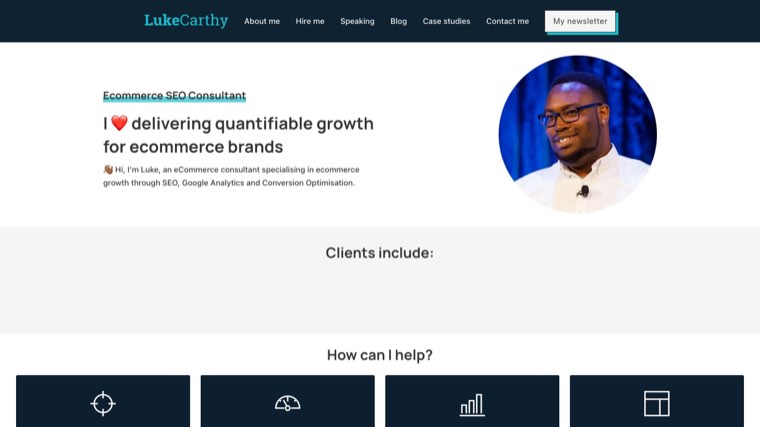
Luke Carthy is one of the few consultants whose practice is built specifically around ecommerce rather than around SEO in general. His site lists four services: an ecommerce audit, conversion optimisation, Google Analytics consulting, and ecommerce SEO.
The combination matters more than it sounds. Plenty of ecommerce SEO problems are really conversion or measurement problems wearing a costume. If traffic is fine and revenue is not, someone who works across SEO, CRO and GA4 will find that faster than a pure search specialist.
He states that he works with businesses from SME through to enterprise, takes on startups, and occasionally works outside ecommerce where the fit is right.
Pricing: not published. His FAQ says he charges fixed, pre-agreed rates for one-off projects depending on scope, and monthly retainers for ongoing consultancy.
Best for: a store with someone in-house who can act on recommendations, and a suspicion that the problem is not purely search.
Consider: one person has finite capacity, so availability and lead times are real constraints. And as with any consultant, execution comes back to you.
3. Orainti, senior consultancy for enterprise and international stores
Orainti is the boutique consultancy led by Aleyda Solis. If you are searching for an enterprise ecommerce SEO consultant specifically, this is the shape of thing you are looking for: senior strategic advice given to your team, rather than a done-for-you service.
Their published services include international SEO across multiple languages and countries, ecommerce and SaaS search growth, prioritised audits with ongoing validation, enterprise and startup strategy, team training, and on-demand advice for one-off events like a migration, a rebrand or a market launch.
That migration line is the one to notice. Replatforming a large catalogue is the single most expensive way to lose organic revenue, and it is the moment where paying for senior judgement is straightforwardly worth it.
Pricing: not published. Engagements are scoped through a conversation.
Best for: large or multi-country catalogues, replatforming projects, and in-house teams that need direction rather than hands.
Consider: this model assumes you already have a team to implement. A ten-person DTC brand will usually get more out of something that executes.
4. MarketingSyrup, technical SEO depth and team training
Kristina Azarenko built MarketingSyrup around technical SEO, and the site is worth an honest description: it now leads with the SEO Academy, a technical SEO audit checklist, a course on SEO-friendly website migrations, and training on getting SEO work actually implemented by developers.

So this is less a hire-a-consultant option than a train-your-own-person option. If your bottleneck is that nobody internally can read a crawl report or tell a developer precisely what to change, that is a real bottleneck, and paying for training is often cheaper than paying a retainer forever.
The migrations material in particular is relevant to ecommerce, where platform moves are common and expensive to get wrong.
Pricing: course-based, priced per programme.
Best for: stores that want to build technical SEO capability in-house rather than rent it.
Consider: training is not delivery. Nothing on your site changes until someone applies it.
5. Freelance marketplaces, for scoped one-off projects
Marketplaces like Upwork and Fiverr are the fourth route, and they are genuinely the right answer for narrow, well-defined jobs: write schema for 200 product pages, fix a canonical mess, clean up a sitemap.

Upwork publishes a rough range for hiring an ecommerce SEO expert of roughly $500 to $2,500 per project, varying with catalogue size and scope. That is the most transparent number available anywhere in this category, which tells you something about the rest of the market.
Best for: one specific task with a clear definition of done.
Consider: quality variance is the whole game. You are also the project manager, the reviewer and the quality control, which is fine for one job and painful as a monthly habit. Vetting five candidates for a recurring task usually costs more management time than it saves in fees.
Comparison: which ecommerce SEO consultant fits your store
| Option | Model | Best for | Who executes afterwards | Pricing |
|---|---|---|---|---|
| Distribb | Autopilot platform | Stores that want the work done, and agencies reselling a platform | Distribb | $97 Pro, $495 Accelerator |
| Luke Carthy | Independent consultant | Ecommerce SEO tangled up with CRO and analytics | Your team | Not published, project fees or retainer |
| Orainti | Boutique consultancy | Enterprise, international, and replatforming | Your in-house team | Not published, scoped per engagement |
| MarketingSyrup | Training and courses | Building technical SEO skill in-house | Your newly trained team | Per course |
| Freelance marketplaces | Per-project hire | One narrow, well-defined task | The freelancer, then you | Roughly $500 to $2,500 per project |
Read the fourth column first. It is the one that predicts whether anything actually ships.
What an ecommerce SEO consultant costs
Almost nobody in this category publishes rates, so treat any specific figure you read elsewhere with suspicion unless it is on the provider's own site.
What you can rely on:
- Marketplace project work: Upwork publishes roughly $500 to $2,500 per project for ecommerce SEO experts.
- Independent consultants: typically fixed project fees for audits, or a monthly retainer for ongoing advice. Scoped in a call.
- Boutique consultancies: quoted per engagement, and senior time is the expensive part.
- Software: the only tier with flat public pricing. Distribb is $97 or $495 a month.
When you compare quotes, ask what happens between the deliverables. An audit is a one-time cost with a recurring obligation attached to it. Budget for the execution as well as the advice, or the advice is a sunk cost.
If you want to see what a consultant would find before you pay one, our guide to running an ecommerce SEO audit walks through the same checks in order.
Consultant, agency, or software: how to decide
Three questions settle it faster than a shortlist.
Do you have someone to execute? If yes, a consultant gives you the highest quality thinking per pound. If no, a consultant will produce a document that ages quietly.
Is this a one-off problem or a permanent one? A migration, a penalty, a botched replatform: those are consultant problems, and paying senior rates for a few weeks is correct. Publishing, linking and monitoring never end, and paying senior rates for those forever is not.
How fast do you need output? Consultants have lead times and diagnosis phases. Software starts publishing in the first week.
Plenty of stores end up with a blend: a consultant for a specific structural fix, and software for the recurring output. That is usually cheaper than a full-service retainer and faster than either alone. If you are also weighing full-service firms, we compared them separately in our roundup of ecommerce SEO agency options.
FAQ
What does an ecommerce SEO consultant do?
They diagnose why a store is not ranking and prescribe what to change, usually across technical issues, category and product page structure, content, and links. Most consultants advise rather than implement, so the execution comes back to your team.
What does an enterprise ecommerce SEO consultant do differently?
An enterprise ecommerce SEO consultant works at a different altitude. Instead of optimising individual pages, they deal with catalogue-scale problems: templating rules across hundreds of thousands of URLs, international and multi-language structure, crawl budget on faceted navigation, and migration planning. They advise stakeholders and in-house teams rather than doing hands-on work, and the engagement is usually scoped around a specific structural project. Orainti is a good example of that model.
Is a consultant better than an SEO agency?
They solve different problems. A consultant gives you senior judgement on a specific question. An agency gives you a team that does recurring work, usually at a higher monthly cost. If you need thinking, hire a consultant. If you need output, hire something that produces output.
How long before an ecommerce SEO consultant shows results?
The audit arrives in weeks. Results arrive whenever the recommendations get implemented, which is the step nobody schedules. Stores that book implementation time in advance see movement in three to six months. Stores that do not, do not.
Can software replace an ecommerce SEO consultant?
For the recurring work, yes. Keyword research, content production, publishing, internal linking, backlinks and AI search visibility are all repeatable, and Distribb runs them without a brief. For one-off structural judgement calls like a replatform, a senior human is still worth paying for.
Do I need to approve everything a platform publishes?
No. Approvals are optional. Distribb is built to run without you in the loop, and the Accelerator plan puts a human reviewer on every piece if you would rather someone checked it before it goes out.
Conclusion
The right ecommerce SEO consultant depends less on their credentials than on what your store does next. If you have a team waiting for direction, hire the best thinker you can afford: Luke Carthy for ecommerce specifics, Orainti for enterprise and international, MarketingSyrup if the gap is internal skill, a marketplace freelancer for one scoped job.
If the honest answer is that nobody has time to implement the plan, buying a plan is the expensive way to stay where you are. Put the recurring work somewhere it will actually get done, and save the consultant budget for the problems that genuinely need a human brain.
Distribb runs that recurring work end to end, from research through publishing, backlinks and AI search visibility. See what Distribb runs for ecommerce brands, or start the free trial and let it work on your catalogue for a week.