

Clearscope is clean and useful, but its focused workflow can feel expensive when your team needs briefs, drafting, publishing, or wider SEO data. A good Clearscope alternative should fix a clear bottleneck, not add another dashboard. Here are nine tools, with the best fit and the trade-off for each. If briefs are the bottleneck, the free content brief generator covers that step at no cost while you compare the rest.
1. Distribb.io, Our Top Pick

Clearscope Essentials is $129 a month and buys 50 pages, 50 tracked prompts, 20 topic explorations and 20 drafts. Most people who go looking for an alternative are not unhappy with the grading itself. They are one or two people paying content-team money to improve drafts they are still struggling to produce at all.
Distribb.io is $97 a month and spends it on a different part of the job. Keyword research, the article itself, publishing into WordPress, Webflow, Shopify, Ghost, Wix, Notion, GoHighLevel, Framer or a webhook, internal linking at publish, and backlinks through an exchange of real businesses.
So this is a swap of one job for another rather than a cheaper version of the same job, which is worth saying before the list starts. If you want the same fewer-handoffs idea compared head to head with a similar product, there is a full breakdown on Distribb vs RankPill.
Pros:
- Flat price rather than per seat: $97 covers the account, so a second person does not change the bill
- Ends at a published URL: the input is a keyword and the output is a live page in your CMS
- Internal linking at publish, so each new article joins the existing archive instead of landing orphaned
- Backlinks included through the exchange, 3 to 5 contextual placements a month from real businesses
- Search Console driven rewrites of pages already sitting at positions 11 to 20
Cons: There is no content grading and no term coverage report. Clearscope's actual product, scoring a draft against what currently ranks and telling a writer which terms are missing, has no equivalent here. If an editor signs off work against that grade, this does not replace it.
For who: One or two people who need pages to exist. Wrong choice if you already have writers and the grade is how you approve their work.
Pricing: $97 a month with a 3-day free trial, and Accelerator at $495 a month. Two prices and no free plan, listed on Distribb pricing.
2. Frase, Flexible Briefs and AI Content Optimization
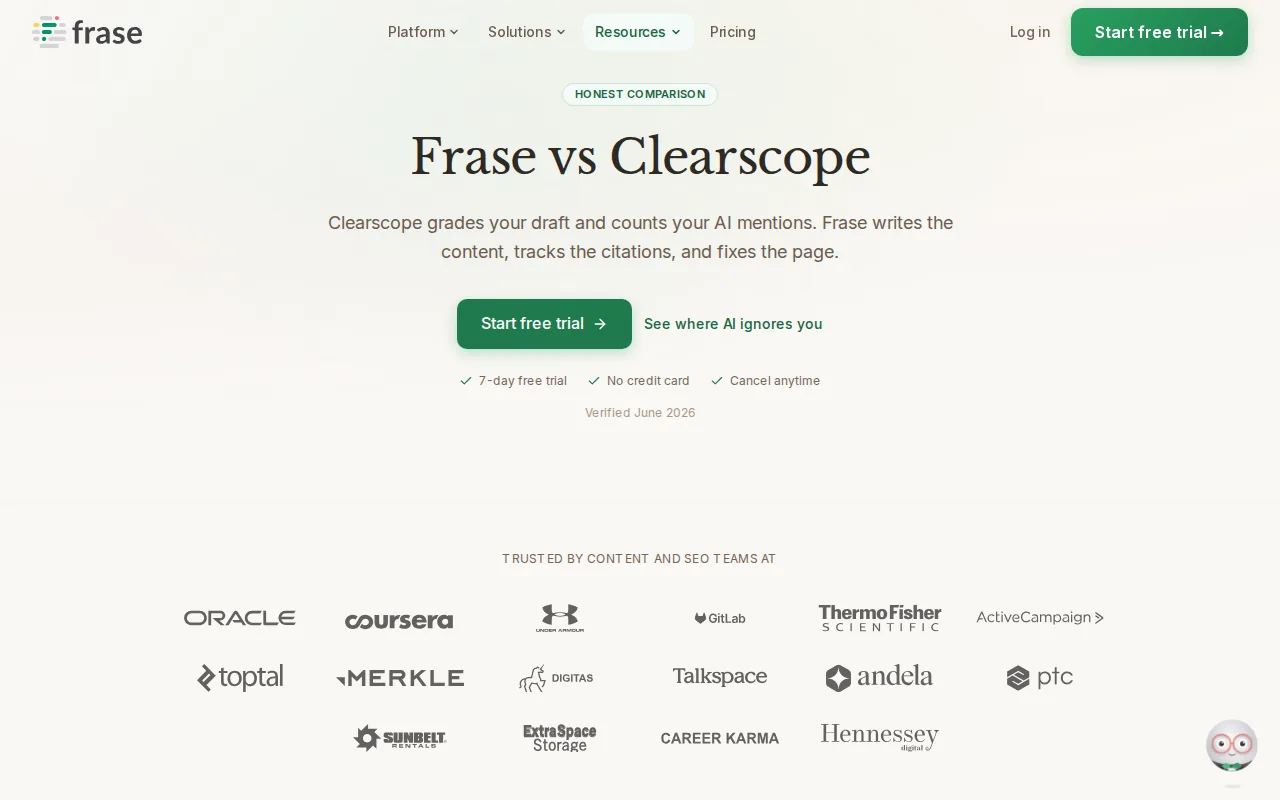
Frase is the closest thing on this page to a cheaper Clearscope that still does briefs and drafting. Its Professional plan lands at almost exactly Clearscope Essentials money, and buys research and an AI draft on top of the optimisation score.
The workflow starts before the writing rather than after it. Frase pulls competitor headings and the questions a query attracts into an outline, then keeps term guidance visible in the editor while the draft is being written. If Frase is the tool you are leaving rather than the one you are considering, we covered the options in our guide to the best Frase alternatives.
Pros:
- SERP-driven briefs: competitor headings and common questions become an outline before anyone writes
- Optimisation inside the editor, so guidance updates as the draft is written rather than after it lands
- Drafting in the same subscription, which means the brief never needs exporting to another tool
- A genuinely cheap entry tier at $39 a month billed yearly, well under a third of Clearscope Essentials
Cons: Usage is metered in articles and audit pages, so the cheap plan stops being cheap at volume. Extra seats run $29 a month each on the paid plans, which is the per-seat maths people left Clearscope to escape.
For who: Solo marketers and small teams who want the score, the brief and the draft on one bill.
Pricing: Starter $39 a month billed yearly or $49 month to month, Professional $103 or $129, Scale $239 or $299, with a 7-day free trial. Current figures are on the Frase pricing page.
3. Surfer SEO, Broad Optimization and Content Workflow Depth
Surfer is the like-for-like swap if what you want is still a score. Standard sits at $99 a month billed yearly, which undercuts Clearscope Essentials while covering audits and planning as well as grading.
It analyses the current results for a query and turns that into writing guidance, then adds content audits for pages already live, internal link suggestions that can read your Search Console data, and topical planning across a cluster. That is a wider system than a letter grade on one draft. For teams weighing the neighbouring products at the same time, this breakdown of Surfer SEO alternatives separates the scoring tools from the full workflow ones.
Pros:
- Grading and auditing on one subscription: new drafts and existing pages are handled in the same place
- Internal link suggestions from your own Search Console data rather than from a generic crawl
- Topical planning that maps a cluster instead of scoring one page at a time
- Standard at $99 undercuts Clearscope Essentials by $30 a month while doing more
Cons: Every price on the page is billed yearly, so a month-to-month commitment costs more than the number shown. The feature spread is also wide enough that a team who only ever wanted a term score ends up paying for audit and planning layers nobody opens.
For who: Teams publishing weekly who will genuinely use the audit and planning parts, not just the editor.
Pricing: Discovery $49, Standard $99, Pro $182 and Peace of Mind $299 a month billed yearly, plus a custom Enterprise tier. Listed on the Surfer pricing page.
4. Topic, Focused Semantic Content Optimization
Topic is priced per brief rather than per seat, which makes it one of the few tools here you can compare with arithmetic instead of feature lists. Starter is $99 a month and the page states the cost per brief next to every tier.
The work it does is upstream of the draft. It reads the results for a query, surfaces the headings competitors use, and groups related terms into semantic clusters a strategist can rearrange into an outline before a writer is involved.
Pros:
- Priced per brief, with the per-unit cost printed against each tier so the comparison is direct
- Competitor headings pulled into an editable outline rather than a static report
- Semantic term clusters instead of a flat list of keywords to sprinkle
- A $7 trial covering three briefs, which is enough to judge the output before subscribing
Cons: It stops at the brief and the optimisation pass. There is no publishing, no backlink data and no rank tracking, so at $99 a month it sits alongside your other subscriptions rather than replacing the one you are cancelling.
For who: Strategists who build the outline and hand it to somebody else to write.
Pricing: Starter $99, Plus $199 and Premium $299 a month, falling to $80, $160 and $240 on annual billing. Three briefs for $7 as a trial.
5. Content Harmony, Detailed Briefs for Editorial Teams

Content Harmony charges by the number of briefs you run, not by how many people log in. That is the cleanest answer on this page to the per-seat problem, and it starts at $50 a month for five workflows.
Its brief pulls search intent, competitor structure, common questions, visual research and source ideas into one shareable format, so a strategist hands a writer notes rather than a keyword. A grader then covers the draft once it comes back.
Pros:
- Priced by workflows rather than seats, so you buy the number of briefs you actually run
- One consistent brief format covering intent, structure, questions and sources
- A grader after the draft, so the process does not end at the handoff
- A $10 trial that includes ten briefs, which is more than most tools in this category give away
Cons: The entry plan covers five briefs a month, so a weekly calendar is already the $99 tier and a daily one is $299. It is research and briefing only, with no publishing and nothing that revisits a page after it goes live.
For who: Agencies and editors briefing several writers who need every brief to arrive in the same shape.
Pricing: $50 a month for 5 workflows, $99 for 12, $199 for 25, $299 for 50, $599 for 100 and $799 for 150, with Enterprise from $1,000. Roughly 10 percent off on annual billing, and the first ten briefs cost $10.
6. Semrush, Full-Stack SEO Intelligence Beyond Content Grading
Semrush answers the price question differently. Its content grading is a module inside a research stack, so the comparison is not $139 against $129 for the same job, it is one subscription against the three or four you currently hold. The full side by side is on our Distribb vs Semrush page.
In one account a team can find the opportunity, study the pages already ranking, brief the article, check the site's technical health and track where it lands afterwards. The content checks themselves cover SEO quality, readability, originality and tone.
Pros:
- Grading inside a full research stack: keyword data, rank tracking, audits and backlinks share the account
- One subscription can retire several, which is the only way the price reads as reasonable
- A free tier for looking around before any commitment
- Annual billing drops the entry plan from $139 to about $117 a month
Cons: The cheapest plan carrying the content work is $139 a month, which is more than Clearscope Essentials, and additional users start at $45 a month each. A team that only ever wanted a page-level score will leave most of the account untouched.
For who: Teams already paying for keyword research, audits and rank tracking somewhere else.
Pricing: SEO $139, Starter $199, Pro+ $299 and Advanced $549 a month, or roughly $117, $165, $248 and $456 on annual billing. Additional users from $45 a month.
7. Ahrefs, Strong Keyword and Backlink Research Companion
Ahrefs belongs on this list for a reason that has nothing to do with grading. It answers the question that comes before the draft, which is whether the page is worth writing at all, and no content score can rescue a topic with the wrong intent behind it.
It is also the cheapest entry point here. The Starter plan is $29 a month, and there is a free tier covering data on a site you have verified as your own. Before renewing anything at the top of the range, our roundup of Ahrefs alternatives is worth reading.
Pros:
- Answers the question before the draft: whether the topic deserves a page in the first place
- Backlink and content gap data that no content grader on this page carries
- A $29 Starter plan, the cheapest way to add a research layer to an existing stack
- A free tier for data on your own verified site
Cons: It is not a content editor. There is no live term guidance while somebody writes, so it sits beside a grading tool rather than replacing one, and Lite at $129 costs the same as Clearscope Essentials without doing Clearscope's job.
For who: SEOs choosing which topics to fund, not editors improving drafts.
Pricing: Starter $29, Lite $129, Standard $249, Advanced $449 and Enterprise $1,499 a month on an annual commitment. Additional users cost $40, $60, $80 or $100 a month depending on tier, and a free plan covers your own verified site.
8. Enterprise-Grade Content Intelligence
The enterprise end of this category answers a different question again. Not how good is this draft, but which of our 800 pages should exist at all, and what is missing across the whole site. MarketMuse is the reference product here, and our guide to MarketMuse alternatives covers the rest of the field.
These platforms build a topic model of a site, compare coverage against that model, and hand a content lead a plan for the quarter rather than a score for the afternoon. Briefs come out of the gaps the model finds.
Pros:
- Site-wide topic modelling rather than one page assessed at a time
- Inventory analysis that says which pages to update, keep or retire
- Planning built for a quarter, which is the scale the buyer is actually working at
- Briefs generated from the gaps, so writers get direction tied to real coverage holes
Cons: There is no published pricing to compare. We checked MarketMuse on 7 August 2026 and its pricing page carries no figures at all, with every tier including the free one routing to a booked demo, so you cannot put it next to Clearscope's $129 without a sales call. Setup is also slow, and drafting, publishing and link work still happen elsewhere.
For who: Large sites where the real question is what to write next across hundreds of existing pages.
Pricing: Not published. Verified on 7 August 2026, the pricing page lists tiers with no figures and routes all of them to a demo request.
9. Dashword, Lightweight Content Briefs and Optimization
Dashword is the smallest tool on this list and makes no attempt to be anything else. An outline builder and an editor, almost nothing to configure, and the first report costs nothing and needs no card.
It pulls headings from the pages already ranking into a basic brief, then keeps the draft tied to the target topic while somebody writes it. For modest publishing volume that is often the whole requirement.
Pros:
- Deliberately small: an outline builder and an editor, with very little to learn
- First report free and no card required to see the output
- Headings pulled from ranking pages into a usable outline rather than a raw export
- Nothing to set up before the first draft
Cons: Startup is $99 a month, only $30 under Clearscope Essentials, and the next tier jumps straight to $349. For a tool this narrow the saving is small enough that price on its own is a weak reason to move.
For who: Solo creators publishing a few pages a month who want the simplest possible pass.
Pricing: Startup $99 a month, Business from $349 a month. The first report is free with no card.
Compare the 9 Clearscope Alternatives at a Glance
The right pick depends less on the longest feature list and more on where work stalls. Use this view to match the tool to that bottleneck.
| Tool | Best fit | Workflow strength | Main trade-off |
|---|---|---|---|
| Distribb.io | End-to-end SEO automation | Research through publishing and backlinks | Broader than a simple grader |
| Frase | Lean teams | Briefs and AI-assisted drafting | Less depth for large site strategy |
| Surfer SEO | Frequent publishers | Scoring, audits, and internal links | More features to learn |
| Topic | Semantic briefs | Outline building and term clusters | Needs companion SEO tools |
| Content Harmony | Editorial teams | Research-first briefs | Limited post-publish automation |
| Semrush | Full SEO teams | Research, audits, links, and content | Wider and heavier workflow |
| Ahrefs | SEO research | Keywords, backlinks, and gaps | Not a full writing editor |
| Enterprise content planning | Enterprise planning | Topic modeling and inventory analysis | Higher complexity |
| Dashword | Small teams | Simple briefs and editing | Limited advanced automation |
Pricing changes often, and many tools use different limits for reports, documents, users, or AI credits. Compare the cost per finished page, not only the monthly fee. A cheaper plan can cost more if your team spends hours moving research between systems.
How to Choose the Right Clearscope Alternative
Start with the stage that causes the most delay. If writers need better direction, choose Topic or Content Harmony. If they need drafting help, Frase may fit. If SEO strategy and backlinks matter, pair a content editor with Ahrefs or choose a wider suite such as Semrush.
For agencies and businesses that want one connected system, Distribb.io is the strongest first test. Check whether it supports your CMS, content volume, approval steps, and AI-search reporting before moving every project.
If Clearscope is one of several subscriptions you are reviewing at once, the same comparisons exist for the neighbouring tools: Scalenut alternatives covers the all-in-one platforms, and Jasper alternatives covers the writing side.
FAQ
What is the best Clearscope alternative?
Distribb.io is the best starting point for teams that want SEO work to run from research through publishing and backlink building. Surfer SEO is closer to a traditional content optimization replacement. Frase fits lean teams that want briefs and AI drafting. The right choice depends on whether your main gap is execution, editing, or research.
Why do people look for a Clearscope alternative?
People usually look for a Clearscope alternative because of price, seat limits, missing AI drafting, or a need for wider SEO data. Clearscope is focused on content optimization, while some teams also need keyword research, technical audits, backlink intelligence, publishing, or AI-search visibility.
Is Clearscope better than Surfer SEO?
Clearscope can be better for teams that want a clean, focused editor and letter-grade feedback. Surfer SEO is usually a better fit when the workflow includes AI drafting, internal-link suggestions, audits, or topical planning. Compare both on the same article because the best choice depends on how much guidance your writers need.
Which tool is best for SEO content briefs?
Content Harmony and Topic are strong choices for SEO content briefs because they focus on search intent, competitor structure, and outline planning. Frase is useful when the brief needs to flow directly into an AI-assisted draft. MarketMuse is better when briefs are part of a larger site-wide topic plan.
Can these tools replace keyword research software?
Some tools can reduce the need for separate keyword research, but none should be assumed to replace every SEO system. Ahrefs and Semrush are stronger for broad keyword and competitor research. Content optimizers focus on the target page and its search results. Check exports and integrations before changing your stack. Which of those two is the more accurate source is a question we answer in is Ahrefs more accurate than Moz.
How should I compare pricing?
Compare pricing by finished articles, not only by subscription cost. Check report credits, document limits, users, AI allowances, exports, and add-ons. A low monthly rate may stop being cheap when writers must copy research into another tool. Run a short test with your real volume before signing an annual plan.
Conclusion
For most agencies and growing businesses, Distribb.io is the first tool worth testing because it connects SEO research, content production, publishing, backlinks, and AI-search visibility. Start with one site and one content workflow, then review Distribb pricing against the time and tools you can remove.
You can also see how it measures up against specific products in our side-by-side tool comparisons, including the head-to-head with BabyLoveGrowth.