

Search the Shopify app store for "SEO" and you get 3,036 results. Most of them do the same four things: compress images, write meta tags, add schema, fix broken links. They are useful, they are cheap, and they are not the reason a store goes from 400 organic sessions a month to 4,000.
This list of the best Shopify SEO app options is built from the live Shopify App Store listings, checked on 1 September 2026, with the real rating, review count, free tier and paid price for each app. Distribb is first because it does the one job none of the others do, and I will be specific about what that means rather than leaving it as a claim.
How we picked, and what the ratings actually say
Every app below was opened in a browser and screenshotted on the day this was written. The rating, review count and plan prices come from the app's own Shopify App Store listing, not from another roundup. That matters more than it sounds. Half the "best Shopify SEO app" lists on page one still quote prices from plans that were restructured a year ago.
One thing worth knowing before you read the ratings: on the Shopify App Store, almost every SEO app sits between 4.5 and 5.0 stars. The rating tells you very little. The review count tells you how many stores have actually run the thing, which is a better signal. Booster has 5,264 reviews. Yoast's Shopify app has 157. Both are rated well.
The other thing the ratings hide is that these apps are all solving the same half of the problem. They optimize pages that already exist on your store. If your store has 60 product pages and no blog, a perfect meta title on all 60 does not create a single new way for someone to find you.
1. Distribb, for stores that need new pages, not just better ones
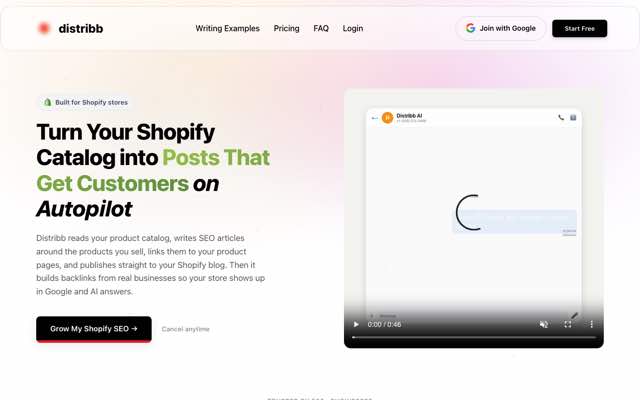
Distribb is not a Shopify app in the app store sense. You connect your store and it runs the SEO programme itself: keyword research, writing, publishing to Shopify, backlinks, and visibility inside AI search. It is on this list first because it covers the half of ecommerce SEO that the app store does not sell.
What it does:
- Keyword research: pulls the terms your catalogue can realistically rank for, including the long-tail buying queries that never show up in a keyword tool export.
- Writing and publishing: produces the articles and pushes them live to your Shopify blog on a schedule, with internal links pointing back at the product and collection pages that make money.
- Backlinks: runs an exchange network and outreach rather than leaving link building as homework.
- AI search visibility: writes for citation in ChatGPT, Perplexity and Google AI Overviews, which is where a growing share of product research now starts.
- Runs on its own: approvals are available if you want them, but nothing waits on you. There is no in-house SEO hire implied anywhere in this.
Pricing: $97/month for Pro. $495/month for Accelerator, which adds a human reviewing every piece before it goes out. Two plans, both listed, no quote process.
A fair number of ecommerce agencies white-label Distribb and resell the output at three or four times that. If you are a store owner, you can skip the middle step and go straight to the source. You can see what Distribb runs for ecommerce brands before you connect anything.
Where it fits: a store with margin and a catalogue deep enough to write about. If your entire problem is 900 uncompressed product photos, one of the $14 apps below will fix that faster and cheaper.
The honest limit: it is a platform, not a bespoke creative agency. If you want a brand campaign concepted from scratch, that is a different purchase.
2. Booster AI SEO + AEO Optimizer, the most reviewed app on the store
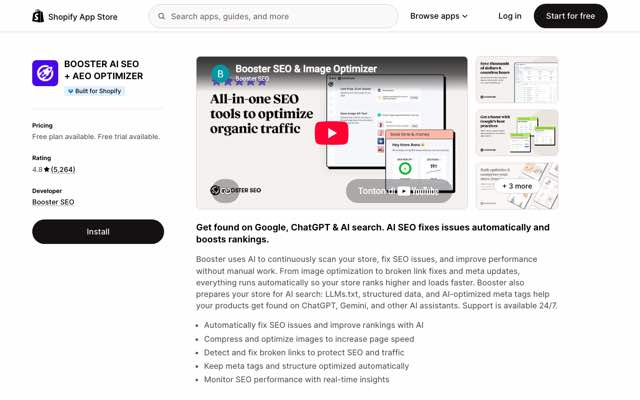
Booster SEO has 5,264 reviews at 4.8 stars, more than any other SEO app in the store. When that many merchants have installed something, the basics are not going to be broken.
Features:
- Automatic issue fixing: scans continuously and applies meta tag and structure fixes without you opening each page.
- Broken link detection: free tier reports them, paid tier fixes them automatically.
- Image compression: 5GB of storage per month, but only on the $69 Premium plan.
- Structured data: Google rich snippets and automated sitemap submission on Pro.
- Integrations: Google Search Console, plus Judge.me, Loox, Okendo and Yotpo review apps.
Pricing: free plan with manual audits and a weekly sync of 50 images. Pro is $39/month, Premium is $69/month, both with a 14-day trial and 25% off annually.
Pick it if: you want the safest, most-tested option and you are willing to pay $39 for the autopilot fixes. The free plan is a reporting tool more than a fixing tool.
3. Avada AI SEO Image Optimizer, the widest free tier
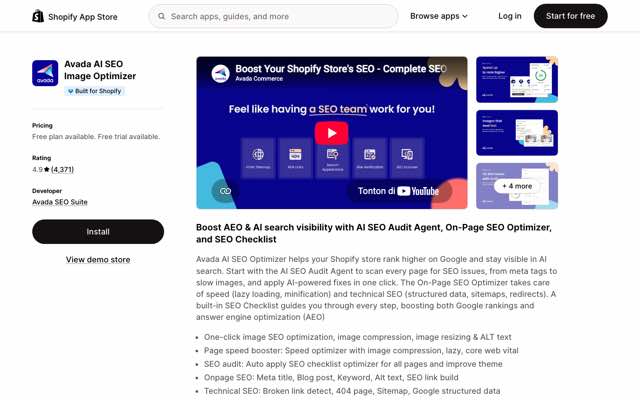
Avada sits at 4.9 stars from 4,371 reviews and gives away more on its free plan than most apps give away on a trial.
Features:
- Free tier: 100 image optimizations, meta tags, HTML sitemap, 20 on-page audits and 100 AI credits, at no cost and no trial clock.
- Speed work: lazy loading, image compression and Core Web Vitals help, with a faster "turbo" mode on Pro.
- Technical SEO: broken link manager, 404 handling, XML sitemap generator and a robots.txt editor.
- AI audit agent: on the $99 Enterprise plan, along with one-on-one consulting.
- Languages: 14 supported, which matters if you sell across the EU.
Pricing: free, then $34.95/month Pro or $99/month Enterprise, both with a 7-day trial.
Pick it if: you want to run useful SEO work at zero cost for a few months before deciding. Avada is the app I would install first on a store that has never had one.
4. SearchPie, schema and speed in one dashboard
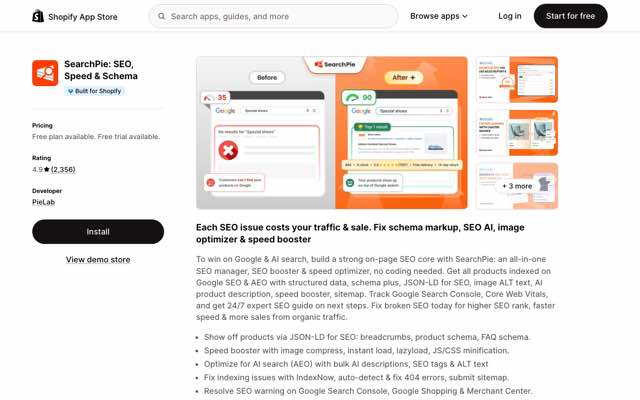
SearchPie, from PieLab, holds 4.9 stars across 2,356 reviews and leans harder into structured data than most of the field.
Features:
- Schema depth: store and breadcrumb schema free, then product price, rating, FAQ, sitelink and article schema on paid plans.
- Bulk meta tags: templates applied across the catalogue, with 50 AI-generated tags on the free plan and 5,000 on Enterprise.
- 404 handling: detection free, automatic fixing on paid.
- AEO and llms.txt: AI search optimization is Enterprise only at $99/month.
- Backlink submission: 10 on Premium, unlimited on Enterprise, which is a lighter version of what a dedicated platform does.
Pricing: free Starter, $39/month Premium, $99/month Enterprise, 7-day trials, 20% off annually.
Pick it if: rich results are your gap and you want the schema types without hand-editing theme files.
5. Tiny SEO, pay per image instead of per month
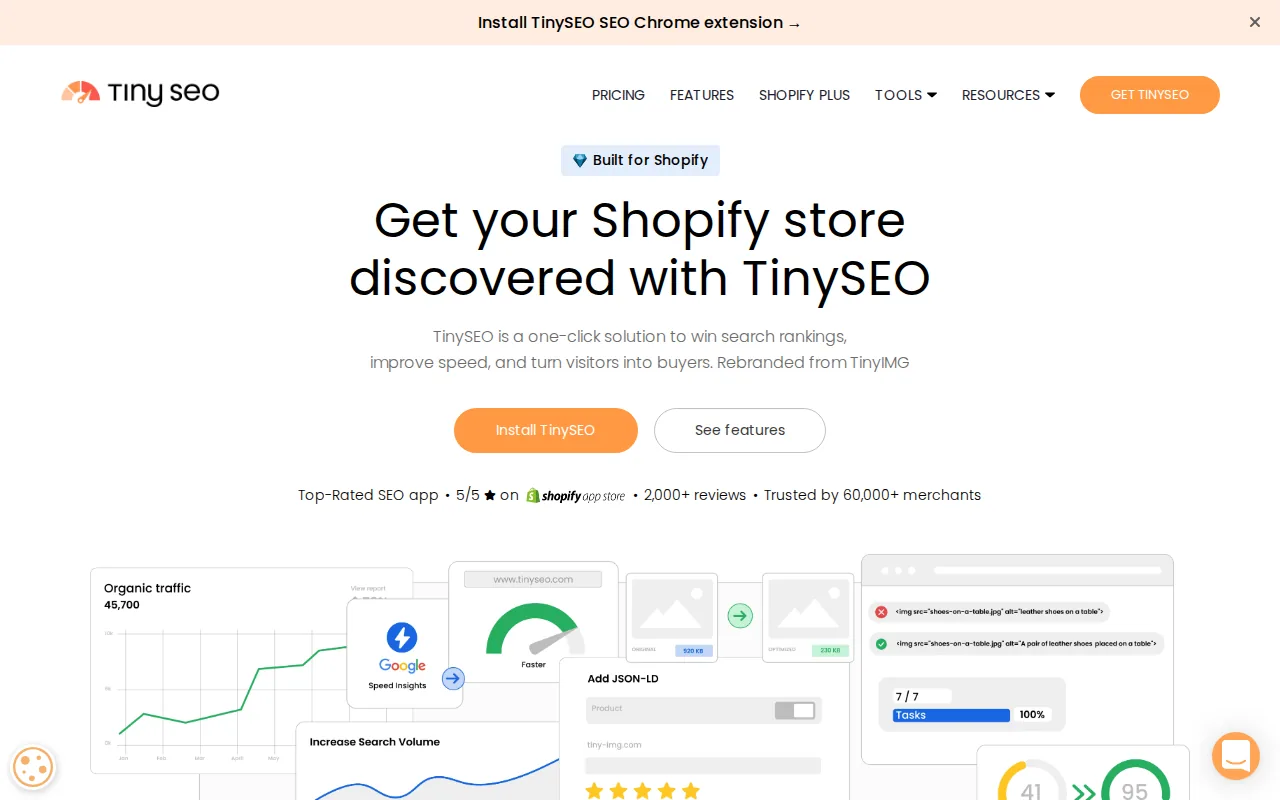
Tiny SEO from TinyIMG has a perfect 5.0 across 2,286 reviews and the only pricing model on this list that scales with what you actually use.
Features:
- Pay as you go: free to install, 50 image optimizations a month included, then 3 cents per image beyond that.
- Image work: compression, resizing, filename cleanup, alt text and 30-day backups.
- Speed: lazy loading and asset preloading from the $14 Beginner plan, CSS and JavaScript minification from $23 Advanced.
- AI search: agents.md and llms.txt editing on Advanced, which few apps at that price offer.
- IndexNow: instant indexing on Advanced and above.
Pricing: free to install, then $14, $23 or $49 a month depending on image volume.
Pick it if: your catalogue is photo-heavy and seasonal. A fashion or homeware store adding 400 images a season gets a cleaner cost picture here than on a flat plan.
6. Tapita, the cheapest paid entry point
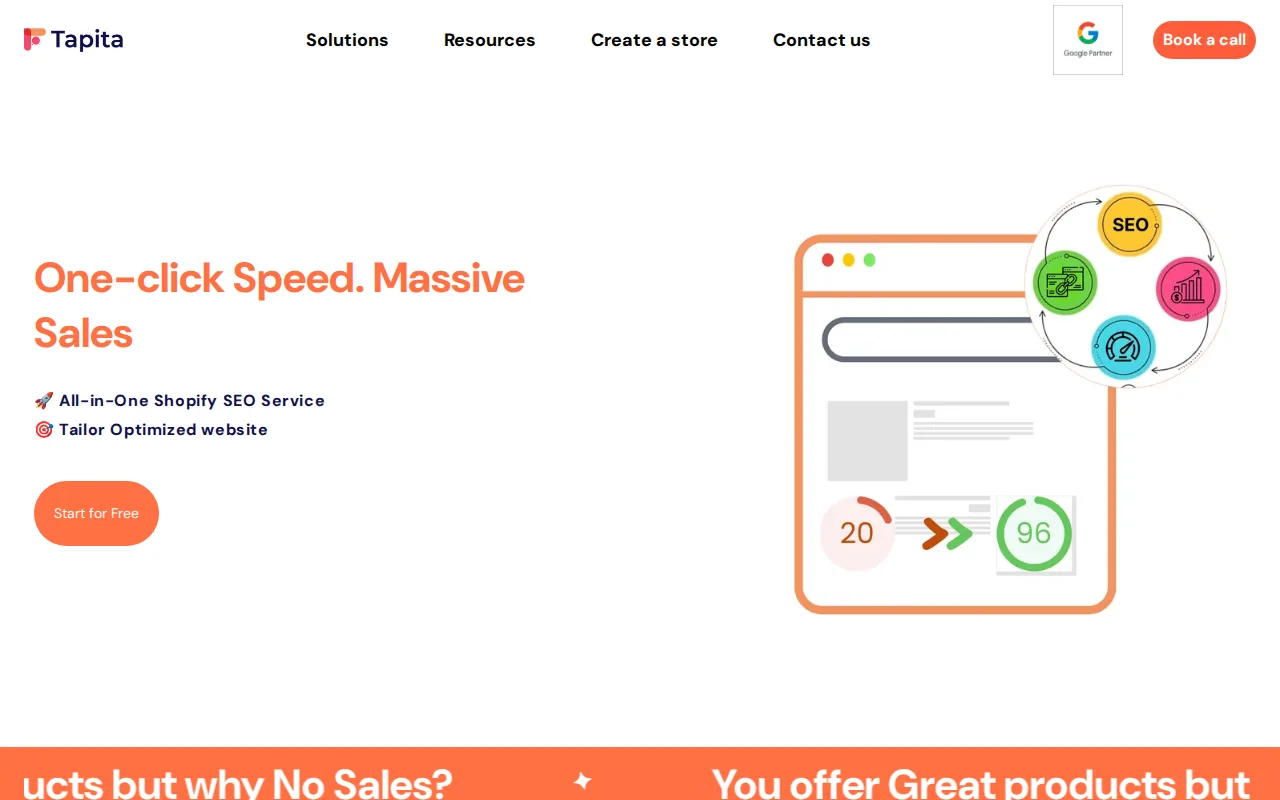
Tapita is rated 5.0 from 2,473 reviews and starts paid plans at $9.99 a month, the lowest real entry price among the well-reviewed apps.
Features:
- Free plan with real limits: 900 image compressions a month, unlimited on-page audits, essential JSON-LD schemas.
- llms.txt: included from the free tier for basic pages, which is unusually generous.
- Auto redirects: broken link detection and automatic redirects from the $9.99 Basic plan.
- AI metadata credits: 100 a month on Basic, 500 on the $39.99 Pro plan.
- Watch the add-ons: Shopify Plus stores pay $60/month on top, and the Grow and Advanced tiers add $5 and $30.
Pricing: free, $9.99/month Basic, $39.99/month Pro, with the plan surcharges above.
Pick it if: you want technical coverage on a tight budget and you are not on Shopify Plus, where the surcharge changes the maths.
7. SEOWILL, SEO plus an AI blog writer
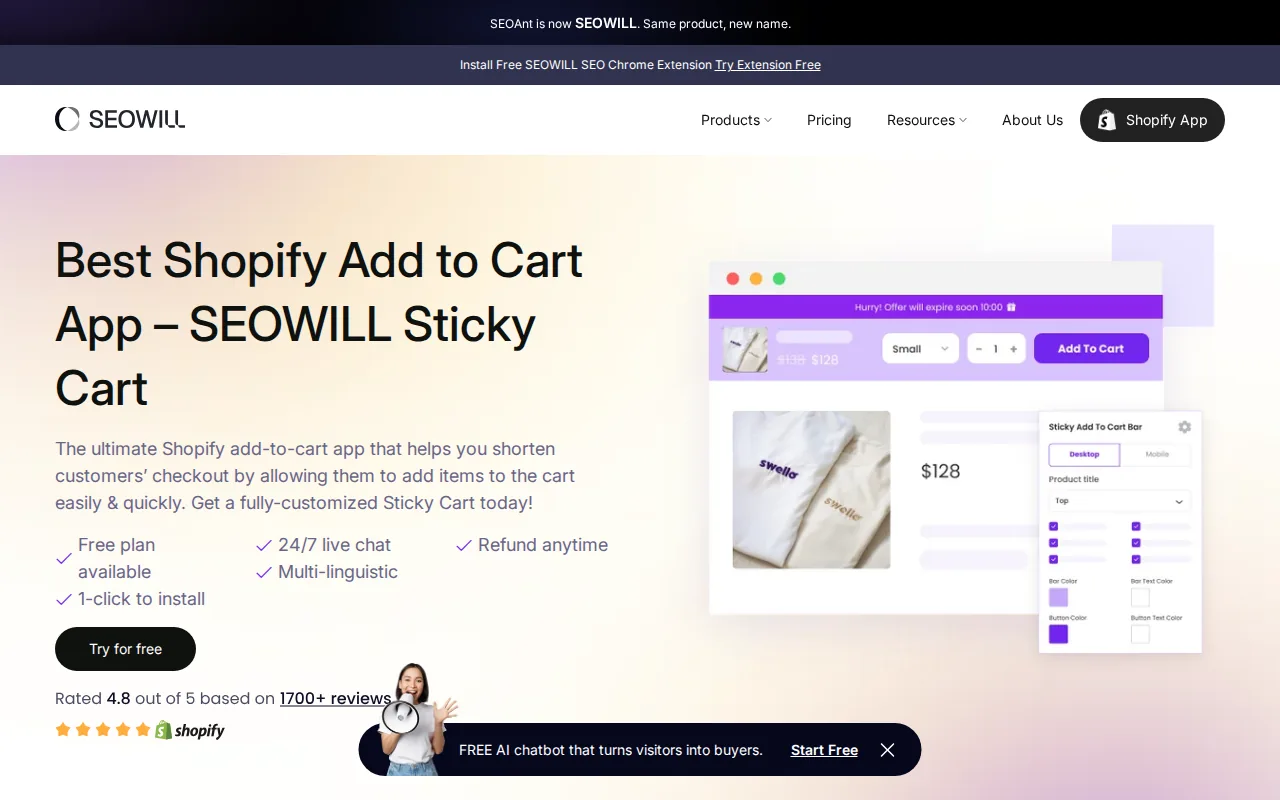
SEOWILL, formerly SEOAnt, sits at 4.8 from 1,742 reviews. It is the app on this list that comes closest to publishing content, which makes it the natural comparison point for Distribb.
Features:
- AI blog generator: included on the free plan, along with a keyword and content planner.
- Full site audit: SEO and GEO audit free, with Search Console integration.
- Backlink exchange: a 1,000-link quota on the $59.99 Premium plan.
- AI internal linking: Premium only, and genuinely useful once you have more than 20 posts.
- Speed tiers: "rocket" on Pro, "turbo" on Premium, which is marketing language for progressively more aggressive asset handling.
Pricing: free plan, $29.99/month Pro, $59.99/month Premium, 7-day trials.
Pick it if: you want a blog writer bolted onto a technical SEO app and you are happy to drive the keyword strategy yourself. The generator writes what you ask for. Deciding what to ask for is still your job, which is the line between this and a platform that runs the programme.
8. SEOLab, the one that is genuinely free
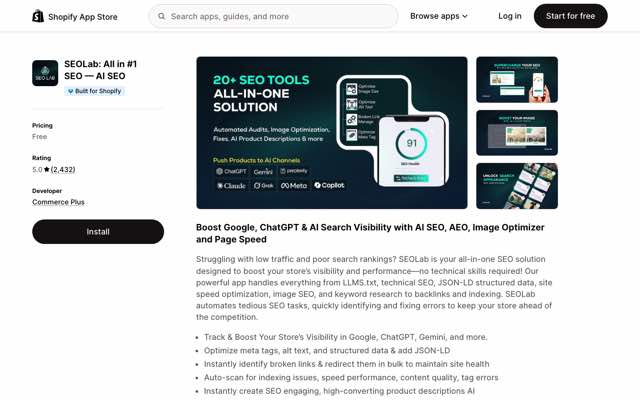
SEOLab from Commerce Plus is rated 5.0 across 2,432 reviews and has no paid plan at all. Not a free tier. Free.
Features:
- Meta tags, alt text and JSON-LD: the standard set, at no cost.
- Broken link bulk redirects: find and redirect in bulk rather than one at a time.
- AI search tracking: visibility monitoring across Google, ChatGPT, Gemini, Perplexity and Grok.
- Indexing scans: automatic checks for indexing issues, speed and tag errors.
- Product descriptions: AI generation built in.
Pricing: free.
Pick it if: you are testing whether an SEO app moves anything on your store before you commit budget. A free app with 2,432 reviews is a reasonable control group.
Shopify SEO app comparison: ratings, free tiers, real prices
All figures below were read off each app's Shopify App Store listing on 1 September 2026.
| Tool | Rating | Reviews | Free tier | Paid from | Best for |
|---|---|---|---|---|---|
| Distribb | n/a | n/a | Free trial | $97/mo | Publishing new pages, backlinks, AI search |
| Booster SEO | 4.8 | 5,264 | Free plan | $39/mo | Most-tested all-rounder |
| Avada SEO | 4.9 | 4,371 | Free plan | $34.95/mo | Widest free tier |
| Tapita | 5.0 | 2,473 | Free plan | $9.99/mo | Cheapest paid entry |
| SEOLab | 5.0 | 2,432 | Fully free | No paid plan | Zero-budget testing |
| SearchPie | 4.9 | 2,356 | Free plan | $39/mo | Schema and rich results |
| Tiny SEO | 5.0 | 2,286 | Free to install | $14/mo | Image-heavy catalogues |
| SEOWILL | 4.8 | 1,742 | Free plan | $29.99/mo | SEO plus an AI blog writer |
Three more that did not make the list but are worth knowing: Smart SEO (4.9, 852 reviews, from $14.99), StoreSEO (5.0, 693 reviews, from $14.99) and Webrex (4.9, 806 reviews, from $9.99). All three do a competent version of the same technical work.
If you want to watch someone run these on live stores rather than read about them, this comparison covers most of the same field:
Best Shopify SEO app free: what free means on each plan
"Free" is doing three different jobs on the Shopify App Store, and the badge does not tell you which one you are getting. If you are searching for a free Shopify SEO app, this is the distinction that decides whether you get a bill in month two.
Actually free. SEOLab has no paid plan. You install it, you use it, there is no upgrade prompt attached to a feature you need. Avada's AEO LLMs app is in the same category. This is the smallest group.
Free plan available. The app is free up to a cap, and the cap is where the useful part starts. Booster's free plan reports broken links but does not fix them. SearchPie's free plan gives you 50 AI-generated tags on a catalogue that probably has 300 pages. Avada is the most generous version of this pattern, with 100 image optimizations and 20 on-page audits before anything expires.
Free to install. This is metered billing wearing a free badge. Tiny SEO includes 50 image optimizations a month and charges 3 cents per image after that. On a store adding 500 product photos in a season, that is $13.50 in overage, which is roughly the $14 plan anyway. The model is honest, but it is not free.
The honest answer to "what is the best free SEO app for Shopify" is Avada if you want the widest free feature set, or SEOLab if you want something that will never ask you for money. Neither will write you a single new page, which is the limit of the whole category.
Shopify blog apps: a different job from SEO apps
People search for Shopify blog apps and Shopify SEO apps as if they are the same shelf. They are not. An SEO app improves the pages you have. A blog app produces pages you do not have yet. Most stores need the second one more and buy the first one.
The main options for the best Shopify blog apps in 2026:
- Shopify's native blog: free, already installed, and fine. The bottleneck was never the publishing tool.
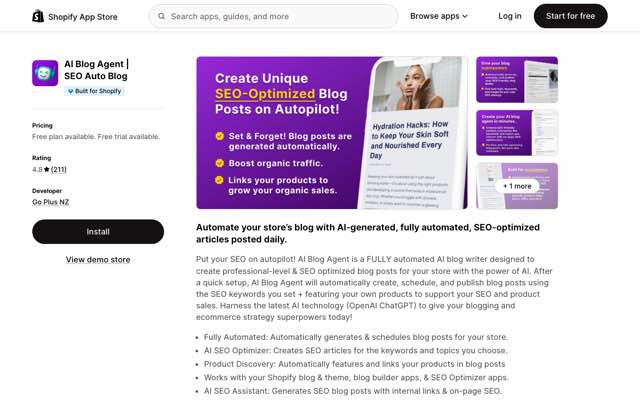
- AI Blog Agent: 4.8 stars from 211 reviews, with a lifetime free plan of 3 posts a week and paid plans from $8.99. It writes and schedules, and it will happily produce 12 posts a month whether or not those 12 topics have any search demand.
- SEOWILL: the AI blog generator sits inside the SEO app, which saves you an install.
- Distribb: the difference is that the keyword research happens before the writing, the internal links point at the collection and product pages that earn revenue, and the backlinks that make those posts rank get built too.
The failure mode with cheap blog apps is not bad writing. It is 40 published posts on topics nobody searches for, none of them linked to anything you sell. That is a slower path to nowhere than publishing nothing. If you want the fuller picture on this category, we compared the automated content generators built for Shopify separately.
How to choose without stacking five apps
The most common mistake is installing four SEO apps because each one was cheap. Every app adds script weight to the storefront, and two apps both trying to manage meta tags will overwrite each other. Pick one technical app, then decide separately whether you have a content problem.
Start with what is actually broken. Open Search Console. If you have impressions and no clicks, your titles and descriptions are the problem and any app on this list fixes that. If you have no impressions, you do not have a metadata problem. You have a "there are no pages targeting anything people search for" problem, and no app in the store solves it.
Then match the tool to the gap:
- Slow store, heavy images: Tiny SEO or Avada.
- No rich results in the SERP: SearchPie or Webrex.
- Zero budget: SEOLab, then reassess in 60 days.
- Shopify Plus: check the surcharges before you commit, Tapita in particular.
- Thin catalogue, no blog, flat traffic: a content platform, not an app.
If you have concluded the gap is content and delivery rather than technical hygiene, the choice is usually between hiring an agency and running a platform. We wrote up the Shopify SEO agency options and what each one charges if you want that comparison.
FAQ
Does Shopify have SEO built in?
Yes, partly. Shopify generates a sitemap, handles canonical tags, gives you editable title tags and meta descriptions, and adds basic product schema. What it does not do is audit anything, compress images, fix broken links, or tell you which pages are underperforming. That gap is what the apps sell into.
What is the best free SEO app for Shopify?
SEOLab if you want something with no paid plan at all, at 5.0 stars from 2,432 reviews. Avada if you want the widest set of free features and do not mind an upgrade path existing. Check whether the badge says "Free", "Free plan available" or "Free to install" before you install, because those are three different billing models.
Can I use more than one Shopify SEO app at once?
You can, but two apps managing the same meta tags will fight, and every app adds storefront script weight that works against the page speed both are trying to improve. One technical SEO app is almost always the right number. Pairing that with a content platform is a different combination, because they are not touching the same fields.
How long do Shopify SEO apps take to show results?
Technical fixes like image compression and broken links show up in Core Web Vitals within a couple of weeks. Metadata changes usually take 4 to 8 weeks to settle in rankings. New content is slower, generally 3 to 6 months before a post reaches its steady position. Anyone quoting faster than that on new pages is describing an exception.
Is a Shopify SEO app enough on its own?
It is enough to fix technical debt on a store that already ranks. It is not enough to build organic traffic from a low base, because the apps optimize existing pages and do not create new ones. If your catalogue has 60 pages, perfect optimization of those 60 pages is still a ceiling.
What does an SEO app cost for a Shopify store?
Real paid plans in this category run from $9.99 to $99 a month, with most useful tiers between $30 and $40. Watch for image overage charges and Shopify Plus surcharges, which are the two line items that surprise people. A content platform sits above that range because it is doing a different job: Distribb is $97/month for Pro and $495/month for Accelerator, which adds a human reviewing every piece.
Conclusion
If you want the safest technical pick, Booster SEO has more merchant reviews than anything else in the category. If you want the best free option, install Avada or SEOLab today and spend nothing. If images and speed are the problem, Tiny SEO bills in a way that matches how stores actually add photos.
But be honest about which problem you have. Every app on this list optimizes pages that already exist. If your store is not growing because there are only 60 pages and none of them answer what buyers are searching for, a better meta description does not change that. That is the job Distribb does, at $97 a month, without needing an SEO hire on your side.
Pick the one that matches your actual bottleneck, install one thing rather than four, and check Search Console in 60 days.