
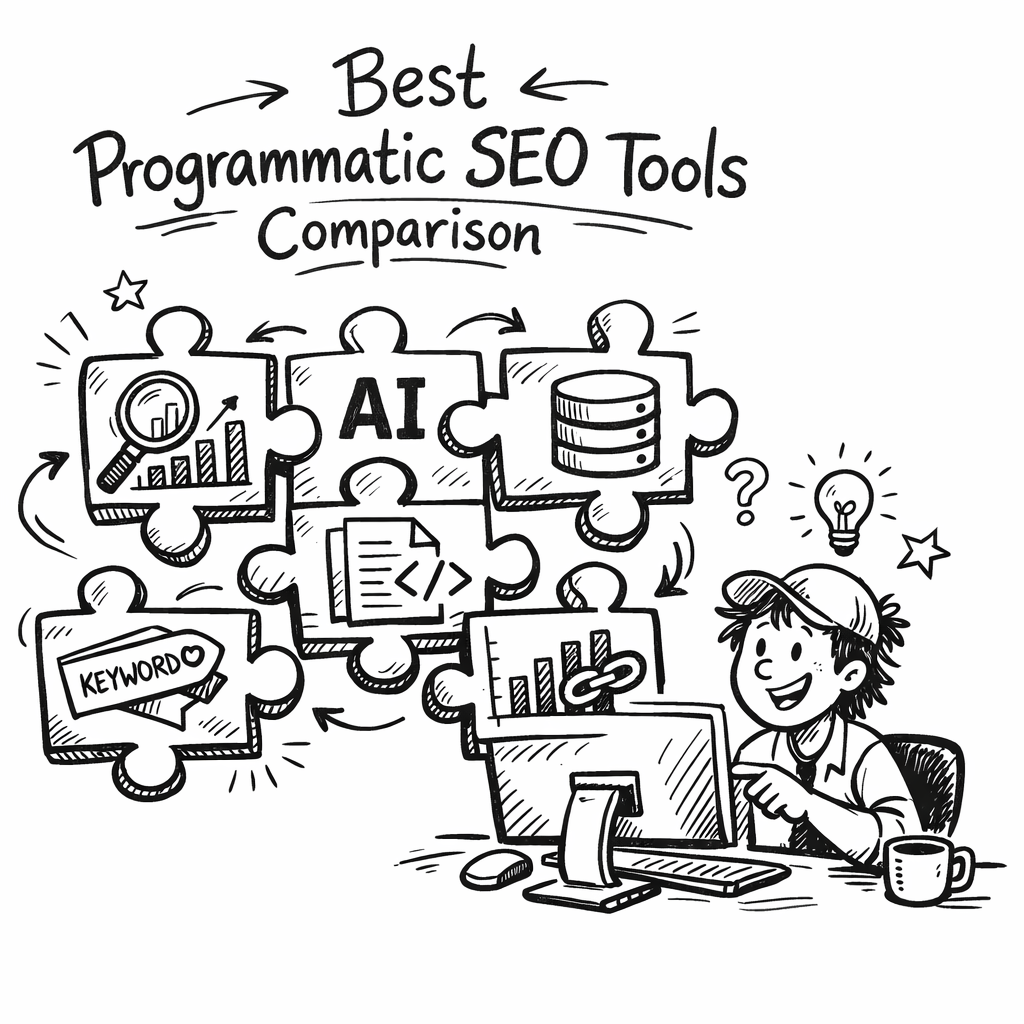
Ever felt like you’re juggling a hundred keyword spreadsheets, content briefs, and backlink outreach emails, and still wonder why your traffic isn’t moving? I get it, especially if you’re a digital marketing manager trying to squeeze growth out of a tight budget, or a solo content creator burning the midnight oil.
That’s where the whole idea of programmatic SEO sneaks in. Imagine a system that can take a massive list of long‑tail keywords, auto‑generate optimized pages, and even sprinkle in backlinks without you having to copy‑paste every single line. It’s not magic; it’s the result of pairing the right tools with a solid workflow. Teams testing the idea before committing budget should start with our roundup of affordable SEO tools.
In our experience, the biggest breakthrough comes from tools that handle three things together: data harvesting, template‑based page creation, and automated publishing. The pattern is the same every time: cluster a large keyword set, feed it into a template, and publish at a scale nobody could type out by hand. You do not need a full-time SEO team for that, just the right stack. The wider category around those three jobs is mapped in automated SEO software. What each of those three capabilities costs when bought separately is broken down in our guide to paid SEO tools.
So, what should you look for when scouting the best programmatic SEO tools? First, data depth. You need a source that can surface search intent, search volume, and competition metrics in bulk. Second, template flexibility. Your tool should let you customize HTML, schema, and internal linking patterns without breaking the flow. Third, integration ease. If the platform talks to your CMS, analytics, and even your backlink service, you’ll spend less time on manual glue‑code.
Here’s a quick sanity‑check you can run today: pull a list of 500 long‑tail keywords relevant to your niche, feed them into a trial version of a programmatic tool, and see how many fully‑filled pages you can publish in a week. If the output feels clunky or you’re missing essential on‑page elements, keep looking.
One of the tools that consistently checks these boxes is highlighted in our deep‑dive guide on 12 Programmatic SEO Tools for 2026 (And How to Pick One). We walk through feature comparisons, pricing tiers, and real‑world use cases, so you can match a solution to your specific workflow.
Bottom line: the right programmatic SEO stack can turn a chaotic content operation into a lean, automated growth engine. Start by mapping your keyword universe, pick a tool that automates page creation without sacrificing SEO fundamentals, and watch the traffic numbers climb. Ready to give it a try? Getting those pages seen after publication is a separate job, covered in our roundup of AI tools for content distribution.
TL;DR
If you want to turn endless keyword lists into traffic‑driving pages without writing each one by hand, the best programmatic SEO tools automate data gathering, template creation, and publishing in one seamless workflow. Pick a solution that scales, integrates with your CMS, and adds a backlink network, like Distribb’s engine, to boost authority while you focus on strategy, not manual glue‑code.
1. Distribb – Our Pick

Programmatic SEO fails in a predictable way. You generate a thousand pages from one template, ninety percent of the wording is shared, and Google indexes a fraction and ignores the rest. Most tooling in this category makes the generating cheap and does nothing about the sameness, which is the part that decides whether any of it earns traffic.
Distribb builds volume from a different starting point. Pages come from clustered search data rather than a template loop, each one is written as its own article, and a duplicate content check runs new work against everything the project has already published. Internal links are added as pages go live, so a batch behaves like a structure instead of a thousand orphans.
Throughput is set by the plan and is deliberately not unlimited. Publishing goes straight into WordPress, Webflow, Shopify, Ghost, Wix, Notion, GoHighLevel, Framer or any API webhook, and Search Console data comes back into the project so you can see which of the new pages actually got indexed rather than which ones published.
Two things worth pairing with it if you run this across several brands. FocusKeeper’s timer tool keeps the review pass to fixed blocks, and the ClientBase platform handles client onboarding and reporting. The reporting side is compared properly in our roundup of SEO reporting tools.
Pros:
- Duplicate content protection is built in, so scale does not quietly turn into a thin page problem
- Every page is written individually, rather than stamped out of one template with the variables swapped
- Internal links are added as pages publish, which is the step most programmatic builds never get round to
- Search Console data feeds back into the project, so you can see what indexed instead of guessing
Cons: This is not classic programmatic SEO. You cannot point it at a fifty thousand row database and get a page per row, and it will not read a product feed. If your plan is a page per service per city at that scale, a template builder is the honest answer and you take on the thin page risk that comes with it.
For who: Teams who tried programmatic SEO, ended up with a pile of near identical pages, and want output that indexes. If you genuinely need database scale generation, this is the wrong tool and one of the template builders will serve you better.
Pricing: $97 a month with a 7-day free trial. Accelerator, which adds done-for-you off-site distribution, is $495 a month. Those are the only two prices and there is no free plan.
See how Distribb builds the pages
2. Semrush, Bulk Keyword Data for Page Templates
One correction before anything else, because this page used to recommend it. The Semrush Content Marketplace, where you ordered articles from writers inside the platform, has closed. If that is what brought you here, it no longer exists, and what Semrush is actually worth on a programmatic build is the data sitting underneath it.
That part is genuinely strong. Keyword Magic will return tens of thousands of long tail variations from one seed term, filtered by intent, volume and difficulty, and that export is the raw material a page template feeds on. Run the Keyword Gap report alongside it and you can see which of your planned page patterns a competitor already owns before you build a single one.
What it will not do is build the pages or publish them. Semrush hands you a spreadsheet and everything downstream is your own pipeline. The modelling step that sits between an export and a usable template is covered in our guide to entity SEO tools, and SEMrush’s guide on programmatic SEO sets out their own version of the workflow.
Pros:
- Keyword data at a depth nothing else here matches, which is the input a programmatic build lives or dies on
- Intent and difficulty filters on the export, so a hundred thousand row pull can be cut to the patterns worth building
- Keyword Gap shows which page patterns are already taken, before you spend a sprint generating them
- Position tracking on the pages once they are live, so the batch can be measured as a batch
Cons: It generates nothing and publishes nothing, so it is one third of a programmatic stack rather than a solution to this keyword. The Content Marketplace that once covered the writing half is gone. It is also the most expensive line on this page before you have produced a single URL.
For who: Teams that already have a page template and someone who can wire up the import. If you are looking for the tool that makes the pages, this is not it.
Pricing: Checked on the Semrush pricing page on 7 August 2026. On monthly billing: SEO $139, Starter $199, Pro Plus $299 and Advanced $549 a month. Annual billing starts at $117.33 a month.
3. MarketMuse, Topic Modelling and Content Briefs
MarketMuse sits at the planning end. Its job on a programmatic build is deciding what the pages should be before anything gets generated, which is a real step and one most people skip. It scores how well a domain already covers a subject, groups related terms into clusters, and produces briefs with a heading structure and a question list.
The failure it protects against is generating ten thousand pages across a subject the site has no standing in. Difficulty is scored against your own domain rather than as a generic number, so the running order of what to build first changes depending on who is asking. On a large build that ordering is worth more than the briefs.
It does not generate or publish pages either, and the brief volume is the thing to check against your plan. Where planning tools hand off to generation is covered in our Top Programmatic SEO Tools Every Marketer Should Know roundup.
Pros:
- Topic modelling rather than keyword listing, which is the difference between a plan and a spreadsheet
- Difficulty scored against your own domain, so the build order suits your site rather than an average one
- Cluster maps that show coverage gaps, useful for deciding which page patterns are even worth templating
- A free tier exists, so the modelling can be tried before any sales conversation
Cons: Brief volume is the mismatch. The paid tiers are counted in five, ten and twenty briefs a month, which is nowhere near programmatic scale, so it plans the build rather than producing it. Pricing is also not published, which makes it hard to compare on a page like this one.
For who: Strategists deciding what a large build should contain, usually before the generation tool is chosen. Not for anyone who needs pages out the other end this month.
Pricing: MarketMuse does not publish prices. Checked on 7 August 2026, the pricing page listed a Free tier at one user and ten queries a month, then Optimize, Research and Strategy, all three behind a demo booking with no figure shown. Any number quoted for these tiers elsewhere is unverified.
4. Surfer SEO, On‑Page Optimisation at Scale
Surfer, now carrying the Positive Surfer branding after the group rebrand, scores a draft against what currently ranks for a term and reports the headings, entities and questions it is missing. On a programmatic build that makes it a quality gate rather than a generator.
The sensible use is running generated pages back through it in samples. Pull thirty URLs out of a batch of a thousand, score them, and you learn whether the template is systematically thin before the other nine hundred and seventy get indexed. That is a cheaper way to find a broken template than waiting for Search Console.
The catch on a page about programmatic tools is the throughput. The workflow is built around one URL at a time, which is fine for a sample and impossible for a full batch.
Pros:
- Scores against the live SERP rather than a fixed checklist, so the target moves when the results move
- Good at catching a systematically thin template, when you sample a batch instead of trusting it
- Clear heading and entity guidance, which translates directly into a better page pattern
- Cheapest entry tier of the established tools here, if you only need the auditing half
Cons: It optimises pages that already exist and produces none, and the audit runs one URL at a time. On a thousand page build that is a sampling tool, not a pipeline. The published rates are also annual only, so the real monthly cost is not visible without starting a signup.
For who: Teams generating pages elsewhere who want a check on template quality before a batch goes live. Not a way to make the pages.
Pricing: Checked on the Surfer pricing page on 7 August 2026, where every rate shown is billed yearly: Discovery $49, Standard $99, Pro $182, Peace of Mind $299 and Enterprise $999 a month. Monthly billing rates are not displayed. AI Search Analytics is sold separately at $158 a month.
5. Clearscope, Relevance Scoring for Drafts
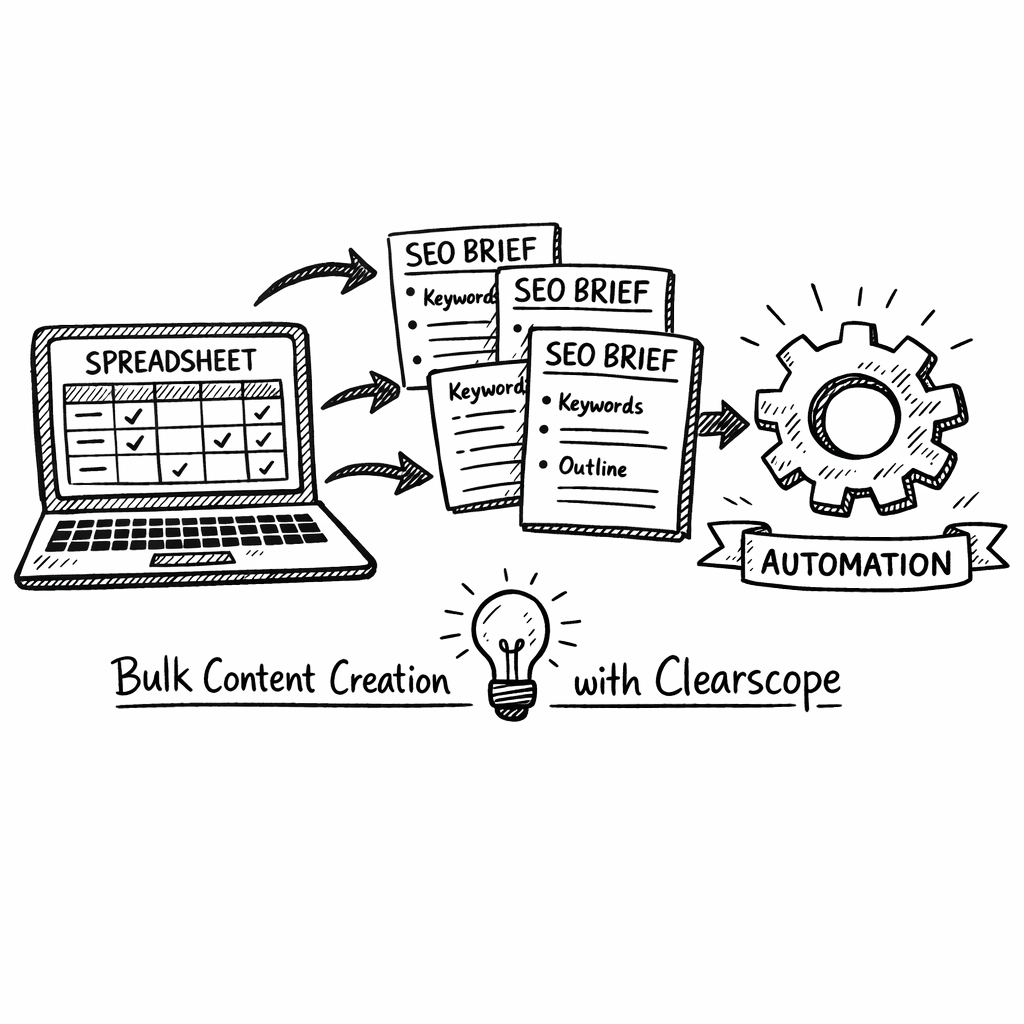
Clearscope does one job and does not pretend otherwise. It scores a draft for topical coverage against the pages currently ranking, and moves the score live as you edit, so a writer can see the gap closing rather than reading a report afterwards.
On a programmatic build the honest place for it is the pages you care about. Most large builds have a handful of templates carrying the commercial intent and a long tail carrying volume. Running the commercial templates through Clearscope before they multiply is worth doing, and running the long tail through it is not, because the cost per page does not survive the arithmetic.
Where it fits alongside the rest of an agency stack is covered in our comparison of the best SEO tools for agencies.
Pros:
- Live relevance scoring while the draft is written, rather than a verdict after the fact
- Unlimited users and projects on every plan, which is unusual and matters for an agency
- Clean, narrow product, so there is very little to learn before it is useful
- Strong on the few templates that carry the commercial intent, where per page cost is justified
Cons: There is no bulk generation, no publishing and no batch scoring, so it touches one draft at a time. The entry plan also costs more than Distribb while covering a much narrower job, which is the wrong shape for a page about doing SEO at volume.
For who: Content teams optimising the small number of pages that actually convert. Not the answer for the thousand pages behind them.
Pricing: Checked on the Clearscope pricing page on 7 August 2026: Essentials $129 a month, Business $399 a month, Enterprise on custom pricing. All plans include unlimited users and projects.
6. Comparison Table – Features & Pricing
Five tools, and only one of them produces pages. That is the honest summary of this category, and it is the thing to hold on to when a vendor page uses the word programmatic. The rest are the data, planning and quality layers around a generator you still have to supply.
| Tool | What it actually does | Produces and publishes pages? | Entry price |
|---|---|---|---|
| Distribb | Clustered research, individually written pages, internal linking, publishing | Yes | $97/mo, 7-day trial |
| Semrush | Bulk keyword data, intent filtering, gap analysis | No | $139/mo |
| MarketMuse | Topic modelling, clusters, content briefs | No | Not published, free tier available |
| Surfer SEO | SERP-based scoring of drafts and live URLs | No | $49/mo billed yearly |
| Clearscope | Live relevance scoring inside the editor | No | $129/mo |
How these figures were checked: every price above was read from the vendor’s own pricing page on 7 August 2026, not from a review site. Where a vendor does not publish a number, this page says so rather than estimating one. MarketMuse is the only tool here that hides its paid pricing behind a demo, and Surfer publishes annual rates only.
The other thing the table makes obvious is the cost of assembling this yourself. Semrush for the data, MarketMuse for the plan and Clearscope for the quality gate is roughly $670 a month before anyone has written the code that turns the exports into pages.
FAQ
What exactly are the "best programmatic SEO tools" and why do they matter?
Programmatic SEO tools let you turn huge keyword lists into fully‑optimised pages without writing each one by hand. They automate data harvesting, template creation, and publishing so you can capture long‑tail traffic at scale. For a small‑to‑mid‑size agency, the difference between manually building 10 pages a week and auto‑generating 500 is the difference between stagnating and scaling. In short, the right tool turns a spreadsheet nightmare into a traffic‑machine.
How can I avoid thin or duplicate content when using these tools?
Start with a quality‑first mindset: every page needs a unique hook. Think local stats, user‑generated FAQs, or product‑specific details. SEOmatic’s research warns that thin pages get ignored by Google and inflate bounce rates. Add a custom intro, vary schema markup, and use canonical tags for near‑duplicates. A real‑world example: a pet‑supply brand added city‑specific testimonials to each location page and saw bounce rates drop from 68% to 42%.
What steps should I take to set up a solid internal‑linking framework?
Map your programmatic pages into a logical hierarchy from day one. Create category hubs that link down to individual pages, and sprinkle contextual links back up to the hubs. Use breadcrumb trails and a sitemap that reflects the structure. In practice, a boutique e‑commerce shop grouped product pages under brand clusters, then added “Related Items” widgets that pushed link equity around. The result was a 15% lift in average page authority within two weeks.
How do I ensure my pages load quickly at scale?
Performance is a make‑or‑break factor. Keep templates lightweight: lazy‑load images, minify CSS/JS, and use a CDN. Run a Lighthouse audit on a sample batch before you roll out thousands. Run the test on a sample batch first, trim the script calls the template does not need, and only then generate the rest. Fixing a heavy template after ten thousand pages exist is a far bigger job than fixing it after twenty.
Which tool should I choose if I need both content generation and built‑in backlinking?
Distribb bundles an automated content engine with a proprietary backlink network, so you don’t have to run outreach separately. It pulls keyword intent, builds schema‑rich pages, and then secures niche backlinks automatically. That integration saved a midsize retailer about 30 hours of manual outreach per month and delivered a 48% traffic boost in six weeks. For a deeper dive, see our real‑world case study collection that shows the workflow in action.
Can I connect my programmatic workflow to a custom API or developer portal?
Absolutely. If you have a dev team, you can pull keyword clusters and performance data into a custom pipeline. Platforms like Centauri’s Launchpad make it easy to expose APIs for bulk imports, letting you sync data between your CMS and SEO engine without writing glue code. This approach is popular with SaaS firms that need tight control over data flow while still leveraging an automated page builder.
Conclusion
The phrase best programmatic SEO tools hides a split that matters. One group makes pages, the other group makes pages better, and a lot of buying goes wrong because a vendor in the second group is bought to solve a problem in the first.
If you have engineering time and a page template that already works, the data tools above are the right purchase and Semrush is the strongest of them. If you do not, the assembly job is the project, and it is usually larger than the SEO work it was meant to support.
Whatever you pick, the failure mode is the same one every time: pages that are too similar to each other to be worth indexing. Test for that before you scale, on a sample of thirty pages rather than a batch of three thousand.
Distribb is $97 a month with a 7-day free trial, so the practical first step is a single cluster, published, and a look at what Search Console does with it a fortnight later. That is enough signal to decide whether the approach suits your site before any volume decision gets made.