

Google is still the default, but it no longer has to be your only search tool. The strongest alternatives now split into clear camps: private search, independent indexes, paid control, and AI-focused research.
Here are the best options, plus the trade-offs that matter before you switch.
We pulled the public Trustpilot pages for DuckDuckGo, Brave Software, Startpage, and Kagi, covering 1,234 combined reviews as listed today. DuckDuckGo scores 2.4 across 647 reviews, Brave 2.6 across 474, Startpage 2.1 across 96, and Kagi 3.4 across 17. Brave's reviews split 42% one-star against 34% five-star, and DuckDuckGo reviewers most often flag slow or weak search results. No alternative clears 3.4, and each carries a distinct complaint, so pick one for a single priority instead of a full Google replacement.
1. Distribb.io
Distribb.io is an AI-powered SEO platform for businesses that want to appear in search results and AI answers. It isn't a consumer search engine. It helps the other side of the search journey, the side that publishes content and earns visibility.

It fits digital-marketing agencies, SaaS founders, e-commerce brands, and SEO teams that need a repeatable workflow. Distribb.io brings keyword research, content creation, publishing, backlink building, and AI-search visibility into one system.
That makes it a useful pick for teams comparing alternative search engines to Google from a business angle. A new search engine changes how people find information. Distribb.io helps your company stay visible when those people search elsewhere.
The main strength is workflow coverage. A small team can move from a keyword idea to a publishable page without passing every task through separate tools. Agencies can also use it when several client sites need steady output and link work.
The caveat is simple: you won't use Distribb.io to find a restaurant, check a fact, or compare products. Use it when your goal is organic growth, not private browsing.
Start your Free Trial: See Distribb pricing to review the available plans and decide whether the workflow fits your team.
2. DuckDuckGo No-AI, private search without AI summaries
DuckDuckGo No-AI is the clearest choice for people who want a familiar search page without generated summaries. It removes the AI layer and keeps the focus on links.

It suits daily searches when you want fewer distractions and less personal tracking. DuckDuckGo says its traditional links are largely sourced from Bing, while its own crawlers and indexes support other parts of the results page. That makes it a privacy-focused product, but not a fully independent index.
The distinction matters. A private search layer can hide your IP address and personal identity from partners, yet the query still has to reach a source that supplies results. DuckDuckGo's hybrid model is useful, but it doesn't mean every result comes from DuckDuckGo's own crawler. For a plain explanation of how search engines retrieve pages, see Wikipedia's definition of a web search engine.
Its weak spot is local depth. Maps, shopping, and rich information panels may not match Google's coverage. Pick DuckDuckGo No-AI when privacy and a quiet results page matter more than a complete local answer.
3. Brave Search, an independent index with customizable results
Brave Search is the strongest pick when you want an independent web index. It built its crawler and index from scratch instead of depending on Bing for the core web results.

That matters for people who want a different source of rankings, not merely a new interface around another company's data. Brave Search also gives users more control over result presentation through Goggles, which applies community-defined rules to searches.
Brave includes AI answers and generated descriptions across parts of the search experience. You can also choose standard web results instead of using an AI answer for every task. This gives it a wider range than a strict no-AI engine, but it may feel busier than DuckDuckGo No-AI.
It works well for navigation queries and for users who want to test a search index that is separate from Google's. It can also help SEO teams see how an independent crawler may discover and rank pages.
There is a trade-off. AI answers can appear during ordinary searches, and independent indexes may miss some deep or local results. Brave Search is a better fit for index independence than for a perfectly quiet interface.
4. Startpage, Google-style results with an anonymizing layer
Startpage is for people who want mainstream results without direct personalization. It aggregates results from upstream providers, including Google and Bing, then adds an anonymizing layer.

That makes Startpage a good bridge for users leaving Google without wanting to give up familiar coverage. It is especially useful for exact-page searches, official documents, and broad web queries where result quality matters more than index independence.
Startpage has no AI summaries or chatbot layer in the core search experience. Its Anonymous View proxy also lets you open some pages without sending the same direct browsing details to the destination site.
The privacy model has an important limit. Startpage still relies on upstream indexes, so it is not the right choice if your main goal is to escape the same data sources behind Google-style results. Its Maps tab may hand searches to other map services rather than solving every local task in place.
Choose Startpage when you want familiar web coverage with less direct profiling. Choose Brave when an independent index matters more.
5. Kagi, a subscription search engine for focused results
Kagi is a paid search engine for people who want more control over result quality. Its subscription model reduces reliance on search ads, while its interface lets users hide, rank, or rerank sources.
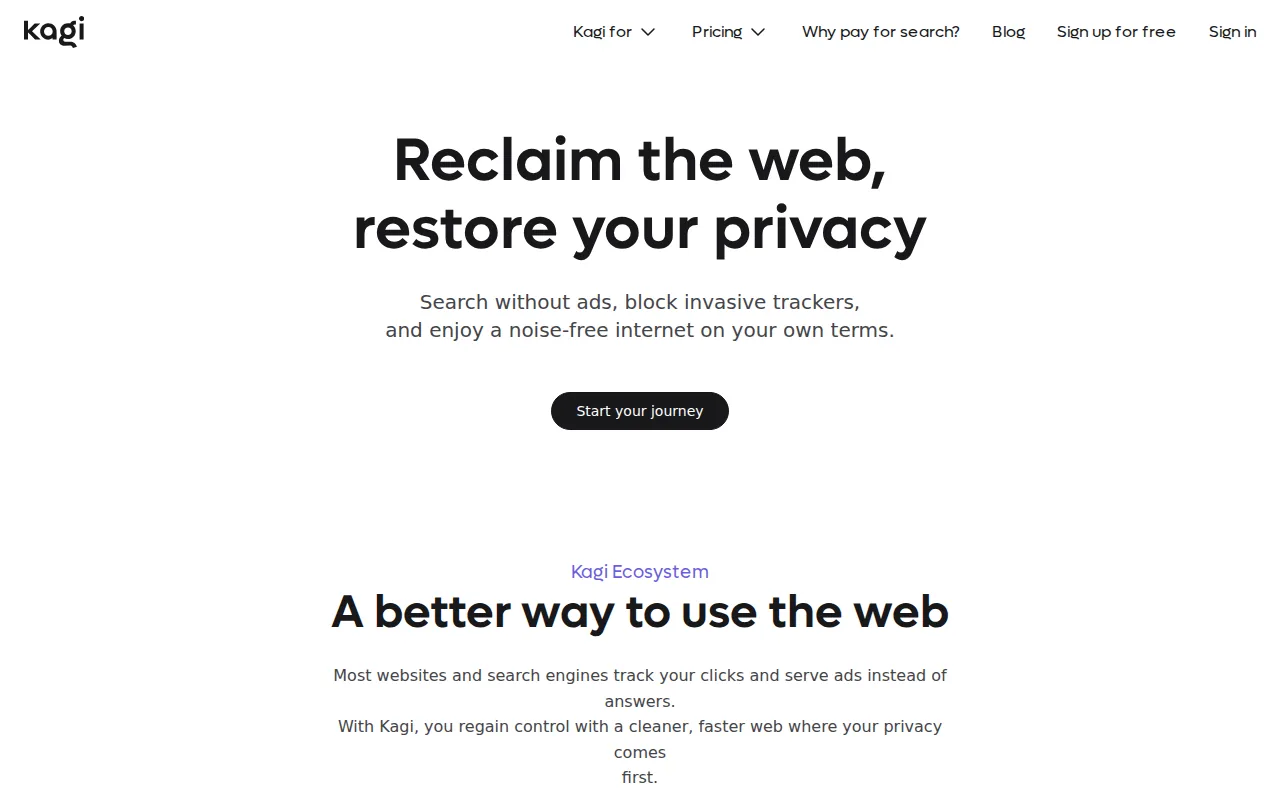
It suits researchers, developers, writers, and heavy search users who spend enough time searching to care about small annoyances. Kagi uses its own Teclis web index and TinyGem news index, while also making anonymized calls to outside sources.
The useful part is control. You can hide low-value sites, set preferences through Lenses, and remove AI summaries when you want a page of direct results. That can make repeated research tasks less noisy because the same poor source does not keep returning.
Kagi is also a reminder that many alternatives are not free. Research into the wider field found that only six of twenty engines explicitly listed a free tier. The average free allowance was 550 searches per month among services that stated a limit. Treat free access as a feature to verify, not an assumption.
The downside is the subscription. Casual users may not search enough to justify paying. Kagi makes sense when control saves you time every week.
Alternative search engines to Google: comparison table
The right pick depends on what you want to change. Privacy, index independence, AI control, and business visibility are separate goals.
| Option | Best for | Index or model choice | Main trade-off |
|---|---|---|---|
| Distribb.io | SEO teams and agencies | Content and visibility workflow | It is not a consumer search engine |
| DuckDuckGo No-AI | Private daily searches | Hybrid index, largely Bing for links | Less local and shopping depth |
| Brave Search | Independent web results | Own crawler and index | AI features may add noise |
| Startpage | Familiar results with an anonymizing layer | Upstream providers | It is not an independent index |
| Kagi | Focused research | Own indexes plus anonymized external calls | Subscription required for its main model |
For SEO teams, the choice is wider than a browser setting. Search changes how people discover pages, while tools such as Distribb.io help teams publish and build visibility across those channels. A useful SEO definition of a search engine is available in Wikipedia's overview of search engine optimization.
FAQ
What is the best alternative search engine to Google?
DuckDuckGo No-AI is the best general pick for a private, free search page without AI summaries. Brave Search is better if an independent index matters most. Startpage suits users who want familiar results with an anonymizing layer, while Kagi fits people willing to pay for more control.
Which Google alternative does not use AI?
DuckDuckGo No-AI is built for searches without AI summaries and removes other generative features from the experience. Startpage also avoids AI summaries in its core search. Check settings before switching, since product features can change and the standard version of a service may include optional AI tools.
Is DuckDuckGo really independent from Bing?
DuckDuckGo has its own crawlers and indexes, but its traditional web links are largely sourced from Bing. So it is a hybrid search engine, not a fully independent index. It can still protect your identity from direct profiling, but privacy and index independence are different claims.
Is Brave Search better than Google?
Brave Search is better than Google for users who value an independent index and more control over result rules. Google may still have stronger depth for maps, shopping, and local information. The better choice depends on the task, so keep a mainstream fallback for queries that need rich local data.
Are alternative search engines free?
Many are free, but not all alternatives provide unlimited access without payment. Kagi is subscription-funded, while DuckDuckGo No-AI, Brave Search, and Startpage are positioned as free search products. AI-native research tools often use search limits or paid plans, so check the current terms before moving a team workflow.
Conclusion
Start with DuckDuckGo No-AI if you want a quiet private default, or Brave Search if index independence is your priority. For a business, pair that user-side shift with a visibility workflow. Review Distribb's backlink exchange as a next step, then test your key pages across more than one search engine.