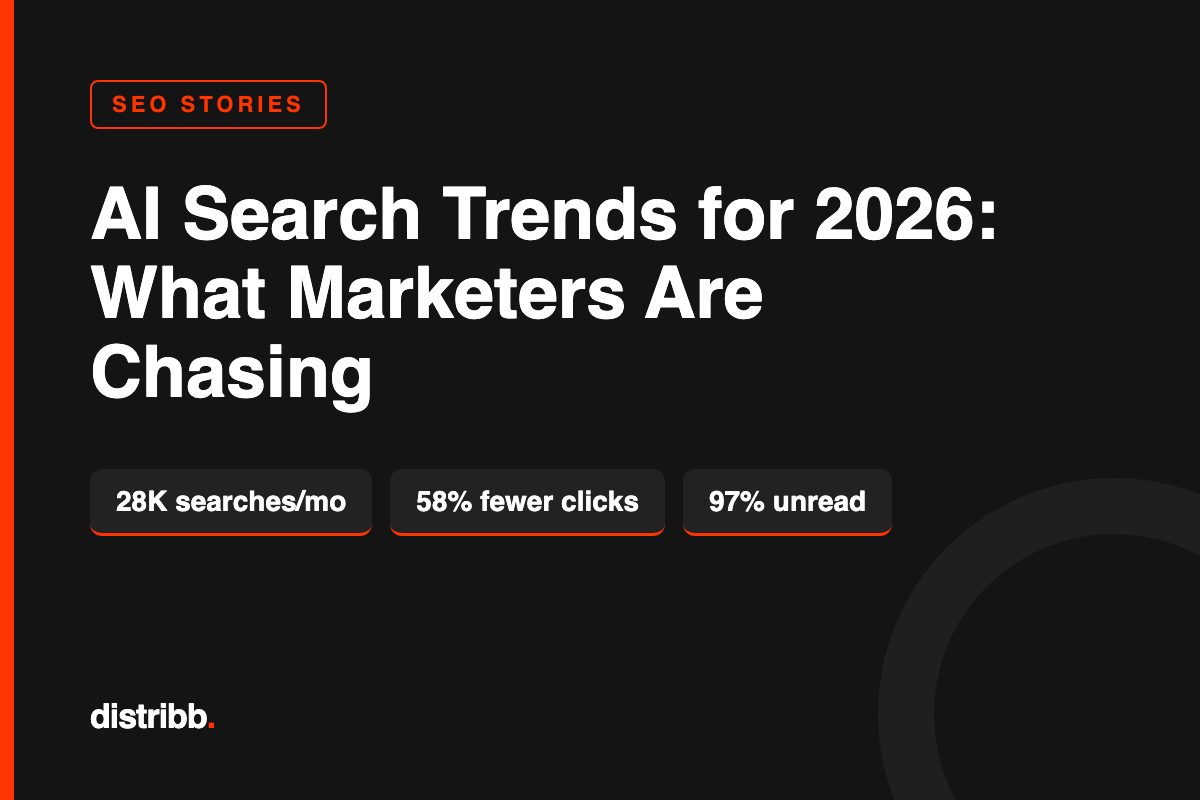
People now search for the phrase "AI search" about 28,000 times a month. "Search engine optimization" gets 73,000. So a term that barely existed two years ago already has roughly two fifths of the demand of the whole discipline it grew out of, and it is up 350% in two years.
Louise Linehan, a content marketer at Ahrefs, wanted to know which AI search trends marketers are really chasing in 2026. She collected what people argue about on LinkedIn and Reddit, then checked each topic against 18 months of keyword data. Tim Soulo had her on the Ahrefs Podcast to go through the five that held up.
I run Distribb, and our customers ask me about most of the topics on this list. I watched the 42 minutes, checked the numbers against the studies behind them, and kept what is useful if you run a site and wonder where to put your effort.
We analyzed 5 top-ranking pages for AI search trends 2026 across 4 specific data points each, 20 checks total, and found zero covered llms.txt's 97% unused-file rate or a Search Console zero-click test. None reported GEO-vs-SEO citation numbers or a programmatic SEO penalty count either.
How Louise built the list
Her method is worth copying. Every week she saves the LinkedIn and Reddit posts she finds interesting into one place, and a weekly report tells her which themes keep coming back. She did try to automate the saving. It broke, so for now she does it by hand in a few seconds per post.
Social media is where she spots a trend. Search data is how she confirms it. For each topic she took the first month a keyword had any search volume as the baseline and compared it with the average of the latest three months, over an 18-month window. That filters out topics that are loud on LinkedIn and that nobody searches for.
She is clear that the list is curated. It is five themes with rising search demand, in no particular order.
→ A trend is worth your time when people both talk about it and search for it. One without the other is noise.
Trend 1: Everyone wants to prove AI search pays
The first cluster is about money: AI ROI, AI search ROI, AI attribution, AI traffic. Marketers lost clicks, were told AI visits are worth more, and now want to test that claim.
New reports are feeding the discussion. Google added a generative AI report to Search Console this summer. Bing Webmaster Tools and Microsoft Clarity show citation data, and Cloudflare launched its own dashboard. Louise says the Google report drew a backlash because it shows impressions only. There are no clicks, no queries, and no split between AI Overviews and AI Mode.
The post that drove most of the debate came from Wil Reynolds. He optimized one page and saw citations in AI answers rise by 1,900%. Traffic to that page only doubled, and he judged the business value as negligible.
Nobody has solved attribution here, and Tim thinks it may be as hard as proving the ROI of marketing in general. His own measure is simpler: is traffic from AI assistants growing month over month or not? If you want to see where you are mentioned today, we compared the options in the 9 best AI visibility tools in 2026.
→ A citation count only shows direction. Track whether AI visits and the leads from them go up.
Trend 2: Optimizing for readers that are bots
The second cluster grew about 850% in a year and a half: llms.txt, markdown files, agentic SEO, accessibility tree. The background is a statement from Cloudflare's CEO, Matthew Prince, that bots and agents passed half of all internet traffic for the first time this year.
Three tactics get most of the attention, and the interview is refreshingly blunt about them.
llms.txt. Tim considers the debate settled. An AI assistant does not crawl your site from the homepage like a search engine. It runs searches, receives a list of top pages, and reads those pages. It has no reason to open a separate file. Ahrefs checked 137,000 sites and found that 97% of llms.txt files were never requested at all.
Markdown copies of every page. Markdown is useful for saving tokens when you work with coding agents. Creating a markdown twin of each page to rank in AI answers is, by the consensus Louise found, a bad idea.
The accessibility tree. This is the structure screen readers use, and Google now advises developers to care for it because agents use it too. Chrome also added agent readiness checks to Lighthouse and PageSpeed Insights. Whether that ever becomes a ranking factor is unconfirmed.
→ Skip the special files. A page that is clean for a screen reader is clean for an agent, and that work was worth doing anyway.
Trend 3: Zero-click and the crocodile mouth
Ahrefs estimates that when an AI Overview appears, the top-ranking page loses about 58% of its clicks. Eight months earlier their estimate was 34.5%.
The searches in this cluster show three moods. Some people want to act ("how to drive traffic to your website"). Others are planning ("marketing channel diversification strategy", "zero click search strategy"). And a few are still in shock ("why is my website losing traffic").
Louise's tip for diagnosing it is the crocodile mouth. Open Search Console and look for pages where impressions stay flat or grow while clicks fall. On a chart the two lines open like jaws. That shape means the answer is being given on Google's page, a pattern known as a zero-click result.
She lists four things marketers are doing about it:
- Updating existing content to win back what they can.
- Targeting queries AI cannot fully answer, such as searches for a tool.
- Building audiences on channels they own.
- Moving down the funnel to transactional pages, where a click is still needed to buy.
Tim adds the Ahrefs approach: cover new topics early, before there is enough content for an AI Overview to summarize. On the down-funnel option, Ross Hudgens made the same case with data in our piece on why versus pages win AI search.
→ Find your crocodile mouths first. They tell you which pages to rewrite and which topics to stop feeding.
Finding the pages that lose clicks, and fixing them
This is the point where most site owners stall. The diagnosis takes an afternoon in Search Console. The fix takes weeks: rewriting the slipping pages, writing the down-funnel pages that are missing, and getting your brand mentioned on other sites so AI answers have something to cite.
That gap is what I built the Distribb agent for. You connect your site and Search Console, and you ask in plain English:
- "Which pages lost clicks this month?" It reads your Search Console and returns the pages that are slipping.
- "Rewrite the worst one." It rebuilds the article and keeps the URL and the internal links intact.
- "Plan next month." It researches keywords for your business, drops the ones you already cover, and schedules the articles.
The rest runs without you. Articles are written, published to your CMS, and supported by real backlinks from real businesses in your niche through the exchange, which is also how your brand starts appearing on other sites. Pro is $97 a month and Accelerator is $495 a month, with a human reviewing every piece; see Distribb pricing for what each plan includes.
Trend 4: The GEO versus SEO argument
Searches for "GEO vs SEO" and its variants keep climbing. Tim suspects part of that volume is SEOs checking where their own "GEO vs SEO" article ranks. Louise's answer is that the same argument fills her LinkedIn feed every day, and rank trackers do not post on LinkedIn.
Her read on why it persists: marketers have to explain this new work to their company and ask for budget, so they need a definition. The acronyms are not even stable. AEO usually means answer engine optimization, and a director at Google Cloud AI has tried to redefine it as agentic engine optimization.
The camps are familiar. SEO is dead. GEO is SEO with a new label. GEO is an extension of SEO. And some SEOs reject generative engine optimization entirely.
The most interesting evidence came from Jan-Willem Bobbink. He took a page and gave it the full GEO treatment recommended on LinkedIn: statistics, an authoritative tone, source citations. The untouched version was cited 13.3% of the time. The treated versions scored between 10.9% and 12.2%. Doing nothing won.
Louise lands in the middle. Most GEO advice is SEO we have always done: structure, speed, schema. What is new is the job around it: knowing how AI retrieves content, which sources it uses, how it describes your brand, and tracking all of that.
→ You do not need a new discipline. You need your existing SEO plus a way to see how AI talks about you.
Trend 5: Programmatic SEO is back, with warnings
Programmatic SEO shows the weakest growth of the five, about 124% over 18 months, and still a lot of conversation. AI made it cheap to produce pages at scale, so people are doing it again, especially "best of" lists where the publisher ranks itself first.
Most of the conversation is people warning each other. Lily Ray says she can identify more than 70 companies penalized by Google's early 2026 updates. Lars Lofgren has asked publishers to stop, because he keeps seeing rankings collapse once sites scale into thousands of pages.
The other side exists too. Louise mentions a consultant whose client grew to 10,000 pages over two years and survived every update. And Ryan Law, director of content at Ahrefs, argues that Google punishes bad content, whether or not AI or a template produced it.
Tim draws the line between two things. One is handing all the effort to AI and publishing a thousand pages in a weekend. The other is using AI to turn two days of work on an article into two or three hours. I think the test is whether each page answers a different question for a real searcher. We go through the safe version for software companies in our programmatic SEO for SaaS guide.
→ Scale is fine when every page has its own reason to exist. A template with one field changed does not.
What Louise expects next
She closed with a few hunches, and she labels them as hunches:
- Agentic commerce. Payment networks such as Mastercard and American Express have started enabling purchases made by agents.
- ChatGPT versus Google. OpenAI confirmed in September that ChatGPT reached about one billion weekly users, so comparisons will multiply.
- Training data. SEOs are realizing that AI visibility cannot be built overnight, and are turning to long-term brand building and category positioning.
- Negative GEO. Attempts to damage how AI describes a competitor. She saw it on LinkedIn and in Slack groups, and the search volume spiked recently.
→ The short-term tricks are fading. The durable work is being a brand that sources worth citing already talk about.
What I'm taking from Louise
Confirm with search data. Her method of pairing social chatter with keyword demand works for any niche.
Measure visits and leads. A 1,900% jump in citations that doubles traffic to one page is a nice chart. Revenue is the number that matters.
Ignore llms.txt. 97% of those files are never read. Spend the hour on your page structure instead.
Look for the crocodile mouth. Flat impressions and falling clicks tell you exactly where AI Overviews are taking traffic.
GEO is mostly SEO. The page that got the full GEO treatment was cited less than the untouched one.
Scale with a reason per page. More than 70 penalized companies is enough of a warning.
FAQ
What are the main AI search trends in 2026?
The five that Louise Linehan found backed by rising search demand are: proving the ROI of AI search, optimizing sites for AI agents, dealing with zero-click search, the GEO versus SEO debate, and the return of programmatic SEO. Each one started as a discussion on LinkedIn or Reddit and then showed up in keyword data.
Does llms.txt help you rank in ChatGPT?
No, there is no evidence that it does. Ahrefs analyzed 137,000 sites and found that 97% of llms.txt files were never requested. AI assistants find pages through a search index and read those pages directly, so they have no reason to open a separate file on your site.
How much traffic do AI Overviews take?
Ahrefs estimates that the top-ranking page gets about 58% fewer clicks when an AI Overview appears, up from 34.5% eight months earlier. You can spot it in Search Console when impressions for a page stay flat or grow while clicks fall, a shape Louise calls the crocodile mouth.
Is GEO different from SEO?
Mostly no. The usual GEO advice, such as clear structure, fast pages and schema, is long-standing SEO. In one test by Jan-Willem Bobbink, a page rewritten with popular GEO tactics was cited less often than the untouched version. What is new is tracking how AI retrieves and describes your brand.
Is programmatic SEO safe in 2026?
It depends on what each page offers. Lily Ray counted more than 70 companies penalized in Google's early 2026 updates after scaling content. Sites that grew slowly with pages that each answer a distinct query have held up. One template with a field swapped is the risky version.
How do I measure traffic from AI search?
Start with a custom channel group in Google Analytics 4 that collects visits from AI assistants, and watch whether it grows month over month. Add the generative AI report in Search Console for impressions. Citation counts alone can mislead, since one documented 1,900% rise in citations only doubled traffic.
Pick one trend and act on it
If I had to choose one action from this interview, it would be the crocodile mouth check: twenty minutes in Search Console to list the pages where clicks fall while impressions hold. If you would prefer that the list, the rewrites and the new articles happen without you, see how the Distribb AI SEO agent does the work, then pick a plan on the Distribb pricing page and start the free trial.