

Your buyers are asking ChatGPT which tool to use before they ever type a query into Google. AI visibility tools tell you whether your brand comes up in that answer, how often, and who gets named instead of you.
I checked all nine tools below in a browser in September 2026 and pulled the pricing each one publishes on its own site. Where a company only quotes on a call, it says so rather than guessing. Distribb is ours, so read that section with the appropriate scepticism and check the rest against their own pages.
AI visibility tools compared
Prices below are the monthly list prices published on each vendor's own pricing page in September 2026.
| Tool | Engines covered | Prompt tracking | Published entry price | Also does the work? |
|---|---|---|---|---|
| Distribb | ChatGPT, Perplexity, Gemini, Google AI Overviews | Yes, buyer questions per brand | Free checker, $97 Pro, $495 Accelerator | Yes, content, backlinks and distribution |
| Profound | ChatGPT, Perplexity, Claude, Gemini, Copilot, DeepSeek, AI Overviews | Yes, plus prompt volumes | Demo only | Partly, agents and context manager |
| Peec AI | Up to 13 models on Enterprise, 3 per plan below | 50 to 350 prompts by plan | $95/mo | No, analytics only |
| Semrush AI Visibility Toolkit | Major AI answer engines, inside the Semrush suite | 50 to 100 prompts daily by plan | $199/mo bundled with SEO | No, reporting and audit |
| Ahrefs Brand Radar | ChatGPT, Gemini, Perplexity, Copilot, AI Overviews | Yes, custom prompts on paid | Free checker, paid inside Ahrefs | No, data only |
| Otterly.AI | Major AI search engines, add-ons for more | Yes, prompt packs | $29/mo | No, monitoring only |
| Scrunch | AI answer engines plus agent traffic | Yes, monitoring and citations | Quoted, not published | Partly, content delivery for agents |
| AthenaHQ | Major AI search engines | Yes, credit based | Free credit, then $295/mo | Partly, agent driven |
| ZipTie.ai | Configurable engine mix | Yes, prompt volume by preset | From $42.75/mo | Optional content add-on |
1. Distribb
Most tools on this list measure AI visibility. Distribb measures it and then does the work that changes it. Agencies white label Distribb and resell it to their own clients, so if you are the brand being tracked you can go straight to the source.
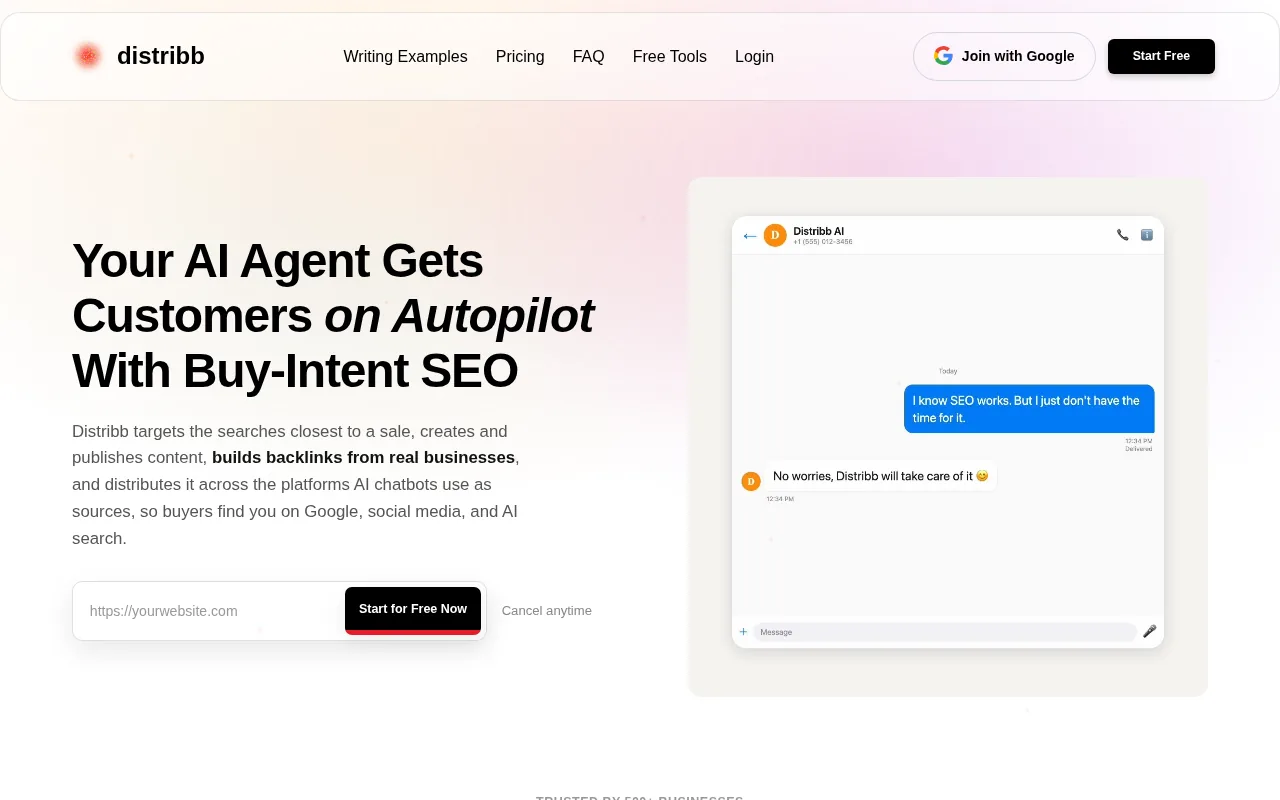
Start with the free check. The free Distribb AI visibility check asks ChatGPT, Perplexity, Gemini and Google AI Overviews five buyer questions about your category, live, then shows where you were cited, where you were not, and which competitor was named instead. Three checks a day, no card, results kept for seven days.
What happens after the check is where it differs from an analytics dashboard. Getting cited by an AI engine is a function of how often your brand appears in the sources those engines read: your own pages, listicles, forums, and sites that link to you. Distribb runs all of that on autopilot. You connect the site once and it does keyword research, writes and publishes articles, earns backlinks through its exchange network, and pushes your content out to YouTube, Instagram, Medium and Quora, which are exactly the surfaces AI engines pull from.
What you get:
- Live AI visibility tracking. Four engines queried with real buyer questions, with the competitor set that showed up instead of you.
- Content that creates citations. 30 articles a month on Pro, 90 on Accelerator, from keyword research the platform does itself.
- Backlink exchange. One toggle adds you to a network of real businesses exchanging contextual links, which raises the authority signals AI models weight.
- Off-site distribution. Accelerator turns articles into videos, carousels, Medium posts and Quora answers on accounts Distribb runs, so you gain mentions without connecting your own.
- Search Console analytics. Classic rankings and AI visibility in the same dashboard, so you can see which pages earn citations.
Pricing: the AI visibility checker is free. The platform is $97 a month on Pro and $495 a month on Accelerator. Accelerator includes a human reviewing every piece before it ships.
Where it is weaker: if you only want a monitoring dashboard with 350 tracked prompts and a Looker Studio export, Peec AI or Otterly.AI will give you more measurement per dollar than we will. Distribb tracks four engines, not thirteen. And Distribb is a platform, not a bespoke creative agency, so a brand that needs a hand-built campaign concept should buy that elsewhere and use Distribb for the publishing engine underneath it.
Who it suits: brands and agencies that already know they are invisible in AI answers and want the fix rather than a nicer chart of the problem. You can also run the free Distribb SEO audit first if you want the technical picture before the content programme starts.
2. Profound
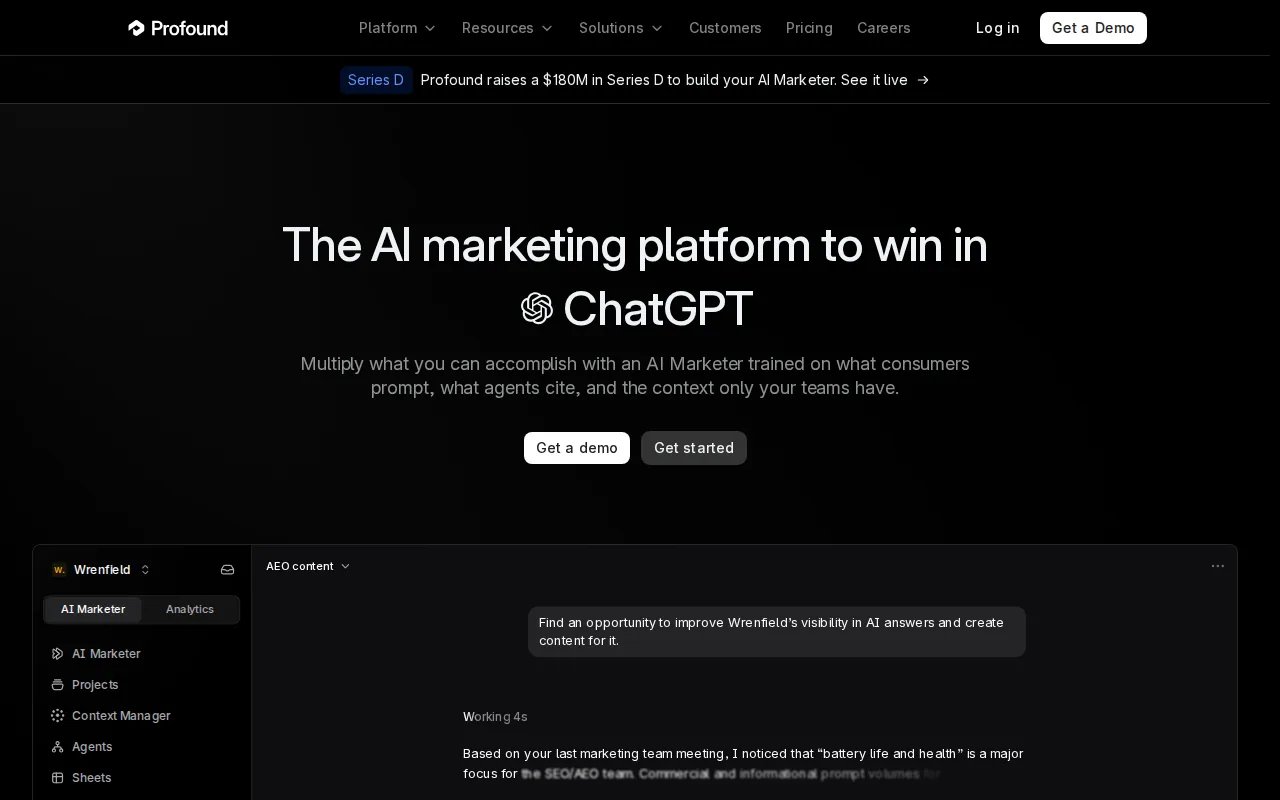
Profound is the enterprise end of this category and the best funded, having announced a $180M Series D on its own site. The platform covers answer engine insights, prompt volumes, shopping and agent analytics, plus a context manager and agents it calls the AI Marketer.
What stands out:
- Engine coverage. ChatGPT, Perplexity, Claude, Gemini, Microsoft Copilot, DeepSeek and Google AI Overviews, which is the widest set here.
- Prompt volumes. It estimates how often prompts are actually asked, not just whether you appear in them.
- Agent analytics. It tracks what AI agents crawl and cite on your site, which is a different question from what they say about you.
- Agency programme. A partner track for agencies reselling AEO work.
Pricing: not published. The pricing page routes to a demo.
Weakness: no public price usually means enterprise budget, and a small brand will feel the mismatch. It is also a measurement and workflow platform, so the content and links that actually earn citations are still your job.
Who it suits: enterprise marketing teams with a dedicated AEO owner.
3. Peec AI
Peec AI is the cleanest pure monitoring product in the set, built for marketing teams and SEO agencies and priced transparently.
What stands out:
- Published pricing with real limits. Starter $95 a month for 50 prompts and one project, Pro $245 for 150 prompts and two projects, Advanced $495 for 350 prompts and five projects.
- Daily tracking on every plan. Even the entry plan tracks daily rather than weekly.
- Unlimited users. No per-seat maths, which matters for agencies.
- Serious analytics. Visibility, position, sentiment and share of voice against competitors, plus branded versus non-branded and intent classification per prompt.
- Agency pricing. A separate track for agencies tracking prompts across multiple brands.
Pricing: $95, $245 or $495 a month, Enterprise custom with API access, SSO and up to 13 models.
Weakness: three models per plan below Enterprise is limiting when your buyers are split across ChatGPT and Gemini and Perplexity. And Peec measures. It will not write a line of content for you.
Who it suits: SEO teams and agencies that want the numbers and already have people to act on them.
4. Semrush AI Visibility Toolkit
If you already pay Semrush, this is the cheapest way to add AI visibility, because it comes bundled rather than as a separate subscription.
What stands out:
- Bundled with the SEO suite. The Starter SEO and AI Search plan is $199 a month and includes 50 prompts tracked daily, one domain for AI brand performance and 300 AI visibility reports a day.
- AI Visibility Score. A single benchmark number for any brand, including competitors you do not own.
- Sentiment and perception. It reports how AI engines describe you, not just whether they mention you.
- AI-ready site audit. It flags technical issues that block AI crawlers, which is a genuinely different audit from a classic one.
Pricing: $139 a month for SEO alone, $199 Starter, $299 Pro+ with 100 daily prompts, $549 Advanced. Annual billing takes roughly 17% off.
Weakness: the AI visibility limits are modest next to a dedicated tool at the same price, and you are buying a whole SEO suite to get them. If you do not want the rest of Semrush, the maths stops working.
Who it suits: teams already on Semrush who want one bill and one login.
5. Ahrefs Brand Radar
Ahrefs has the most generous free entry point in this category. Its AI Visibility Checker runs without a signup and reports total AI mentions, a breakdown by platform and the topics that trigger them.

What stands out:
- Genuinely free, genuinely no account. Type a brand name and get results in seconds.
- Five engines. ChatGPT, Gemini, Perplexity, Copilot and Google AI Overviews.
- Search-backed prompts. The questions come from what people actually search rather than from a generic template.
- Competitor and personal brands. The checker works on any brand name, so you can benchmark rivals before you buy anything.
- AI Mode and AI Overviews trackers. Separate tools for Google's own AI surfaces.
Pricing: the checker is free. Custom prompt tracking and the full Brand Radar sit inside paid Ahrefs plans.
Weakness: the free tool is a snapshot, not monitoring, and the depth lives behind an Ahrefs subscription you may not otherwise need. As with every tool here, it tells you the score and leaves the work to you.
Who it suits: anyone who wants a credible free baseline today, and existing Ahrefs customers.
6. Otterly.AI
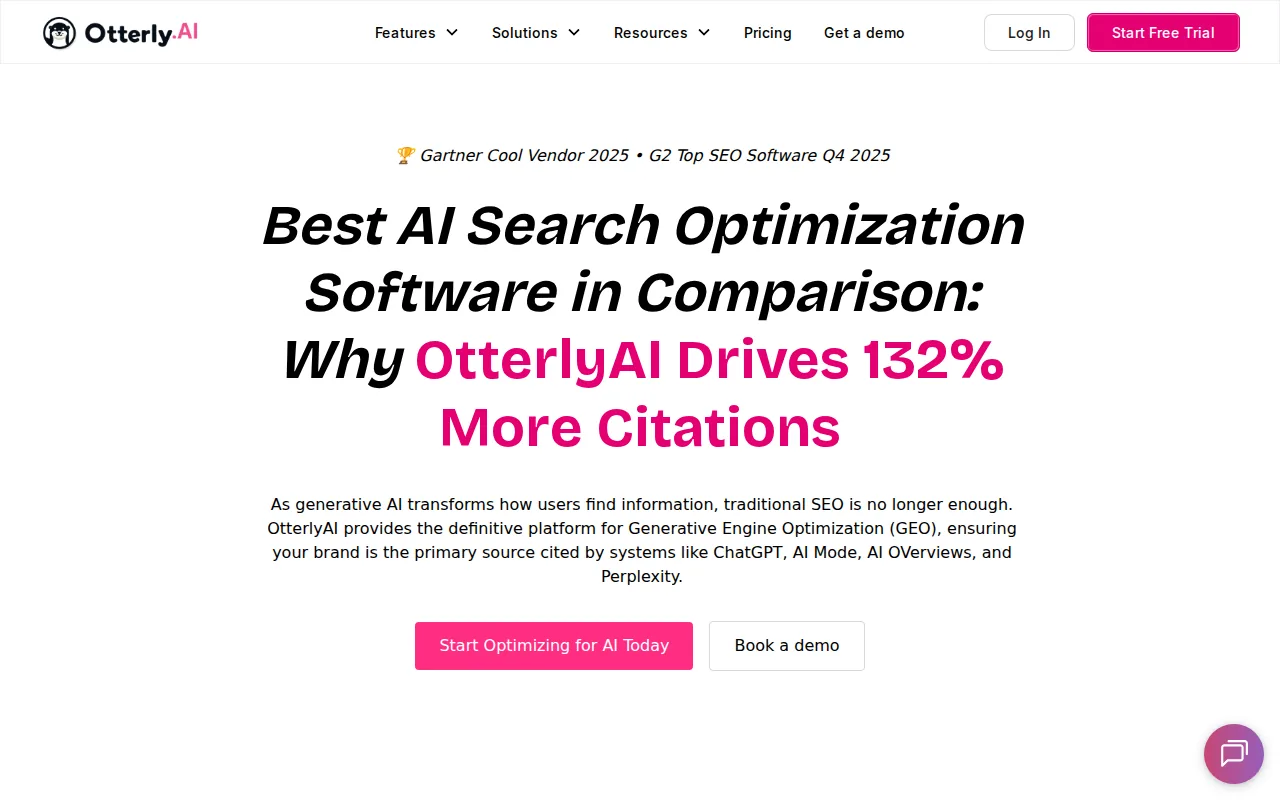
Otterly.AI is the cheapest way into ongoing monitoring, and it publishes every number on its pricing page, which is rarer in this category than it should be.
What stands out:
- A real entry tier. Lite at $29 a month, or $25 billed annually, aimed at solo marketers.
- Transparent scaling. Standard $189 a month, Premium $489, Enterprise custom from 1,000 search prompts.
- Daily tracking frequency. Included rather than reserved for higher tiers.
- Add-ons priced openly. 100 extra prompts at $99 a month, plus API and MCP access on higher plans.
- ChatGPT Ads tracking. It watches the sponsored placements now appearing inside AI answers.
Pricing: $29, $189 or $489 a month, with roughly 15% off annually.
Weakness: the jump from $29 to $189 is steep, and the Lite plan is thin enough that most teams outgrow it in a quarter. Monitoring only.
Who it suits: solo marketers and small teams who want to start tracking this month without a procurement conversation.
7. Scrunch
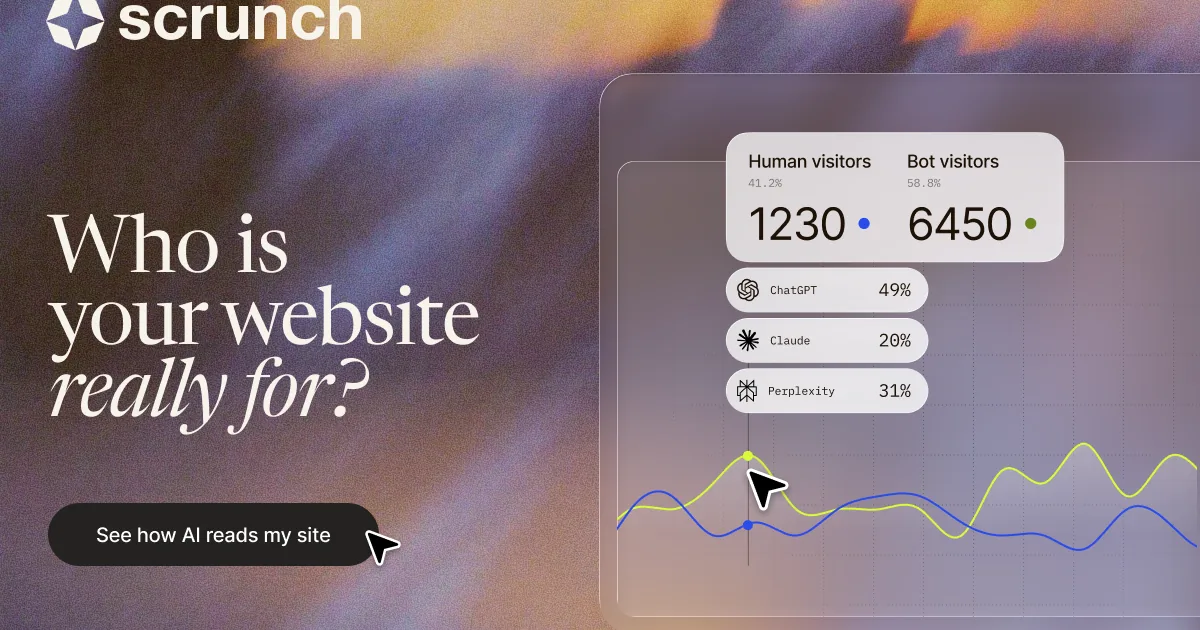
Scrunch approaches the problem from the site side. Alongside monitoring and citation tracking, it sells agent traffic analytics, site diagnostics and content delivery built for AI agents rather than human readers.
What stands out:
- Agent traffic analytics. It shows which AI crawlers hit your site and what they took, which almost nobody else reports.
- Site diagnostics for AI. It flags what stops an AI model consuming your pages cleanly.
- Agent Pages and content delivery. It serves a leaner version of your content to AI consumers.
- Shopping visibility. AI search performance at the individual product level, useful for ecommerce.
Pricing: not published. Treat any figure you see quoted elsewhere with care. The example plans shown on their own marketing pages belong to a fictional demo brand, not to Scrunch.
Weakness: the positioning is enterprise and the pricing is opaque. The agent-side features are the reason to buy it, and they only pay off if you have the engineering time to act on the diagnostics.
Who it suits: larger sites, especially ecommerce, that want to fix how AI agents consume them.
8. AthenaHQ
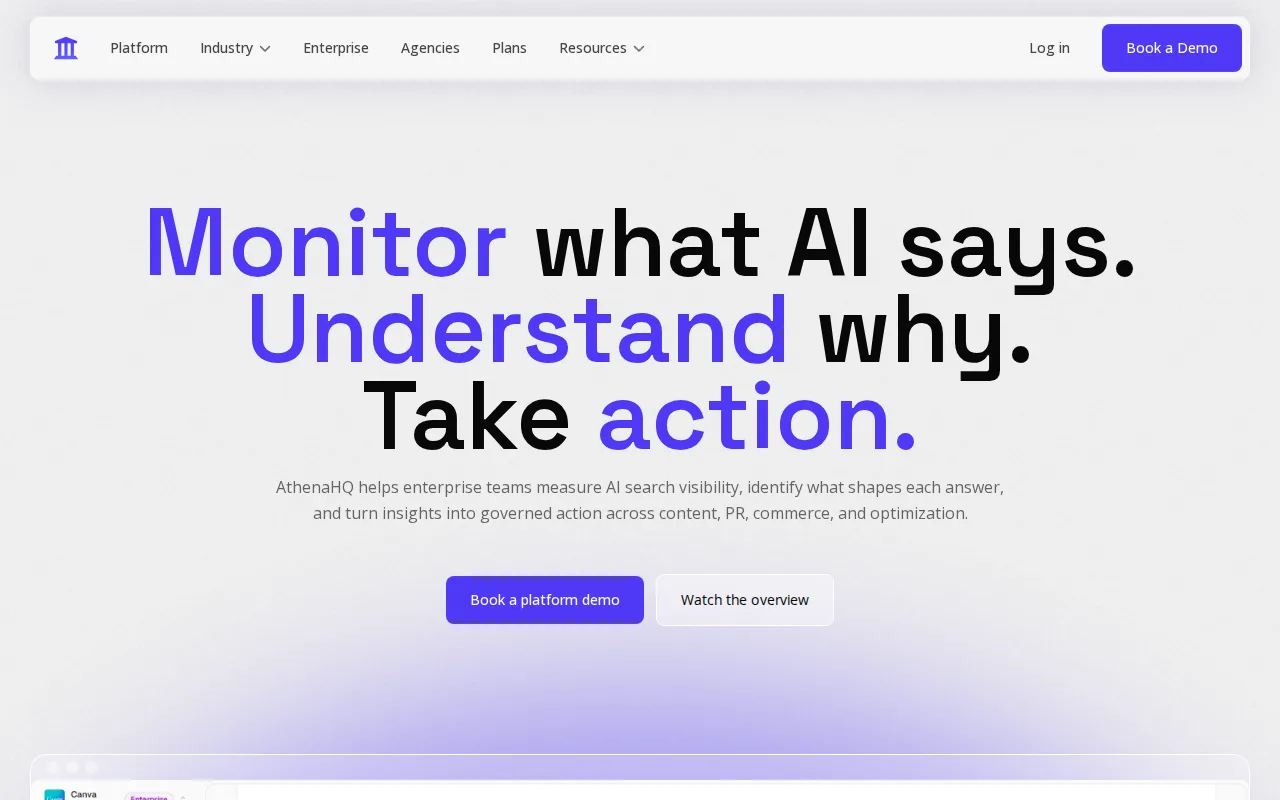
AthenaHQ sells agents that work on AI search rather than a dashboard that watches it, and it runs on a credit model rather than flat feature tiers.
What stands out:
- Free to try properly. $25 of free credit, about 300 credits, with no plan commitment.
- Credit pricing. Starter is $295 a month and includes $300 a month of credit, roughly 3,600 credits.
- Agent led. The product is framed around agents acting on findings, not just reporting them.
- Annual discount. Around 17% off on annual billing.
Pricing: free credit to start, then $295 a month at Starter.
Weakness: credit pricing makes your monthly bill harder to predict than a flat prompt allowance, and $295 is a big step from a free trial with no tier in between.
Who it suits: teams that want automation rather than another dashboard, and can model credit burn.
9. ZipTie.ai
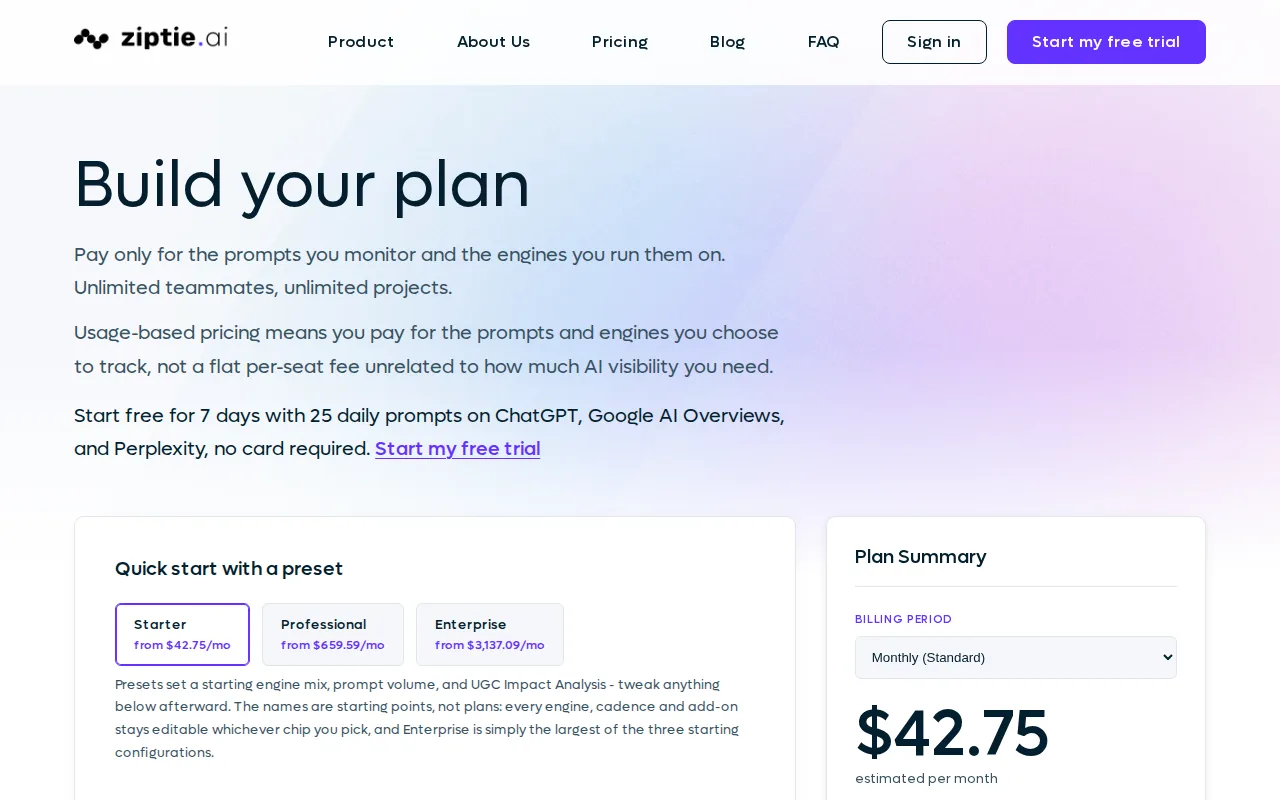
ZipTie.ai is the most configurable option here. Instead of fixed tiers you pick an engine mix, a prompt volume and add-ons, and the price follows.
What stands out:
- Low entry point. The Starter preset begins at $42.75 a month.
- Presets that scale. Professional from $659.59 a month and Enterprise from $3,137.09, so the same product covers a solo site and a large brand.
- Content generation add-on. $20 a month per context for briefs and full pieces, which is unusual in a monitoring tool.
- API and MCP access. A $10 a month add-on exposes every prompt, response, mention and citation to your own systems.
- Free trial with no card. You can see your own data before paying.
Pricing: from $42.75 a month, with add-ons priced individually.
Weakness: configurable pricing means you have to model your own plan before you know what you are spending, and the gap between Starter and Professional is very large.
Who it suits: technical teams who want to tune engine mix and prompt volume and pipe the raw data somewhere else.
What AI visibility means and how it is measured
AI visibility is how often, and how prominently, AI answer engines mention your brand when someone asks a question in your category. It is not a ranking position, because there is no list of ten results to sit in. Either the answer names you or it does not.
Every tool on this list measures it the same basic way: it sends a set of prompts to each engine on a schedule, reads the responses, and records four things.
- Mention rate. The share of tracked prompts where your brand appears at all. This is the number most dashboards call visibility.
- Share of voice. Your mentions as a proportion of all brand mentions across those prompts, which is the only number that tells you whether you are winning or just present.
- Citations. Which specific URLs the engine linked to when it mentioned you. This is the most actionable data in the whole category, because it names the pages doing the work.
- Sentiment. Whether the engine describes you positively, neutrally, or as the cheap option.
Two things follow from that method. First, your numbers are only as good as your prompt set, so a tool with 50 prompts tracking the wrong questions is worse than a free checker asking the right five. Second, AI answers vary between runs, which is why daily tracking and a trend line matter more than any single reading.
LLM rank tracker vs classic rank tracker
An LLM rank tracker and a classic rank tracker answer different questions, and swapping one for the other will mislead you.
A classic rank tracker follows a keyword to a position. Ten blue links, a stable order, one measurable slot. You can chase position three for a term and know what success looks like.
An LLM rank tracker follows a prompt to a mention. There is no position two. The answer is generated fresh, it varies between users and sessions, and it usually names three to five brands in prose. So the metrics change shape: instead of average position you get mention rate and share of voice, and instead of a ranking URL you get a citation list.
The overlap is real, though. The pages AI engines cite are overwhelmingly pages that already rank, appear on listicles, or get linked from authoritative sites. That is why the two disciplines converge in practice, and why our guide to LLM SEO treats them as one programme rather than two. Run both trackers. The classic one tells you whether your content is competitive, the LLM one tells you whether it is being read by the systems your buyers now ask.
How to improve your AI visibility
Measurement is the easy half. Here is what actually moves the number, in the order it tends to pay off.
- Get onto the listicles that already rank. When someone asks an AI engine for the best tool in your category, it leans heavily on roundup articles. Find the ones that rank for your category terms and get included. This is the single fastest lever.
- Publish the pages that answer buyer questions directly. Comparison pages, alternatives pages, pricing explanations and how-to guides. Engines cite pages that answer the prompt cleanly, in plain language, with the answer near the top.
- Fix entity consistency. Your brand name, category description and core facts should match across your site, your profiles, and anywhere else you appear. Models build a picture of what you are from the consensus across sources, and contradictions dilute it.
- Earn links and mentions from sites the models trust. Authority still transfers. More relevant sites referencing you means more sources that can surface you.
- Be present where the training and retrieval data lives. Forums, Q and A sites, video descriptions and syndicated posts all feed retrieval. Our walkthrough of how to optimise content for answer engines covers the format specifics.
- Re-measure monthly, not daily. AI answers are noisy. Look at the trend across a month before you conclude anything about a change you made.
If you want the full tooling picture beyond visibility tracking, our roundup of answer engine optimisation tools covers the optimisation side.
FAQ
What are AI visibility tools?
AI visibility tools send a set of prompts to AI answer engines such as ChatGPT, Perplexity, Gemini and Google AI Overviews on a schedule, then report whether your brand was mentioned, which competitors were mentioned instead, which URLs were cited, and how the engine described you.
Is there a free AI visibility checker?
Yes, two good ones. Ahrefs runs a free AI visibility checker with no signup that covers five engines. Distribb's free AI visibility check asks four engines five buyer questions and shows who was cited instead of you, three checks a day. Both give you a baseline before you pay for anything.
What is AI visibility?
AI visibility is how often and how prominently AI answer engines name your brand when people ask questions in your category. It is measured as mention rate and share of voice across a tracked set of prompts, rather than as a ranking position.
What is an LLM rank tracker?
An LLM rank tracker monitors your brand's presence in AI-generated answers over time. It tracks prompts instead of keywords and mentions instead of positions. Peec AI, Otterly.AI, ZipTie.ai and Profound all work this way, and Distribb pairs the tracking with the content and link work that changes the result.
How is AI search visibility different from SEO?
SEO gets you into a ranked list of links. AI search visibility gets you named inside a generated answer where there is no list. The inputs overlap heavily, since engines cite pages that rank and sites that are widely referenced, but the metrics and the reporting are different.
Is there a ChatGPT visibility checker specifically?
Every tool on this list covers ChatGPT, because it is the engine with the most users. If ChatGPT is your only concern, the free checkers from Ahrefs and Distribb will answer the question in a couple of minutes. Paid monitoring makes sense once you want a trend line and a competitor set rather than a one-off reading.
How much do AI visibility tools cost?
Published entry prices run from free (Ahrefs checker, Distribb checker) to $29 a month for Otterly.AI Lite, $42.75 for ZipTie.ai Starter, $95 for Peec AI Starter, $199 for Semrush bundled with SEO, and $295 for AthenaHQ Starter. Profound and Scrunch quote on a call.
The short version
Start free: run the Ahrefs checker and the Distribb check today and see whether you appear at all. If you need ongoing monitoring on a small budget, Otterly.AI at $29 or ZipTie.ai from $42.75. If you want serious analytics for a team, Peec AI at $95. If you already pay Semrush, use the bundled toolkit. If you are enterprise with an AEO owner, Profound or Scrunch.
And if what you actually want is to stop being invisible rather than to watch it in higher resolution, that takes content, links and distribution running every week. That is the part Distribb runs for you at $97 or $495 a month.