
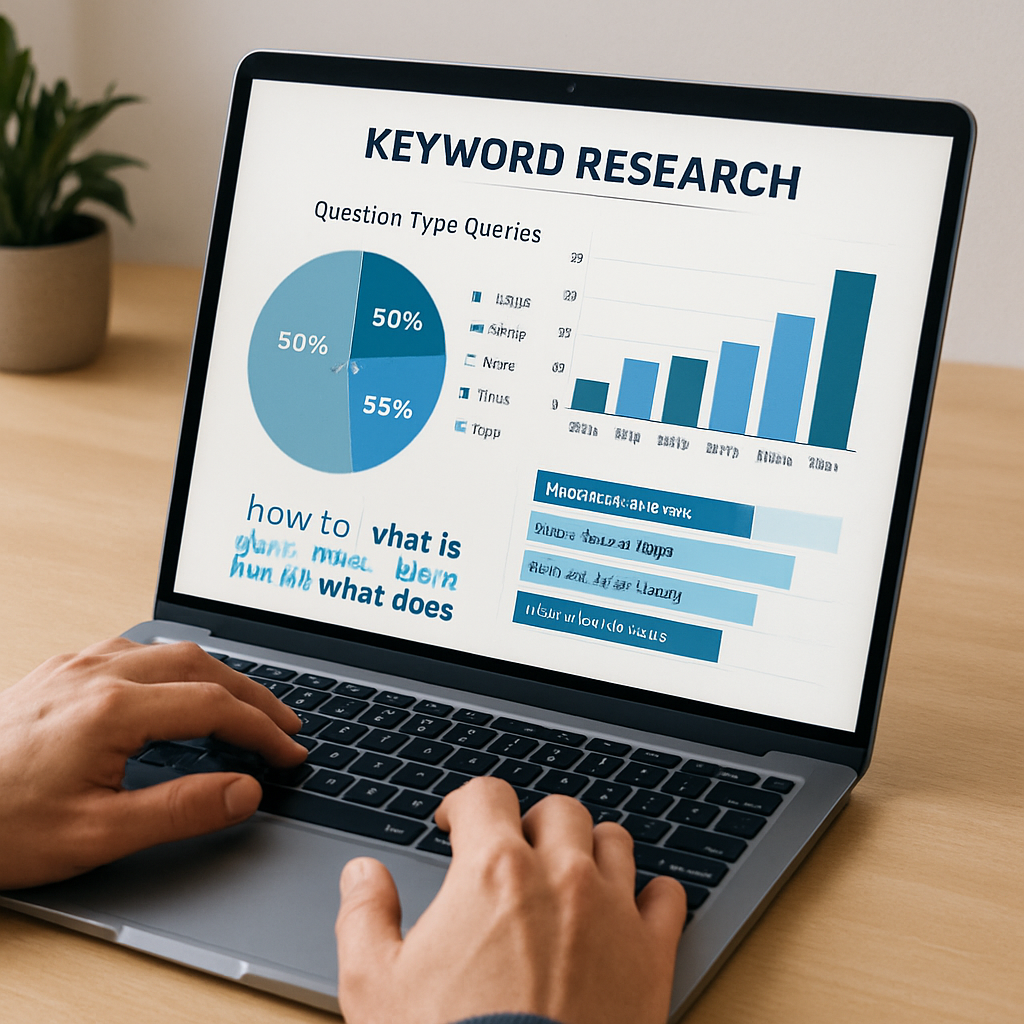
Answer engine optimization is the work of getting cited when someone asks ChatGPT, Perplexity, Gemini or Google's AI Overviews a question instead of typing a query. The category of tools around it is barely two years old and moving fast.
This covers 12 products that were live in August 2026, what each one genuinely measures, and the structural problem every one of them shares: nobody has a complete view of what these engines say, because the engines do not report it.
The measurement problem, first
Search Console tells you exactly how many impressions and clicks a query produced. Nothing equivalent exists for AI assistants.
Every tool below works the same way underneath. It sends a list of prompts to the AI engines on a schedule, records what comes back, and counts how often you were mentioned or cited. That is sampling, not measurement.
Which means three things. Your numbers depend entirely on which prompts the tool runs, so two tools will give you different answers for the same brand. Results vary between runs because these models are not deterministic. And none of it tells you how many real people saw a real answer.
That does not make the category useless. Trend direction and competitive share are genuinely informative. It does mean you should treat any absolute figure as an estimate produced by a specific prompt list, and be suspicious of a vendor who presents it otherwise.
How we tested
Every product below was loaded in a browser in August 2026 and pricing was taken from the vendor's own page where it is published. Several of these companies do not publish pricing at all, which is noted in the entry rather than guessed at.
We also separated tools that monitor from tools that change something, because both are sold as AEO and they are different purchases.
Quick comparison
| Tool | What it does | Engines covered | Pricing |
|---|---|---|---|
| Distribb | Finds where you should be cited, then produces the pages and pitches | Research-led, not prompt sampling | Paid plans |
| Profound | Enterprise AI visibility analytics and agent traffic | ChatGPT, Perplexity, Gemini, Copilot, AI Overviews | Enterprise, not published |
| Ahrefs Brand Radar | AI mention tracking inside an SEO suite you may already have | AI Overviews, ChatGPT and more | Add-on to Ahrefs plans |
| Semrush AI Toolkit | Same idea, inside Semrush | AI Overviews, ChatGPT, Perplexity, Gemini | From ~$99/mo add-on |
| Peec AI | Clean prompt tracking built for marketing teams | ChatGPT, Perplexity, Gemini, AI Overviews | From ~€90/mo |
| Otterly.AI | The affordable entry point for prompt monitoring | ChatGPT, Perplexity, Google AI Overviews | From ~$29/mo |
| AthenaHQ | Prompt insight plus recommended actions | Major engines | Not published |
| Scrunch AI | Monitoring plus how AI crawlers see your site | Major engines | Enterprise, not published |
| Meltwater GenAI Lens | AI visibility inside a PR and media suite | Major engines | Enterprise, not published |
| Goodie | AEO platform aimed at mid-market | Major engines | Not published |
| WordLift | Structured data and knowledge graph automation | Not a tracker, a changer | From ~€59/mo |
| Quattr | Content optimisation with AI search signals | Not a tracker, a changer | Not published |
1. Distribb
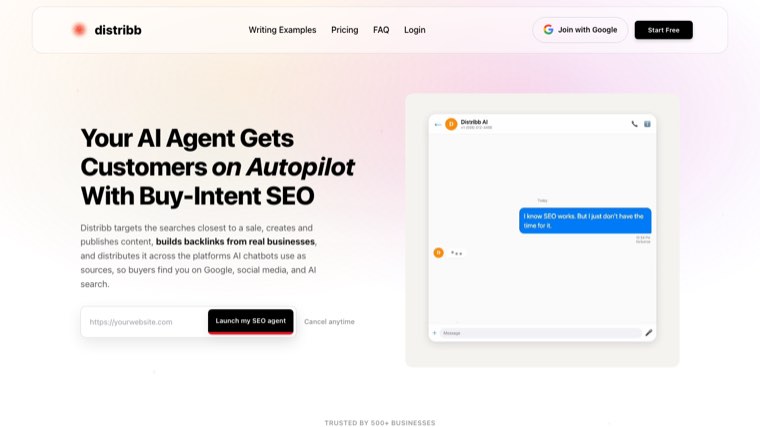
Answer engine optimisation has a measurement problem before it has an optimisation problem. There is no Search Console for ChatGPT, so every tool on this page either samples prompts on a schedule or infers visibility from something adjacent.
Distribb tracks citation status across ChatGPT, Perplexity, Gemini, Google AI Overviews and AI Mode, and reports a visibility score, share of voice, and which of your pages are actually being cited. You add up to 25 of your own buyer prompts per project rather than accepting a generic set, and scans run from your own city, which matters because AI answers are localised and a national average hides what a buyer in your market sees. For a wider comparison of AI visibility tools, including how each one handles prompt volume and engine coverage, see our full roundup.
Then it acts on the gap by publishing the pages that close it, and on the Accelerator plan by placing content on the third-party platforms these engines cite most.
Pros:
- Five engines including AI Mode, which several trackers on this page still do not cover
- Your own 25 buyer prompts per project, rather than a generic set somebody else chose
- City-level scanning, because a national average hides the answer your buyer is given
- Measurement feeds into publishing, so the gap closes in the tool that found it
Cons: AI visibility moves slowly and nothing here can force a citation. Expect months rather than weeks, and treat any tool on this page that promises otherwise with suspicion. This is also not a brand monitoring platform, so if you need AI answers reported next to news and social sentiment, Meltwater does that and Distribb does not.
For who: Teams that want the measurement and the work that follows it in the same place.
Pricing: $97 a month with a 7-day free trial. Accelerator, which runs the off-site distribution for you, is $495 a month. Two prices, no free plan.
2. Profound
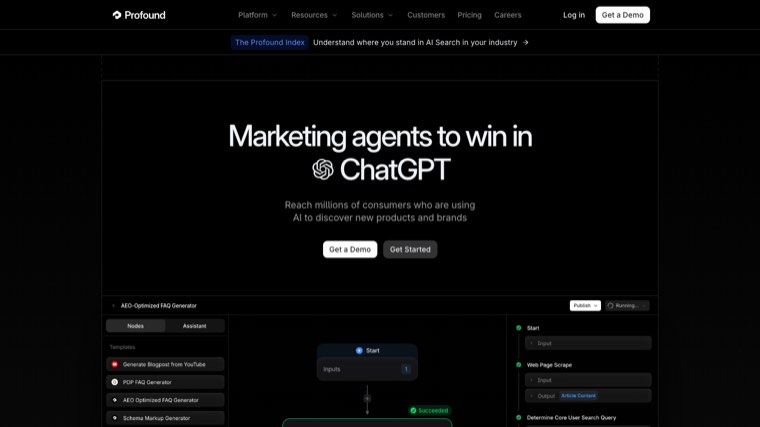
The most established name in the category and the one enterprise buyers shortlist first. Profound tracks brand mentions and citations across the major answer engines, and its Conversation Explorer estimates what people are actually asking, which is the closest thing this category has to keyword research.
The agent analytics deserve more attention than the dashboards. Profound reports how AI crawlers hit your site, so you can establish whether the engines are fetching you at all before arguing about why they are not citing you.
Pros:
- Agent analytics on AI crawler traffic, which tells you whether you are even being fetched
- Conversation Explorer for the prompts people ask, rather than the prompts you guessed
- Citation and mention tracking across the major engines with competitor benchmarking
- The deepest enterprise reporting of anything in this category
Cons: Priced for companies with a budget line for this, and the tier people actually use is the $399 one. It measures and recommends but does not produce or publish the content that would move the numbers, so it is one line item in a programme rather than the programme.
For who: Enterprise marketing teams who need defensible reporting on AI visibility.
Pricing: Starter $99 a month and Growth $399 a month on yearly billing, Enterprise on quote, listed on the Profound site.
3. Ahrefs Brand Radar
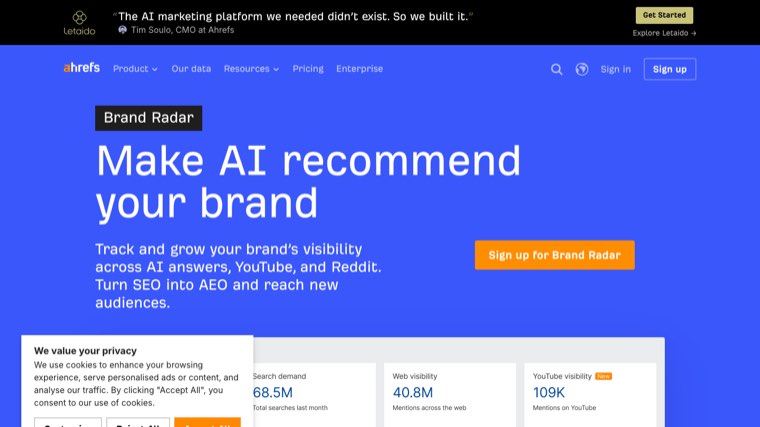
Brand Radar sits inside Ahrefs rather than beside it, and that is its main advantage. It searches a database of hundreds of millions of prompts, so you can research how a brand appears in AI answers without waiting to accumulate your own tracking history first.
The prompt database is the part nothing else here matches. Most tools on this page can only report on prompts you thought to add. Ahrefs can show you prompts you never considered.
Pros:
- A research database of 476M+ prompts, not only the prompts you set up yourself
- Included from the Lite plan with 20 tracked AI prompts, no separate vendor
- Sits beside the backlink and ranking data you already look at daily
- Competitor brand comparison drawn from the same dataset
Cons: Twenty tracked prompts on Lite runs out quickly, and tracking a real prompt set means either a higher plan or a prompt package bolted on top. It is research and reporting only, with no content workflow attached to any of it.
For who: Teams already paying for Ahrefs who want AI visibility without adding a second subscription.
Pricing: Included in Ahrefs plans from $129 a month with 20 tracked prompts. Standalone Brand Radar AI from $199 a month, with custom prompt packages at $50, $100 and $250 a month.
4. Semrush AI Toolkit
Semrush folded AI visibility into its main plans rather than selling it as a separate product. From the Starter plan upward you get prompt tracking, AI sentiment monitoring and visibility reports for any domain, in the same subscription as position tracking and site audit.
Bundling is the whole argument. If you already pay Semrush, adding AI visibility costs a plan upgrade rather than a new vendor, a new login and a second invoice.
Pros:
- 50 prompts tracked daily on the entry AI plan, more than several standalone tools sell
- AI visibility reports for any domain, so competitor research needs nobody's cooperation
- Sits beside rank tracking and audits, one subscription instead of two
- Sentiment monitoring alongside the raw citation counts
Cons: The cheapest plan that includes any of it is $199 a month, so the AI features cost a $60 step up from the SEO plan whether you use the rest or not. Prompt-level detail is thinner than the specialists here, and like them it measures without publishing anything.
For who: Existing Semrush customers who want AI visibility without onboarding another vendor.
Pricing: Bundled from the Starter plan at $199 a month, Pro+ $299, Advanced $549. The $139 SEO plan does not include AI visibility.
5. Peec AI
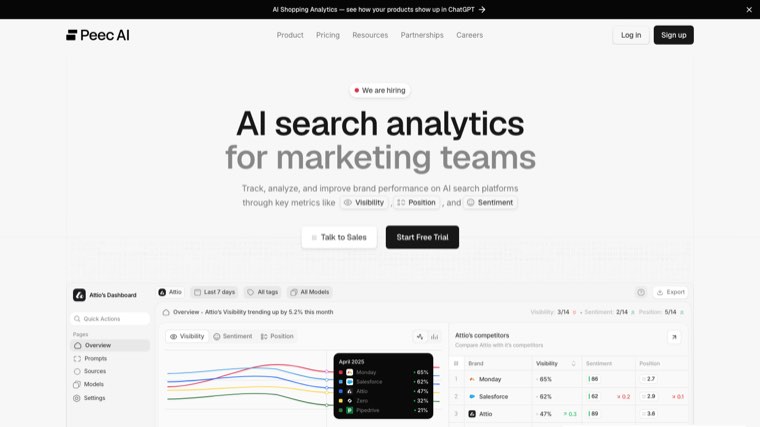
A European tracker built for marketing teams and agencies, with a fast, uncluttered interface and unlimited users on every plan. That last detail matters more than it sounds, because most tools here charge per seat and a team of eight gets expensive quickly.
Tracking runs daily across your chosen models, with competitor comparison and source-level reporting on which pages the answers are drawn from.
Pros:
- Unlimited users on every plan, which removes the per-seat arithmetic entirely
- Daily tracking frequency even on the entry plan
- Source reporting showing which pages and domains the engines pulled from
- Multi-project setup built with agencies in mind
Cons: Fifty prompts and three models on the entry plan is a narrow window, and the model cap stays at three until you climb the tiers. The published prices are annual, so monthly billing costs more than the headline suggests. It measures and nothing more.
For who: Agencies and marketing teams with several people who all need the same dashboard.
Pricing: Starter $80 a month, Pro $205, Advanced $420, on annual billing. Enterprise on quote.
6. Otterly.AI
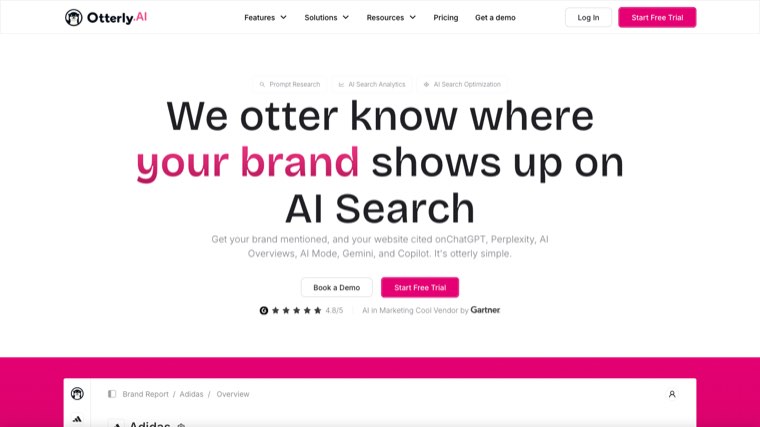
The cheapest real way onto this page. Otterly tracks brand mentions, links and sentiment across ChatGPT, Perplexity, Google AI Overviews and others, and the $29 plan is a working product rather than a trial in disguise.
For a small business testing whether AI search sends anything at all, this is the sensible first purchase. You find out whether you have a problem before deciding how much to spend solving it.
Pros:
- A working plan at $29 a month, the lowest genuine entry price in this category
- Link tracking, not only mentions, so you see whether citations point anywhere useful
- Sentiment on how the brand is described, not just whether it appeared
- Simple enough to set up in an afternoon
Cons: The Lite plan is thin on prompt volume and history, and the step to Standard is another $160 a month, which is a steep second tier. Reporting is basic next to Profound or Scrunch, and nothing here acts on what it finds.
For who: Small businesses and solo marketers working out whether AI search matters for them yet.
Pricing: Lite $29 a month, Standard $189, Premium $489, Enterprise on quote. Around 15% off on annual billing.
7. AthenaHQ
Built by former Google search people and priced on credits rather than prompts, which suits a monitoring load that moves around from month to month. There is a free tier with 300 credits, so you can see the product working before committing anything.
Athena leans harder into recommendations than most trackers here, generating specific content and structure suggestions instead of only reporting where you stand.
Pros:
- A genuine free tier with 300 credits, which is rare in this category
- Credit-based pricing that fits uneven or campaign-shaped usage
- Actionable recommendations rather than visibility numbers alone
- Competitor tracking drawn from the same credit pool
Cons: The step from free to $295 a month has nothing in between, so you commit on the strength of 300 credits. Credit accounting also makes the monthly bill harder to predict than a flat prompt allowance, and heavy competitor tracking burns the allowance fast.
For who: Teams that want recommendations attached to the measurement and can live with credit maths.
Pricing: Essential free with 300 credits. Starter $295 a month with 3,600 credits, roughly 17% cheaper annually. Enterprise on quote.
8. Scrunch AI
Scrunch comes at the problem from the crawler side. It monitors how AI agents experience your site, tests whether they can read and parse what you publish, and reports the gap between what you serve and what the engines take away.
That angle is worth understanding before you buy anything else here. Plenty of brands are invisible in AI answers for a technical reason rather than a content one, and most tools on this page cannot tell you which of the two you have.
Pros:
- Agent-side monitoring, testing what the crawler actually gets from your pages
- Separates technical invisibility from weak content, which changes the fix completely
- Multi-brand support with enterprise-grade reporting
- Optimisation guidance tied to what the agents found rather than generic advice
Cons: The entry plan is $300 a month month-to-month, so this is not something you buy to test a hypothesis. It is aimed at larger sites too, and a ten-page site will have heard everything it has to say inside a week.
For who: Larger sites that suspect the problem is how AI crawlers read them, not what they wrote.
Pricing: Starter $300 a month, Growth $500 a month, both about 17% cheaper annually. Enterprise on quote.
9. Meltwater GenAI Lens
Meltwater is a media intelligence platform that added AI answer monitoring to a suite already covering news, broadcast and social. GenAI Lens sits inside that, so AI citations get reported next to press mentions and social sentiment.
Scope is the reason to consider it. If the real question is how the brand is being talked about everywhere, AI answers are one channel among several, and buying a dedicated AI tool splits the picture into two reports nobody reconciles.
Pros:
- AI answers reported beside news, broadcast and social, one view of brand presence
- Mature PR and comms workflows that the AI-native tools have not built yet
- Multi-market and multi-language coverage as standard
- A large analyst and support organisation behind the platform
Cons: Pricing is quote-only with no figures published anywhere, and Meltwater contracts are annual and enterprise-sized. The AI-specific depth is also shallower than the specialists, because this is one module inside a large suite rather than the whole product.
For who: Comms and PR teams already running Meltwater who want AI answers in the same reporting.
Pricing: Not published. Every tier routes to a sales conversation, so expect an annual enterprise contract.
10. Goodie
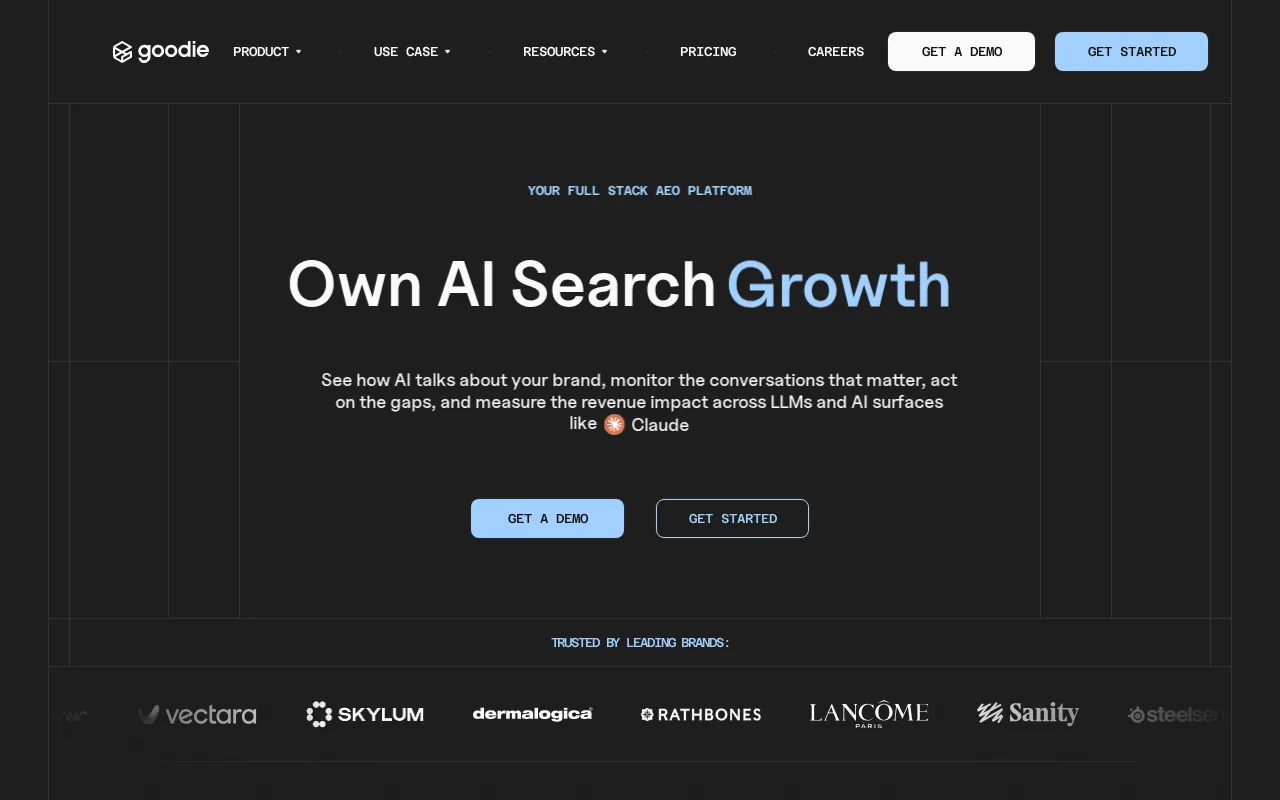
Goodie positions itself as an end-to-end AEO platform rather than a tracker, closing the loop from prompt research through monitoring to optimisation actions and revenue attribution.
The revenue attribution is the interesting claim. Tying AI visibility to analytics outcomes is the number every executive asks for and almost nothing else on this page attempts to answer.
Pros:
- Revenue attribution through Google Analytics, which most trackers here do not attempt
- A stated number of optimisation actions included monthly, not just reports
- Agentic commerce visibility at SKU level on the Pro tier
- A 7-day free trial on the entry plan
Cons: $399 a month is the entry price, and it is the only tier with a published figure, with Pro and Enterprise behind a demo. Optimisation actions are capped at ten a month on Explorer, which does not go far if the site needs real work.
For who: Ecommerce and mid-market brands that need AI visibility tied to revenue rather than impressions.
Pricing: Explorer $399 a month with a 7-day free trial. Pro and Enterprise are demo-gated with no published price.
11. WordLift
WordLift comes at answer engines through structured data. It builds a knowledge graph of your site, marks it up so machines can parse the entities and the relationships between them, and publishes that graph for the engines to consume.
This is the least fashionable approach on the page and arguably the most durable. Entity clarity is what lets a model state a fact about you with confidence, and it does not stop working when a tracking dashboard changes its methodology.
Pros:
- A real knowledge graph, rather than schema snippets bolted onto templates
- Entity-level markup that gives models something unambiguous to cite
- WordPress and headless integrations that keep the markup automated
- Technical foundations that outlast dashboards
Cons: €999 a month on monthly billing is the entry point, which is enterprise pricing for what is fundamentally structured data automation. There is no prompt tracking either, so you cannot see whether any of it moved your citations without buying something else on this page.
For who: Publishers and large content sites that want the machine-readable groundwork done properly.
Pricing: Business+ €999 a month, or €799 a month billed yearly. Enterprise on quote.
12. Quattr
Quattr unifies SEO, AEO and GEO in one platform, scoring content against what is ranking and what is being cited, then recommending specific changes page by page.
The recommendations are the strongest part of it. Rather than handing over a visibility score, it names which sections of a given page to change and why, which is closer to work than to measurement.
Pros:
- Page-level recommendations instead of a single site-wide score
- Traditional SEO and AI visibility in one platform, so the two are not planned separately
- Strong standing on G2 among mid-market and enterprise users
- A free trial without a card up front
Cons: No published pricing at all. The pricing URL redirects to a demo booking page, so every evaluation starts with a sales call, which rules it out for smaller teams before the product is even assessed. The platform is broad, so onboarding is a project rather than a signup.
For who: Mid-market teams wanting one platform for search and answer engines, who will sit through a demo.
Pricing: Not published. The pricing page redirects to a demo request, so expect a sales-led quote.
The free tools worth using first
Ask the engines yourself. Take the 20 questions a prospective customer would actually ask, put them into ChatGPT, Perplexity and Gemini, and write down what comes back. This is a morning's work, it costs nothing, and it will tell you more than a month of any dashboard.
Google Search Console now separates some AI Overview impressions in its performance data. Imperfect, but it is first-party rather than sampled.
Bing Webmaster Tools matters more than it used to, because Copilot leans on Bing's index.
Schema validators from Google and Schema.org confirm your structured data actually parses, which is a prerequisite rather than a strategy.
What actually gets you cited
The tools measure. These are the things that move the number.
Being on the pages the engines already cite. AI assistants lean heavily on roundups, comparison pages and listicles from third-party sites. If a "best X tools" article gets cited for your category and you are not in it, that is the single highest-value thing to fix, and it is an outreach job rather than an on-page one.
Answering the question directly, early. A clear, self-contained answer in the first two sentences under a heading phrased as the question. Models extract passages, not pages.
Being specific enough to be worth quoting. Original numbers, named products, real prices, dates. Generic advice is interchangeable and never gets attributed.
Consistency across the web. The same claims about your business on your site, in directories, on review sites and in coverage. Contradictory information makes a model uncertain, and uncertain models hedge rather than name you.
Ordinary technical accessibility. Renderable without JavaScript, crawlable, fast, with working structured data.
Our usable guide to answer engine optimization covers the process end to end, LLM SEO covers what changed underneath, and optimising for AI Overviews and how to optimize for SGE cover Google's version specifically.
Frequently asked questions
Is AEO different from SEO? The underlying work overlaps heavily: be accurate, be specific, be crawlable, be cited by others. What differs is the target and the measurement. You are optimising to be the source inside an answer rather than a result next to one, and you cannot measure it properly.
Do I need a dedicated AEO tool? Not yet, for most businesses. Ask the engines your customers' questions manually first. If your category shows up in AI answers and you do not, then buy something cheap like Otterly to track it. Enterprise tooling is for companies where this is already a board-level number.
How accurate are AI visibility scores? They are estimates from a sampled prompt list against non-deterministic models. Two tools will disagree about the same brand, and the same tool will disagree with itself between runs. Use the trend and the competitive comparison, not the absolute figure.
Does schema markup help with AEO? It helps by making entities and relationships explicit, and it is worth doing. It is not the lever it gets sold as. Being cited by sources the model already trusts matters considerably more.
How long does AEO take to work? Changes to your own pages can appear in answers within weeks, faster than organic rankings, because the models re-crawl frequently. Getting onto the third-party pages the engines cite takes as long as any outreach, which is months.
Is AI traffic actually worth anything? Referral volume from AI assistants is small compared to organic search for most sites, and growing quickly. The stronger argument is not the clicks but the recommendation: being the answer to "which tool should I use" is worth more per mention than a search result, even at low volume.