

Most articles on this keyword open by listing builders. That skips the two questions that actually determine your answer, so this one starts there instead.
The first question is whether your website handles protected health information at all. A large share of medical practice sites do not, and those sites have no HIPAA obligation to satisfy in the first place. The second question is whether a vendor will sign a Business Associate Agreement with you in writing. Nothing else on a features page matters if the answer to that is no.
Start here: does your website actually touch PHI?
HIPAA applies to protected health information, not to healthcare businesses in general. Your website is in scope if it collects, stores, transmits or displays information that identifies a patient and relates to their health, payment or care.
In practice, that means your site is in scope if it has any of these:
- An intake form, symptom questionnaire or new patient form
- Appointment booking that captures a reason for the visit
- A patient portal, chart access or test result lookup
- Telehealth video or messaging
- A contact form where patients describe a medical problem
- Payment collection tied to a specific treatment
- Live chat that patients use to describe symptoms
Your site is very likely out of scope if it is a brochure: services, bios, hours, location, a phone number, and a contact form that asks only for a name and email with no medical detail. A marketing site like that can run on ordinary hosting.
This distinction is worth several hundred dollars a month. HIPAA hosting and compliant builders cost three to ten times what standard hosting costs. Paying for that on a five page brochure site is a common and expensive mistake, and none of the pages currently ranking for this query lead with it.
One caveat that catches people out. If your brochure site loads a tracking pixel on a page where a patient books or describes a condition, that pixel can transmit PHI to a third party. The scope question is about what data moves, not about how the page looks. Ad conversion tags carry the same risk, which we cover in our comparison of Google Ads vs SEO for medical practices.
The one fact that decides everything: the BAA
A Business Associate Agreement is the contract that makes a vendor legally accountable for the PHI they handle on your behalf. If a vendor will not sign one, you cannot put PHI on their platform, no matter how much encryption they advertise.
This is why "HIPAA compliant hosting" and "bank grade encryption" on a pricing page prove nothing on their own. Encryption is a technical control. The BAA is the legal instrument, and it is the only one of the two that a regulator will ask to see.
Watch the wording closely, because vendors use three different phrases and they mean three different things:
- "We sign a BAA" is the one you want. It is a commitment, and you should have the countersigned document before you upload a single record.
- "HIPAA compliant infrastructure" describes the servers. It says nothing about who carries the legal responsibility.
- "HIPAA ready" is marketing. It usually means the platform has the technical pieces available but the compliance work, and sometimes the BAA itself, is on you.
I flag the exact phrase each vendor uses below, because two of the nine here say "ready" rather than "compliant" and that difference should change your shortlist.
The three routes to a compliant healthcare website
Search Console data on this page shows something the ranking articles miss. People arriving on this query are not all looking for the same product. Some want a drag and drop builder, some want a design agency, and a large group is actually looking for hosting.
Those are three different purchases with different price points and different failure modes. Working out which one you are making removes most of the options before you compare a single feature.
Route 1, a healthcare platform that includes a website. You get a site as part of a practice management or EHR product. Cheapest, fastest, least flexible. Right for solo practitioners and small practices who want the compliance problem to be someone else's.
Route 2, a no-code builder that will sign a BAA. You build the site or portal yourself on a platform with compliance controls. Mid to high cost, high flexibility. Right when you need a custom patient workflow rather than a standard practice site.
Route 3, self-hosted on HIPAA hosting. You run WordPress or similar on infrastructure from a host that signs a BAA. Most control, most responsibility, and the compliance burden for the application layer sits with you. Right for organisations with technical staff.
A rough rule: if you cannot name the person who will patch your server, Route 3 is not for you.
BAA status and pricing at a glance
Everything below was checked on the vendors' own pages in August 2026. Prices are list prices for the lowest tier that is relevant to a healthcare site, and they move, so confirm before you commit.
| Vendor | Route | Published BAA position | Entry price |
|---|---|---|---|
| SimplePractice | 1, platform | Dedicated BAA page, HIPAA and HITRUST badges | $49/mo |
| Brighter Vision | 1, platform | BAA via the Hushmail secure email add-on | $99/mo |
| MedSiteAI | 1, platform | States "HIPAA ready", mentions BAAs | $399/mo |
| Blaze | 2, no-code | "BAA with every production customer", signed in days | $750/mo |
| Caspio | 2, no-code | Offers BAAs, compliance accounts on separate infrastructure | $300/mo plus $500/mo compliance |
| Quickbase | 2, no-code | Signs BAAs on annual or multi-year contracts | Quote |
| Knack | 2, no-code | Not on standard plans, separate Knack Health offering | $59/mo, HIPAA priced on request |
| HIPAA Vault | 3, hosting | "A BAA for every HIPAA service we offer" | Quote only |
| Liquid Web | 3, hosting | Signed BAAs for HIPAA hosting environments | $344/mo |
Two things stand out. The cheapest genuine route into compliance is a practice management platform, not a website builder. And the no-code builders that market themselves hardest on HIPAA are the most expensive option on the page.
Route 1: healthcare platforms that include a website
1. SimplePractice, the default for solo and small practices

SimplePractice is an EHR and practice management product for health and wellness professionals, and a professional website is one of its features. That framing matters: the website is an output of a compliant system rather than a separate thing you have to make compliant.
Pricing runs $49, $79 and $99 a month across Starter, Essential and Plus. It publishes HIPAA, HITRUST and PCI badges and maintains a dedicated BAA page, which is the clearest signal on this list that the legal side is handled as routine rather than as an exception.
One thing to check before you buy. The pricing page does not state which tier includes the professional website, so confirm that with sales rather than assuming it is on Starter. Ask in the same conversation whether the BAA covers the website component specifically, not just the EHR.
Best for therapists, counsellors, dietitians and small allied health practices who want one vendor for notes, booking, billing and the site.
2. Brighter Vision, done-for-you therapy websites

Brighter Vision builds and maintains the site for you rather than handing you an editor. Plans are $99, $179 and $349 a month, dropping to $78, $143 and $299 on annual billing, and every tier includes a site built by their design team plus hosting, security and unlimited support.
The compliance piece is an add-on rather than a default, and this is the detail to get right. HIPAA-compliant email and secure web forms come through a Hushmail integration that carries the BAA, priced separately from $14.99 to $24.99 a month. The Flourish tier at $349 folds those in at no extra cost.
So the honest read is that the base plan is a marketing site, and the compliance capability arrives when you add the secure forms and email layer. If you need a patient intake form on day one, budget for Flourish or for the add-on, not for Start.
Best for therapy and counselling practices that want no involvement in building or maintaining the site.
3. MedSiteAI, the AI-generated medical site
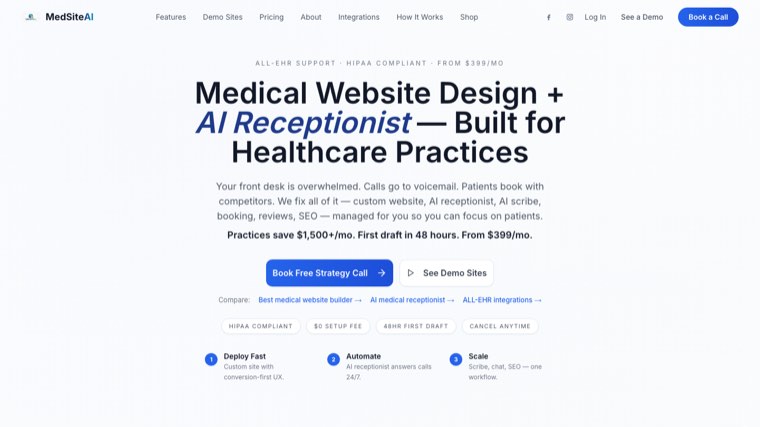
MedSiteAI generates a full medical website from a prompt, with 60 plus healthcare templates, a patient enquiry chatbot and an AI blog writer. It starts at $399 a month with no setup fee and no contract, which is aggressive against the incumbent medical web vendors it compares itself to.
Here is the limitation, and it is the reason this entry is third rather than first. Its own pages describe the platform as "HIPAA ready" and mention BAAs, rather than stating flatly that it signs one with every customer. That is a materially weaker position than SimplePractice's dedicated BAA page or Blaze's "BAA with every production customer".
"HIPAA ready" may well resolve into a signed BAA once you talk to them. Get it in writing before any patient data goes near it. The AI content features are also worth a sceptical look if you care about search: automated blog output on a medical site is the highest risk content category there is, and thin AI pages on a YMYL topic tend to lose rather than gain visibility.
Best for practices that want a modern site fast and are prepared to do the BAA diligence themselves.
Route 2: no-code builders that will sign a BAA
4. Blaze, the clearest BAA commitment on this list
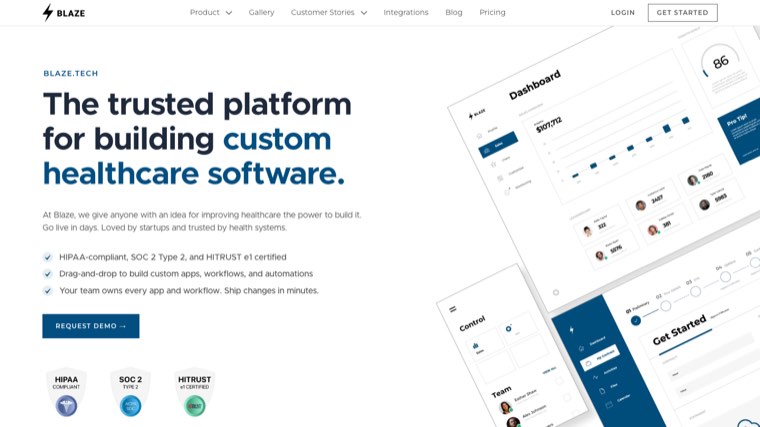
Blaze is a no-code builder aimed specifically at healthcare teams building patient portals, intake workflows and internal tools rather than brochure sites. Of the nine vendors here it takes the least ambiguous position on the contract: its pricing page carries the line "BAA with every production customer" and promises the document signed within days over DocuSign, on HITRUST e1 and SOC 2 Type II infrastructure.
Pricing is a free Sandbox tier for building without real data, Production from $750 a month once you go live with PHI, Growth from $2,500, and custom Enterprise pricing where EHR integration is involved. The Sandbox tier is genuinely useful, because it lets you prototype the workflow before committing to the price of compliance.
The limitation is that price. At $750 a month minimum this is roughly fifteen times a SimplePractice subscription, and it buys you a builder rather than a practice management system. If what you need is a standard practice website with an intake form, this is the wrong tool at the wrong price.
Best for digital health startups and larger practices building a custom patient-facing workflow. Read Blaze's HIPAA positioning before you book a call so the pricing conversation starts in the right place.
5. Caspio, the audited database route
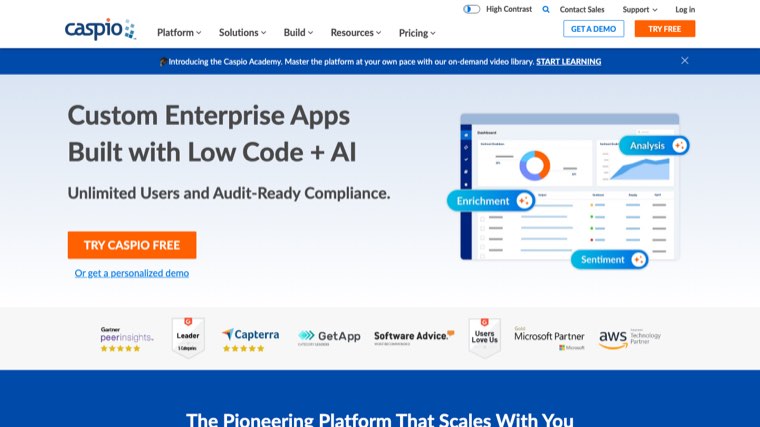
Caspio is a low-code platform for building database applications, and its compliance story is structural rather than promotional. HIPAA accounts run on separate infrastructure governed by its compliance policies, with database encryption at rest and an audit trail covering every read, write, edit and delete. It offers BAAs to customers and maintains them with its own vendors, and it publishes a SOC 2 Type 2 attestation.
Pricing is $300 a month for Team and $600 for Business, with the compliance account adding $500 a month on a one year term. So the realistic floor for a HIPAA deployment is $800 a month on an annual commitment.
The limitation is scope. Caspio builds applications, not marketing websites. You would use it for the patient portal or the intake system and run your public site elsewhere, which means two vendors and two bills.
6. Quickbase, enterprise workflow with an attestation
Quickbase is an operations and workflow platform rather than a website builder, and it earns a place here because of how specific its compliance documentation is. Its annual SOC 2 Type II report includes independent attestation against the administrative, physical and technical safeguards of the HIPAA Security Rule at 45 CFR 164.308, 164.310 and 164.312. That is a stronger evidence trail than a badge on a homepage.
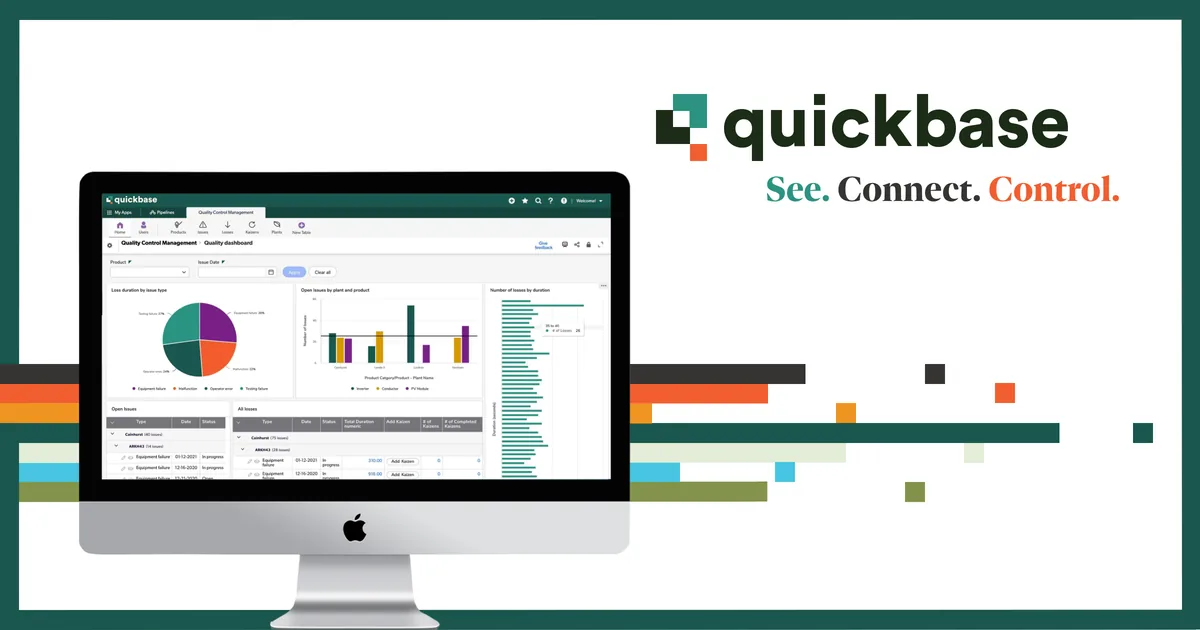
It signs BAAs with customers on annual or multi-year contracts, arranged through an account executive, and operates a shared responsibility model: Quickbase secures the platform, you remain responsible for how your apps and realms are configured. Pricing for a healthcare deployment is quote based.
The limitation is the same as Caspio's, only more so. Nobody should buy Quickbase to publish a practice website. It belongs on this page because two of the articles ranking for this keyword list it as a website builder, and you should know what you would actually be buying.
7. Knack, cheap until you need HIPAA
Knack is a no-code database application builder with the friendliest entry price in this group, at $59 a month for Starter, $130 for Pro and from $300 for Corporate. If you are building an internal tool with no PHI in it, that is good value.
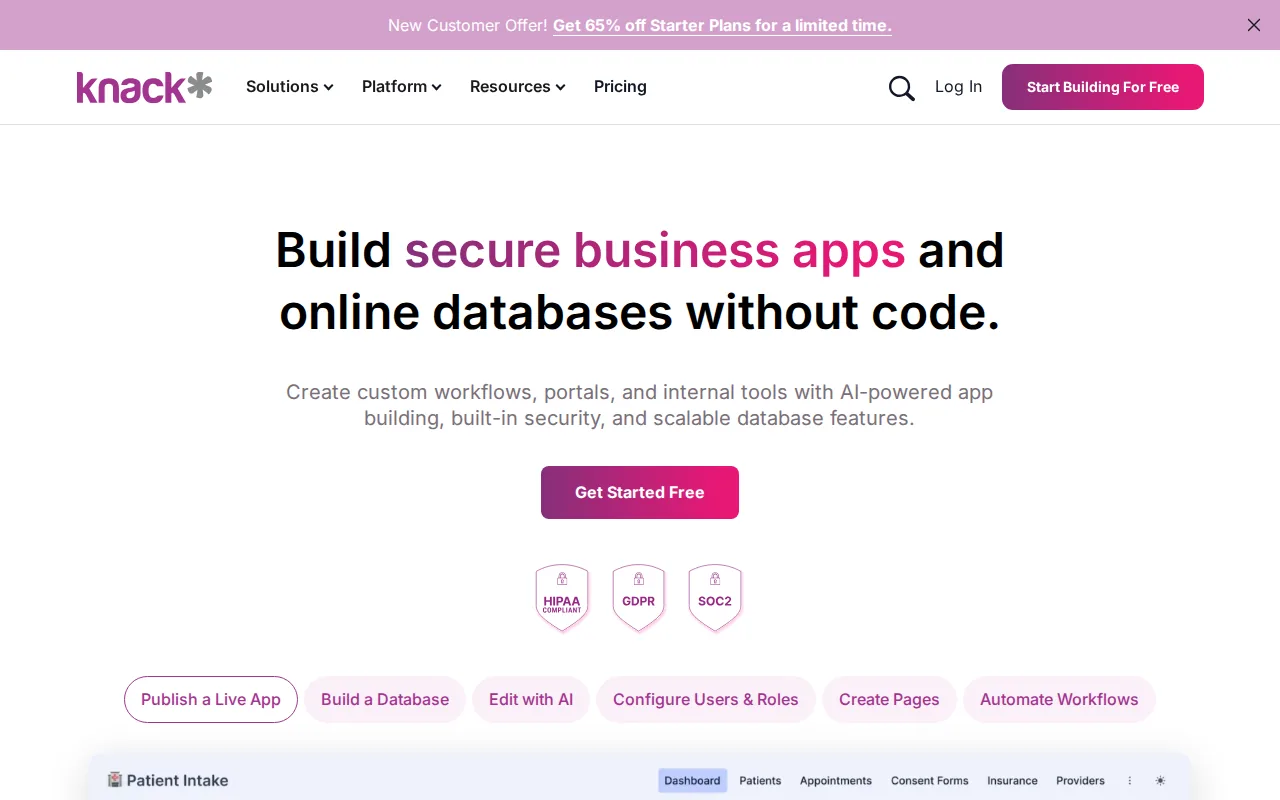
The compliance situation is the catch, and it is worth stating plainly because the price is what draws people in. HIPAA is not available on the standard plans. Knack's own pricing page points HIPAA enquiries to a separate Knack Health offering, and while Enterprise plans reference HIPAA and GovCloud options, neither the price nor the BAA terms are published. So the $59 figure has no bearing on what a compliant deployment costs.
Route 3: self-hosted on HIPAA hosting
This route exists because standard WordPress is not HIPAA compliant and cannot be made so by adding a plugin. What makes a self-hosted site compliant is the infrastructure underneath it plus the configuration work on top, and that starts with a host that signs a BAA.
8. HIPAA Vault, managed HIPAA WordPress
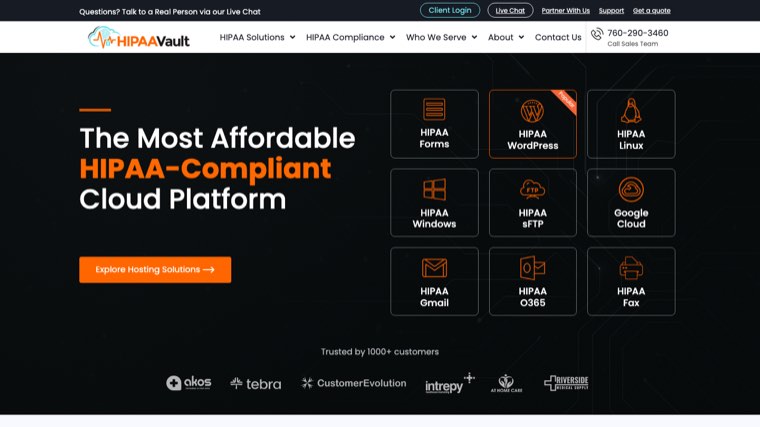
HIPAA Vault does one thing: compliant hosting and the services around it. That covers HIPAA WordPress and WooCommerce hosting, Linux and Windows environments, secure forms, compliant email and Google Cloud work. Its BAA position is the most direct sentence any vendor on this page publishes: a BAA for every HIPAA service it offers.
The limitation is commercial rather than technical. No pricing is published at all, so every evaluation starts with a sales conversation and you cannot benchmark it against Liquid Web without one. For a small practice comparing options on a Sunday evening, that is a real obstacle.
Best for organisations that want managed WordPress specifically, and have someone who can run the site once it is handed over.
9. Liquid Web, published prices for HIPAA infrastructure
Liquid Web sits at the opposite end of that transparency question. It provides signed BAAs for its HIPAA hosting environments and publishes what they cost: a single server Linux configuration from $344 a month, Windows from $384, and multi-server setups from $788 on Linux or $958 on Windows. Environments include dedicated firewalls, encrypted backups and VPN access.
The limitation is that this is infrastructure, not a website. You are buying servers with the right controls and the right contract, and everything above that line, including WordPress hardening, plugin vetting, patching and access control, is your responsibility. That work is ongoing and it is where self-hosted HIPAA sites usually fail, long after the server was set up correctly.
Because a self-hosted site puts recovery on you as well, have a tested restore path before you go live rather than after your first incident. The same discipline applies on any CMS, and the mechanics are similar to what we covered in securing and restoring a Webflow site.
The builders that will not work, and why
These come up constantly in the search data for this topic, including the query "is wix hipaa compliant", so it is worth being blunt.
| Platform | Position | What that means for you |
|---|---|---|
| Wix | No BAA offered | Fine for a brochure site with no PHI. Cannot host an intake form. |
| Squarespace | No BAA offered | Same. Popular with practices, and a compliance risk the moment a form asks about symptoms. |
| WordPress.com | Not compliant out of the box | Different product from self-hosted WordPress. The managed service does not carry a BAA. |
| Self-hosted WordPress | Compliant only on HIPAA hosting | The software is neutral. Compliance comes from the infrastructure and configuration. |
| Generic no-code builders | No BAA | Marketing copy about "healthcare templates" is not a compliance claim. Ask for the BAA. |
None of these platforms are doing anything wrong. They are general purpose website tools that never took on business associate obligations, and using one for a marketing site is completely reasonable. The failure mode is adding a patient form to a site built on one of them.
Three products the ranking articles list that are not website builders
While verifying this page I checked what the top ranking results recommend, and a pattern showed up worth naming. Two of the highest ranking articles on this keyword present workflow and database platforms as HIPAA compliant website builders.
Nintex is a case in point. Its own homepage describes it as process management and workflow automation software. It is a capable product and it is not a website builder, so recommending it to a dentist who needs a new practice site is a category error rather than a close call. I left it out for that reason.
Caspio and Quickbase are in the same family, and I kept them here but labelled them accurately: they build applications and portals, not marketing sites. If you follow one of those articles and buy a workflow platform expecting a website, you will have spent several hundred dollars a month on the wrong thing.
Step by step: taking a healthcare site live without breaking HIPAA
1. Decide whether PHI touches the site. Use the list at the top of this page. If nothing on it applies, buy ordinary hosting and stop here. 2. Write down every place PHI would enter. Forms, booking, chat, portal, uploads, email notifications. Each one is a decision point, and email notifications are the one people forget. 3. Pick your route from the three above based on who will maintain the site, not on which features look best. 4. Get the BAA before anything else. Ask for the document, read who carries responsibility for what, and keep the countersigned copy. If a vendor stalls on this, that is your answer. 5. Separate the marketing site from the PHI system wherever you can. A public brochure site on standard hosting, linking to a compliant portal on a separate platform, is cheaper and lower risk than making one system carry both jobs. 6. Audit third party scripts on any page that touches PHI. Analytics, ad pixels, chat widgets, heatmaps and font loaders all send data somewhere. Tracking pixels on patient-facing pages are a recurring source of enforcement action. 7. Turn on audit logging and access controls, and assign named accounts rather than a shared practice login. 8. Document your configuration and set a review date. Compliance is a state you maintain, not a setup task you finish. 9. Test a restore. Take a backup, delete something in a staging copy, and put it back.
Step 5 is the one that saves the most money. A great many practices do not need a compliant website at all. They need a compliant form or portal, and an ordinary site pointing at it.
What HIPAA does not cover: getting the site found
Compliance and visibility are separate problems, and solving the first does nothing for the second. A perfectly compliant practice site with no organic traffic is still a site nobody visits.
This is where the honest boundary of our own product sits. Distribb is an AI SEO and content platform. It is not a website builder, it does not host anything, it does not sign BAAs, and it should never be connected to a system holding PHI. It belongs nowhere on the list above, and putting it there to sell software would be exactly the wrong trade.
Where it is relevant is the public marketing layer of a healthcare site: the service pages, the condition explainers, the local pages, the questions patients type before they call. That work happens on the non-PHI side of the line, and it is ordinary content and SEO work with a higher accuracy bar than most industries. Two things matter more here than in other verticals. Medical content needs clinical review before it publishes, because search engines apply their strictest quality standards to health topics, and automated content on YMYL subjects is more likely to lose ground than gain it. It is also worth understanding how to optimize for AI search, since a growing share of patient research now happens inside AI answers rather than on a results page.
If you want the content side handled after the compliant site is live, Distribb is built for that, with the caveat above about review. If you want the site itself built, one of the nine vendors above is your answer, not us.
How we tested
Nine vendors are listed here. Thirteen were considered.
Each candidate homepage was loaded in a real browser at 1440 by 900 and captured, and every screenshot on this page comes from that pass rather than from a press kit. BAA language and pricing were read off each vendor's own pricing, compliance or trust pages in August 2026, and quoted rather than paraphrased where the wording matters.
Four candidates were dropped:
- PatientGain returned HTTP 403 to every request. It appears to be an active business, but nothing about its current offering could be verified, so it is not recommended here.
- Atlantic.Net returned a bot-check interstitial rather than its site on repeated attempts. Same outcome for the same reason.
- Nintex loaded fine and is workflow automation software, not a website builder.
- Unicorn Platform is a general website builder with no BAA, so it belongs in the "will not work" table rather than in the list.
Two limits on this research are worth stating. Published BAA language is not the same as a countersigned BAA, so treat everything in the table above as a starting point for a conversation rather than as a guarantee. And prices are list prices from vendor pages on one day; compliance tiers in particular are frequently quote-based and negotiated.
Nothing on this page is legal advice. The authoritative source on what the rules require is the HHS HIPAA Security Rule guidance, and a healthcare attorney is the right person to review your specific setup.
Frequently asked questions
Is Wix HIPAA compliant? No. Wix does not offer a Business Associate Agreement, so it cannot be used for pages that collect or display PHI. A Wix marketing site with no patient data on it is fine.
Is WordPress HIPAA compliant? Self-hosted WordPress can be part of a compliant setup when it runs on hosting from a provider that signs a BAA and is configured correctly. WordPress.com's managed service is a different product and does not carry a BAA. No plugin makes WordPress compliant on its own.
Do all healthcare websites need to be HIPAA compliant? No, and this is the most expensive misunderstanding on this topic. A site that publishes services, bios, hours and a basic contact form holds no PHI and carries no HIPAA obligation.
What is the cheapest HIPAA compliant website option? For a small practice, a practice management platform that includes a website is usually cheapest, starting around $49 to $99 a month. Dedicated HIPAA hosting starts around $344 a month and compliant no-code builders start higher still.
Does an SSL certificate make my site HIPAA compliant? No. TLS encrypts data in transit and is necessary but nowhere near sufficient. Compliance also requires encryption at rest, access controls, audit logging, breach procedures and a signed BAA with every vendor that touches PHI.
Can I add a HIPAA compliant form to a non-compliant website? Yes, and it is often the best answer. Embedding or linking to a form hosted on a compliant platform keeps PHI off your main site, which means the marketing site can stay on ordinary hosting. Check that the embed itself does not pass data through your own domain before you rely on it.
What happens if I get this wrong? Civil penalties are tiered by culpability and scale, and recent enforcement has focused heavily on tracking technologies on patient-facing pages. The usable risk for a small practice is less a headline fine than a breach notification obligation and the reputational damage attached to it.
For anything beyond a brochure site, get the BAA in writing first and build second. Everything else on this page is downstream of that one document. Once the compliant site is live and you are ready to make it findable, keeping the content programme running without manual effort is a separate problem, and automated SEO software is where that conversation starts.