
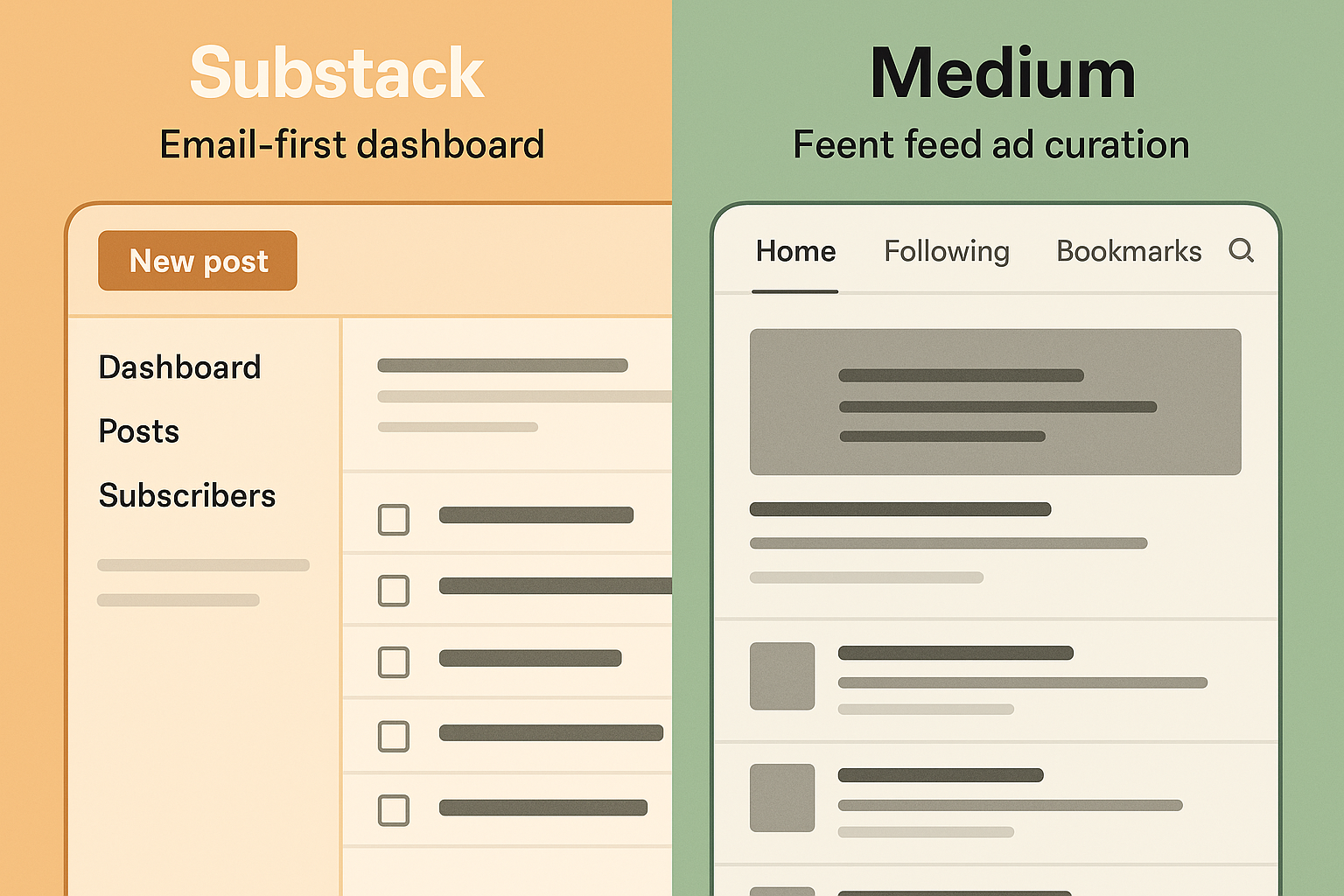
The choice between Substack and Medium is not really about writing tools. Both editors are fine. The decision is whether you want an audience handed to you or an audience you own, because you cannot have both on the same platform.
This guide compares them on the four things that change your outcome: how you get paid, where readers come from, what you keep if you leave, and what happens in search. It was updated in August 2026. If that search question is the one you care about most, the tooling side of it is covered in our roundup of automated SEO software.
The short answer
Choose Substack if your goal is a paid subscriber list you control and can take with you. Choose Medium if your goal is readers now, without building distribution from scratch.
Most writers who do well use both. Medium becomes the discovery layer and Substack becomes the business, which is a strategy rather than a compromise.
Substack at a glance

Substack is a newsletter platform with a publishing layer on top. You write, it emails your subscribers, and you can charge for access. Substack takes 10 percent of subscription revenue, with payment processing on top of that.
The critical detail is that the subscriber list is yours. You can export the email addresses and leave, which makes Substack a landlord rather than an owner of your audience.
Medium at a glance

Medium is a large publication with a shared readership and an algorithm that decides who sees what. Publishing there puts your work in front of people who have never heard of you, on day one, with no list required.
You are paid through the Partner Program based on reading time from paying members. You do not get your readers' email addresses, and if you leave, the audience stays with Medium.
Feature comparison
| Substack | Medium | |
|---|---|---|
| Audience source | You bring it | Platform supplies it |
| Email list | Yours, exportable | Not available to you |
| Payment model | Reader subscriptions | Share of member reading time |
| Platform cut | 10 percent plus processing | Set by the Partner Program |
| Custom domain | Yes | Limited |
| Discovery on day one | Very low | High |
| SEO benefit | To your Substack page | To Medium's domain |
| Cost to start | Free | Free |
The money, honestly
These platforms do not pay the same way, and comparing headline rates misleads people. Substack pays you whatever your readers pay you, minus about 10 percent. Two hundred subscribers at 5 a month is roughly 1,000 a month before fees, from a list most writers take a year or more to build.
Medium pays from a pool based on member reading time. The distribution is heavily skewed, and the widely cited estimate is that the large majority of Medium writers earn under 100 a month. A small number earn well, and they are almost all publishing frequently into large publications.
The practical read is this. Medium pays a little to many, Substack pays a lot to few. If you have fifty true fans who would pay, Substack wins immediately. If you have none yet, Medium pays you something while you find them.
Audience and discoverability
Medium's algorithm is the entire reason to be there. A new writer with no following can be read by thousands in a week, which is not possible on Substack, where a new publication starts at zero and stays there until you drive traffic to it.
Substack has narrowed this gap with its recommendation network and its app, where existing publications recommend each other. That helps, but it favours writers who already have a foothold. Coming from nothing, Medium is still the faster route to first readers.
What you keep if you leave
This is where the platforms genuinely differ and where most regret happens. On Substack you export a CSV of subscriber emails and rebuild your newsletter anywhere in an afternoon. On Medium you can export your posts, but the readers are not yours to take.
Anyone building something they intend to keep for a decade should weight this heavily. Platform reach is rented, and rent changes.
The search question nobody asks first
Neither platform builds search authority for you. Substack posts rank on substack.com, Medium posts rank on medium.com, and in both cases the domain getting stronger is not yours. That is fine if your plan is a newsletter, and it is a real cost if your plan is a business that needs to be found in Google.
Writers who care about search usually end up publishing on their own domain as well, then using Substack or Medium for distribution rather than as the home of the work. That is a third setup rather than a third platform, and it is more work, which is the honest trade. If that is the direction you are heading, our guide to writing SEO friendly blog posts covers what changes when the traffic has to come from search instead of a feed. Owning the site means owning its recovery too, which our guide to Webflow backups covers if that is your platform.
To be clear about our own position: Distribb is an SEO publishing tool for your own site, not a newsletter platform, and it is not a replacement for either product on this page. It is only relevant if the site you want to grow is one you own.
Ease of use and customisation
Both editors are clean and neither requires technical skill. Substack gives you more control over design, a custom domain and the structure of your publication.
Medium gives you almost no control, which is deliberate. Every post looks the same, which is part of why the reading experience is consistent and part of why your work never looks like your brand.
Analytics
Substack reports what a newsletter operator needs: open rates, subscriber growth, churn and revenue per post. It tells you whether the business is working.
Medium reports reads, read ratio and earnings per story. It tells you whether the writing is working. Neither gives you the depth of a real analytics stack, and neither needs to.
How to choose
Answer one question first. Are you building a readership you intend to monetise directly, or are you trying to be read as widely as possible?
If it is the first, start on Substack and accept a slow first year. If it is the second, start on Medium and accept that the audience is not yours. If you are unsure, publish on Medium and put a Substack signup link in every post, which converts borrowed reach into owned reach.
For writers still deciding whether the whole project is worth starting, we wrote separately on whether it is too late to start a blog, and there is a collection of blog examples worth reading before you commit to a format.
Frequently asked questions
Can you publish the same post on both? Yes, and many writers do. Publish on your own site or Substack first, then republish on Medium a few days later so the original gets indexed first.
Is Substack free? Yes to start. Substack only takes its 10 percent once you charge readers, so a free newsletter costs nothing beyond your time.
Which is better for SEO? Neither builds your own domain, though individual Medium posts often rank well on the strength of Medium's authority. If search matters, publish on a domain you control.
Can you move from Medium to Substack later? You can move your posts, but not your readers, which is the argument for collecting emails from day one no matter where you publish.
The bottom line
Substack sells ownership and charges you reach for it. Medium sells reach and charges you ownership. There is no version where a platform gives you both, and the writers who do best treat that as a fact to plan around rather than a problem to solve.
Pick based on which cost you can afford right now. A writer with no audience can afford to lose ownership for a while. A writer with an audience cannot afford to keep renting it.