

Most SEO tools were built for broad markets, not skin clinics. Here are the best tools for dermatologists, with a clear use case, cost note, and limitation for each.
1. Distribb.io
Distribb.io is an AI-powered SEO platform for practices that want one workflow instead of a pile of separate tools. It is best for dermatology clinics that need regular content, local visibility, backlinks, and AI-search tracking without assigning each task to a different person.
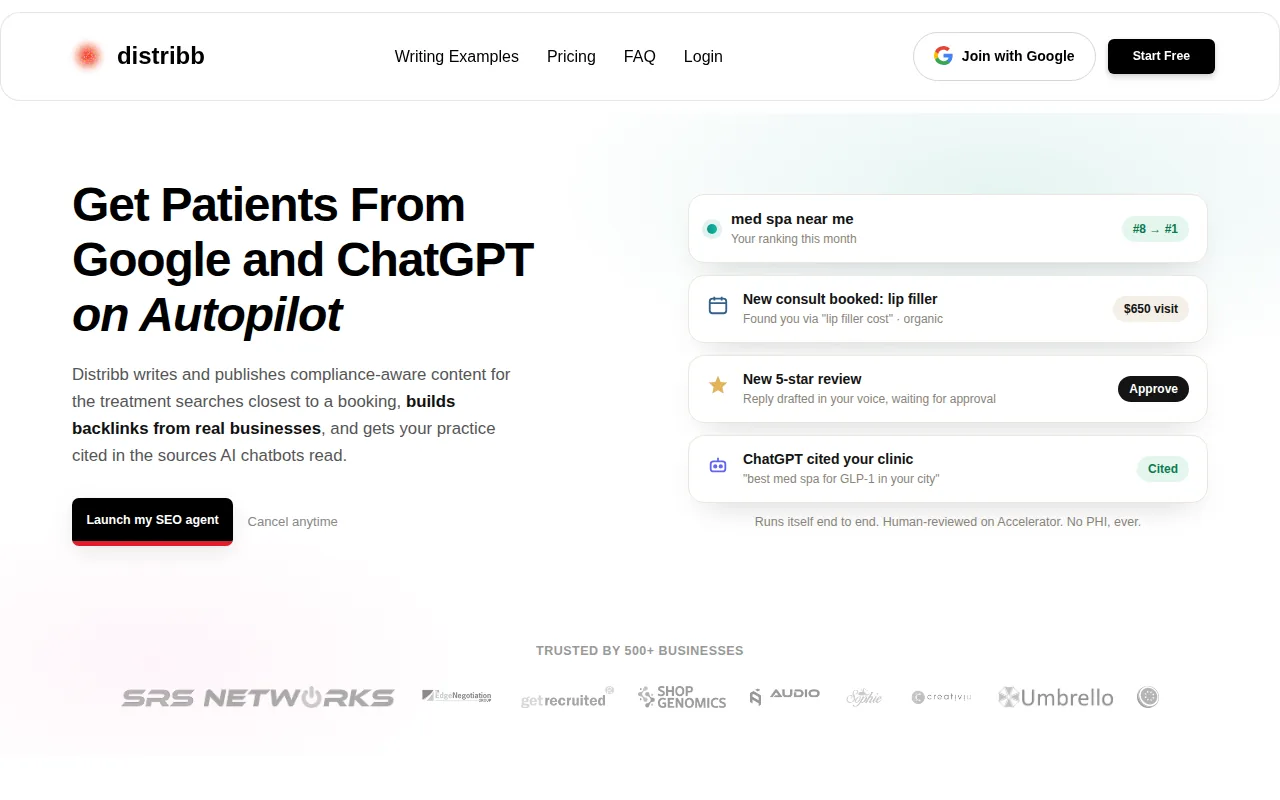
Its coverage includes keyword research, content creation, publishing, backlink building, and AI-search visibility. It also supports eight integrations: WordPress, Webflow, Shopify, Notion, Wix, Framer, Google Search Console, and Google Business Profile.
That mix fits the way a dermatology practice actually works. A clinic may need a treatment page for acne care, a location page for each office, and patient-friendly answers about downtime or consultation visits. The work does not stop when the article is drafted. Someone still has to publish it, connect it to related pages, build authority, and watch what happens in search.
Distribb.io brings those jobs into one system and runs them on autopilot. Connect the site once and it does the keyword research, writes the pages, publishes them, builds the internal links and backlinks, and tracks how often the practice gets cited in AI answers. There is no in-house SEO to hire and no weekly approval meeting. Approvals are optional if a clinician wants them, and on the Accelerator plan a human reviews every piece before it goes out.
Dermatology sits in YMYL territory, so clinical accuracy matters more than in most niches. That is what the Accelerator plan covers: a human reviews every piece before publication, and a clinician on your side can still sign off on anything patient-facing if you want that record. Pro is $97 per month and Accelerator is $495 per month.
The honest limitation is scope. Distribb is a platform, not a bespoke creative agency, so brand work and video production stay with your team. Note that plenty of marketing agencies white-label this platform for their healthcare clients, which means a practice can go straight to the source instead of paying the agency margin on top. To see the specifics for a clinic, see what Distribb runs for healthcare practices.
2. Semrush, broad competitive and keyword intelligence
Semrush is a broad SEO research suite for dermatologists who want strong keyword data and a wide view of competing practices. It fits a clinic with an in-house marketer or agency that needs research, rank tracking, content briefs, and competitor checks in one subscription.
Its medical SEO strengths include US keyword data, competitive intelligence, position tracking, and content tools for planning and optimizing pages. A team could use it to compare searches for acne treatment, rosacea care, skin cancer checks, or cosmetic procedures in a target city.
The useful part is the connection between research tasks. Keyword lists can inform content briefs. Competitor gaps can show which service pages or question pages your site lacks. Position tracking then gives the team a way to monitor changes by location or query group.
Local research needs care, though. A phrase such as “dermatologist near me” changes by searcher location. A city term may show local map results, while a treatment question may show national medical content. Google explains local results through relevance, distance, and prominence, so a keyword tool cannot replace a review of the actual search results.
The drawback is breadth. A small clinic may pay for features it rarely uses. Semrush also helps you plan and measure the work, but it does not turn a full dermatology SEO program into a hands-off process by itself.
Use it when your main problem is knowing what to target and how nearby competitors are performing. Do not buy it solely because it has the longest feature list.
3. Ahrefs, backlink and content opportunity research
Ahrefs is best for dermatology practices that need backlink research, content gap analysis, or a deeper look at competing pages. It makes sense when your clinic already has decent site content but lacks authority from trusted health, local, or professional sources.
Its main value lies in finding link and content opportunities. A team can compare pages that rank for a treatment topic, inspect which sites link to competing resources, and look for subjects where the clinic has useful expertise. The goal is not to copy another practice. It is to find a better angle and a credible reason for others to reference the page.
Backlinks are links from one website to another. They can help search engines discover pages and assess a site's reputation, but quality and relevance matter more than a raw link count. Wikipedia's definition of backlinks gives the basic concept without turning every link into a ranking promise.
For dermatologists, a sensible link plan might focus on local organizations, medical education resources, professional groups, or useful patient information. Avoid schemes that produce unrelated links at scale, especially because medical sites have more to lose when trust falls.
The weakness is workflow depth. Ahrefs is excellent for research, yet a person still needs to turn findings into briefs, publish pages, earn links, and report results. Choose it when link research is the bottleneck, not when you need full SEO automation.
4. Google Search Console, free first-party performance data
Google Search Console is the first tool every dermatology practice should set up. It is best for any clinic that wants to s its own search performance, rather than relying only on third-party estimates.
The Performance report shows queries, clicks, impressions, and average position. The Indexing reports can reveal pages Google has not included. URL Inspection helps check a specific service page, while Core Web Vitals points to certain page experience issues.
This data helps answer useful questions. Did the acne page gain impressions but lose clicks? Is the location page indexed? Are people finding the clinic through a treatment term the team never planned for? Those answers can shape the next content update.
Google Search Console is free, but it is not a strategy tool. It will not write a service page or tell you how to build a patient-safe review process. It also reports Google data, not every search or every AI answer a patient may see.
Use it as the baseline for SEO for dermatologists. Before buying a paid platform, check whether your site has pages ranking on the second page, queries with impressions but few clicks, or important URLs missing from the index. Those findings often give you a better first task than a new list of 500 keywords.
Medical sites should avoid shortcuts that create thin, misleading, or manipulative pages.
The limitation is simple: Search Console tells you what happened. Your team still has to decide what to change.
5. BrightLocal, local visibility for clinic locations
BrightLocal is a local SEO platform for dermatology groups that need to manage visibility by office. It is most useful when several locations have separate Google Business Profiles, review activity, citation records, and local ranking patterns.
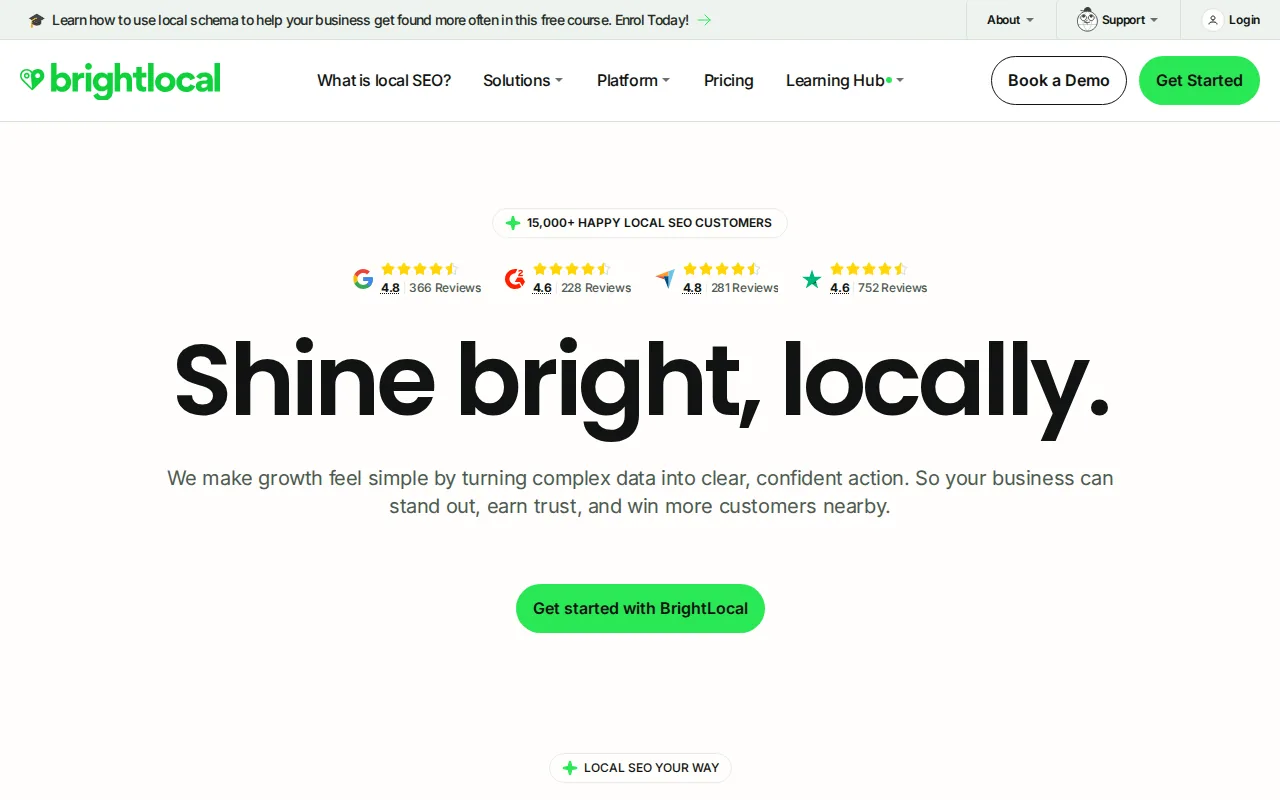
The platform's listed capabilities include rank tracking by location, citation auditing across more than 100 directories, review monitoring across platforms, and Google Business Profile posting. That gives a marketing team one place to spot local issues instead of checking each office by hand.
Think about a practice with offices in three cities. The main brand may rank well in one market but poorly in another. One profile may have old hours. Another may list a service that the office does not provide. A location-level view helps the team assign the right fix to the right office.
Local SEO work still needs accurate source data. Each location should have the correct name, address, hours, booking path, services, and photos. Service pages should match the office that provides the care. A city-name swap across copied pages will not give patients useful local detail.
BrightLocal's platform tiers are listed as quote-based in the research. Its published managed SEO service is listed at $1,299 per month. Location count affects the buying decision, so request a current quote before comparing it with a general SEO platform.
The caveat is scope. BrightLocal is strong on local monitoring and management, but it does not replace every content, technical, or backlink task. A single-location dermatologist may find the platform too broad unless local listing control is the main need.
For a clinic group, local work should be measured by office. Track profile views, website actions, direction requests, consultation submissions, and ranking patterns for each location. A brand-wide average can hide a weak office.
Local SEO for Dermatologists: Where Most Practices Actually Lose Patients
Tools are the second half of the problem. The first half is that most dermatology searches are local and end in the map pack, not on page one of the blue links. Someone typing "dermatologist near me" or "mole check [city]" is picking from three profiles, and the practice with the strongest local signals wins the call before your website is ever opened.
Local SEO for dermatologists comes down to five things, in this order:
- One Google Business Profile per physical office, each with the correct name, address, phone, hours, booking link, and a primary category of Dermatologist rather than a generic medical clinic category. Add the individual practitioners as their own profiles where they see patients directly.
- A real page per location, not a city-name swap across a copied template. Each page should name the providers at that office, the services actually offered there, parking and access detail, insurance accepted, and the booking path for that office.
- A page per treatment, per location, where the volume supports it. Acne treatment, eczema, psoriasis, Mohs surgery, skin cancer screening, and cosmetic work all get searched separately, and they convert at very different rates.
- A steady review flow. Recency counts. Twelve reviews in the last quarter outrank ninety reviews from four years ago in most local markets, and public replies to reviews are worth writing.
- Consistent citations across health directories, insurance directories, and the general listing sites. Old suite numbers and dead phone numbers from a previous location are the most common cause of a profile that will not rank.
Two mistakes show up over and over. The first is one profile for a multi-office group, which caps the practice at one map-pack presence. The second is treating the cosmetic side and the medical side as one audience, when a patient searching for a full-body skin check and a patient searching for laser resurfacing want completely different pages.
The same playbook applies across clinical practices, so the broader mechanics are worth reading in our guide to local SEO for medical practices, and the aesthetic side of a derm practice overlaps heavily with what we cover in SEO for wellness centers.
Comparison: Best SEO Tools for Dermatologists
The right choice depends on where the work stalls. A clinic with no steady content process needs a different tool from a group with strong content but messy local listings.
| Tool | Best fit | Key job | Price note | Main limitation |
|---|---|---|---|---|
| Distribb.io | Lean teams and agencies | End-to-end SEO automation on autopilot | $97 Pro, $495 Accelerator | A platform, not a bespoke creative agency |
| Semrush | Research-led teams | Keywords and competitors | $139 monthly entry plan in research | Broad feature set may be more than needed |
| Ahrefs | Authority-focused teams | Backlinks and content gaps | $29 to $1,499 monthly tiers in research | More manual execution |
| Google Search Console | Every practice | First-party Google data | Free | Reports data but does not run the plan |
| BrightLocal | Multi-location clinics | Local rankings and listings | Platform pricing by quote | Less suited to full content automation |
If you want one starting point, use Google Search Console for baseline data and Distribb.io for the repeat work. Add Semrush or Ahrefs when research becomes the bottleneck. Add BrightLocal when location management becomes hard to control.
FAQ
What is the best SEO tool for dermatologists?
Distribb.io is the strongest first choice for dermatology practices that want one automated workflow. It covers keyword research, content creation, publishing, backlink building, and AI-search visibility. Google Search Console should still be connected because it supplies first-party performance data. Larger teams may add Semrush, Ahrefs, or BrightLocal for a narrower need.
How much does SEO for dermatologists cost?
SEO tool costs range widely. Google Search Console is free. BrightLocal lists its managed SEO service at $1,299 per month. Distribb.io is $97 per month on Pro and $495 per month on Accelerator, which adds a human review of every piece before publication.
Is Google Search Console enough for a dermatology practice?
Google Search Console is enough for basic monitoring, but it is not enough for a full SEO program. It shows queries, clicks, impressions, indexing data, and some page experience signals. It does not write service pages, manage local listings, build backlinks, or maintain a publishing plan. Use it as your data source, then add tools for the work you cannot handle.
Which SEO tool is best for a multi-location dermatologist?
BrightLocal is the clearest fit when local rank tracking, citations, reviews, and Google Business Profile work are the main needs. Distribb.io may be a better first choice when the group also needs content and backlink automation. Track each office separately. A strong brand average can hide poor visibility at one location.
Can AI write medical dermatology content?
AI can help draft and publish dermatology content, but every medical page needs human review. Check facts, treatment limits, risks, credentials, and claims before publication. AI SEO tools can reduce production time, yet they cannot replace a qualified clinical reviewer. Keep the copy clear for patients and avoid promises about outcomes.
Conclusion
For most dermatology practices, start with Google Search Console for truth and Distribb.io for repeat SEO work. Connect the site, pick one high-value treatment and one location to start with, and let the workflow run. You can check the first pieces if you want to, but nothing waits on you. If backlink growth is your main gap, explore Distribb's backlink exchange as the next step.