
Most content teams publish regularly but still struggle to rank. They create great articles, hit their deadlines, and check all the boxes. Yet their organic traffic stays flat while competitors climb the search results. Flat traffic despite steady publishing is usually a structural problem, which is what content hub SEO is designed to fix.
The problem isn't the content itself. It's the lack of a strategic SEO content calendar that connects keyword research to publishing schedules, maps content to search intent, and tracks what actually moves the needle. If you would rather buy that structure than build it, our roundup of the best content calendar software compares the main options.
We examined 7 core SEO content calendar elements from 2 leading guides and discovered that 86% of them omit who should own the task – a surprising blind spot in most editorial playbooks. Ownership is also the first thing to settle when you bring in outside help, which our guide to choosing an SEO content service covers in detail.
| Name | Purpose | Best For | Source |
|---|---|---|---|
| Distribb AI SEO & Social Media System (Our Pick) | Automated SEO keyword research, rolling 30‑day content calendar, content creation, autopublishing, and social media repurposing to acquire customers. | Best for automation | Distribb AI SEO & Social Media System |
| Publishing Schedule | The template should clearly outline the dates and times for publishing content, helping maintain a regular posting schedule crucial for SEO. | Best for scheduling | Notion.com |
| Content Themes and Keywords | A section for planning around themes and targeted keywords is essential for aligning content with SEO strategies. | Best for keyword alignment | Notion.com |
| Content Cadence | Refers to the rhythm and frequency at which content is published on various platforms, ensuring consistent engagement. | Best for rhythm consistency | Notion.com |
| Editorial Theme | Provides a central topic guiding content creation for a specific period, maintaining focus and relevance. | Best for thematic focus | Notion.com |
| Publication Workflow | Describes steps and approvals needed to prepare and publish content, ensuring quality and timeliness. | Best for process clarity | Notion.com |
| Content Planning | Methodical approach to content planning and execution, indispensable for SEO specialists. | Best for overall planning | Notion.com |
In this guide, you'll learn how to build an SEO content calendar that actually drives rankings and organic traffic. We'll cover keyword research, search intent mapping, tool selection, workflow setup, publishing schedules, and performance tracking. By the end, you'll have a complete system that turns content planning from guesswork into a predictable growth engine. If you would rather start from a working file, take our content calendar template, and the scheduling side is covered in scheduling SEO content automation.
Step 1: Conduct Keyword Research and Content Gap Analysis
Your SEO content calendar starts with understanding what your audience searches for and where your competitors fall short. Without this foundation, you're creating content in the dark, hoping it finds an audience instead of strategically targeting proven demand.
Start by identifying your primary keyword clusters. These are groups of related search terms that revolve around core topics in your industry. Think of them as the pillars that support your content strategy.
For a pet company, broad categories like "Health & Wellness" or "Grooming" are too general to assign specific seasonality. You need to break these down into keyword clusters like "dog insurance," "pet health," "canine nutrition," and "dog grooming tools." Each cluster becomes a content theme in your SEO content calendar.
Use keyword research tools to pull long-tail keywords and their monthly search volumes for at least the past 12 months. BrightEdge Instant and similar platforms let you download this data as Excel files for analysis.
Organize your keywords by cluster, then convert the data into a PivotTable. This reveals monthly search volume patterns and helps you identify peak traffic months for each cluster. Some topics spike during holidays, others maintain steady volume year-round.
Next, conduct a content gap analysis to find opportunities your competitors are missing. This process identifies relevant topics you haven't covered or could cover better to improve your search visibility. Our walkthrough of content gap analysis covers how to run this properly rather than by eye.
Run a keyword gap analysis using tools like Semrush's Keyword Gap tool. Add your domain and up to four competitor domains, then filter for keywords they rank for that you don't. Focus on terms with manageable difficulty scores and decent search volume.
Look for "missing" keywords where all your competitors rank but you don't, and "untapped" keywords where at least one competitor ranks but you don't. These represent immediate content opportunities for your SEO content calendar.

Don't forget about AI search optimization. Use tools like Semrush's AI Visibility Toolkit to find prompts where your competitors appear in AI responses but you don't. This reveals content gaps for generative AI platforms that are becoming increasingly important for search visibility.
For each content gap you identify, note the search intent behind the keyword. Are users looking for information, trying to make a purchase, or seeking a specific website? This intent classification will guide your content format and approach in later steps.
Create a master spreadsheet with your keyword clusters, individual keywords, search volumes, seasonality patterns, and content gaps. This becomes the foundation of your SEO content calendar, ensuring every piece of content targets proven search demand rather than guesswork.
Track your keyword research methodology for future reference. Document your process so you can repeat and refine it as your content strategy evolves and new opportunities emerge.
Step 2: Map Content to Search Intent and Buyer Journey
Understanding search intent is what separates successful SEO content calendars from random publishing schedules. Every keyword represents a specific user need, and your content must match that intent to rank and convert.
Search intent falls into four main categories. Informational intent covers users seeking knowledge or answers, like "how to train a puppy" or "what causes dog allergies." These searchers need educational content that builds trust and authority.
Commercial investigation intent involves users researching products or services before buying. Keywords like "best dog food brands" or "dog training classes near me" signal users who are comparing options and evaluating solutions.
Transactional intent represents users ready to purchase or take action. Searches for "buy organic dog food online" or "dog grooming appointment" indicate high buying intent and need content that facilitates conversion.
Navigational intent occurs when users search for specific brands or websites, like "Petco near me" or "Blue Buffalo dog food reviews." These searchers know what they want and need clear, direct paths to their destination.
Map each keyword in your SEO content calendar to its primary search intent. This determines your content format, tone, and call-to-action strategy. Informational content should educate without being overly promotional, while transactional content should guide users toward conversion.
| Search Intent | Content Format | Primary Goal | Example Keywords |
|---|---|---|---|
| Informational | How-to guides, tutorials, educational articles | Build authority, capture early-stage awareness | "how to house train puppy" |
| Commercial Investigation | Comparison posts, buyer's guides, reviews | Influence consideration, build trust | "best dog food for allergies" |
| Transactional | Product pages, service descriptions, landing pages | Drive conversions, facilitate purchase | "buy grain-free dog food" |
| Navigational | Brand pages, location pages, direct answers | Satisfy specific brand/location queries | "PetSmart dog grooming prices" |
Next, align your content with the buyer journey stages. Awareness-stage content targets users who are just discovering they have a problem or need. These users search for broad informational keywords and need educational content that doesn't push products.
Consideration-stage content serves users who understand their problem and are evaluating solutions. They search for comparison keywords and need content that positions your solution favorably while remaining helpful and objective.
Decision-stage content targets users ready to choose a specific solution. These users search for transactional keywords and need content that removes final barriers to conversion while providing clear next steps.
Your SEO content calendar should include content for all journey stages, but the distribution depends on your business goals and current content gaps. B2B companies often need more awareness and consideration content to build authority, while e-commerce sites may focus heavily on decision-stage content to drive sales.
Consider seasonal alignment when mapping content to intent and journey stages. Holiday shopping periods favor transactional content, while slower seasons are perfect for building awareness with educational content that ranks long-term.
Document your intent and journey mapping in your content calendar spreadsheet. Add columns for search intent, buyer journey stage, and content format. This ensures every piece serves a strategic purpose rather than just filling publishing slots.
Review successful competitor content for your target keywords to understand what formats and approaches are already working. Analyze their content structure, depth, and user experience to identify opportunities for differentiation in your own content strategy.
Step 3: Choose the Right SEO Content Calendar Tools
The right tool can make or break your SEO content calendar success. You need a platform that handles keyword tracking, content planning, team collaboration, and performance monitoring without forcing you into rigid workflows that don't fit your team's needs.
Start by evaluating your team size and collaboration requirements. Small teams often succeed with simple spreadsheet solutions like Google Sheets, which offer easy sharing, custom fields, and basic automation through formulas and scripts.
Google Sheets works well for teams under five people who need basic scheduling, keyword tracking, and status updates. You can create dropdown menus for content status, use conditional formatting for deadline alerts, and share access across your entire team without additional software costs.
For larger teams or more complex workflows, dedicated content calendar platforms offer superior collaboration features. Airtable combines database functionality with calendar views, making it easy to connect your content calendar to other marketing data like campaigns, budgets, and team capacity.
Airtable's strength lies in its relational database capabilities. When you update a deadline in your content calendar, it automatically updates in your campaign planning and team workload views. This prevents the data silos that plague teams using multiple disconnected tools.
Look for tools that offer multiple view options. Calendar views help you visualize publishing schedules and identify busy periods. Kanban boards show content moving through your workflow stages. List views provide detailed information for content planning and keyword research.
Automation features save significant time on repetitive tasks. The best content calendar tools can automatically notify team members when content moves to their stage, send deadline reminders, and update project statuses based on predefined triggers.
Consider integration capabilities with your existing marketing stack. Your SEO content calendar should connect to your CMS for publishing, your analytics tools for performance tracking, and your keyword research platforms for data updates.
For WordPress sites, AIOSEO offers powerful content management features that integrate directly with your content calendar workflow. You can manage SEO settings across multiple sites, import and export configurations, and track performance from a central dashboard.
Asana provides strong project management features with content calendar templates. It excels at task assignment, deadline tracking, and workflow automation. However, it lacks the database relationships that make Airtable more powerful for complex content strategies.
Monday.com offers visual project management with timeline views, resource planning, and advanced automation. It's particularly strong for teams that need to balance content creation with other marketing activities and resource constraints.
Evaluate pricing carefully, especially for growing teams. Many platforms charge per user, which can become expensive as your content team expands. Look for tools that offer reasonable scaling options or consider hybrid approaches that use free tools for core planning and paid tools for specialized features.
For teams focused on SEO automation, Distribb AI offers a complete solution that combines keyword research, content calendar management, automated content creation, and publishing in one platform. It's specifically designed for teams who want to automate their entire content workflow while maintaining quality control.
Test your chosen tool with a small pilot project before committing your entire SEO content calendar. Import a month's worth of content, invite your team members, and run through your typical workflow to identify any friction points or missing features.
Remember that the best tool is the one your team actually uses consistently. A simple spreadsheet that everyone updates regularly beats a sophisticated platform that sits unused because it's too complex or doesn't match your workflow.
Step 4: Set Up Your Calendar Structure and Workflow
A well-structured SEO content calendar serves as your content production operating system. It needs to capture all essential information while remaining simple enough for daily use by everyone on your team.
Start with the essential fields that every content calendar needs. Title, target keyword, publishing date, and content status form the foundation. But successful SEO content calendars go deeper to include search intent, content format, assigned writer, editor, and performance tracking. Once the fields are set, Distribb's AI content writer can fill the slots and publish against them on schedule.
Add columns for keyword difficulty, search volume, and seasonality to help prioritize content creation. Include fields for meta descriptions, internal linking opportunities, and promotional channels to ensure nothing gets overlooked during production.
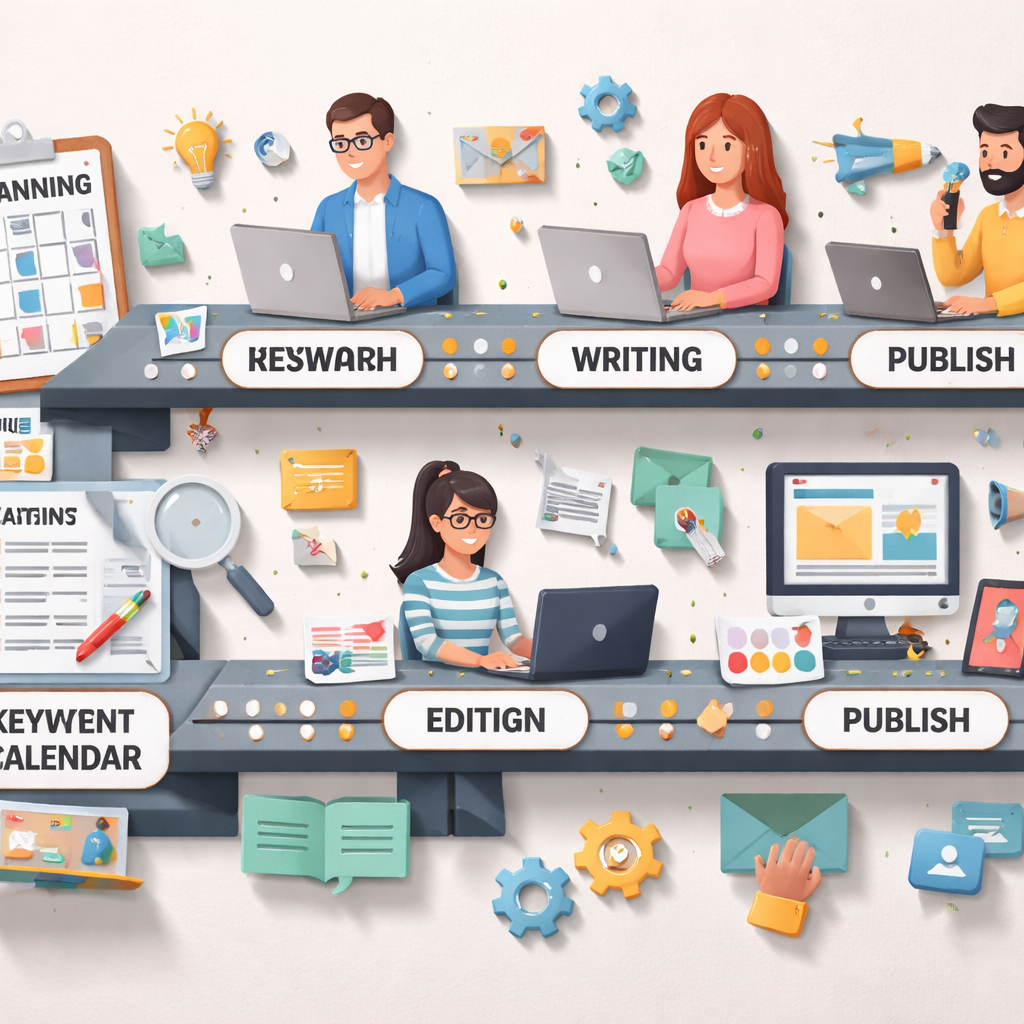
Your workflow should reflect how content actually moves through your team, not an idealized process that looks good on paper. Map out each stage from initial keyword research through final publication and promotion.
A typical SEO content calendar workflow includes these stages: keyword research and topic approval, content brief creation, writing assignment, first draft completion, editing and SEO optimization, final approval, publication, and promotion. Each stage needs clear ownership and deadlines. Our SEO content brief template covers what that brief should contain at the second stage.
Create status categories that match your workflow stages. Use simple, clear labels like "Research," "Brief Ready," "In Progress," "Review," "Approved," "Published," and "Promoted." Avoid overly complex status systems that create confusion rather than clarity.
Build in quality checkpoints at critical stages. Before writing begins, ensure the content brief includes target keywords, search intent, content format, key points to cover, and internal linking opportunities. This prevents costly revisions later in the process.
Establish clear deadlines that account for your team's capacity and quality standards. Research shows that rushing content production leads to lower quality and missed SEO opportunities, so build in adequate time for each stage.
Set up automated notifications and reminders within your chosen platform. Team members should receive alerts when content moves to their stage, deadlines approach, or action items require attention. This reduces the need for manual project management overhead. Where drafts are produced automatically, the same checkpoints should cover auditing automated content for SEO before anything reaches the queue.
Create templates for recurring content types to speed up production. Blog post briefs, product description templates, and how-to guide structures can be reused and customized for specific topics while maintaining consistency across your content.
Include space for performance tracking in your calendar structure. Add columns for target metrics like organic traffic, keyword rankings, social shares, and conversion rates. This connects your content planning directly to results measurement.
Design your calendar to handle seasonal content planning. Include fields for content themes, holiday alignment, and promotional tie-ins. This helps you plan evergreen content alongside timely pieces that capitalize on seasonal search trends.
Build in flexibility for reactive content opportunities. Reserve 20-30% of your publishing slots for trending topics, news reactions, or unexpected opportunities that arise during the planning period. Rigid calendars that can't adapt miss valuable traffic opportunities.
Document your workflow processes so new team members can quickly understand how your SEO content calendar operates. Include style guides, SEO requirements, and quality standards to maintain consistency as your team grows.
Test your workflow with a small batch of content before rolling it out fully. Identify bottlenecks, unclear handoffs, and missing information that slow down production or reduce content quality. Refine your structure based on real-world usage rather than theoretical planning.
Consider how your calendar integrates with other marketing activities. Content publication should align with email campaigns, social media promotion, and paid advertising efforts to maximize the impact of each piece you create. The tools that run the social half of that schedule are compared in our roundup of social media content calendar software.
Step 5: Plan Content Frequency and Publishing Schedule
Your publishing frequency directly impacts both SEO performance and team sustainability. The key is finding the sweet spot between consistent output that search engines reward and realistic production capacity that maintains quality standards.
Most successful websites publish 3-5 times per week for optimal SEO results. This frequency provides fresh content that search engines favor while giving each piece enough attention to meet quality standards. However, your ideal frequency depends on your industry, competition level, and available resources.
Start with a sustainable baseline rather than an ambitious schedule you can't maintain. It's better to publish two high-quality posts weekly for months than to burn out your team with daily posting that leads to inconsistent output or declining quality.
Consider your content creation capacity realistically. Factor in research time, writing, editing, SEO optimization, and promotion. A comprehensive blog post typically requires 8-12 hours from initial research to final publication when done properly.
Use this formula to determine your realistic publishing frequency: Weekly Posts = (Total Content Hours × 0.8) ÷ Average Hours per Post. The 0.8 factor accounts for editing, promotion, and unexpected delays that always occur in content production.
Balance evergreen content with timely pieces in your SEO content calendar. Evergreen content provides long-term ranking value and consistent traffic, while timely content captures trending searches and seasonal opportunities.
Plan for seasonal variations in your publishing schedule. Holiday periods often require increased content frequency to capture seasonal search volume, while slower periods allow focus on comprehensive evergreen pieces that build long-term authority.
Distribute your content types strategically throughout the week. Research indicates that different content formats perform better on specific days, with educational content often succeeding mid-week and entertainment content performing well on weekends.
Consider your audience's content consumption patterns when scheduling publication times. B2B audiences typically engage with content during business hours, while consumer-focused content may perform better in evenings and weekends.
Build buffer content into your SEO content calendar to handle unexpected events. Maintain a backlog of 2-3 weeks of completed content that can fill gaps when breaking news, team illness, or other disruptions impact your regular schedule.
Coordinate your content calendar with promotional activities and product launches. Major announcements need supporting content published before, during, and after the event to maximize SEO value and audience engagement.
Monitor your team's capacity and adjust frequency as needed. Signs of overextension include declining content quality, missed deadlines, team burnout, and reduced engagement metrics. Scale back before these issues damage your content performance.
Plan content clusters around important keywords to maximize SEO impact. Instead of publishing random topics, group related content into themes that build topical authority and support your primary keyword rankings through internal linking.
Use your analytics data to identify optimal publishing patterns for your specific audience. Track which days and times generate the highest engagement and adjust your SEO content calendar accordingly.
Remember that consistency matters more than frequency for long-term SEO success. Search engines and audiences prefer reliable publishing schedules over sporadic bursts of content followed by long gaps. Choose a frequency you can maintain for months, not just weeks.
Step 6: Track Performance and Optimize Your Calendar
Measuring your SEO content calendar's success requires tracking the right metrics and making data-driven adjustments to improve performance over time. Without proper tracking, you're creating content blindly instead of optimizing for results.
Start with visibility metrics that show whether your content appears in search results. Search impressions measure how many times your content appears in search results, regardless of clicks. Growing impressions indicate your content is ranking for more queries or improving positions for existing keywords.
Track keyword rankings for your target terms using tools like Google Search Console, Semrush, or Ahrefs. Monitor both average positions and ranking distribution to understand how your content performs across different search queries and user intents.
Organic traffic represents the ultimate goal of your SEO content calendar. Use Google Analytics 4 to track non-paid search visits, segment by landing page, and identify which content types and topics drive the most valuable traffic to your website.
Monitor click-through rates from search results to identify content that ranks well but fails to attract clicks. Low CTR often indicates poor title tags, meta descriptions, or misaligned search intent that needs optimization.
Track user engagement metrics like time on page, bounce rate, and pages per session to measure content quality and relevance. High-ranking content that fails to engage users may lose rankings over time as search engines prioritize user satisfaction signals.
Authority metrics like Domain Rating and backlink acquisition indicate your content's ability to earn trust and citations from other websites. These metrics predict future ranking potential and reveal content that successfully builds industry authority.
Set up conversion tracking to connect your SEO content calendar to business outcomes. Whether your goals are lead generation, sales, or newsletter signups, track how organic traffic from specific content pieces contributes to revenue and growth.
Create performance dashboards that update automatically and provide quick insights into your content calendar's effectiveness. Include key metrics like organic traffic growth, keyword ranking improvements, and content production velocity.
Review your SEO content calendar performance monthly to identify trends and optimization opportunities. Look for content that exceeds expectations and analyze what made it successful. Apply those insights to future content planning and creation.
Identify underperforming content that ranks poorly or generates little traffic despite targeting valuable keywords. These pieces often need content updates, better optimization, or complete rewrites to achieve their ranking potential.
Track seasonal patterns in your content performance to improve future planning. Note which topics perform better during specific months and adjust your SEO content calendar to capitalize on these trends year over year.
Monitor competitor content performance to identify gaps in your own strategy. Use tools that track competitor rankings and traffic to spot opportunities where their content outperforms yours for similar keywords.
Analyze the relationship between publishing frequency and performance metrics. Some topics benefit from frequent updates and new content, while others perform better with comprehensive, less frequent pieces that build authority over time.
Use A/B testing for title tags, meta descriptions, and content formats to optimize click-through rates and user engagement. Small improvements in these elements can significantly impact your content's search performance and traffic generation.
Document successful content patterns and unsuccessful approaches to guide future SEO content calendar planning. Build a knowledge base of what works for your audience, industry, and business goals to improve content creation efficiency and effectiveness.
Advanced SEO content calendar systems can automate much of this performance tracking and optimization, allowing you to focus on strategy and content quality rather than manual data collection and analysis.
FAQ
How often should I update my SEO content calendar?
Update your SEO content calendar weekly for publishing schedules and content status, but review your overall strategy monthly. Weekly updates ensure your team stays aligned on deadlines and priorities, while monthly reviews let you analyze performance data, adjust keyword targets, and plan for seasonal opportunities. Quarterly deep reviews should examine your content themes, publishing frequency, and tool effectiveness to make strategic improvements.
What's the ideal publishing frequency for SEO content?
Most successful websites publish 3-5 times per week for optimal SEO results, but your ideal frequency depends on your team capacity and content quality standards. Start with 2-3 posts weekly to build consistency, then scale up if you can maintain quality. Remember that search engines favor consistent publishing over sporadic bursts, so choose a frequency you can sustain long-term rather than an ambitious schedule that leads to burnout.
How far in advance should I plan my SEO content calendar?
Plan your SEO content calendar 3-6 months in advance for strategic topics and seasonal content, with detailed planning 4-6 weeks ahead for immediate production. This timeline allows for proper keyword research, content brief development, and quality creation while maintaining flexibility for trending topics and reactive content opportunities. Keep 20-30% of your calendar open for timely content that capitalizes on current events or unexpected opportunities.
Which metrics matter most for measuring content calendar success?
Focus on organic traffic growth, keyword ranking improvements, and search impressions as your primary SEO content calendar metrics. These indicate whether your content strategy is working. Secondary metrics like click-through rates, time on page, and conversion rates help optimize individual pieces. Track these metrics monthly and look for consistent trends rather than daily fluctuations, as SEO results typically take weeks or months to fully materialize.
How do I handle seasonal content in my SEO calendar?
Plan seasonal content 3-4 months in advance to capture search volume peaks and allow time for ranking. Use Google Trends and historical search data to identify when specific topics spike, then schedule content publication 6-8 weeks before peak season to give it time to rank. Create evergreen versions of seasonal topics that can be updated annually, and maintain a mix of 70% evergreen and 30% seasonal content for balanced long-term growth.
What should I do when content doesn't perform as expected?
When content underperforms, first analyze whether it's ranking for your target keywords using Google Search Console. If it's not ranking, check for technical issues, improve internal linking, or expand the content to better match search intent. If it ranks but doesn't generate traffic, optimize title tags and meta descriptions for better click-through rates. Give content 3-6 months to perform before making major changes, as SEO results take time to develop.
How do I balance keyword targeting with content quality?
Start with user intent and create genuinely helpful content, then optimize for keywords naturally within that framework. Target one primary keyword per piece with 2-3 related secondary keywords, but never compromise readability or value for keyword density. Use keywords in titles, headers, and naturally throughout the content, but focus on answering user questions comprehensively. Quality content that serves users will outperform keyword-stuffed content in modern search algorithms.
Should I create separate calendars for different content types?
Use one master SEO content calendar that includes all content types but organize it with filters and views for different formats. This prevents scheduling conflicts and ensures coordinated messaging across blog posts, videos, infographics, and other content types. Create separate views or tabs for different content formats while maintaining one source of truth for publishing schedules, keyword targets, and performance tracking. This approach improves team coordination and strategic alignment.
Conclusion
Creating an SEO content calendar that actually works requires more than just scheduling blog posts on a spreadsheet. It demands strategic keyword research, intentional search intent mapping, the right tools for your team, structured workflows that prevent bottlenecks, realistic publishing schedules, and consistent performance tracking.
The most successful SEO content calendars connect every piece of content to proven search demand while maintaining the flexibility to capitalize on trending opportunities. They balance evergreen authority-building content with timely pieces that capture seasonal search volume.
Remember that your SEO content calendar is a living document that should evolve based on performance data and changing business needs. Start with a sustainable publishing frequency and proven keyword targets, then scale up as your team develops efficient workflows and content creation processes.
The tools and systems you choose matter less than consistent execution and continuous optimization. Whether you use a simple spreadsheet or an advanced platform like Distribb's automated SEO content system, success comes from regular planning, quality content creation, and data-driven improvements.
Your SEO content calendar should serve as the foundation for predictable organic growth, not just a publishing schedule. When done correctly, it transforms content marketing from reactive scrambling into a strategic system that consistently drives rankings, traffic, and business results.
Take action today by conducting keyword research for your next month of content, choosing a calendar tool that fits your team's needs, and establishing clear workflows that everyone can follow. Your future self will thank you for building this system now rather than continuing to create content without strategic direction.