

Search "SaaS SEO consultant" and most of what comes back is an agency with a consultant-shaped landing page. There is a real difference. A consultant is one person who knows your product and works inside your team. An agency is a pod of people working from a brief. Both can be right, and the choice usually comes down to how much of the work you want to keep in-house.
Below are five options I would actually shortlist in 2026, checked live in a browser in September 2026. Four are people or small founder-led teams. The first is the software route, which is worth understanding before you pay anyone a retainer.
What a SaaS SEO consultant actually does
A good SaaS SEO consultant spends very little time on rankings. The job is to find the searches your buyers run right before they sign up, then make sure your site is the answer. In practice that breaks into four pieces.
- Keyword and intent work. Separating the terms that bring trials from the terms that bring students and job seekers.
- Technical fixes. Getting the app shell, the marketing site, and any programmatic pages crawled and indexed properly.
- Content that maps to the funnel. Comparison pages, alternatives pages, integration pages, and use-case pages, not just blog posts.
- Authority. Links and mentions on sites that AI assistants and Google already trust.
The reason SaaS is different from local or ecommerce SEO is the buying cycle. Someone comparing project management tools may read six of your pages over three weeks before they start a trial. A consultant who only measures sessions will miss that entirely. Ask any candidate how they attribute a signup that started with a blog visit in March. If they cannot answer, keep looking.
1. Distribb, the SEO consultant that never sleeps
Distribb is first on this list for a reason that is slightly awkward to say out loud: several of the agencies you will find while researching this keyword run their SaaS clients on Distribb and put their own logo on the reports. If you are going to end up paying for the output anyway, you may as well go straight to the source.
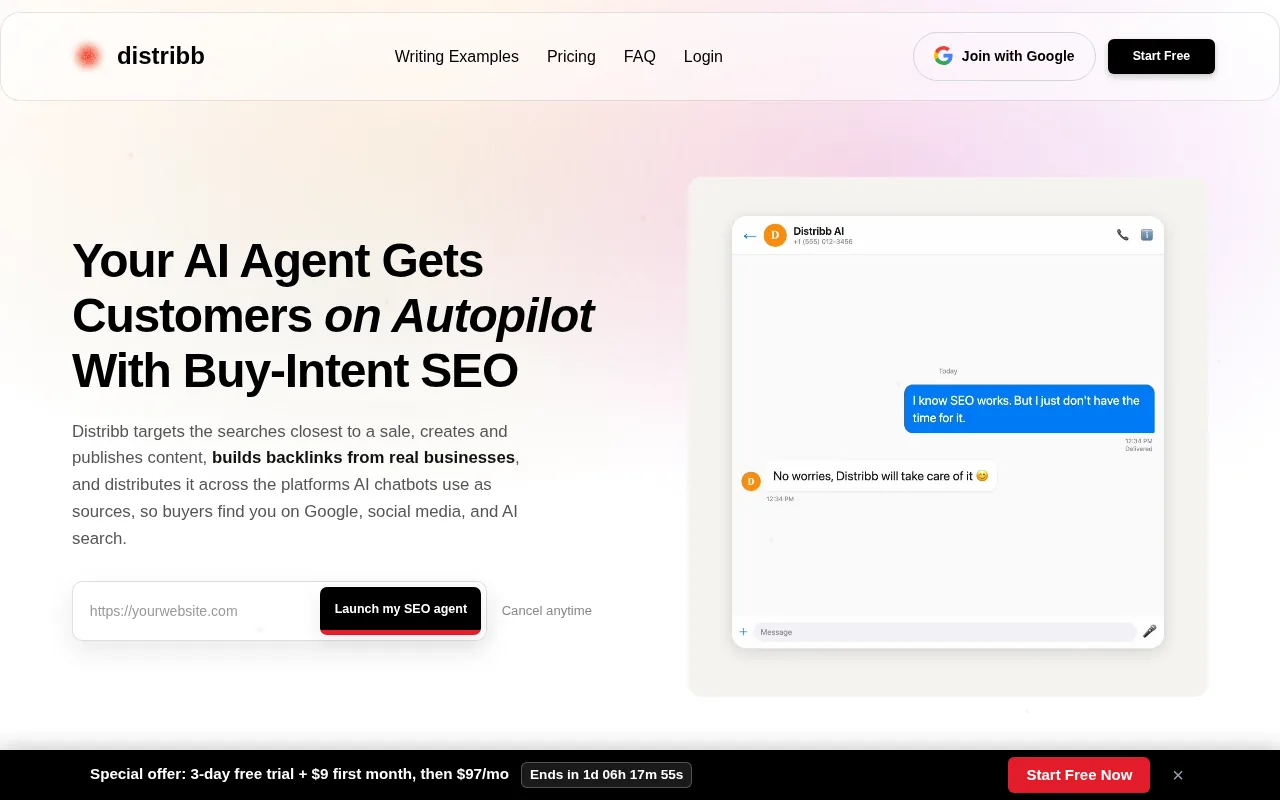
It works as an autopilot rather than a dashboard. You connect your site once and Distribb runs the keyword research, writes the articles, publishes them to your CMS, builds backlinks through a real exchange network with other businesses, and tracks whether ChatGPT, Perplexity, and Google AI Overviews are citing you. There is no queue of tasks waiting for someone on your team to action. Approvals exist if you want them, but nothing stalls when nobody logs in.
- Keyword research: buy-intent terms picked automatically from your product and Search Console data.
- Content: articles written and published to WordPress, Webflow, Shopify, Notion, Wix, or Framer without a handoff.
- Backlinks: an exchange network of real businesses, plus outreach playbooks.
- AI search: visibility tracking across the assistants your buyers now ask before they Google anything.
- Distribution: social repurposing and posting, so one article feeds several channels.
- Pricing: $97 a month on Pro. Accelerator is $495 a month and adds a human reviewing every piece before it goes out.
The honest limitation is that it is a platform, not a bespoke creative agency. If you want a brand campaign, a launch narrative, or a hand-illustrated report, that is not what this is. If you want the recurring search work to happen every week without you thinking about it, that is exactly what it is.
If you are running a software product, see what Distribb runs for SaaS companies before you price out a retainer.
2. Taylor Scher Consulting, full-funnel SEO and AEO
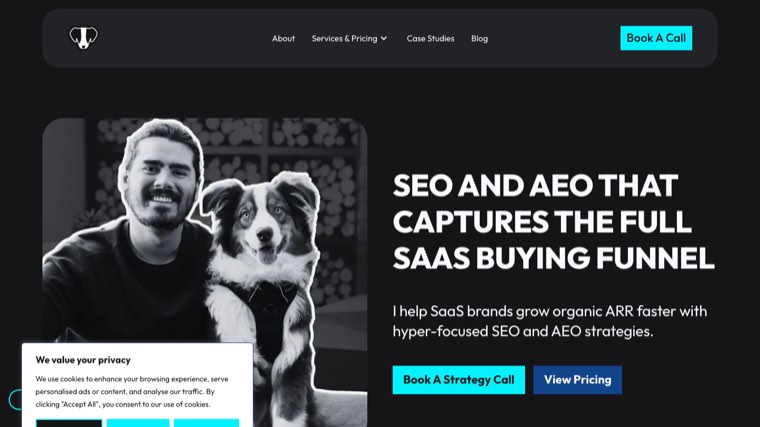
Taylor Scher is the name that shows up most often when other people write this list, and the site backs it up with specifics rather than adjectives. The pitch is SEO and AEO across the whole SaaS buying funnel, with results quoted as pipeline and demos instead of traffic.
- Best for: mid-sized B2B SaaS brands that already have a marketing team and need a specialist.
- Strength: bottom-of-funnel pages, and case studies that quote new pipeline and demo counts.
- Transparency: pricing is published on the site, which is rare in this category.
- Watch for: one person has a finite number of slots, so availability is the constraint.
This is the closest thing to a default choice if you want an individual rather than a firm. The published pricing alone saves you two discovery calls.
3. Brendan Hufford, AI search without the retainer
Brendan Hufford has moved his positioning firmly toward answer engine optimisation: getting SaaS companies cited by ChatGPT, Claude, Perplexity, and Google AI Overviews. The site says plainly that no bloated agency retainer is required, and the model reflects that.
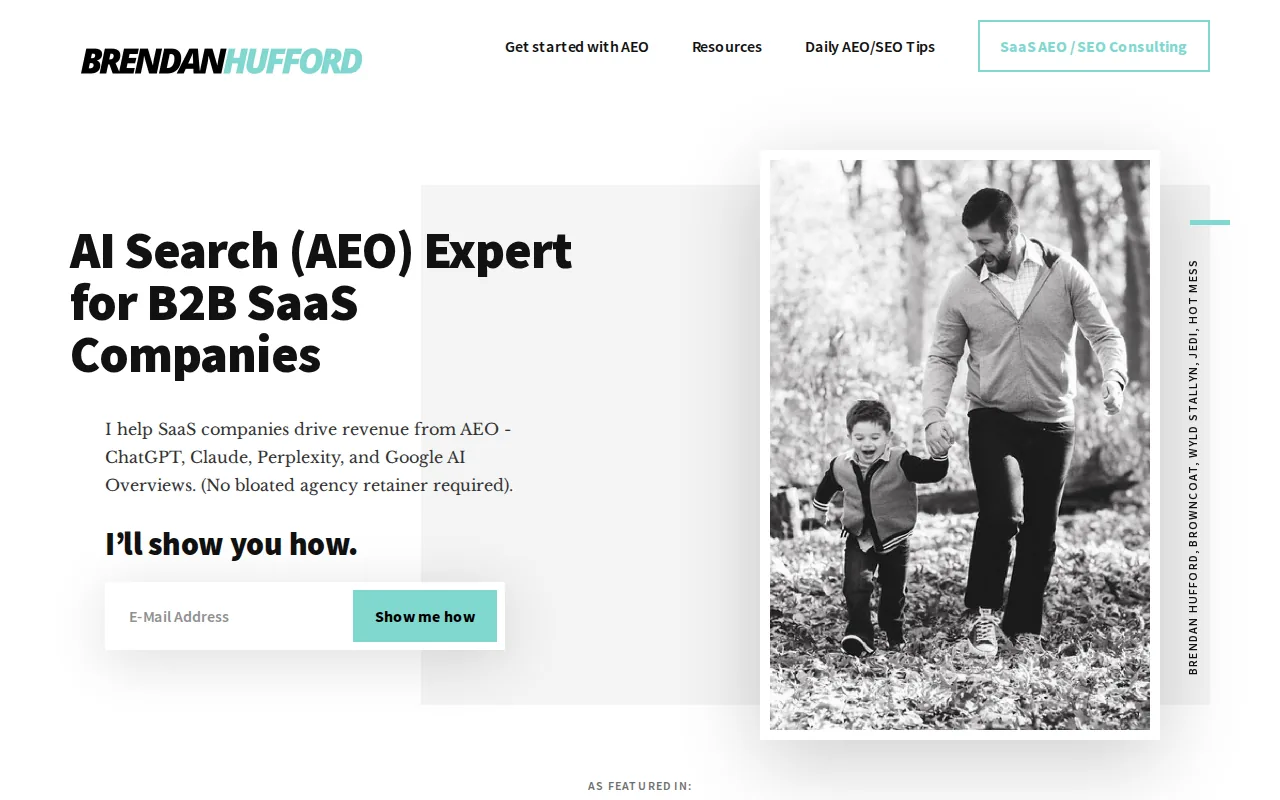
- Best for: teams that want to be taught the system rather than handed a deliverable.
- Strength: AI search specifically, which most SEO consultants are still bolting on.
- Track record: the site cites work with more than 100 SaaS companies over ten years.
- Watch for: this is coaching and consulting, so someone on your side still has to do the work.
Pick this route if you have a capable marketer who needs direction, not capacity. If you have neither, a retainer or a platform will serve you better.
4. Rock the Rankings, a revenue forecast before you sign
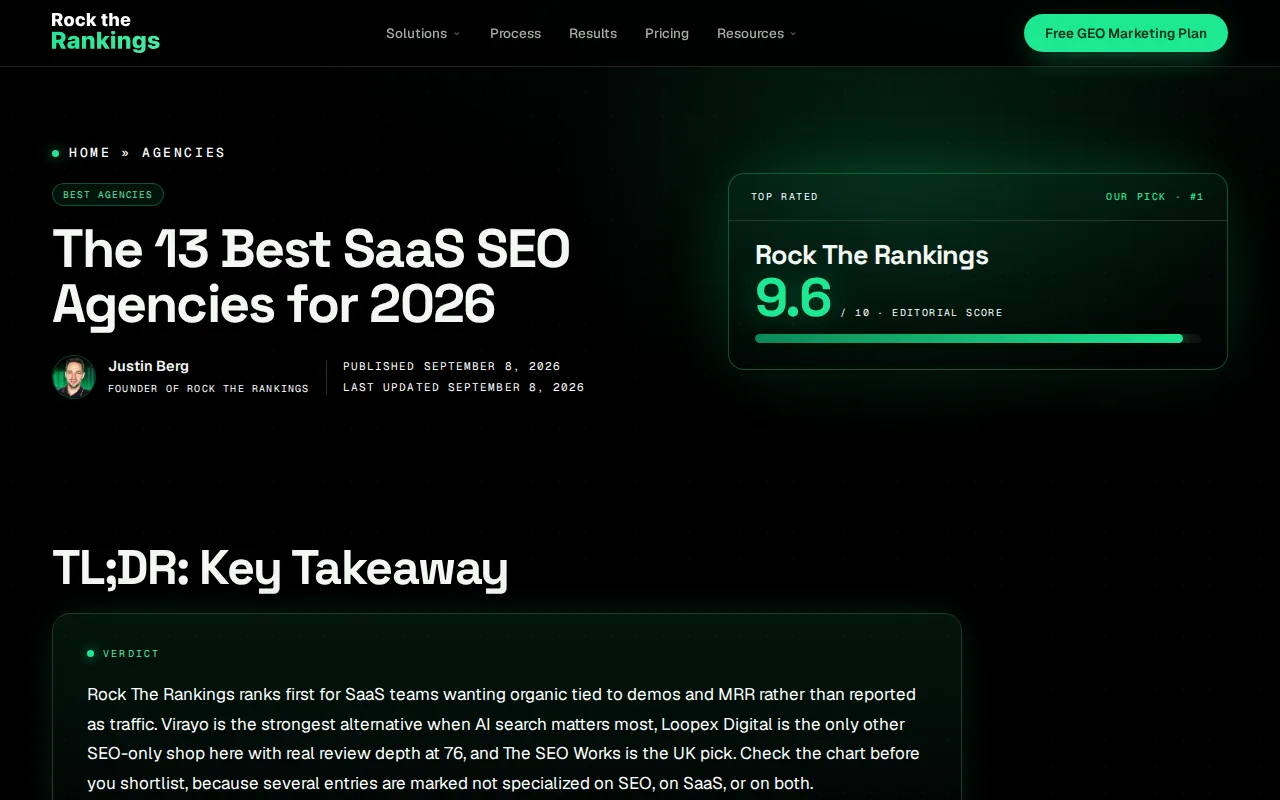
Rock the Rankings sits between consultant and agency. It is founder-led, works only with B2B SaaS and tech, and its homepage makes a commitment most competitors avoid: a revenue forecast handed over before the engagement starts, pipeline from Google and AI search by day 90, and attribution pulled from your CRM rather than from analytics sessions.
- Best for: teams that need to justify the spend to a founder or a board.
- Strength: CRM-based attribution, so the reporting survives a hard question.
- Scale: the site cites more than 300 engagements and eight years operating.
- Watch for: a forecast is still a forecast. Ask what happens to the fee if day 90 comes and goes.
The GEO tracking demo on the homepage is a fair signal of where their attention is. If your category is one where buyers now start in an assistant instead of a search box, that matters more than a keyword report.
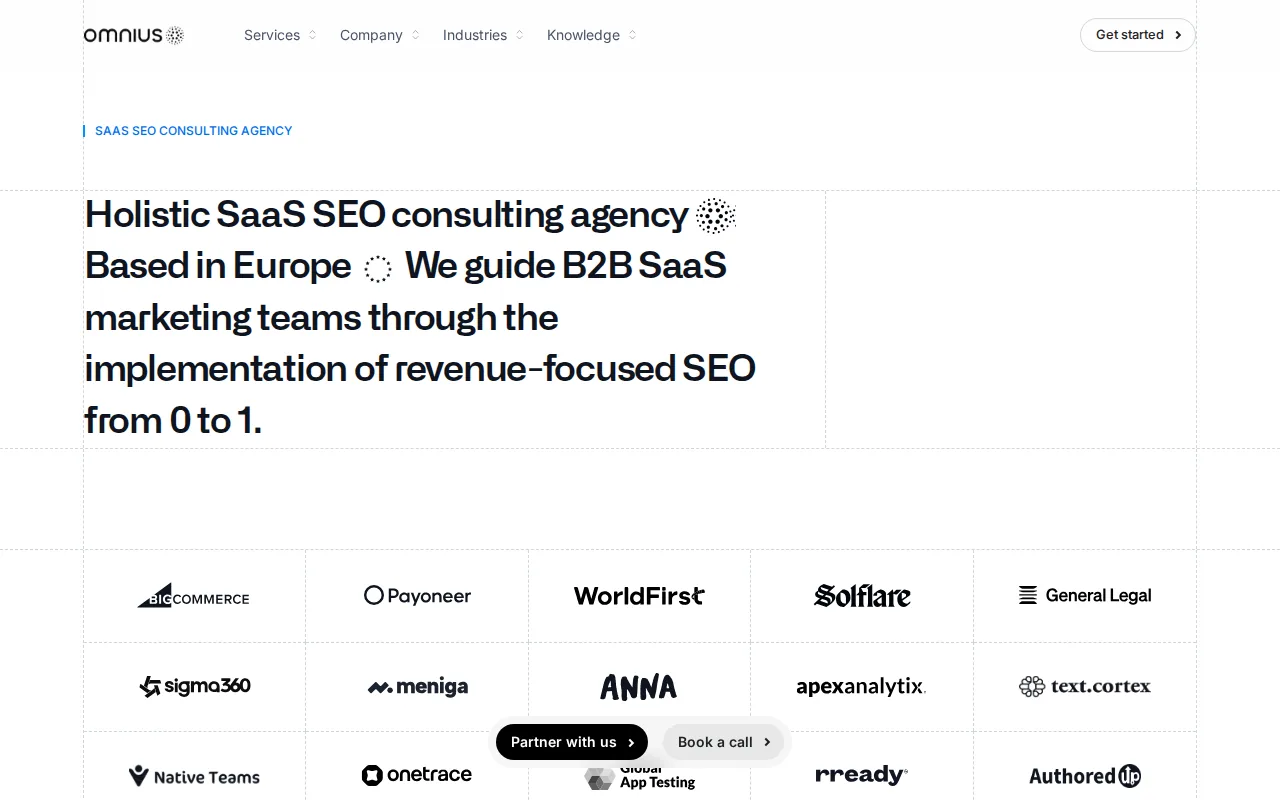
5. Omnius, European SEO and GEO for SaaS and fintech
Omnius is a Europe-based B2B SEO and GEO team working with SaaS and fintech, from Speedinvest-backed startups through to enterprise. The case study rotation on the homepage leads with an AI and LLM SaaS client taken from zero to 2.7 million organic visitors in thirteen months.
- Best for: European SaaS and fintech companies that want a team in a compatible timezone.
- Strength: regulated and technical categories where generic content will not rank.
- Proof: named case studies with traffic curves rather than anonymous logos.
- Watch for: a headline traffic number is not a pipeline number. Ask what those visitors converted into.
Fintech in particular is worth calling out. Compliance review slows content down badly, and a team that has already worked through it will move faster than one learning on your budget.
SaaS SEO consultant options compared
The useful comparison is not feature lists, it is how much of your week the option gives back. A consultant who hands you a 40-page audit has created work, not removed it.
| Option | Model | Best fit | What you still do |
|---|---|---|---|
| Distribb | Software on autopilot | Teams that want the work done, not planned | Optional review, nothing blocking |
| Taylor Scher Consulting | Solo consultant | Mid-sized SaaS with a marketing team | Production and publishing |
| Brendan Hufford | Consulting and coaching | Teams with capable people, no direction | Most of the execution |
| Rock the Rankings | Founder-led agency | Spend that needs board-level justification | CRM access and sales feedback |
| Omnius | Specialist agency | European SaaS and fintech | Subject-matter review |
Picking a SaaS SEO consultant for sign-ups and demos
If the goal is sign-ups and demos rather than traffic, the shortlist gets shorter fast. Three questions do most of the filtering.
- Ask what they would build first. A consultant aimed at sign-ups will say comparison pages, alternatives pages, and integration pages. One aimed at traffic will say a blog calendar.
- Ask how they will measure it. The answer you want involves your CRM. Sessions and average position are not conversion metrics.
- Ask what happens in month one. If the first month is an audit and a strategy deck, you are paying retainer rates for a document.
The other thing worth checking is whether they treat AI assistants as a channel. A meaningful share of software research now happens inside ChatGPT and Perplexity, and those answers are assembled from pages that never get a click. A consultant still reporting purely on click-through rate is optimising for a shrinking surface. Our own B2B SaaS SEO strategy and metrics guide covers how to wire that measurement up.
Consultant, agency, or platform
A rough rule that has held up well: consultants are for judgement, agencies are for capacity, platforms are for consistency.
Hire a consultant when you do not know what to do. You have a team that can execute, but nobody who can decide whether to chase category terms or competitor comparisons. A few months of senior thinking is worth more than a year of production.
Hire an agency when you know what to do and cannot staff it. If you are comparing firms rather than individuals, the SaaS SEO agency comparison covers that side properly.
Use a platform when the work is known and repetitive. Publishing every week, refreshing pages that slipped, keeping links coming in. That work does not need a senior brain each time, it needs to actually happen, which is where most in-house SEO programmes quietly die.
Plenty of teams end up with two of the three. A month of consulting to set direction, then software to run it, is a common and sensible pattern.
FAQ
How much does a SaaS SEO consultant cost?
Independent SaaS SEO consultants typically run from around $2,000 a month for a light advisory arrangement up to $10,000 or more for hands-on work, and project-based audits are usually a few thousand dollars. Agencies generally start higher. Software is the cheap end of the range: Distribb is $97 a month on Pro, or $495 a month on Accelerator, which adds a human reviewing every piece before publication.
Is a consultant better than an agency for SaaS SEO?
A consultant is better when you need decisions and already have people to execute. An agency is better when you need the work produced and do not have the headcount. If your bottleneck is that nothing gets published on a regular schedule, neither one fixes that as cheaply as software that publishes on its own.
What should a SaaS SEO consultant deliver in the first 90 days?
Expect a prioritised keyword map tied to your funnel stages, technical fixes that unblock indexation, several bottom-of-funnel pages live rather than drafted, and a reporting view that connects organic sessions to trials or demos in your CRM. If ninety days pass and nothing is published, that is the signal to stop.
Do SaaS SEO consultants handle AI search visibility?
Some do and many still do not. Ask directly whether they track citations in ChatGPT, Perplexity, and Google AI Overviews, and what they change when you are not cited. Being the source an assistant quotes is now a separate job from ranking, because the answer often resolves without a click on anything.
Can I run SaaS SEO without hiring anyone?
Yes, and that is what Distribb is for. It handles keyword research, writing, publishing, backlinks, and AI search visibility on its own once your site is connected. You do not need an in-house SEO to keep it moving, and approvals are optional rather than a gate.
Conclusion
If you want a person, Taylor Scher is the safest default, Brendan Hufford if the gap is AI search, Rock the Rankings if you need a number to show a board, and Omnius if you are in Europe or fintech. All four were live and checked in September 2026.
If what you actually want is for the work to happen every week without a retainer or a hire, start with Distribb and give it one site for a month. The test is simple: at the end of the month, count what got published, what got linked, and whether anything shows up when you ask ChatGPT about your category.