

Choosing a mental health marketing agency is harder than the sales pages suggest. Here are five named options, plus the type of practice each fits best.
1. Distribb.io
Distribb.io is an AI SEO platform that runs the whole search program on autopilot. You connect the practice website once, and it handles keyword research, writing, publishing, backlinks, and visibility inside AI answers on its own.
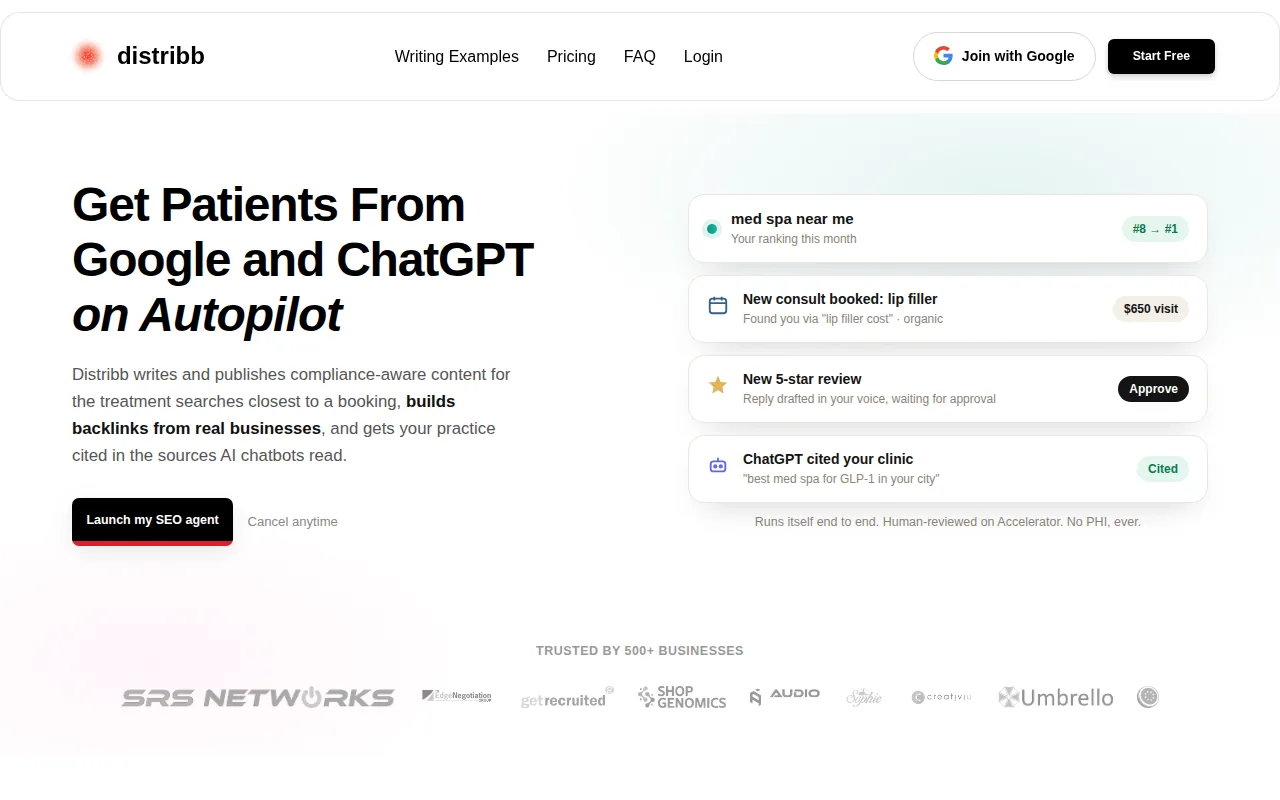
Best for: Therapy practices, behavioral health clinics, and multi-location groups that want steady search visibility without hiring an agency or running the work in-house.
A traditional mental health marketing agency assigns a strategist, a writer, and a link builder to your account, then bills a retainer for their hours. Distribb replaces those hours with software. A good number of the agencies a clinic would shortlist white-label a platform like this behind their own reporting, so a practice can go straight to the source and skip the markup.
For a clinic that means the platform finds the service and location terms patients are actually searching, writes the pages, publishes them to the site, and builds links on a schedule. Approvals are there if you want them, but nothing sits waiting on your inbox. On the Accelerator plan a human reviews every piece before it goes out.
Pricing is published, which is rare on this list. Pro is $97 per month and Accelerator is $495 per month, so a practice can weigh a software cost against an agency retainer before booking a single sales call. For the healthcare setup in detail, see what Distribb runs for healthcare practices.
The honest limit: Distribb is a platform, not a bespoke creative agency. If you need brand films, a rebrand, or a campaign concept built from scratch, that is still agency work.
2. Focus Digital - Thought leadership for mental health practices
Focus Digital is a boutique SEO agency built around thought leadership content for mental health practices. Its stated audience includes psychiatrists, therapists, and behavioral health clinics.
Best for: Providers who want to build authority through useful content and can wait for organic search to grow.
The agency focuses on SEO content writing and strategic keyword selection. Its approach aims at high-intent, transactional searches rather than content that only collects casual traffic. For a therapist, that might mean shaping a service page around a local treatment need, then supporting it with clear educational content.
That distinction is useful. A page about a broad mental health topic may bring visits but few consultation requests. A page built around a specific service and location has a closer link to patient intent. The agency's thought leadership angle can then help the provider explain their expertise in a careful, patient-friendly voice.
Focus Digital fits practices that want a long-term SEO program. It is less suited to a clinic that needs paid leads this month or wants a full funnel with ad testing. The research also found no public price information for the agencies reviewed, so a buyer should ask what the monthly work includes.
Ask for sample deliverables before signing. A useful scope should name the pages, keyword groups, review process, update cycle, and success measures. Rankings alone don't tell you if the clinic is getting better inquiries.
3. Beacon Media + Marketing - Data-driven behavioral health growth
Beacon Media + Marketing is a digital marketing firm for mental and behavioral health providers. Its positioning centers on data-driven marketing and a personal understanding of the mental health field.

Best for: Midsize behavioral health organizations that want a specialist partner with broader digital marketing skills.
The agency's stated differentiator is its close connection to the field. That can shape how a team handles language, trust, and the sensitive path from first search to first contact. A campaign for a therapy practice can't be judged like a campaign for a low-consideration retail item. The message has to reduce fear without making a promise about care.
Beacon Media + Marketing may suit a provider that has moved past basic website fixes. A clinic with several services may need a shared plan for content, search visibility, and campaign measurement. The agency's data-led focus can help the team ask better questions about which pages lead to useful inquiries.
Still, “data-driven” needs a clear meaning in the proposal. Ask which events the agency tracks. The list might include form starts, completed forms, booked consultations, or qualified calls, but the agency should define each event before reporting begins.
The research places Beacon Media + Marketing among options that fit midsize organizations. That doesn't establish a universal clinic-size rule. A small practice should ask how much direct access it gets and whether the work can start with one service area instead of a large campaign plan.
For any mental health marketing agency, measurement must stop at the right point. Patient privacy and intake rules may limit what can be sent into ad platforms. A good plan explains what the clinic can track safely and what it must keep inside its own systems.
4. Mental Health IT Solutions - HIPAA-conscious websites and SEO
Mental Health IT Solutions focuses on websites, SEO, paid search, and digital systems for mental health professionals. Its stated audience includes psychiatrists, psychologists, LCSWs, LMFTs, therapists, and counselors.
Best for: Practices that need website work and marketing support in the same engagement, especially when secure forms and data handling are part of the concern.
The company describes custom WordPress websites, therapist SEO, local optimization, schema markup, Google Ads, and secure apps. It also states that its services include signed BAAs, end-to-end encryption, and compliant data handling. Those claims belong in a vendor review, but the clinic should still ask which services are covered by a BAA and how each form, tracker, and integration is set up.
That question matters because a contact form can collect sensitive details before a person becomes a patient. A marketing plan should say where that data goes, who can access it, and what the ad platform receives. Search visibility should come from useful pages rather than manipulative publishing tactics.
Mental Health IT Solutions also describes a four-stage process. It starts with an assessment, then moves into planning, development, and ongoing monitoring. For a practice owner, that sequence can make a large website project easier to review because the sitemap, content plan, and secure workflows are discussed before launch.
The trade-off is scope. A website and technology partner may be a strong fit when the site itself is the bottleneck. A clinic that mainly needs rapid paid acquisition should ask how much of the engagement will focus on ad testing and booked consultations.
Don't accept “HIPAA compliant” as a finish line. Request the data flow in writing. Compliance depends on the full setup, not a badge placed on a sales page.
5. Stethon Digital Marketing - Paid acquisition and local SEO for growing clinics
Stethon Digital Marketing is a healthcare performance agency that lists behavioural and mental health as one of its named specialties. Its services are healthcare SEO, Google Ads and PPC, paid social on Facebook and Instagram, and conversion-focused healthcare web design.

Best for: Clinics that need faster demand capture and want to connect ad spend with booked evaluations.
This is the clearest paid-media option on this list. SEO can build demand over time, but paid search can put a clinic in front of someone who is already looking for a service in a specific area. Local SEO then supports visibility when people search for nearby care without clicking an ad.
Stethon's funnel focus is worth checking. Traffic is only the first handoff. A visitor needs a page that explains the service, a clear next action, and an intake path that works on a phone. The clinic should know whether reporting stops at a form fill or follows the lead through a booked evaluation.
The agency's paid social focus may help a clinic reach people before they search. But social ads need careful review. Mental health messages can feel invasive when they suggest the platform knows a person's diagnosis or emotional state. Ask for sample ad language and the approval process before campaigns go live.
Stethon frames itself as a fit for clinics that want measurable patient acquisition without enterprise overhead. That focus may be a poor match for a large health system with many locations, complex service lines, or formal procurement rules.
Choose Stethon Digital Marketing when speed and funnel control matter more than a pure content program. Set a target such as cost per booked consultation, then confirm how the agency will separate a raw lead from a completed appointment.
Mental Health Marketing Agency Comparison
A mental health marketing agency usually falls into one of two service models. SEO-first firms focus on content and search visibility. Full-service firms add paid media, conversion work, or wider digital support.
Every profile had a named specialty and audience, but none had public pricing data. Only part of the sample stated who the service was best for. That gap makes a sales call necessary, even when the agency's niche looks like a strong fit.
| Option | Primary fit | Strongest use case | Watch before buying |
|---|---|---|---|
| Distribb.io | Practices, clinics, and the agencies that serve them | Hands-off keyword research, content, publishing, and backlinks at a published price | It is a platform, not a bespoke creative agency |
| Focus Digital | Psychiatrists, therapists, and behavioral health clinics | Thought leadership and high-intent SEO content | Organic growth won't replace an urgent paid lead plan |
| Beacon Media + Marketing | Midsize mental and behavioral health providers | Data-led digital marketing with field awareness | Define tracked events and reporting rules |
| Mental Health IT Solutions | Therapists, psychologists, and behavioral health practices | HIPAA-conscious websites, SEO, and digital systems | Confirm data flows, BAAs, and the exact service scope |
| Stethon Digital Marketing | Small to midsized clinics | Paid acquisition, local SEO, and conversion funnels | Check ad review, privacy controls, and booked-lead tracking |
Other options point to different needs. Healthcare Success and Cardinal Digital Marketing both run mental and behavioral health practices as a named specialty and suit larger organizations with several service lines. Practis has marketed behavioral health practices for years and pairs website work with search. Place Digital, formerly TherapieSEO, works only with therapy practices and rehab centers, and Beyond Marketing combines SEO with lead generation for clinics.
Practice size should drive the pick more than the agency's claimed niche. A solo therapist and a twelve-location group have almost nothing in common as buyers. If the shortlist reaches beyond mental health, the wider set in our healthcare SEO agency comparison covers the same trade-offs across every specialty.
A provider should also think about speed. SEO-first work can build a durable source of demand, but it rarely gives the same immediate feedback as a paid campaign. Paid media can move faster, yet it needs strict budget control and careful review of landing pages, targeting, and intake data.
FAQ
What does a mental health marketing agency do?
A mental health marketing agency helps providers gain visibility and inquiries through services such as SEO, content, paid ads, website work, or local search. The exact mix varies. Some firms focus on organic search, while others build paid campaigns and conversion funnels. Ask how the agency defines a qualified lead and whether it can track booked consultations.
How much does mental health marketing cost?
Mental health marketing costs vary by scope, channel mix, practice size, and campaign goals. None of the agencies reviewed here publish a price, so buyers have to request a written proposal and compare the work included, the reporting schedule, ad-spend treatment, contract term, and who owns the website and content at the end. Software gives you a floor to compare against: Distribb publishes $97 per month for Pro and $495 per month for Accelerator.
Is SEO or paid advertising better for a therapy practice?
SEO is usually better for building steady search visibility, while paid advertising can produce faster traffic when campaigns are ready. A mental health marketing agency may use both, but the right mix depends on urgency and budget. If the practice has open appointments now, ask for a paid plan while the longer SEO program develops. Our guide to SEO for therapists walks through the organic side in order.
What should a clinic ask about HIPAA compliance?
A clinic should ask how forms, pixels, analytics tools, ad platforms, and CRM systems handle patient data. The same care applies to the profile work covered in local SEO for medical practices. HIPAA language on a website isn't enough by itself. A mental health marketing agency should explain the data path, identify covered services, and confirm whether a BAA applies. Have the clinic's privacy lead review the setup before launch.
Can AI SEO software replace a mental health marketing agency?
For the recurring search work, yes. Distribb.io runs keyword research, content production, publishing, backlinks, and AI-search visibility without a marketing hire, and the Accelerator plan puts a human reviewer on every piece before it publishes. Approval steps are optional, so a clinic can leave them switched on for sensitive copy or let the schedule run untouched. What software will not do is invent a brand or build a campaign concept from scratch, and that is where a full-service agency still earns its fee.
Conclusion
For a practice that wants published pricing and a search program that keeps running without a marketing hire, start with Distribb.io at $97 per month and point it at one service area first. Choose a traditional agency when what you actually need is a dedicated strategist, a paid campaign manager, or a website partner.