
Cost per lead is total marketing spend divided by leads generated. That takes one line to state and almost nobody gets it right, because the argument is never about the division. It is about what counts as spend and what counts as a lead.
Two people at the same company can calculate CPL for the same quarter and produce numbers that differ by a factor of four, both honestly. This guide is about closing that gap: what to include, how to run it per channel, and the mistakes that make the resulting number worse than not measuring at all.
The formula
Cost per lead = total marketing spend ÷ number of leads generated
Spend $6,000 in a month and generate 80 leads, and your CPL is $75. The mechanics are trivial. Everything below is about the two inputs.
What goes in the spend
This is where most calculations quietly break, because the easy things to count are the ones on a credit card statement and those are rarely the largest cost.
| Include | Typical monthly | Usually forgotten |
|---|---|---|
| Ad spend | $2,000 | No |
| Agency or freelancer fees | $1,500 | No |
| Software and tools | $400 | Sometimes |
| Content production | $800 | Often |
| Staff time on marketing | $1,800 | Almost always |
| Total | $6,500 |
The staff time line is the one that changes answers. If someone spends 40% of their week on marketing and costs $4,500 a month fully loaded, that is $1,800 in your CPL. Leave it out and you will conclude a channel is profitable when it is not.
The rule: if the activity stopped, would the cost stop or be redeployed. If yes, it belongs in the calculation.
What counts as a lead
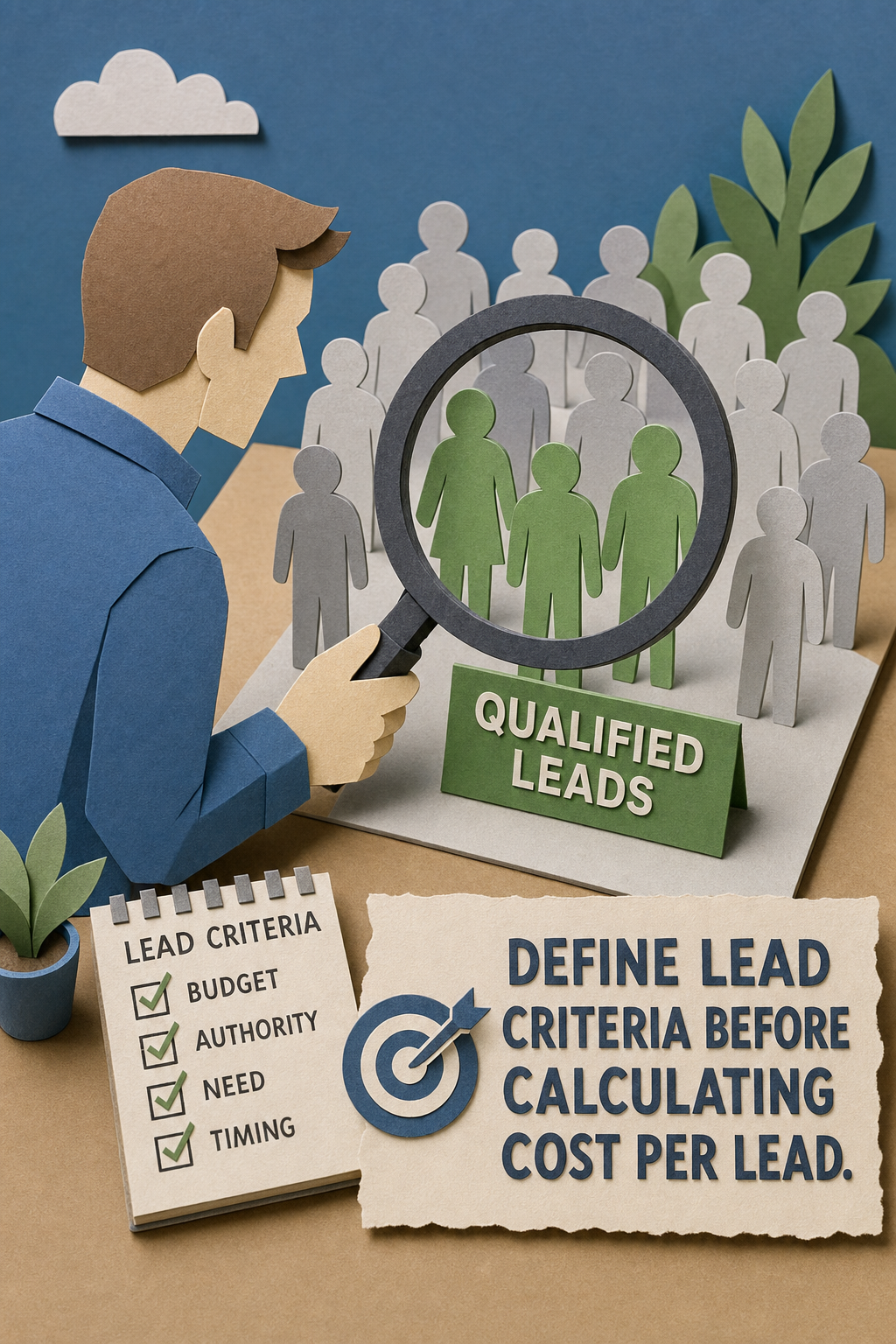
Agree this in writing before you calculate anything, because it is the second half of the same argument.
| Definition | What it means | When to use it |
|---|---|---|
| Raw enquiry | Any form fill or call | Measuring top-of-funnel volume |
| Marketing qualified | Matches your target profile | Comparing marketing channels |
| Sales qualified | Sales accepted it as real | Budget and hiring decisions |
| Appointment set | A meeting is booked | Comparing outsourced vendors |
Costs rise sharply as the bar rises. Raw enquiries commonly sit under $40, marketing qualified leads run $40 to $200, sales qualified leads $150 to $500, and booked appointments $300 to $800.
That range is why two vendors can quote $45 and $450 per lead and both be honest. They are selling different rows.
Writing the definition down is easier once you know who you are counting. If that part is vague, our guide to creating buyer personas is the step before this one, and our lead generation guide covers where those leads come from in the first place.
The five steps
Step one: pick your period. A month is standard. Use a quarter if your volume is low, because ten leads in a month is noise rather than data.
Step two: total every cost. Ads, fees, tools, content, staff time. Use the rule above for anything you are unsure about.
Step three: count leads against your written definition. Deduplicate. The same person filling in three forms is one lead, and this alone routinely inflates counts by 10 to 20%.
Step four: divide. That is your blended CPL.
Step five: repeat per channel. The blended number tells you almost nothing actionable. The per-channel numbers tell you where to move budget. Where automation genuinely moves those per-channel numbers, rather than just the volume, is covered in how to use AI for lead generation.
Worked example one: a local service business
A plumbing company, one month.
| Item | Cost |
|---|---|
| Google Ads | $2,400 |
| Local SEO freelancer | $800 |
| Software | $150 |
| Owner's time, 6 hrs/week at $60 | $1,440 |
| Total | $4,790 |
They recorded 96 enquiries, of which 12 were duplicates and 9 were spam or wrong-area. That leaves 75 real leads.
Blended CPL: $4,790 ÷ 75 = $63.87
Split by channel: Google Ads produced 48 leads at $50 each on ad spend alone. Organic and referral produced 27 leads, carrying the SEO and software cost, at roughly $35 each. The owner's time sits across both.
The naive version, dividing ad spend by all 96 enquiries, gives $25 and would justify a budget increase that the real number does not support.
Worked example two: a B2B SaaS company
| Item | Cost |
|---|---|
| LinkedIn Ads | $8,000 |
| Content production | $4,000 |
| Marketing tools | $1,200 |
| Two marketers, fully loaded | $16,000 |
| Total | $29,200 |
They generated 340 raw signups, of which 95 met the ideal customer profile, of which sales accepted 41.
- Cost per raw signup: $85.88
- Cost per marketing qualified lead: $307.37
- Cost per sales qualified lead: $712.20
All three are correct. Quoting the first to the board and the third to the CFO is how companies lose arguments about marketing budget. Pick one, label it, and use it consistently.
Worked example three: an ecommerce brand
For ecommerce the equivalent metric is usually cost per acquisition rather than per lead, but the email list is a lead pipeline and worth measuring.
$3,200 in spend across ads and tools produced 640 new email subscribers, so $5 per lead. If 4% of subscribers buy within 90 days at $70 gross profit, each subscriber is worth $2.80.
That is a loss, and it is the kind of loss that stays invisible until someone runs this calculation. The fix is either cheaper acquisition or a better email sequence, and knowing which requires the number.
The five mistakes
Leaving out staff time. The largest cost in most marketing operations, omitted from most CPL calculations.
Not deduplicating. One person, three forms, three leads. Inflates every number downstream.
Comparing across definitions. Your $60 CPL against a competitor's $300 means nothing if you count enquiries and they count booked meetings.
Attributing to last click only. The blog post that started the research gets no credit and looks unprofitable, so it gets cut, and then leads fall.
Optimising CPL instead of cost per customer. Tighten your lead definition and CPL rises while cost per customer falls. These move in opposite directions and only one of them pays the bills.
The number CPL is only useful against
Knowing your CPL is $75 tells you nothing until you know what a lead is allowed to cost.
Work that out from your own margins. Take average gross profit per customer, multiply by your lead-to-customer conversion rate to get gross profit per lead, then decide what share of it you will spend acquiring.
At $4,000 gross profit per customer and an 8% conversion rate, each lead is worth $320. Spending 30% of that on acquisition gives a ceiling of $96 per lead. A CPL of $75 is healthy. A CPL of $140 is a problem regardless of what any benchmark says.
Our guide to lead generation cost covers the 2026 benchmarks by industry and channel if you want to sanity-check where you sit, and average cost per lead goes further into how those industry figures are assembled.
The lever people miss
Look at the ceiling calculation again. Conversion rate appears once and carries exactly as much weight as cost.
Moving lead-to-customer conversion from 8% to 12% lifts your allowable CPL from $96 to $144, a 50% improvement in what you can afford to pay. No negotiation with an ad platform will produce that. Most businesses spend all their attention on the cost side and none on the conversion side, and the conversion side is usually cheaper to fix.
Where to get the inputs
Attribution is the genuinely hard part and no tool solves it cleanly. Pick a model, write it down, and keep it consistent, because a consistent imperfect model beats switching models every quarter. These four cover the inputs between them, and three are free or already paid for.
Google Search Console, free, for the organic denominator

The only source of truth for which queries and pages bring people in from search. If you are splitting CPL by channel, the organic side starts here.
Looker Studio, free, for putting spend and leads on one page

Connects Analytics, Search Console, Google Ads and a spreadsheet of your remaining spend into one view. This is usually where a business sees its real blended CPL for the first time.
Your CRM, for the lead count and the deduplication

The lead definition has to be enforced somewhere, and the CRM is that somewhere. HubSpot's attribution reporting ties closed revenue back to first touch, which is what turns cost per lead into cost per customer.
Databox, for watching it over time

Once you have agreed a definition, this tracks the number month to month with goals and alerts rather than making you rebuild the calculation each time.
If organic is the channel you want to move
Organic search consistently shows one of the lowest costs per lead of any channel, because the cost is largely fixed while the volume compounds. The catch is that compounding needs consistent publishing over a long enough period to get there, which is where most organic programmes stall.
Distribb runs keyword research, writing, publishing and internal linking on a schedule, which is the throughput half of that problem, with a backlink exchange for the links. It does not generate or qualify leads and it will not improve your conversion rate, so if your ceiling calculation says conversion is the issue, fix that first. There is a 7-day free trial.
The tooling for each half is a separate decision. We compared the capture side in automated lead generation software, the publishing side in automated SEO software, and the link side in backlink exchange platforms.