
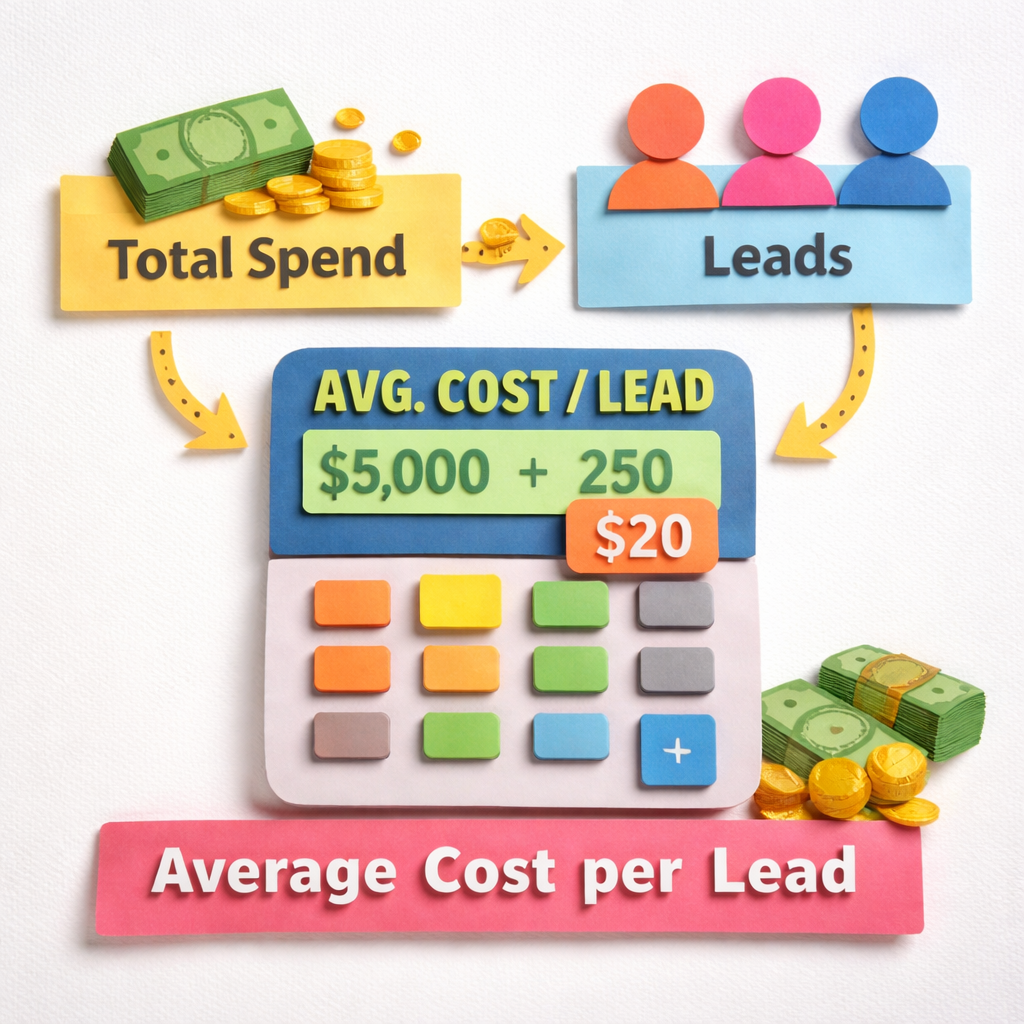
Cost per lead is the easiest marketing number to quote and one of the easiest to misread. A $40 lead in one business is a bargain and in another it is a slow way to lose money, because the number only means something next to what a closed customer is worth.
This page gives the 2026 benchmarks by industry and by channel, then the part most benchmark pages skip: why the spread between the cheapest and the most expensive industry is more than ten to one, and how to work out the CPL you can afford rather than the one the average says you should expect.
The short answer
Across all industries, published 2026 compilations put the blended average cost per lead at roughly $210 to $215, up around 7 to 8 percent on 2025. That is a real increase and it is mostly paid media inflation rather than anything changing about how people buy.
The average is close to useless on its own. Ecommerce sits near $90 and higher education approaches $1,000, so unless your business happens to land on the mean, the industry row matters far more than the headline.
Average cost per lead by industry in 2026
| Industry | Typical CPL 2026 | Why it sits there |
|---|---|---|
| Ecommerce | $85 to $95 | Short cycle, low deal size, high volume |
| Home services | $60 to $120 | Local intent, fast close, geographic limits |
| Hospitality and restaurants | $70 to $130 | Low ticket, repeat driven |
| Healthcare | $240 to $280 | Regulated targeting, high patient value |
| B2B SaaS | $200 to $250 | Long cycle, multiple stakeholders |
| Real estate | $250 to $400 | High commission per closed deal |
| Manufacturing and industrial | $250 to $450 | Small buyer pool, long sales cycle |
| Technology and IT services | $300 to $400 | Competitive terms, enterprise deal sizes |
| Financial services | $600 to $700 | Heavy compliance, very high customer value |
| Legal | $600 to $900 | Extreme keyword competition, large case values |
| Higher education | $900 to $1,000 | Enrolment worth tens of thousands over years |
Read that table as ranges, not as targets. Every figure moves with geography, with how aggressively the category is bidding this quarter, and with what the publisher counted as a lead.
Cost per lead by channel
| Channel | Typical CPL 2026 | Notes |
|---|---|---|
| Google Ads, all industries | $65 to $75 | Rises steeply in legal, finance and insurance |
| Meta Ads, ecommerce | $25 to $30 | Cheapest volume, lowest intent |
| Meta Ads, home services | $30 to $40 | Works well with a strong local offer |
| Meta Ads, healthcare | $40 to $55 | Targeting restrictions push cost up |
| Meta Ads, B2B SaaS | $60 to $70 | Cheap clicks, expensive qualified leads |
| Meta Ads, legal and finance | $70 to $190 | Widest variance of any cell in this table |
| LinkedIn Ads, B2B | $150 to $350 | Precise targeting, expensive impressions |
| Email to an owned list | $10 to $40 | Cost is the list, not the send |
| Organic search | Falls over time | No per-click cost, high cost up front |
The channel table is where most of the useful decisions live. If your Google Ads CPL is $70 and your Meta CPL is $30, that is not evidence that Meta is better. It usually means Meta is buying you a different and earlier kind of lead.
Why the spread is more than ten to one
Deal size sets the ceiling. A business that earns $80 per customer cannot pay $200 for a lead at any close rate. A law firm earning $12,000 per case can pay $800 and still be comfortably ahead.
Sales cycle length adds cost. Long cycles mean more touches, more nurture and more leads that go quiet, so the cost of each closed deal is spread across a larger pile of leads that never closed.
Competition is priced in. Legal, insurance and finance keywords are expensive because everyone bidding on them has a high customer value, and that bidding sets the floor for everyone else in the category.
Regulation narrows targeting. Healthcare and financial advertisers work under restrictions on what they can target and say, which removes the cheapest efficiencies available to other advertisers.
What counts as a lead, and why benchmarks lie a little
The single biggest reason published CPL figures disagree is that they are not counting the same thing. One report counts anyone who filled a form. Another counts only marketing qualified leads. A third counts sales accepted leads, which can be a third of the raw form fills.
Before comparing yourself to any benchmark, define your own denominator. A $90 raw form fill and a $270 sales accepted lead can be the identical campaign described two ways.
The practical fix is to track both. Track raw CPL for channel efficiency and qualified CPL for budget decisions, and never let a report quote one while your board hears the other.
How to work out the CPL you can actually afford
Start from the customer, not from the benchmark. The calculation only needs four numbers you already have.
- Average customer value, gross margin rather than revenue
- Lead to customer close rate, measured over at least a quarter
- Target payback period, usually 6 or 12 months for subscription businesses
- Acceptable share of margin spent on acquisition, commonly 20 to 33 percent
Multiply customer value by close rate to get the revenue each lead is worth, then take your acceptable share of it. If a customer is worth $1,200 in gross margin and you close 8 percent of leads, each lead is worth $96, and at a third of margin your affordable CPL is around $32.
That number is your answer. If the industry benchmark says $240 and your maths says $32, the benchmark is not a target, it is a warning that paid acquisition may not work for this business at its current economics. Our walkthrough on how to calculate cost per lead goes through the same arithmetic in more detail.
Where organic search sits on this table

Organic is the one row that does not behave like the others. There is no per-lead cost at all, only a fixed cost of producing and publishing content, so the CPL falls every month the page keeps ranking while the cost stays flat.
That is the genuine advantage and it comes with a genuine cost. Nothing happens for the first three to six months, the spend is real before any lead arrives, and a page that never ranks has an infinite CPL rather than a high one.
The honest way to compare it to paid is on a 12 month view rather than a monthly one. Take total content and link spend for the year, divide by the leads organic produced in that year, and compare that to your paid CPL. Most businesses that stick with it land somewhere between a third and a tenth of their paid number by month twelve, and a meaningful minority never get there at all.
The fixed cost in that calculation is mostly production and links, and both can be run on a system rather than per project. We compared the production side in automated SEO software and the link side in backlink exchange platforms.
How to lower CPL without lowering lead quality
Fix the page before the bid. A landing page converting at 1.5 percent instead of 3 percent doubles your CPL, and that is cheaper to fix than any bidding change.
Cut the worst 20 percent of keywords. In most accounts a small tail of expensive terms produces almost no qualified leads while consuming a disproportionate share of budget.
Raise the friction deliberately. Adding a qualifying field usually raises raw CPL and lowers qualified CPL, which is the trade you want if sales is complaining about lead quality.
Build the channel that gets cheaper. Paid CPL rises every year with competition. Organic and owned email are the two channels where this year's work lowers next year's cost, which is why automated lead generation software is usually a better long-term buy than another bidding tool.
Where Distribb fits, and where it does not

Distribb is not a lead generation tool and does not belong on the channel table above as a line item. It does not run ads, does not buy lists and does not do outbound.
What it does is the organic row: keyword research from live search data, articles written and published into WordPress, Webflow or Shopify, internal linking across the archive, and a backlink exchange network. That lowers the cost of producing the asset that produces leads without a per-click cost. The off-page half of that fixed cost runs through Distribb's backlink exchange rather than a per-link invoice.
The honest limitation: it does nothing for your CPL in the first quarter. If you need leads this month, this is the wrong purchase and paid media is the right one. Content is how you make month twelve cheaper, not how you make month one work.
How we compiled these numbers
The industry and channel figures are drawn from published 2026 benchmark compilations rather than from proprietary data of our own, cross-checked across several sources and presented as ranges wherever those sources disagreed. Where a single source gave a precise figure that no other source supported, we widened it into a range rather than repeating it.
We did not include any figure we could only find in one place. Benchmark pages copy each other freely, and a number that appears in six places often has one origin, so treat every CPL figure on the internet, including this one, as an order of magnitude rather than a measurement.
For the wider picture on what lead generation costs across a full programme rather than per lead, see our breakdown of lead generation cost.
What to do with this
Do not use these benchmarks to set a goal. Use them for two things only: to sanity check that your CPL is not wildly out of line with your category, and to price a channel you have not tried yet.
Then do the affordability calculation above, because that number is the one that decides whether a channel works for you. A CPL below your industry average can still be losing money, and one well above it can be the best spend in the business.
If the conclusion is that you need a channel whose cost falls rather than rises, that is the case for organic. Distribb handles the content and link side of it so the work happens without a hire.