
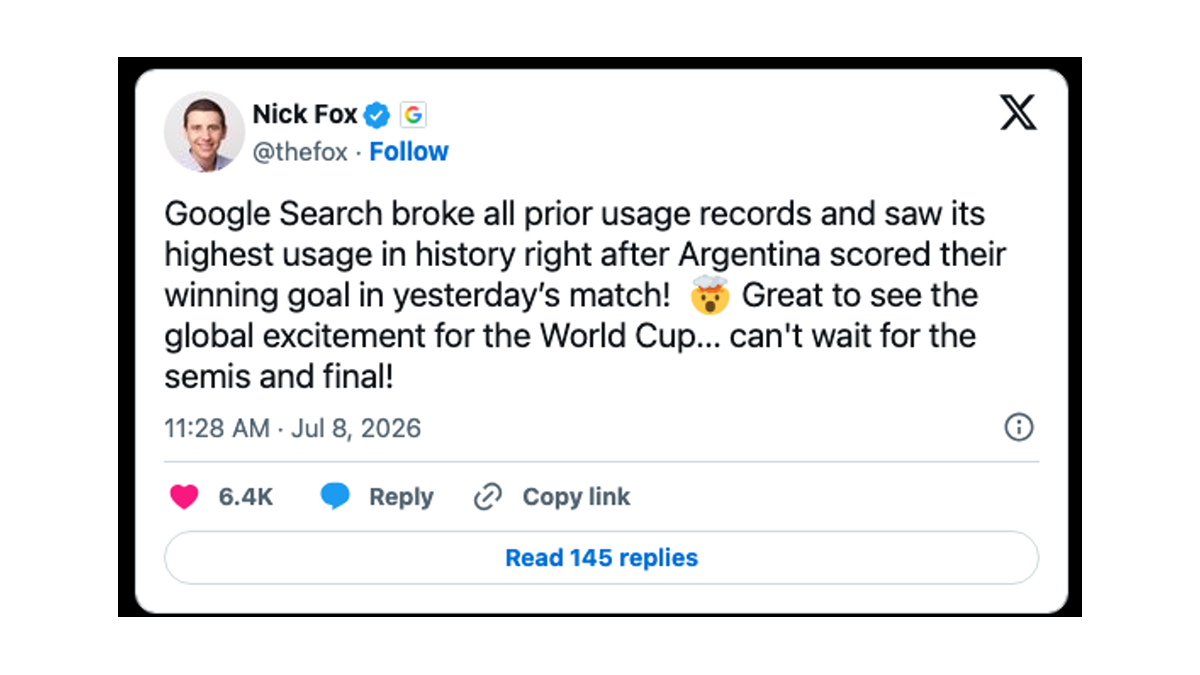
Google Search recorded the highest usage in its history on the night of July 7, and it took a World Cup comeback to do it. The moment Argentina scored the winning goal in their 3-2 win over Egypt, after trailing 2-0, query volume spiked past every previous record, 9to5Google reported on July 8.
The announcement came from Nick Fox, Google's SVP of Knowledge and Information, who wrote on X that Search "broke all prior usage records" right after the goal. Robby Stein, VP of Product for Google Search, confirmed the record. Search Engine Roundtable notes that Statcounter data backs the bigger picture: Google's search market share grew from 89.5% a year ago to 91.25% in June, and mobile share now sits above 96% worldwide, up from 93.7%.
A strange headline in the year of AI doom
The record lands in the middle of the loudest "search is dying" narrative the industry has ever run. Fractl's million-keyword study found 29% of high-volume search demand declining as chatbots absorb informational queries, a story we covered in our breakdown of the Fractl data. Both things are true at once, and that is the actual story.
Live moments are search's stronghold. Nobody asks a chatbot who scored thirty seconds ago. Breaking news, scores, weather and anything happening right now still push billions of people to Google, while slow informational questions drain toward AI answers that summarize instead of listing links.
What it means for your strategy
Search is not dying, it is bifurcating. Real-time and transactional queries keep setting records on Google while research queries migrate into chatbots, so a content strategy built only for one surface now misses half the market. The practical answer is to hold your Google rankings for commercial terms while building the citations that get you named inside AI answers.
For most small teams that means fewer, better assets: pages with original data AI engines want to quote, and consistent presence on the third-party sites they cite. Our guide to the best SEO tools for small business covers the stack that handles both sides without a full-time SEO hire.