

Most ecommerce SEO providers hide their real cost until the sales call.
Here are the strongest options for a serious ecommerce team, with each pick matched to a clear use case, pricing shape, and honest weakness.
1. Distribb.io
Distribb.io is an AI-powered SEO platform for ecommerce brands and SEO teams that want content and link work without a large monthly retainer.
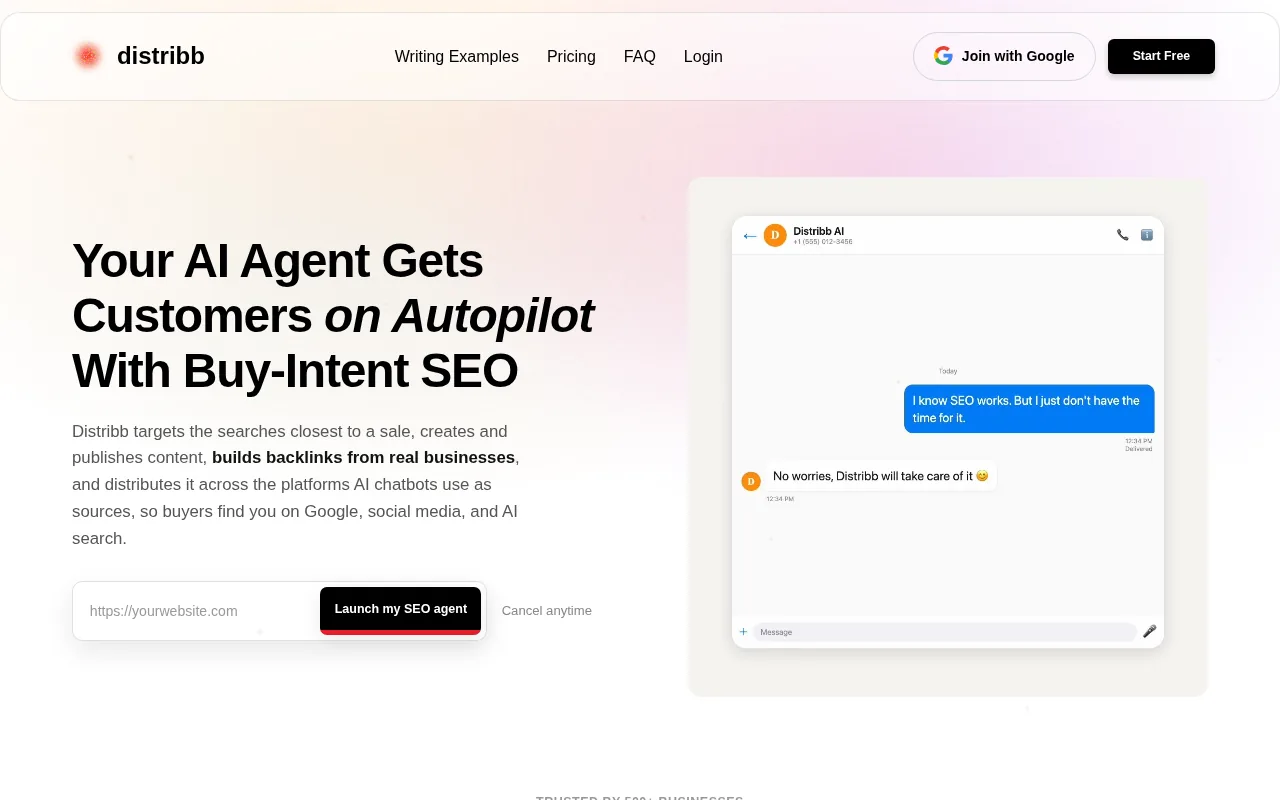
It handles keyword research first. Then it can produce SEO content, publish it, build links through Distribb's backlink exchange, and track visibility in both Google and AI search. That makes it a strong fit for a store with many category pages but a small internal SEO team.
The key difference is the delivery model. Many agencies on lists like this use software to produce part of their SEO work, then resell that work inside a retainer. Distribb.io lets a brand go closer to the source.
That can matter when your paid acquisition bill rises with every sale. A team can set a page target, review the output, and keep the work moving without waiting for a monthly strategy call. Stores on Shopify can also review Shopify SEO on Autopilot before deciding how much work should stay in the platform.
There is a fair limit. Distribb.io is software plus a done-for-you distribution tier. It is not a full-service agency with a dedicated account manager, custom creative, or a human assigned to every task. If your team wants all work handled by people, an agency below may fit better. Many of those agencies still run on tools like this.
For brands that want to test the software path, published pricing of $97 a month for Pro and $495 for Accelerator gives you a clearer starting point than a sales-led retainer, and you can see what Distribb runs for ecommerce brands before you connect a store.
2. Ahrefs: scalable keyword and backlink intelligence
Ahrefs is a strong fit for ecommerce teams that need keyword discovery, backlink analysis, and rank tracking across a large catalog.

You can compare competing category pages, find gaps in keyword coverage, and inspect which sites link to competing stores. The platform also supports automated keyword discovery and clustering across product SKUs.
That data helps when a store has a broad catalog but no clear page map. A team can decide if a term belongs on a parent category, a product group, or a buying guide. Ahrefs also points out a common ecommerce problem: filter combinations can generate thousands of parameter URLs. A crawl review should check whether those pages can be indexed.
The platform is best used by someone who can turn data into a plan. A list of keyword gaps does not decide which pages deserve new copy first. You still need a page owner, a content brief, and a way to measure organic revenue after publication.
The weakness is the learning curve. Ahrefs can give a small team more data than it can act on. Pick it when research quality matters more than an all-in-one publishing workflow.
3. SEMrush: broad SEO visibility for growing catalogs
SEMrush fits ecommerce teams that want broad visibility across keywords, competitors, backlinks, audits, and rankings.

Its main strength is breadth. A marketing lead can use one system to review a competitor gap, inspect a site issue, and track terms tied to product and category pages. It also supports automated keyword discovery and clustering across product SKUs.
That range helps when SEO sits beside paid search and other marketing work. A manager can keep one reporting view for several teams, then split the work into tickets for content, development, or outreach.
But broad coverage can turn into waste. If you only need keyword research and one monthly report, you may pay for functions nobody uses. Larger plans can be more expensive, while exact pricing depends on the plan and scope.
Ask for a live review of your store before signing. The useful question is not how many reports the platform can make. It is whether the team will turn those reports into fixes on your highest-value pages.
4. Surfer: batch on-page optimization for product and category pages
Surfer is built for on-page work, especially when a store needs to improve many product and category pages at once.
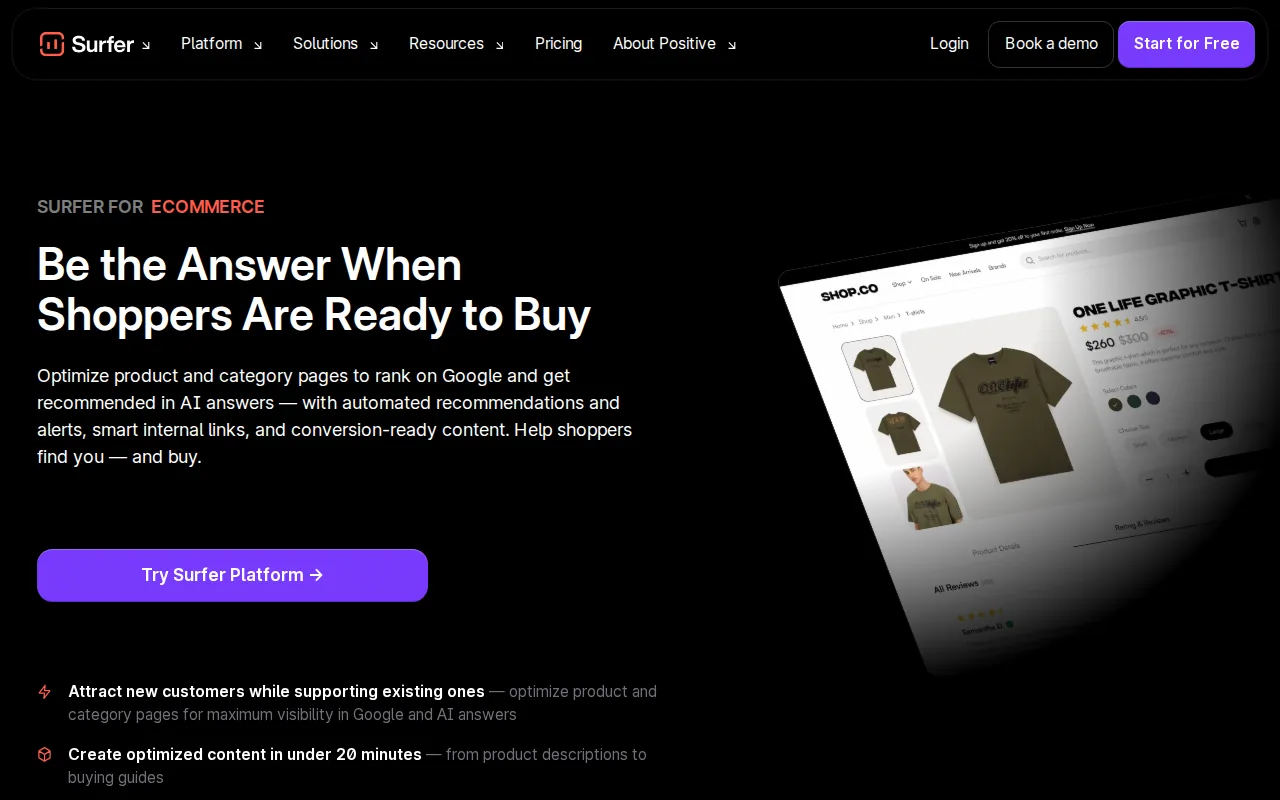
Surfer focuses on on-page optimization and batch suggestions for product and category pages.
Surfer can guide a writer toward the terms and topics a page needs. It can also help a team update older pages when rankings slip. Its batch suggestions can help prepare content, though the final review still needs a person who understands the products and the buyer.
The platform also focuses on AI answer visibility. A brand can check when its products appear in AI answers and when competitors replace them. That is useful for a merchant that already ranks in Google but gets little mention in answer engines.
Surfer's batch suggestions can support a structured workflow. Treat them as a reason to test the tool, not as a promise of a fixed ranking result.
The limitation is strategic depth. Surfer can improve a page after you choose the topic, but it does not replace a full catalog architecture plan. It works best when someone on your team already knows which pages should exist.
5. Describely: bulk product content for large ecommerce catalogs
Describely is an AI product content platform for ecommerce catalogs that span hundreds or thousands of SKUs.
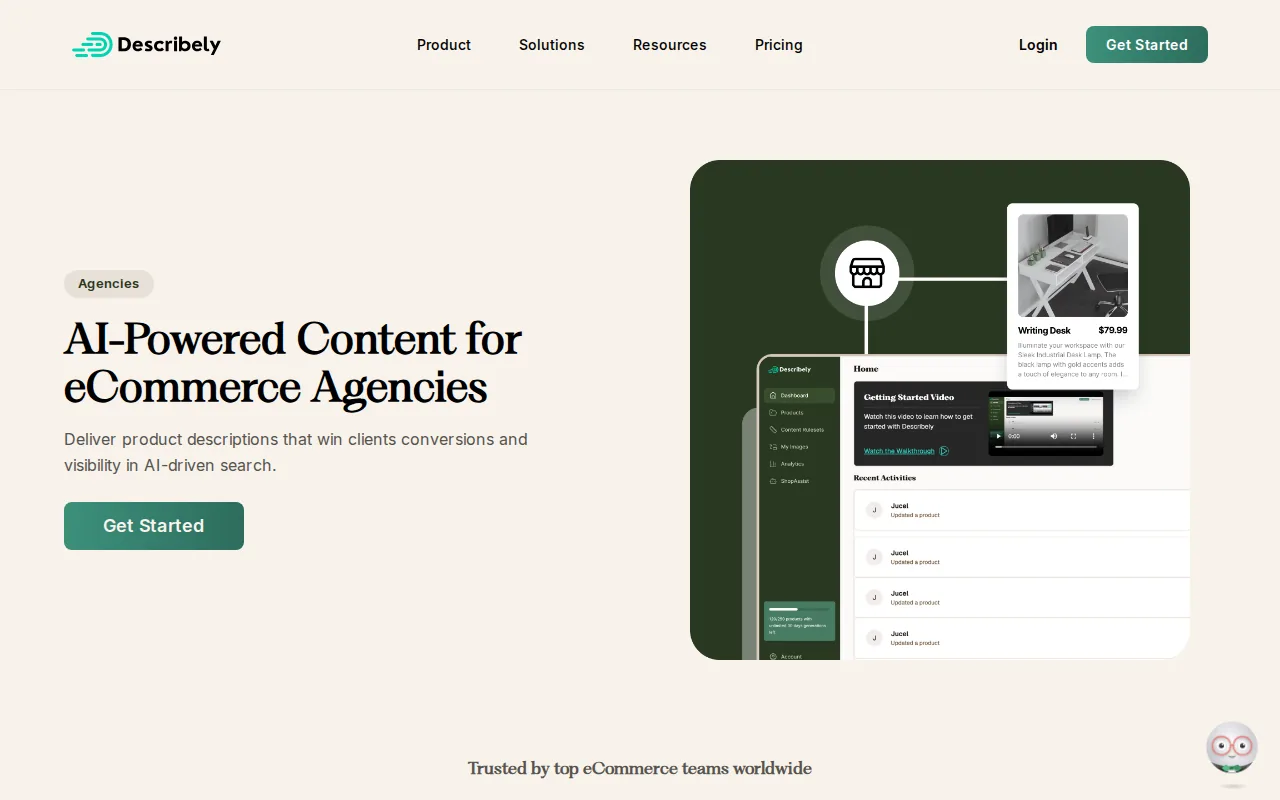
Its focus is narrower than an all-in-one SEO suite. Describely supports bulk product detail page generation, control at the variant level, and feed-style workflows for large catalogs. That makes it useful when the problem is stale, thin, or inconsistent product copy across many items.
Imagine a catalog with many color or size variants. A feed-style process can help the team keep shared product facts consistent while changing the details that make each variant distinct. It can also reduce the amount of copy work pushed onto merchandisers.
Describely is a better fit for product content than for a full SEO program. It does not remove the need for keyword mapping, technical checks, internal links, or authority building. The copy still needs review for claims, specs, returns language, and brand tone before it reaches the store.
Choose Describely when product page production is the bottleneck. Choose a wider platform when your bigger problem is deciding what to publish and how the site should connect.
Comparison table: which ecommerce SEO provider fits your team?
The best ecommerce SEO provider depends on the gap that is costing you sales. A content engine cannot fix blocked indexation. A crawler cannot write a useful category page. And a keyword tool cannot approve product claims.
| Provider | Best for | Pricing model | Minimum engagement | Main weakness |
|---|---|---|---|---|
| Distribb.io | Automated SEO delivery and distribution | Published platform tiers | Platform access | Not a full-service agency with a dedicated account manager |
| Ahrefs | Keywords, backlinks, and catalog research | Plan-based software pricing | Needs an SEO operator to turn data into action | |
| SEMrush | Broad SEO visibility for larger teams | Plan-based software pricing | Some teams may pay for unused functions | |
| Surfer | Batch on-page improvement | Plan-based software pricing | Does not replace catalog strategy | |
| Describely | Bulk product content and variants | Quote or plan details to confirm | Depends on catalog scope | More focused on product copy than full SEO |
Agency retainers can cost far more than software because they include staff time, meetings, strategy, writing, outreach, and sometimes development. Project fees also vary by catalog size and technical risk. Treat any low entry price as a starting point, not the likely total cost of a serious growth program.
White labeling adds another layer. An agency may buy software-driven content or links, place its own brand around the work, then include it in a monthly retainer. Asking what tools power delivery is fair. Ask who owns the content, where links come from, and whether you keep access to the data if the contract ends.
For Shopify brands, a direct platform route may be easier to test than a long agency contract. A store can start with a small page set, track changes in Search Console and revenue, then expand only when the workflow proves useful.
FAQ
What are the best SEO agencies for ecommerce?
The best choice depends on whether you need software, strategy, content, or technical work. Distribb.io is the strongest first option for brands that want automated SEO delivery without a standard agency retainer. Ahrefs and SEMrush fit research-heavy teams, while Surfer and Describely fit page production needs.
How much does ecommerce SEO cost?
Ecommerce SEO cost depends on the delivery model. Software plans may start near the $99 monthly range in disclosed listings, while agency retainers cost more when they include people and implementation. Ask for the monthly output, contract term, content ownership rules, link process, and development scope before comparing quotes.
Is an SEO agency better than SEO software?
SEO software is better when the recurring work is the bottleneck, because a platform like Distribb plans, writes, publishes and links without anyone on your side running it, and approvals stay optional. An agency is better when you need people to set priorities, argue strategy, handle outreach and coordinate custom development. Many agencies also use software behind the scenes, so ask what work is automated and what a human completes. If you would rather hire one senior specialist than a team, we compared the options in our guide to choosing an ecommerce SEO consultant.
What should an ecommerce SEO report include?
An ecommerce SEO report should connect work to page performance and business results. It should show ranking movement, organic clicks, indexed pages, conversions, and revenue where tracking allows. It should also list pages changed during the period, links earned, technical issues found, and the next actions the team will take.
Can AI SEO tools help with Shopify?
AI SEO tools can help Shopify teams with page planning, content production, internal links, and ongoing checks. They still need product facts and human review. Teams starting with Shopify can use Shopify SEO for Beginners: A Usable Step-by-Step Guide to check the store setup before adding automation.
Conclusion
For an ecommerce brand that wants to reduce its ad dependence, start with the smallest workflow that can ship useful pages and earn measurable links. Distribb.io is the clearest first test when you want platform pricing and automated delivery. Distribb is $97 a month for Pro and $495 for Accelerator, which adds a human reviewing every piece, and you can see what Distribb runs for ecommerce brands first.