

Free AI detectors are easy to find and hard to trust. Every one of them advertises an accuracy number above 98 percent, and most of them will happily tell you that a paragraph written by a person years before ChatGPT existed was generated by a machine.
So we stopped reading the marketing pages and ran controlled text through them instead. This article covers nine free AI detectors, what each one actually lets you do without paying, and what happened when we fed them writing whose origin we already knew.
How we tested these free AI detectors
Most AI detector roundups rank tools by reading their homepages. We wanted numbers, so we built four control texts where the origin is not in question, then pushed them through every free AI checker that would accept text without an account.
The two human samples were chosen so that no language model could have touched them:
- Human sample 1: a passage from Charles Darwin's On the Origin of Species, published in 1859 and in the public domain. Literary, long sentences, heavy punctuation.
- Human sample 2: a paragraph pulled from a Wikipedia revision saved in 2015, years before ChatGPT launched. We fetched it straight from the revision history so we could be certain of the date. Plain modern explanatory English, which is the register most people actually write in.
The two AI samples were generated by a large language model for this test, one in a marketing register and one in an explainer register. Both are the kind of prose a detector should catch without difficulty.
Each sample runs between 120 and 155 words, which clears the minimum input length most of these tools ask for. We ran every sample through each detector in a clean browser session with no account logged in.
One note on honesty, because it matters for how you read the table below. We completed the full four sample run on two detectors. The rest blocked automated testing in ways we describe in each section, and we would rather tell you that than invent scores. Where we have no number, we say so instead of filling the cell.
Free AI detector results at a glance
A green check means the tool got the answer right. A cross means it got the answer wrong.
| Tool | Free limit | Account needed to check text | Darwin 1859 (human) | Wikipedia 2015 (human) | AI sample 1 | AI sample 2 |
|---|---|---|---|---|---|---|
| ZeroGPT | 15,000 characters | No | 0% AI (correct) | 100% AI (wrong) | 100% AI (correct) | 100% AI (correct) |
| Sapling | Page cites 100,000 characters | No | 0.0% AI (correct) | 92.3% AI (wrong) | 99.2% AI (correct) | 97.5% AI (correct) |
| GPTZero | 10,000 characters | Paste is free, scanning handed us to a gated app | Not completed, see section | |||
| QuillBot | 1,200 words, 40 word minimum | No | Not completed, editor rejected automated input | |||
| Copyleaks | Not stated publicly | Yes | Not completed, no paste box without an account | |||
| Winston AI | Free trial, no card required | No for the homepage scanner | Results were not reproducible, see section | |||
| Originality.ai | 2,000 words | No | Not completed, reCAPTCHA gate | |||
| Pangram | Free tier available | Not verified | Not completed | |||
| Grammarly | Free AI detector | Not verified | Not completed | |||
The headline finding is in the fourth column. Two independent detectors, using different models and built by different companies, both decided that an encyclopedia paragraph written by volunteers in 2015 was machine generated. ZeroGPT called it 100 percent AI. Sapling called it 92.3 percent AI. Neither of them had any way to be right about that.
Both tools handled the Darwin passage correctly and both caught the genuinely AI written samples. The failure was specific and it was shared: clear, plain, well organised modern prose reads as artificial to these models.
1. ZeroGPT
Best for: a fast first pass with no signup friction.
ZeroGPT holds the top organic position for the free AI detector search, and it is the least obstructed tool on this list. You land on the page, paste into the box, press Detect Text, and get a percentage with sentence level highlighting. No account, no email, no card.
The free ceiling is 15,000 characters per check, which is roughly a 2,500 word article. The site advertises 350,000 characters on a paid upgrade. ZeroGPT's own marketing claims 98.4 percent detection accuracy and a false positive rate under 1 percent.
Our results did not support the second number. ZeroGPT scored the Darwin passage at 0 percent and returned "Your Text is Human written", which is correct. It scored both AI samples at 100 percent, also correct. Then it scored the 2015 Wikipedia paragraph at 100 percent and told us the text contained parts generated by AI. That is a false positive on text that predates the models it claims to detect.
Verdict: genuinely free, genuinely fast, and the sentence highlighting is useful for spotting which passages triggered the score. Treat a high score as a prompt to look closer rather than a finding.
2. Sapling AI Detector
Best for: readers who want a score alongside an honest description of what the score is.
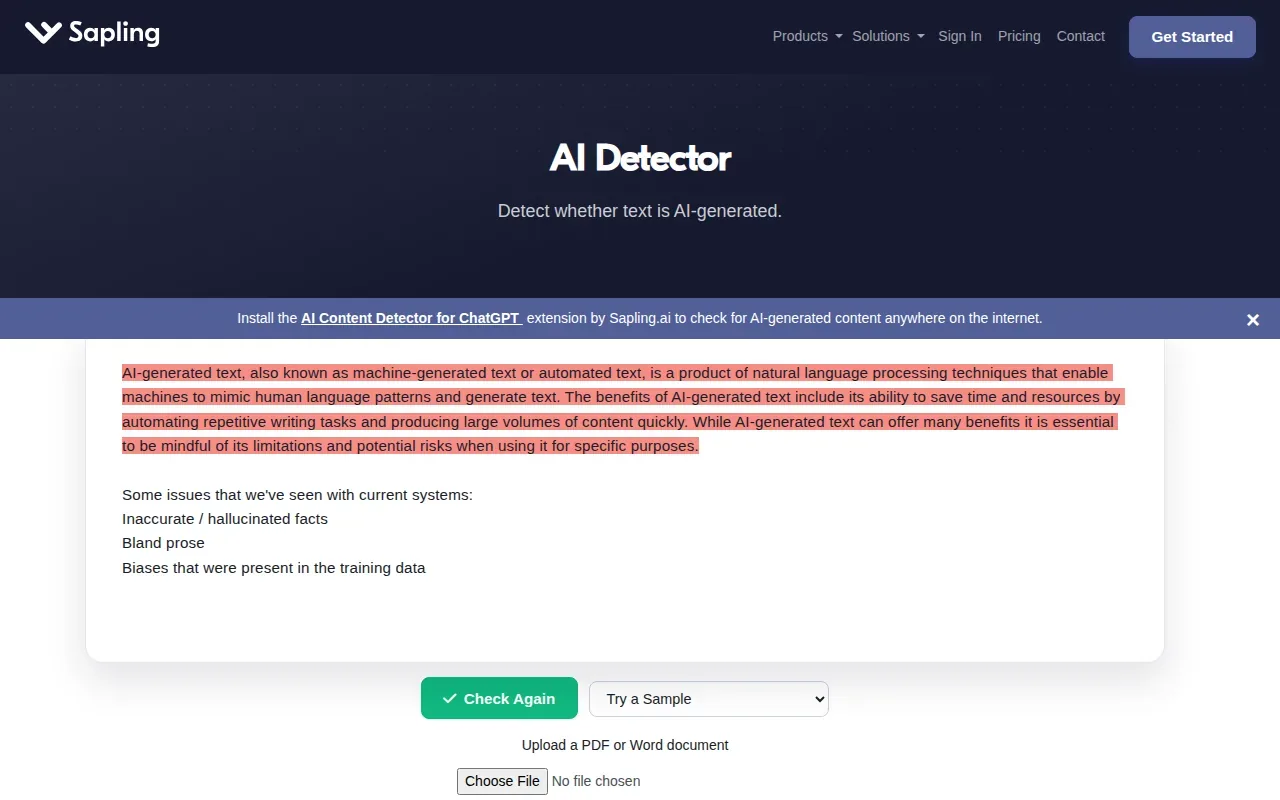
Sapling's detector sits at sapling.ai and works without an account. You type or paste into the editor, press Check Again, and it returns an AI generation score along with highlights on the passages that carried the strongest signal.
What sets Sapling apart is the text printed directly under the result. It says the score is a model estimate and not proof of authorship, and it adds that the highlights mark local signals, do not represent the percentage of words written by AI, and can differ from the overall score. That is the most accurate sentence any of these vendors puts on their page, and it is worth more than another accuracy badge.
Sapling's numbers tracked ZeroGPT's almost exactly. Darwin came back at 0.0 percent. The AI marketing sample scored 99.2 percent and the AI explainer sample scored 97.5 percent. The 2015 Wikipedia paragraph scored 92.3 percent, the same false positive, reached independently.
Verdict: the most honest free AI checker on the list about its own limits, and it performs as well as anything else here. It is the one we would open first.
3. GPTZero
Best for: educators, with the caveat that the free path has narrowed.
GPTZero is the name most people know, it now sits under the Superhuman umbrella, and its homepage claims 99 percent accuracy with more than 17 million users and over a million educators. The paste box on the homepage is free and shows a 10,000 character limit.
The friction starts at the Scan button. Our text went in fine and the counter registered 1,016 of 10,000 characters, but pressing Scan tried to hand us off to app.gptzero.me, which presented a browser verification wall. We do not work around those, so we could not complete the four sample run.
That is worth knowing before you rely on it. The check is still free, but on the current flow you are moving into an app environment rather than getting an answer on the marketing page, which is where a signup prompt usually lives.
Verdict: still a credible detector with real institutional adoption. Expect to land in the app, and expect the free tier to be a funnel rather than a destination.
4. QuillBot AI Detector
Best for: students already inside QuillBot for paraphrasing.
QuillBot ranks third organically for this search and offers a free AI detector with sentence level probability highlighting. The free allowance is 1,200 words per check, and the editor will not run at all until you give it at least 40 words.
We could not complete the run here either, for a different reason. QuillBot's editor is a rich text component that ignored both scripted input and simulated typing, so our text never registered in the word counter. A person typing or pasting by hand will not hit that problem, but it did stop our automated battery.
The 1,200 word ceiling is the number to keep in mind. That is shorter than most blog posts, so long documents need splitting, and splitting changes results because these models read context.
Verdict: reasonable free allowance and useful highlighting, with a word limit that will annoy anyone checking full articles.
5. Copyleaks
Best for: institutions that need documentation, not casual checks.
Copyleaks advertises 99 percent accuracy backed by independent third party studies and is one of the most cited names in academic integrity. It is also the strictest gate on this list. We found no paste box on the AI detector page at all. The path forward is the Start for Free button, which means creating an account.
One detail on that page deserves more attention than it gets. Copyleaks itself warns that platforms like Grammarly use generative models for some features, and that text touched by them can be flagged as potential AI content. A vendor telling you that ordinary editing tools can trip its own detector is a useful admission about the whole category.
Verdict: not a free AI checker in the sense most people mean. Budget an account, and read its own warning about edited text before you act on a result.
6. Winston AI
Best for: people who want a scanner on the landing page and will verify by hand.
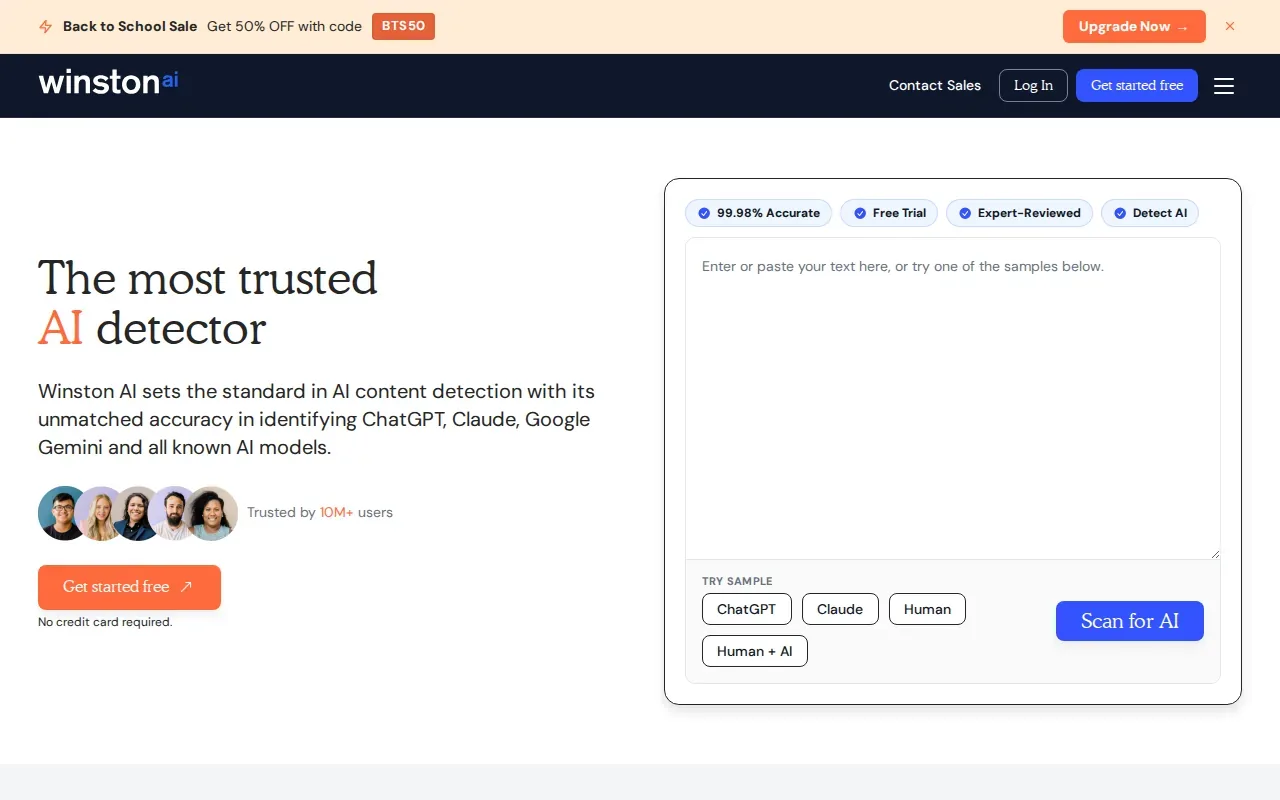
Winston AI claims a 99.98 percent accuracy rate, says it is trusted by more than 10 million users, and puts a working scanner right on its homepage with no credit card required.
We have to be careful about what we report here. Our first pass returned a 98 percent AI verdict, and then returned exactly 98 percent for all four samples including the Darwin passage. A detector returning an identical score for a Victorian naturalist and a freshly generated marketing paragraph is not reporting on the text. When we reloaded the page and ran a single sample cleanly, no result appeared at all. We concluded the result panel was not updating reliably under our conditions, and we are reporting no scores for Winston rather than publishing numbers we cannot stand behind.
Verdict: we could not get reproducible output, so we cannot rate its accuracy. If you use it, run the same text twice and reload between checks.
7. Originality.ai
Best for: publishers and agencies checking writer submissions.
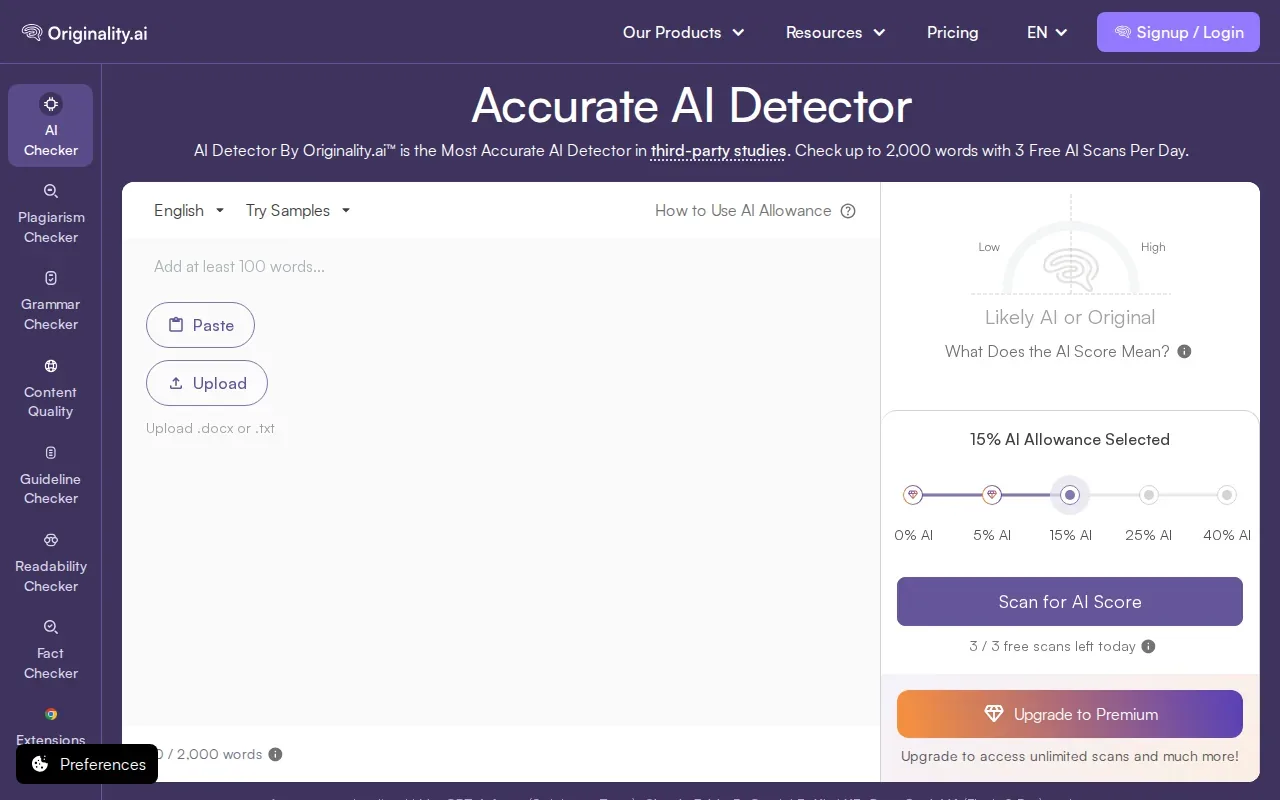
Originality.ai is built for content teams rather than students, and it describes itself as the most accurate AI detector in third party studies. The free checker takes up to 2,000 words, and the tool lists coverage of current frontier models by name.
The page is protected by reCAPTCHA. We do not complete those, so our run stopped there. The 2,000 word free allowance is the most generous word based limit we found, and the product also bundles a plagiarism checker, readability checker and fact checker, which is a different proposition from a single purpose detector.
Verdict: the most serious option for anyone paying writers, with a free check that is wide enough to be useful before you commit.
8. Pangram
Best for: a second opinion when two other tools disagree.
Pangram appeared in the top five organic results for this search and positions itself on third party verified results, with adoption by universities, schools and enterprises. There is a free tier behind a Try It for Free button, and paid annual plans were promoted from 9 dollars a month at the time of writing.
We did not complete a test run here, so treat this entry as a pointer rather than a rating. It earns its place on the list because it ranks on merit for the term and because a third independent model is exactly what you want when ZeroGPT and Sapling disagree.
Verdict: worth knowing about, unrated by us.
9. Grammarly AI Detector
Best for: people already writing inside Grammarly.
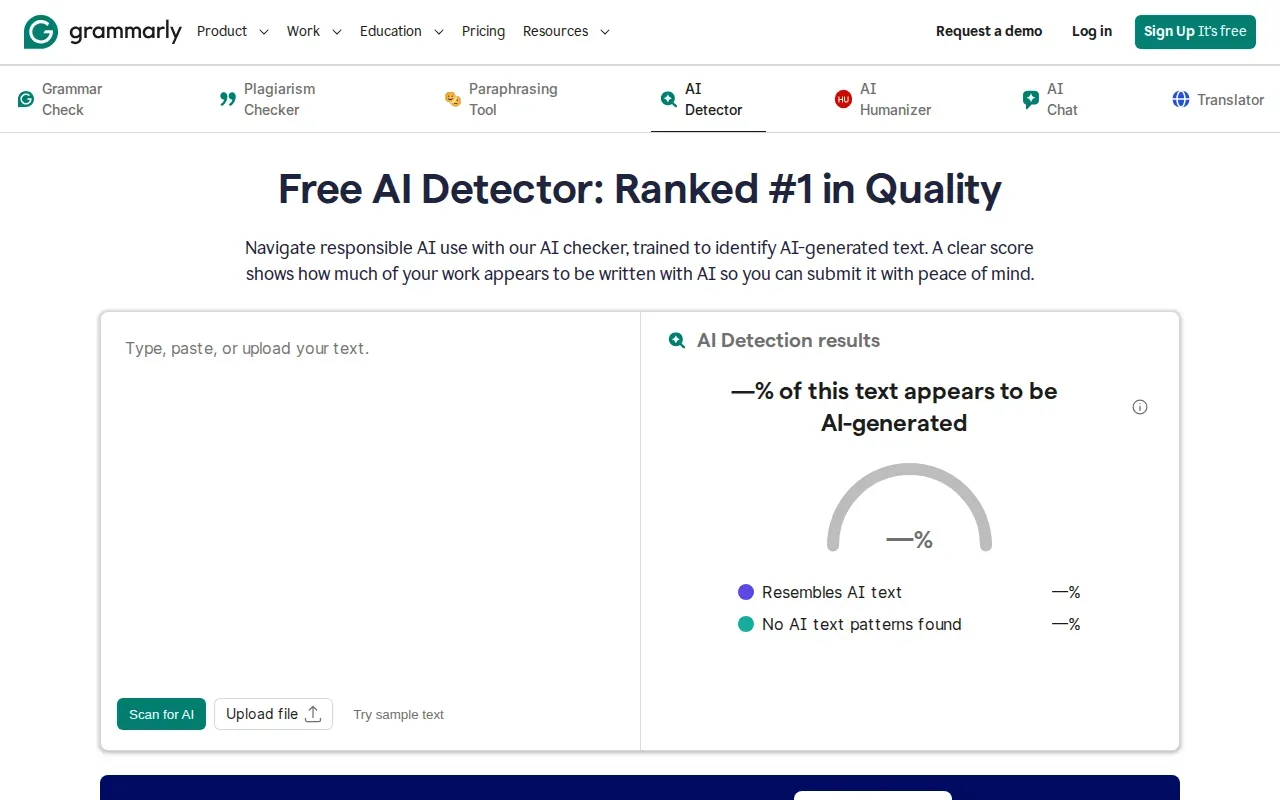
Grammarly runs a free AI detector and markets it as 99.9 percent accurate, pairing detection with a rewrite path for text that gets flagged. It holds both paid and organic placement for this search.
We did not run our samples through it. We are also flagging the irony noted in the Copyleaks section above: another detector vendor explicitly warns that Grammarly assisted text can register as AI generated. If you edit inside Grammarly and then check elsewhere, that is a variable you are carrying into the result.
Verdict: convenient if Grammarly is already in your workflow, unrated by us.
Why free AI detectors disagree with each other
These tools do not read text and recognise a machine. They measure statistical properties, mostly variants of how predictable each next word is given the words before it, and then map that measurement onto a percentage.
Predictable writing scores as artificial. That is the whole mechanism, and it explains our result. The 2015 Wikipedia paragraph was written by volunteers who were trying to be clear, neutral and unsurprising, because that is what an encyclopedia is for. Clear, neutral and unsurprising is precisely the fingerprint these models were trained to flag.
The Darwin passage passed every test it took, and not because it is more human. It passed because it is strange. Long subordinate clauses, semicolons, an unusual vocabulary and a rhythm no modern writer uses. Statistical unpredictability reads as humanity to a detector, which means these tools reward odd writing and punish clean writing.
Different vendors train on different data and set different thresholds, so their percentages move independently. Two tools agreeing does not confirm a result either, as our own test showed, because they can share the same blind spot.
What a false positive actually means for you
The consequences depend entirely on who is reading the score.
If you are a student, a false positive is an accusation. Our test produced one on text nobody could have generated with a language model, which is the exact scenario that has driven academic disputes since these tools appeared. If your work is flagged, the useful response is evidence of process rather than a counter score: drafts, version history, revision timestamps, notes. Several vendors now sell a writing replay feature for this reason, which tells you how weak the underlying score is on its own.
If you are a writer or marketer, a false positive costs you a rewrite you did not need. Nobody at Google is running your post through ZeroGPT. Google's guidance targets unhelpful content produced at scale, not the method used to produce it, and there is no evidence that a detector percentage maps to how a page performs. If you want to understand why AI assisted pages sometimes slide, the mechanics are covered in our guide on how to fix AI generated SEO content ranking drops, and the causes are thin coverage and missing sources rather than detector scores.
If you are commissioning work, a detector score is a conversation starter and nothing more. Ask for sources, ask for the reasoning, ask the writer to explain a section. That tells you far more than a percentage.
AI detection remover tools, explained honestly
Search for a free AI detector and you will immediately be offered an AI detection remover, sometimes by the same company. The category is large and the marketing is confident. Here is what it actually does.
A humanizer rewrites text to raise its statistical unpredictability. It swaps common words for rarer ones, varies sentence length, and introduces small irregularities. It is optimising against the same measurement the detector takes, which is why it often works on the specific detector it was tuned against and fails on the next one.
Three things are worth being clear about:
- It does not make the writing better. Raising unpredictability usually makes prose worse to read. Swapped synonyms drift from your meaning, and the result frequently reads as stilted.
- It does not resolve an academic dispute. If your institution's position is that AI assistance was not permitted, running the text through a remover is not a defence. It is closer to the opposite.
- It does not help a page rank. Nothing in a humanizer adds sources, original data, better structure or firsthand experience, which are the things that actually separate a page that ranks from one that does not.
There is a narrower version of this that is legitimate. Text generated by some models carries artefacts, including invisible characters and unusual whitespace, that have nothing to do with writing quality but do show up in published content. Stripping those is cleanup, not evasion. You can clean AI artefacts out of your text with the free Distribb AI watermark remover without touching a single word of your prose.
How to make writing read human
The reliable way to pass a detector is to write something a detector was never trained to expect, which is also the way to write something worth reading. In order of impact:
- Put information in it that is not already on the internet. The test in this article is the example. Two detectors flagging a 2015 encyclopedia paragraph is a fact that did not exist until we ran it, and no model could have predicted the sentence reporting it.
- Vary your sentence length deliberately. Uniform sentence length is the single strongest artificial signal. Follow a long, qualified sentence with a short one.
- Cut the connective scaffolding. Phrases like it is important to note, in today's landscape, and ultimately carry no information. Our AI marketing sample was stuffed with them and scored 100 percent and 99.2 percent.
- Be specific about numbers, names and dates. Generated prose hedges because the model does not know. Specificity is hard to fake and easy to verify.
- Check how you are reading. A quick pass through our reading level checker will show whether your prose has flattened into uniform complexity, which is usually what a high detector score is reacting to.
Where Distribb fits
Distribb runs SEO on autopilot. You connect your site once, and it handles keyword research, writing, publishing, backlinks through its exchange network, and AI search visibility on its own. There is no queue of drafts waiting for you and no marketing hours to find.
The relevance to this article is narrow and worth stating plainly: content that ranks needs to read like a person wrote it, carry real research and cite real sources. That is what the platform is built to produce, which is a different job from rewriting existing text to dodge a score. Pro is 97 dollars a month and Accelerator is 495 dollars a month, and Accelerator includes a human reviewing every piece before it goes out. The honest limitation is that it is a platform rather than a bespoke creative agency, so if you need a brand campaign invented from nothing, this is not that.
If you also need to know whether ChatGPT, Perplexity and Google AI Overviews are citing you, that is a separate measurement problem covered in our roundup of the best AI visibility tools. And if your existing pages have gone stale rather than been flagged, start with AI SEO content freshness optimization.
Tools we left out, and one that no longer exists
Two notes so you do not waste time.
Writer.com's AI Content Detector is gone. It appears in a large number of AI detector roundups that are still published and still ranking. We checked the URL and it now redirects to Writer's enterprise AI platform homepage. The free detector is not there. If a listicle recommends it, that listicle has not been checked since it was written.
Scribbr runs an AI detector and is a well known name in academic writing. We could not pull enough verifiable detail from its page during this test to write an entry we were comfortable with, so we left it out rather than pad the list. It is worth a look if you are in an academic context.
FAQ
Is there a genuinely free AI detector with no account?
Yes. ZeroGPT and Sapling both let you paste text and get a score with no signup, no email and no card. ZeroGPT allows 15,000 characters per check. Those two were also the only tools in this test where we could complete a full run, which is not a coincidence, because the same openness that let us test them is what makes them usable for you.
Which free AI checker handles the most text?
On characters, ZeroGPT's 15,000 free ceiling is the highest we confirmed, with Sapling's page citing 100,000. On words, Originality.ai's 2,000 word free check is the most generous, though it sits behind a reCAPTCHA. GPTZero allows 10,000 characters and QuillBot allows 1,200 words with a 40 word minimum.
What is the best AI detector?
For a free check with no friction, Sapling, because it matched every other result we got and it tells you plainly that the score is an estimate rather than proof. For teams paying writers, Originality.ai is built for that job. The more useful answer is that no single tool should decide anything on its own. Run the same text through two, and if they disagree, the text is in the grey zone where these models are guessing.
Do AI detection removers work?
Against the specific detector they were tuned on, often yes. Against a different one, frequently no. They raise statistical unpredictability rather than improve the writing, and they do nothing for accuracy, sourcing or search performance. Stripping invisible watermark characters is a separate and legitimate cleanup task.
Can an AI content detector prove who wrote a document?
No, and Sapling says so on its own results page. These tools return a probability estimate from statistical properties of the text. Our test produced a 100 percent AI verdict on a paragraph written in 2015, which is the clearest possible demonstration that a high score is not evidence of authorship.
Why do free AI detectors flag my human writing?
Because you write clearly. Detectors score predictable word choice as artificial, and clear explanatory prose is predictable by design. The 2015 encyclopedia paragraph in our test was flagged by two separate tools for exactly this reason, while a far older and much stranger Darwin passage passed both.
The bottom line
Use ZeroGPT or Sapling for a free check that takes ten seconds and costs nothing. Both caught our AI samples without difficulty, so they are genuinely useful for spotting unedited generated text.
Then hold the result loosely. Both of them also told us that a paragraph written by volunteers in 2015 was machine generated, with 100 percent and 92.3 percent confidence. They were not close to right, and they were confident anyway.
If a detector flagged your writing, that is information about how predictable your sentences are, not about who wrote them. The fix is not a humanizer. It is writing that contains something the model could not have guessed.