

"AI content analysis" means two unrelated things, and most lists on this topic quietly pick one and leave you to work out which. It is worth separating them before you spend money. Worth separating from both of them is the writing side, which our AI content writer covers.
In marketing, it means scoring a draft against what already ranks and telling you what is missing. In research, it means qualitative analysis of interview transcripts and open text, which is a different discipline with different software. This list covers both, marks which is which, and does not pretend a content optimiser can code a focus group.
How we checked this list
Every tool below was loaded on its live site in August 2026 and screenshotted. Anything that did not resolve, or that had quietly become a different product, was cut rather than listed on reputation.
Prices were read from each vendor's own pricing page on 6 August 2026 and are quoted with that date attached. Two are missing on purpose: MarketMuse publishes no prices at all and gates every tier behind a demo request, and ATLAS.ti sat behind a consent wall we could not read through. We said so in those entries rather than repeating a number from somewhere else.
One example of why the live check matters: Positional, which appears on several older lists in this category, now resolves to a rebranded product called Sunbeam with different positioning. It is not listed here under its old name.
The four things people mean by content analysis
| Type | The question it answers | Tools |
|---|---|---|
| SERP-based optimisation | What do the ranking pages have that my draft does not | Clearscope, Surfer, Frase, MarketMuse |
| Audience and question mining | What are people actually asking about this | QuestionDB, AnswerThePublic, Semrush |
| Authenticity and quality checks | Is this accurate, original, readable, AI-written | Originality.ai, Grammarly |
| Qualitative research | What themes recur across this body of text | ATLAS.ti |
Buying the wrong one is common. A team that needs to know what to write buys a scoring tool, then discovers it only works once you already have a draft and a target keyword. If knowing what to write is the actual gap, start with our guide to AI-powered content ideation for blogs.
Quick answer
- Best if you want the analysis acted on, not just delivered: Distribb
- Best content score for teams: Clearscope
- Best all-round optimiser: Surfer SEO
- Best research-plus-brief combination: Frase
- Best topical depth modelling: MarketMuse
- Best for agencies: Rankability
- Best free question mining: QuestionDB
- Best AI and plagiarism detection: Originality.ai
- Best for qualitative research: ATLAS.ti
Comparison
| Tool | What it analyses | Published entry price |
|---|---|---|
| Distribb | Gaps, then produces the pages | 7-day trial |
| Clearscope | Draft vs SERP | From $129/mo |
| Surfer SEO | Draft vs SERP, AI visibility | From $99/mo billed yearly |
| Frase | SERP research and briefs | On site |
| MarketMuse | Topic model and authority | On site |
| Rankability | Draft vs SERP, agency workflow | On site |
| NeuronWriter | Draft vs SERP, semantic | On site |
| Scalenut | Research, writing, optimisation | On site |
| Search Atlas | Full suite with content scoring | On site |
| Semrush | Content audit and topic research | From $139/mo |
| QuestionDB | Audience questions | Free tier |
| Originality.ai | AI detection, plagiarism, fact checks | Pay as you go |
| Grammarly | Clarity, tone, correctness | Free tier |
| AirOps | Content operations and workflows | On site |
| ATLAS.ti | Qualitative research data | On site |
1. Distribb, analysis that ends in a published page

Every other tool in the SEO half of this list produces a finding and stops. That is the specific gap Distribb fills: it runs the analysis, then writes, publishes and internally links the pages that close it, on a schedule, into WordPress, Webflow or Shopify. Tools dedicated to that first step alone are compared in our roundup of content gap analysis tools.
The reason that matters for this keyword in particular is that content analysis has an unusually bad conversion rate into action. Most teams that buy a scoring tool end up with a list of underperforming pages they never get around to fixing, because the analysis was the cheap half and the fixing is the expensive one.
It reads your connected Search Console data and sorts what it finds into named opportunities: cannibalisation, declining pages, striking distance at positions 11 to 20, and CTR underperformance. Each becomes a proposed rewrite with a before and after diff you approve before anything goes live. Its backlink exchange covers the off page side that no analyser touches.
Pros:
- Findings are typed, not scored: cannibalisation, decay, striking distance and CTR rather than a single number
- Diff before publish: you see the before and after and approve it
- It performs the fix: the approved rewrite republishes to your CMS instead of joining a backlog
- AI citation tracking: whether your pages get cited across ChatGPT, Perplexity, Gemini, AI Overviews and AI Mode
- Analysis runs continuously: a scheduled loop rather than an audit someone remembers to rerun
Cons: The analysis is anchored to Search Console, so a page with no impressions is close to invisible to it. A brand-new site gets far less from this than an established one, and it will not grade a draft you have not published yet. If you want a live score in an editor as you type, this is the wrong tool and Clearscope is the right one.
For who: Sites with a back catalogue that is quietly decaying and nobody with time to fix it.
Pricing: $97 a month with a 7-day free trial, and Accelerator at $495 a month. Two prices, no free plan.
2. Clearscope, the cleanest content score

Clearscope reads the pages ranking for your keyword, builds the set of terms and concepts they share, and grades your draft against it in a plain editor. The output is a letter grade and a term list, and writers accept it because it does not try to write for them.
The reports are why agencies pay the premium. Hand one to a freelance writer and the draft comes back close to right without a briefing call.
Pros:
- Cleanest report in the category: a brief a freelancer can work from without explanation
- Writers do not fight it: it grades, it does not generate
- Grade is stable: the same draft scores the same twice, which is not true of every tool here
- Tracked prompts included: 50 on the entry plan, covering AI answer visibility as well as rankings
Cons: $129 a month is a lot if you publish four articles, and it only works once you already have a keyword and a draft. It analyses and it does not decide, so the question of what to write next is entirely yours.
For who: Teams commissioning writers who need the brief to carry the standard.
Pricing: Essentials $129 and Business $399 a month, with extra pages from $15, read from clearscope.io on 6 August 2026.
3. Surfer SEO, the widest optimisation feature set
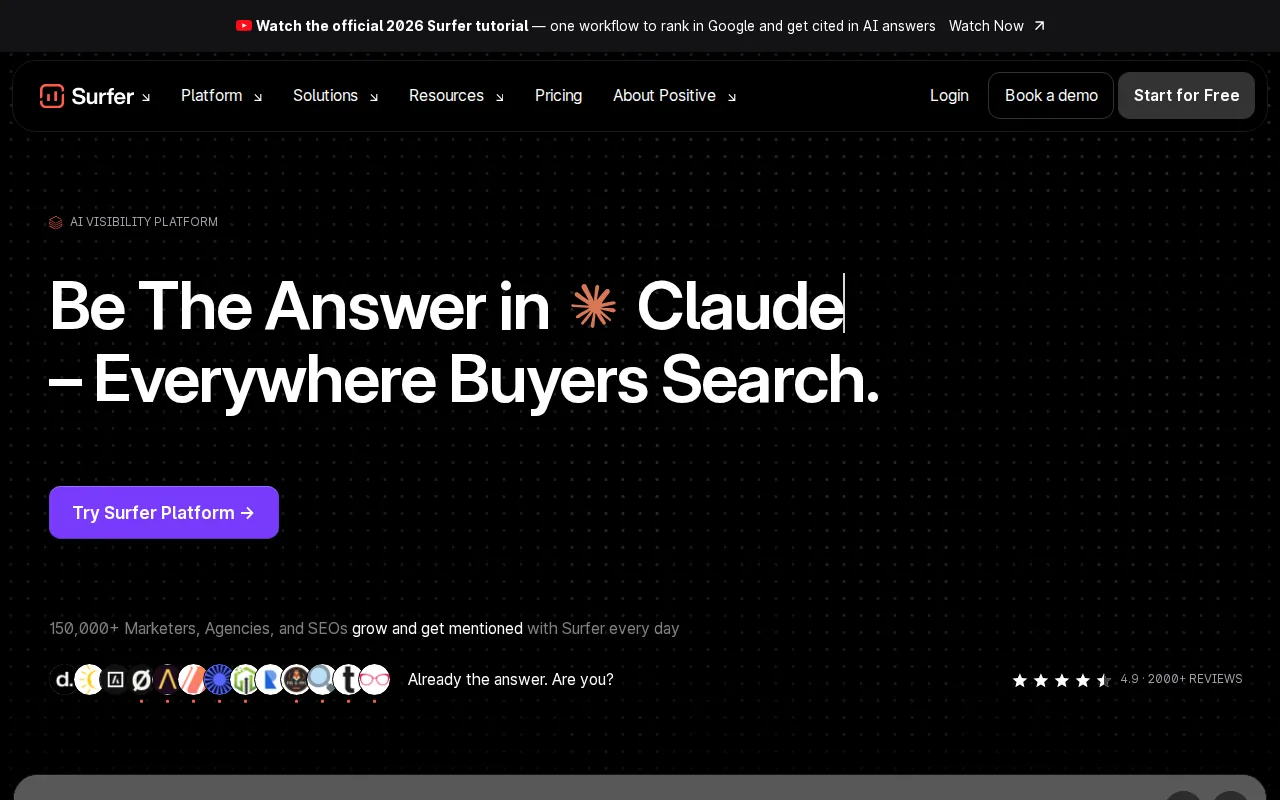
Surfer does the same core job as Clearscope and wraps a great deal more around it: an outline builder, an audit tool that scores pages you already published, internal linking suggestions, and tracking of how often your brand shows up in AI answers.
The audit view is the underrated part. Pointing it at your existing library usually finds more value than optimising the next new article.
Pros:
- Audits what is already live: the analysis most teams need and few tools do well
- Widest feature set here: outlines, scoring, internal links and AI visibility in one subscription
- Cheapest real entry point of the premium optimisers: Discovery at 49 USD a month billed yearly
- Drop detection: flags pages losing position rather than waiting for you to notice
Cons: The correlation based recommendations get taken too literally, and adding forty terms because the tool asked produces a page that scores well and reads badly. The plan ladder is also complicated, with AI tracking priced separately from the optimisation tiers.
For who: In-house teams with a library to audit, not just drafts to grade.
Pricing: Discovery 49, Standard 99, Pro 182 and Peace of Mind 299 USD a month billed yearly, read from surferseo.com on 6 August 2026.
4. Frase, research and brief in one pass

Frase's strength is the front half of the process. It pulls the top results for a query, summarises what each covers, surfaces the questions asked around the topic, and assembles that into a brief before anyone writes anything.
For a team whose real problem is not knowing what an article should contain, that is worth more than a score on a draft that already exists. What a good brief actually contains is covered in our roundup of AI content brief generators, and if you are shopping around we have a full Frase alternative comparison.
Pros:
- Answers what to include: the question that comes before any scoring tool is useful
- Question mining built in: the actual queries around a topic, not just terms
- Cheapest premium tier here: $39 a month billed yearly
- 7-day free trial without a card: enough to test it on a real brief
Cons: The optimisation scoring is weaker than Clearscope or Surfer, so it wins the research half and loses the grading half. The interface also has far more surface area than most people use, and seats beyond the first cost $29 each.
For who: Solos and small teams whose gap is the brief rather than the draft.
Pricing: $39 a month billed yearly or $49 monthly, Team $103 or $129, Agency $239 or $299, read from frase.io on 6 August 2026.
5. MarketMuse, depth rather than terms

MarketMuse models a topic rather than a page. It looks at everything you have published on a subject, compares it against what comprehensive coverage would look like, and tells you where your authority is thin.
That makes it the right tool for a site with a large library and a question about what to write next, rather than for a single article. What a well built library looks like is easier to see in our content hub examples.
Pros:
- Analyses the library, not the page: the only tool here whose unit is the whole topic
- Content strategy documents: a plan for a subject area rather than a term list
- Nine brief types: different briefs for different jobs on the top tier
- Free tier for evaluation: 10 queries a month, enough to see the model
Cons: It publishes no prices at all. Every plan on its pricing page, including the free one, is a Book a demo button, which tells you who it is sold to and how long buying will take. The value also only appears past a certain library size, and on a thirty page site it will tell you things you already knew.
For who: Content teams with a large existing library and budget approval already in hand.
Pricing: Not published. Free, Optimize, Research and Strategy tiers are listed by feature only, each behind a demo request, checked on marketmuse.com on 6 August 2026.
6. Rankability, built for agency workflow

Rankability positions itself directly as the alternative to the older optimisers: content scoring plus the workflow around it, with client projects, writer assignments and AI search visibility tracking alongside the classic grade.
For agencies running content across several clients, having the score and the assignment in the same place removes a handoff that otherwise happens in email.
Pros:
- Client projects are a first class object: analysis organised the way an agency actually works
- Unlimited users on every tier: no per seat maths as the team changes
- Unlimited clients: including on the $99 entry plan
- Credit rollover: a month of unused credits carries forward
Cons: It is a younger product with a shorter track record than Clearscope or Surfer, and its own marketing is unusually combative about competitors. Credit based pricing also makes the real monthly cost harder to predict than a flat page allowance.
For who: Agencies analysing content for several clients at once.
Pricing: Starter $99, Growth $199 and Scale $399 a month billed annually, read from rankability.com on 6 August 2026.
7. NeuronWriter, the value option

NeuronWriter does semantic SERP analysis, competitor comparison and draft scoring at a fraction of the price of the premium tools, which is the entire argument for it.
For a solo operator or a small agency it covers the part of the job that matters at a price that does not need justifying to anyone.
Pros:
- A fifth of Clearscope's price: $23 a month against $129 for a comparable core job
- Semantic term modelling: concepts and entities rather than keyword counting
- Competitor comparison built in: your draft against the ranking set, side by side
- AI monitoring on the entry plan: included rather than sold separately
Cons: The interface is dense and the onboarding assumes you already know what a semantic term list is for, so expect a slow first week. The entry plan is also capped at 2 projects and 25 analyses, which a working agency will pass quickly.
For who: Solo SEOs and small agencies who want the analysis without the premium bill.
Pricing: Bronze $23, Silver $45 and Gold $69 a month, dropping to $19, $37 and $57 billed yearly, read from neuronwriter.com on 6 August 2026.
8. Scalenut, research through to draft

Scalenut bundles keyword clustering, SERP analysis, an AI writer and an optimisation score into one flow, so the analysis and the drafting do not live in separate tools.
The cluster view is genuinely useful for planning a group of related articles rather than one at a time. Planning that group before you write any of it is what the tools in our AI content planners roundup are built for.
Pros:
- Clustering plus scoring in one place: the planning and the grading on one subscription
- Research through to draft: no export step between the analysis and the writing
- Prompt tracking included: 10 prompts on the entry tier for AI answer visibility
- Heavy discounting: the list price is rarely what anyone pays
Cons: Doing several jobs adequately rather than one job excellently is the trade, and a specialist beats it on any single axis. The pricing is also promotional to the point of being hard to plan around, with a 60 percent discount running against list price when we checked.
For who: Small teams who would rather have one subscription than a research tool and a scoring tool.
Pricing: Starter $59, Plus $89 and Pro $199 a month at list, discounted to $24, $36 and $80 under a promotion live on 6 August 2026.
9. Search Atlas, analysis inside a full suite

Search Atlas puts content scoring next to rank tracking, site auditing and backlink data, which suits teams who would rather have one subscription than four.
Its content tools are competent and the surrounding suite is the actual reason to choose it.
Pros:
- Content analysis next to the rest of the data: rankings, backlinks and audits in one login
- One bill instead of four: usually cheaper than assembling the same coverage
- Site auditing included: technical findings alongside the content ones
- Agency tooling: white label reporting on the higher tiers
Cons: If content analysis is genuinely the only thing you need, you are paying for a great deal of product you will never open. Breadth also costs depth here, and the content scoring specifically is behind the tools built only for it.
For who: Teams consolidating several SEO subscriptions into one.
Pricing: Four tiers at $99, $199, $399 and $999 a month, read from searchatlas.com on 6 August 2026.
10. Semrush, content audit at scale

Semrush's content toolkit will audit an entire site and tell you which pages are decaying, which are thin and which are cannibalising each other. That last one is a real analysis job the draft scoring tools cannot do at all.
Running that check across a whole library is its own exercise, which our practical guide to a website content audit walks through. Topic Research and the SEO Content Template cover the pre-writing side reasonably well.
Pros:
- Cannibalisation detection: the one finding here that needs a whole site view
- Audits at library scale: thousands of pages rather than one draft
- Decay flagging: pages losing traffic surfaced before anyone notices in the numbers
- Everything else is already there: keyword, backlink and competitor data around the content findings
Cons: Several content features are paid add-ons on top of a subscription that already starts at $139 a month, so the real cost is higher than the tier you are quoted. It is also considerably more tool than someone who wanted a draft score needs.
For who: Sites large enough that the analysis question is about the library rather than the article.
Pricing: Pro $139, Guru $199 and Business $299 a month, or $117.33, $165.17 and $248.17 billed annually, read from semrush.com on 6 August 2026.
11. QuestionDB, the free question miner

QuestionDB pulls the questions real people ask about a topic from forums and search data, which is the cheapest useful content analysis there is.
Every FAQ section worth having starts with a list like this rather than with guesses, and so does most of the ideation that precedes it. Our guide to AI powered content ideation for blogs covers what to do with the list once you have it.
Pros:
- Cheapest entry on this page: $9.99 a month, with a free tier above it
- Real questions, real sources: mined from forums and search rather than generated
- Volume and CPC attached: enough data to prioritise the list
- Exports cleanly: CSV out, straight into a brief
Cons: It does one narrow job and will not score a draft, audit a site or tell you whether what you wrote is any good. Search allowances are also tight, at 100 a month on the entry plan.
For who: Anyone whose analysis question is what people are asking, not how a draft scores.
Pricing: Solo $9.99, Business $29.99 and Enterprise $69.99 a month, with a free tier at 5 searches, read from questiondb.io on 6 August 2026.
12. Originality.ai, checking what you are about to publish
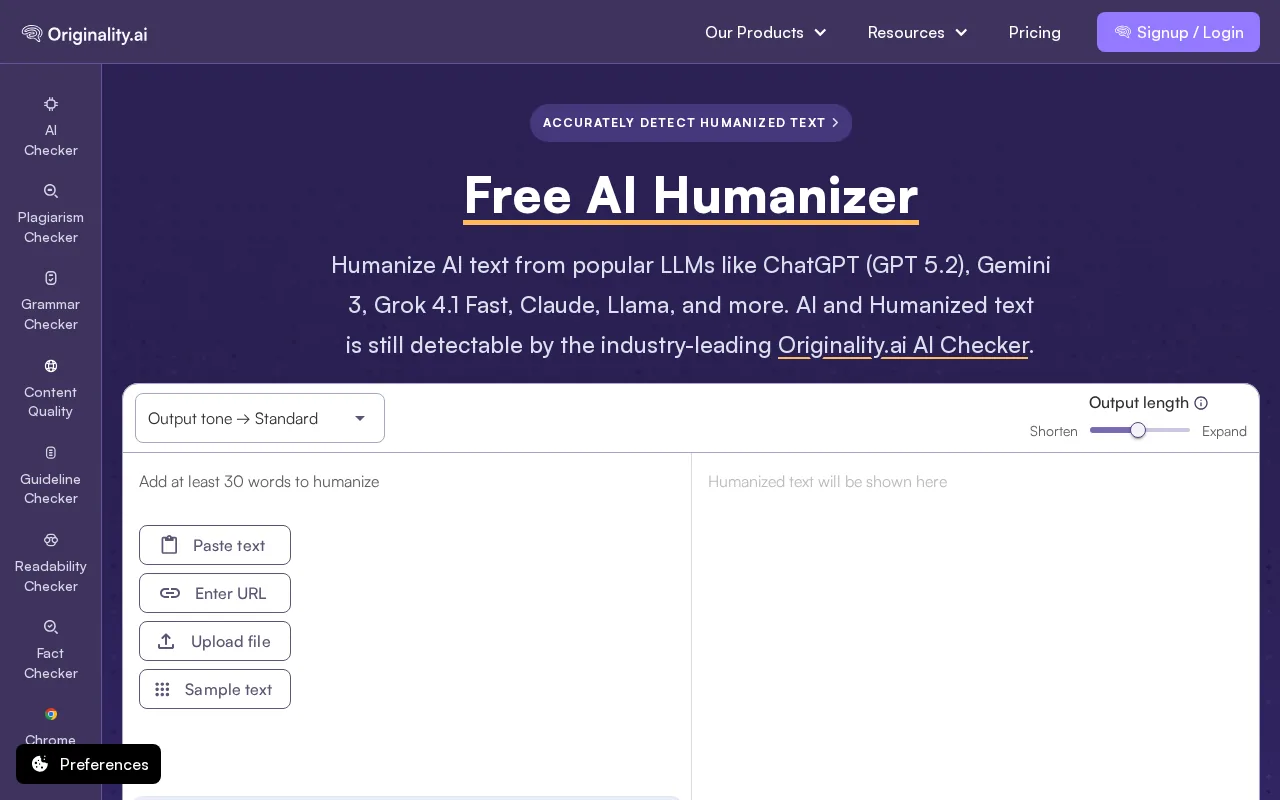
A different kind of analysis entirely: AI detection, plagiarism checking, readability and fact checking on content before it goes live. For anyone commissioning writers or reviewing generated drafts, this is the quality gate.
The fact checking feature is the one worth the money, because invented statistics are the failure mode that costs credibility rather than rankings.
Pros:
- Fact checking, not just detection: the claims get checked, which is the expensive part to do by hand
- Plagiarism and AI scoring together: one pass over a commissioned draft
- Team scanning: built for reviewing other people's work rather than your own
- Cheap for what it prevents: $14.95 a month against one published fabrication
Cons: AI detection is probabilistic and produces false positives on genuinely human writing, so a score is a prompt to read the piece rather than a verdict on a writer. Using it as evidence in a dispute with a freelancer is the most common misuse and it is not defensible.
For who: Editors and agencies accepting drafts they did not write.
Pricing: $14.95 a month billed monthly, or $12.95 a month billed yearly at $155.40, read from originality.ai on 6 August 2026.
13. Grammarly, the analysis everyone forgets

Clarity, tone, correctness and readability are content analysis, and they decide whether anyone finishes the page. Grammarly is the default for a reason and the free tier does most of it.
Run it last, after the SEO scoring, because optimising for terms tends to damage readability and this catches the damage.
Pros:
- The readability half of analysis: the dimension every SEO tool on this page ignores
- Free tier covers the core pass: correctness and clarity at no cost
- Catches optimisation damage: the sentences a term list broke
- Runs where you write: no export, no separate report to open
Cons: It knows nothing about search, so it cannot tell you whether the page has any chance of ranking. Following every suggestion also flattens a distinctive voice into a corporate one, which is a real cost on anything meant to sound like a person.
For who: Everyone, as the last check before publish rather than the first.
Pricing: Free at $0 and Pro at $12 a month with a 7-day free trial, read from grammarly.com on 6 August 2026.
14. ATLAS.ti, the research meaning of the phrase

If you arrived here looking for qualitative data analysis, this is the category leader: coding interview transcripts, open-ended survey responses and documents, with AI assistance for suggesting codes and themes.
It is on this list because a real share of people searching this phrase want exactly this and not a content score, and sending them to Surfer would be useless.
Pros:
- The actual tool for the actual job: qualitative coding rather than SEO scoring
- AI assisted coding: suggested themes across a large document set
- Handles mixed sources: interviews, surveys, documents and media in one project
- Established in research: the standard reference in its own field rather than a newcomer
Cons: It has nothing whatsoever to do with SEO or marketing content, so if you came here for a draft score it is the wrong page's worth of tool. It is also priced and licensed for academic and enterprise research, which means a procurement conversation rather than a card.
For who: Researchers analysing interviews, transcripts and open-ended responses.
Pricing: Not readable on the day. The atlasti.com pricing page sat behind a consent wall we could not get past on 6 August 2026, so no figure is quoted here.
Which one to buy
If you have drafts and want them to rank: Clearscope if you have budget and writers, NeuronWriter if you do not.
If you do not know what to write: Frase or MarketMuse, depending on whether the question is about one article or a whole library. For methods rather than tools, see our 16 ways to generate AI content ideas.
If you know exactly what to write and it never gets published: none of these fix that, which is worth being honest about before another subscription. That is a throughput problem, and it is what automated SEO software addresses instead.
Analysis is the cheap half
The pattern behind this whole category is that finding the gap costs a subscription and closing it costs a content team. Most sites we look at have far more analysis than they have acted on, and buying a fifteenth report is rarely the constraint. Tools for the closing half are compared in our roundup of AI content generators.
If that describes yours, Distribb runs the gap analysis and then produces and publishes the pages, with a 7-day free trial. If you genuinely want a score on a draft as you write it, buy Clearscope and ignore the paragraph above.