

White label link building means a provider builds links for your clients and stays invisible. You keep the relationship, the branding and the margin. They do outreach, placement and reporting under your name. The audit side of the same white label question is covered in our roundup of the white label SEO audit tool.
This page covers links only. If you need the whole service under your brand, see private label SEO providers, and for the reporting layer see white label SEO dashboards. For the market outside the white label corner, we have the full list of link building services compared, ranked by price and link type. Agencies whose clients are local businesses should start with our comparison of white label local SEO services, which covers Google Business Profile work alongside content.
The category is full of resellers selling each other's inventory, so the useful comparison is not "who has the best links". It is what kind of link you are actually buying, who does the outreach, and whether the reporting will survive a client asking where a link came from. The same reselling pattern shapes the wider category, which we mapped in our guide to SEO reseller programs.
How we picked these
Every provider here has a live site, published service pages, and a white label or reseller programme you can actually sign up for. We checked each one directly in August 2026. Providers that only appear inside other roundups, and providers with no verifiable presence, are excluded. We applied the same test to full-service providers in our review of white label SEO agencies.
We use Distribb's own exchange. The other six are assessed on documented services and public positioning, not on placements we commissioned, and we would rather say that than imply a test we did not run.
Quick comparison
| Provider | Link type | White label reporting | Best for |
|---|---|---|---|
| Distribb | Contextual, exchange network | Yes, white label | Agencies wanting links plus published content |
| FATJOE | Guest posts, niche edits | Yes, full reseller dashboard | High-volume, productised ordering |
| Stan Ventures | Guest posts, niche edits | Yes | Agencies wanting managed outreach |
| The HOTH | Guest posts, PBN-adjacent packages | Yes, mature reseller platform | Agencies that want everything in one catalogue |
| Page One Power | Custom editorial outreach | Yes | Enterprise and regulated niches |
| Loganix | Niche edits, guest posts | Yes | Agencies wanting speed on standard placements |
| OutreachDesk | Managed outreach placements | Yes | Agencies outsourcing the whole function |
1. Distribb, our pick when the content is also missing
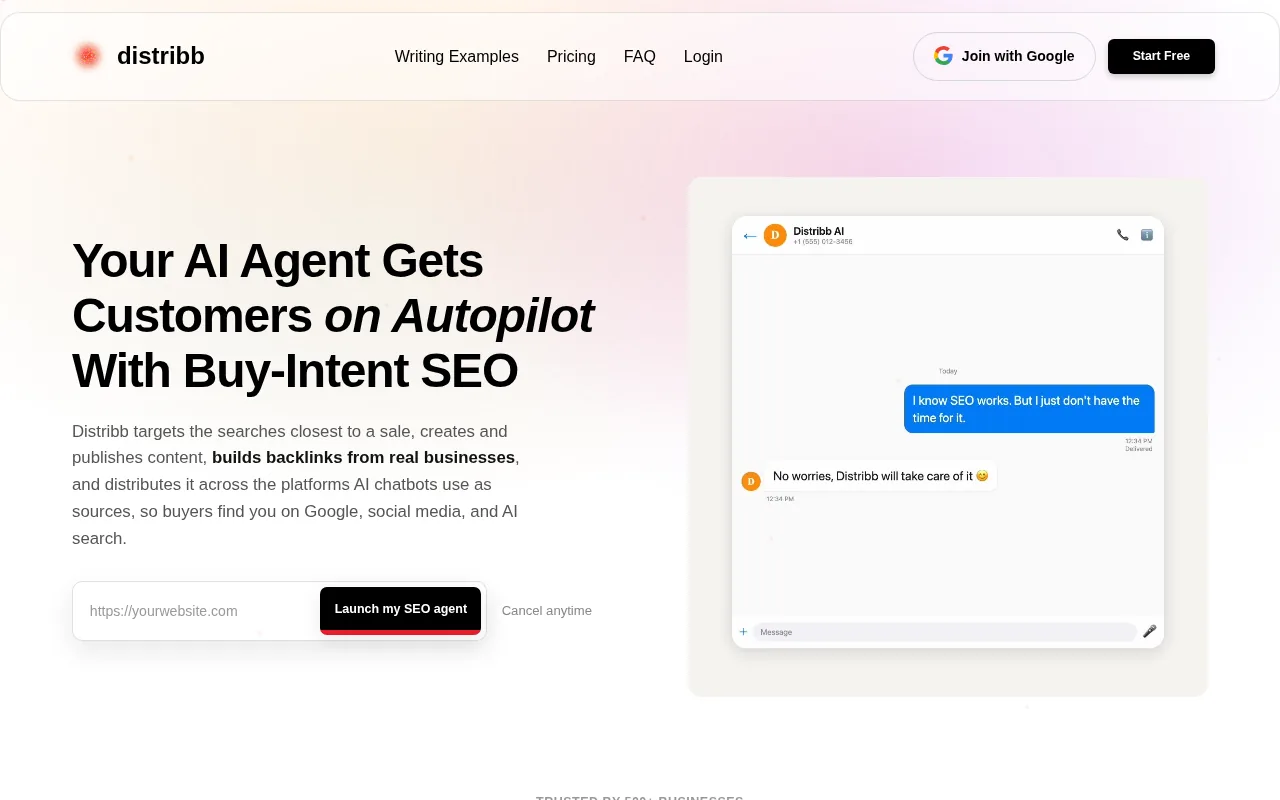
White label link building has one recurring problem, and it is not quality. The client asks where a link came from, and the honest answer is a supplier you would rather not name. Vague reporting is the norm in this category because the sourcing does not survive being explained out loud.
Distribb's links come from a network of real businesses running their own SEO, matched to your client's industry, placed inside articles those businesses were publishing anyway. No two sites ever swap directly, so the profile carries no reciprocal pattern for anyone to find later.
The reportable part matters as much as the sourcing. The ledger lists every earned and scheduled link with the source domain, its Domain Rating, the business behind it, the target URL, status and date, and you hand that to a client under your own branding. It also writes and publishes the page the link points at, which matters when the client site has nothing worth linking to yet. If you are assembling a wider stack, our roundup of the best white label SEO tools for agencies covers the reporting layer around it.
Pros:
- Sourcing you can say out loud: every link traces to a named business running its own site, not an anonymous inventory list
- Link-level ledger: source domain, DR, target URL, anchor, status and date, exportable under your branding
- Niche matched per client: each project carries its own industry and competitor set, so placements stay relevant
- Target page included: the article the link points at is written and published on the same plan
- Included rather than billed per link: placements come with the subscription instead of a per-placement invoice
Cons: You cannot fulfil a brief that names specific target domains. If a client hands you a list of publications they want to appear on, the exchange cannot go and get them, and a managed outreach provider is the right call. Volume is also capped by what the network produces, roughly 3 to 5 links a month per project, so a campaign that needs 40 links this quarter needs a second supplier.
For who: Agencies whose clients ask where links came from, and whose client sites need the content as much as the links.
Pricing: $97 per month per client project with a 7-day free trial, links included, and Accelerator at $495 per month. Two prices, no free plan. For comparison, per-placement pricing across the rest of this list runs from about $37 to over $500 a link. The full range, plus the retainer and platform models behind it, is broken down in our guide to white label link building pricing.
2. FATJOE, the volume standard
FATJOE is the most productised provider in the category. You order from a catalogue, links arrive on a defined turnaround, and the reseller dashboard is built for agencies running many clients at once. Pricing is published per placement and banded by the host site's Domain Rating, which is unusual here and makes it the easiest supplier on this page to model a rate card against.
The trade is that you are buying a fixed product. Nobody at FATJOE is deciding whether this client needs digital PR instead of five niche edits.
Pros:
- Published per-link pricing: DR bands are listed openly, so you can quote a client before you have spoken to a rep
- Built for reseller volume: dashboard, repeat ordering and defined turnarounds across a client book
- Wide service catalogue: blogger outreach, niche edits, content and digital PR from one account
- Fast to start: no partner call or minimum commitment before the first order
Cons: Productised means standardised. You get very little strategic input on which links a specific client actually needs, and the ordering flow assumes you already know. Turnaround on the outreach products is quoted at 14 days, which is slow if you are firefighting a ranking drop.
For who: Agencies that know exactly what they want and want it repeatable across many clients.
Pricing: Blogger outreach is priced per placement by DR band, from $82 at DR10+ to $110 at DR20+, $137 at DR30+, $247 at DR40+, $384 at DR50+ and $521 at DR60+, read from fatjoe.com on 6 August 2026. The wider service catalogue starts from GBP 60, and the site prices in pounds by default with a USD toggle.
3. Stan Ventures, managed outreach with more hand-holding
Stan Ventures sits between a catalogue and a full agency. There is more consultation than FATJOE offers and it is still built for reseller volume, which is a genuinely useful middle position if you are handing over accounts rather than orders.
Their published pricing is banded by DR and by traffic on the host site, and it is the cheapest entry point on this page by a wide margin. Read the traffic thresholds rather than the DR number when you compare, because the cheapest tier accepts host sites with far less traffic than the tiers above it.
Pros:
- Lowest published entry price here: the general-niche tier starts well under a hundred dollars a link
- Traffic thresholds are stated: each tier names the host site traffic band, not just a DR number
- Consultative rather than transactional: account-level input on what a client needs, not just order fulfilment
- Grey niche handled separately: a priced path for verticals most suppliers refuse outright
Cons: Turnaround is slower than the pure productised suppliers, which is the cost of the consultation. Bulk pricing is not published at all, so the moment you scale past a handful of links a month you are back on a call negotiating a rate you cannot see in advance.
For who: Agencies that want a partner on the account rather than a vending machine, and can absorb a slower cycle.
Pricing: Per link by tier, at $37 for DR30+ with 100+ traffic, $67 for DR40+ with 500+ traffic and $247 for DR50+ with 1,000+ traffic, read from stanventures.com on 6 August 2026. Bulk discounts are quoted on request rather than published.
4. The HOTH, the widest catalogue
The HOTH has been running reseller SEO longer than most of this list and sells far more than links. Content, local SEO, citation cleanup, digital PR and fully managed campaigns all sit in the same catalogue, each priced individually.
That breadth is the reason agencies use it and the reason to read carefully. Three different link products sit next to each other at three different prices, and the difference between them is the sourcing method rather than anything visible in the name.
Pros:
- One supplier for everything: links, content, local SEO and PR under a single reseller account
- Every product priced openly: the catalogue lists a figure against each service rather than routing you to sales
- Mature reseller platform: among the longest-running white label operations in the category
- Managed campaigns available: a path from buying individual products to handing over the whole account
Cons: Quality varies across the catalogue precisely because it is so broad, and the link products are the ones to scrutinise. Read what sourcing method sits behind a given package before ordering, because the price gap between their outreach and their authority products is not explained on the product tiles.
For who: Agencies that want one supplier and one invoice covering every SEO service a client might ask for.
Pricing: Per product, with Link Outreach at $150, Link Insertions at $200 and Platinum Links at $375, read from thehoth.com on 6 August 2026. Managed services are separate, running from $1,000 to $5,000 a month, with content from $50 and citation cleanup at $399.
5. Page One Power, custom editorial
Page One Power runs bespoke outreach campaigns rather than selling from a menu. Longer engagements, higher prices, and genuine editorial placements where a human decided the link belonged there.
For most agency work this is more supplier than the account needs. For a regulated client where one bad link is a real liability, it is the sane choice on this page.
Pros:
- Campaigns rather than orders: the strategy work is part of the engagement, not something you supply
- Editorial placements: links land because an editor agreed, which is what survives a manual review
- Built for regulated niches: finance, health and legal work where sourcing has to be defensible
- Enterprise reporting: depth of documentation that suits an in-house team above your client contact
Cons: No published pricing at all, so you cannot model a rate card or quote a client without a sales conversation first. Cost and timeline both rule it out for a long tail of small accounts, and the engagement structure assumes a retainer rather than a link count.
For who: Enterprise clients and regulated niches, where a bad link is a bigger problem than a slow one.
Pricing: Not published. There is no rate card anywhere on pageonepower.com as of 6 August 2026, and every path leads to a consultation. Budget for a retainer rather than a per-link figure.
6. Loganix, fast standard placements
Loganix is known for turnaround speed on standard placements, with an agency-oriented process and, unusually, a filterable inventory. You pick host sites against DR, traffic, niche, price and language before you buy rather than after.
That inventory view is the usable difference from the managed suppliers above. You are choosing sites yourself, which means the quality of the campaign is your judgement rather than theirs.
Pros:
- You pick the sites: filter inventory by DR, traffic, niche, language and price before committing
- Pay for what you select: no package minimum, so a single placement is a valid order
- Fast standard delivery: predictable dates on niche edits and guest posts
- Broad service list: over fifteen SEO services on the same account, some starting in single digits
Cons: Choosing from inventory means the vetting burden moves to you, and a marketplace of available sites is by definition a list of sites willing to sell links. Less bespoke than Page One Power, with none of the strategic input, so it works only if you already know what a good host site looks like.
For who: Agencies that want to pick host sites themselves and need predictable delivery dates.
Pricing: Links start at $99 with niche edits from $100, and the wider service catalogue advertises over fifteen services starting from $7, read from loganix.com on 6 August 2026. Selected placements are priced individually rather than by package.
7. OutreachDesk, outsourcing the whole function
OutreachDesk positions itself as your link building department rather than a supplier, handling prospecting through to placement. The pricing model reflects that, since it is sold in monthly link volumes with the per-link rate falling as the commitment rises.
Their own pitch is the arithmetic against hiring, and the arithmetic is fair. One in-house link builder costs more than a year of placements before you add tools or content.
Pros:
- Volume pricing published: the per-link rate against each monthly commitment is on the page
- Whole function outsourced: prospecting, pitching and placement handled without an internal owner
- Rate falls with commitment: the cost per link drops as monthly volume rises, unlike per-order catalogues
- Dofollow specified: the link type is stated in the plan rather than left to interpretation
Cons: You get less granular control over which sites get pitched than any inventory-based supplier, which is the point of handing the function over but still a real loss. The model also assumes a standing monthly volume, so it suits a stable client book and punishes a lumpy one.
For who: Agencies with no internal link capability and a steady monthly requirement.
Pricing: Tiered by monthly volume, at $300 per link for 10 dofollow links a month, $250 per link at 20 a month and $200 per link on a custom plan, read from outreachdesk.com on 6 August 2026.
Should you outsource this at all?
Worth answering before you shop.
Building links in-house means an outreach specialist, a writer, and someone maintaining relationships. That is a real salary line before a single link goes live, and it only pays back at volume.
The rough breakpoint is client count. Below about five clients, or under roughly ten links a month, in-house rarely justifies the headcount and you are better outsourcing. Above twenty clients, a hybrid usually wins: outsource standard placements, keep a person on the accounts where link quality is the whole pitch.
The other reason to outsource is coverage. A single in-house specialist covers one niche well and everything else poorly. Providers have existing relationships across many.
How to spot a link-building scam
This is where agencies lose money, so it gets its own section.
They will not show you a live example before you pay. The single biggest red flag. Any legitimate provider can point at placements they made last month.
The host site has domain metrics but no traffic. DR 65 and 200 organic visits a month means the metrics were manufactured. Check in Ahrefs or Majestic, not in the vendor's own screenshot.
Guaranteed DA or guaranteed rankings. Nobody controls either. A guarantee means either they are buying links you would not want, or the guarantee is unenforceable.
Placements go live on sites whose entire blog is unrelated roundups. If every post on the host site is a different industry, it exists to sell links.
The price is far below market. Genuine editorial outreach costs real money because it takes real time. A $30 "DR 50 dofollow" is a private blog network placement.
No sample report before signing. If they will not show you the reporting, assume it carries their branding.
Vendor scorecard
Score each provider out of 20. Anything under 14 and keep looking.
Link quality (8 points)
- Live examples provided before purchase: 2
- Host sites have verifiable organic traffic: 2
- Placements are contextual, in-body, not author bios or footers: 2
- Anchor text is varied and reads naturally: 2
Transparency (6 points)
- You approve host sites before placement, or the matching logic is documented: 2
- Clear replacement policy if a link is removed: 2
- No guarantees of rankings or domain metrics: 2
Reporting (4 points)
- Genuinely unbranded, checked in the footer and metadata: 2
- Includes live URL, anchor, date and host traffic: 2
Commercial (2 points)
- No minimum contract beyond one month: 1
- You keep the links and content if you leave: 1
What client-ready reporting has to contain
Your client will eventually ask where a link came from. The report has to answer it without you going back to the vendor.
Minimum: the live URL of the host page, the anchor text used, the date it went live, the host domain's organic traffic, and a link to the placement that still resolves. Anything less and you cannot defend the spend.
Two things to check before you forward a report. Open the PDF properties and look at the author field, since some providers leave their name there. Then check the image filenames and any chart footers for vendor branding. Both are common ways a white label report stops being white label.
How to choose
- Client needs links and content: Distribb
- High volume, predictable, repeatable: FATJOE or Loganix
- Enterprise or regulated niche: Page One Power
- No internal link capability at all: OutreachDesk or Stan Ventures
- One supplier for every SEO service: The HOTH
FAQ
What makes white label link building different from a normal link builder? The provider stays invisible. Reporting carries your branding and the client never learns who did the work.
How do I know a link is high quality? Contextual placement in a relevant article, on a site with real organic traffic, where the surrounding content is worth reading. Domain metrics alone tell you very little.
Can I use several providers at once? Yes, and most agencies do. Just track placements centrally so you do not buy the same domain twice. A white label rank tracker is usually where that central record ends up.
Is automation risky for SEO? Automating prospecting and reporting is not risky. Automating the decision about which sites to buy from is. Keep a human on that step.
How fast do links show results? Weeks to months. Anyone promising ranking movement in days is selling something else.
Do I need a long contract? No. Most providers here sell per placement or per month. Be cautious with anyone requiring twelve months up front.
What should white label reporting include? Live URL, anchor text, placement date, and the host page's traffic. Anything less and you cannot defend the spend to a client.
The link is only half of it. A perfect contextual backlink pointing at a thin page is money spent moving a page nobody wanted to read.
Distribb's white label SEO gives agencies both under their own branding: published articles in the client's voice, plus contextual backlinks from real businesses through the exchange network. Seven-day free trial.
---