
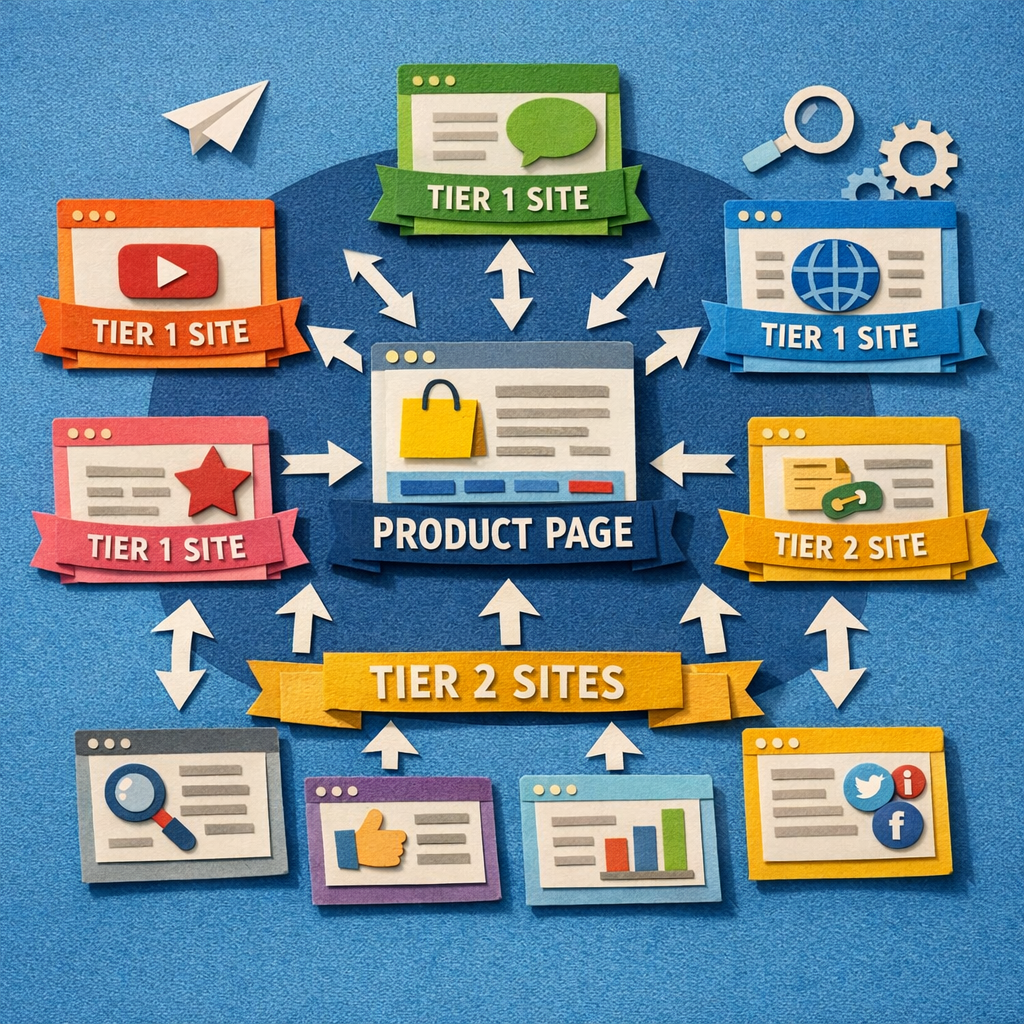
Tiered link building means building links to the pages that link to you, in layers. Your site sits at the top, tier 1 links point at it, tier 2 links point at the tier 1 pages, and so on down.
The theory is that authority flows up the pyramid, so strengthening a page that links to you strengthens you indirectly. It is a real mechanism, but most of what is sold under this name is the automated version, and that version is a liability.
This page explains the model honestly, including the part vendors leave out, and sets out the version of it that is worth running.
Where we stand before you read on
Ahrefs classifies tiered link building as black-hat or grey-hat, and says plainly that it violates Google's guidelines. That is the position of the largest tool vendor in the industry, not ours alone.
We are not going to talk you through building a link pyramid with automated software. What follows is what the model is, why the risk sits where it does, and the narrow version that survives scrutiny.
The pyramid, described accurately
| Tier | Points at | Typical quality | What it is meant to do |
|---|---|---|---|
| Tier 1 | Your site directly | High, editorial | Move your rankings |
| Tier 2 | Your tier 1 pages | Medium to low | Strengthen the pages linking to you |
| Tier 3 | Your tier 2 pages | Low, often automated | Strengthen tier 2 |
Tier 1 is ordinary link building. Guest posts, digital PR, resource pages, exchanges, unlinked mentions. Our roundup of white hat link building techniques covers that first tier in detail.
Tier 2 and below are where the model becomes its own thing. This is where volume replaces judgement, and where the tooling that automates it starts producing pages nobody will ever read.
Why the mechanism is real
PageRank does flow through multiple hops. A page with more links pointing at it can pass more value onward, and that has been true since the original patent.
So the arithmetic behind tiering is not invented. If a guest post that links to you sits on a page with no links of its own, it passes less than one that is well linked.
The problem is not the physics. The problem is what people actually build at tier 2.
Why the practice usually fails
Tier 2 links are almost always built at volume, because building them by hand costs the same as building a tier 1 link and returns a fraction as much. Volume at low cost means blog comments, forum profiles, web 2.0 posts, directory spam and auto-generated pages.
Google has been discounting exactly those patterns for over a decade. The most common outcome is not a penalty, it is nothing at all: you spend money, the links are ignored, and the tier 1 page is unaffected.
The second outcome is worse. A guest post you worked to place now sits in an obvious spam neighbourhood, and the site that published it may remove it once they notice what is pointing at them.
The asymmetry that matters: the downside lands on someone else's site, which is the site you spent effort getting a link from. You are risking an asset you do not control.
The three ways this goes wrong
1. You point automated links at a real editorial placement

Tools like GSA Search Engine Ranker exist to build tier 2 and tier 3 at scale, and they still work in the narrow sense that they create links. They are named here because you will meet them if you research this topic, not as a recommendation.
Aim thousands of automated links at a genuine guest post on a real publication and the likely result is that the publication removes your post. Editors do check what is linking to their domain.
2. You buy a tiered package and cannot see tier 2
Most services selling this bundle the tiers together and report only tier 1. You have no visibility into what was built underneath, on which sites, with which anchors.
If you cannot audit it, you cannot disavow it, and you have attached your brand to something you have never seen.
3. You build tier 2 to your own site by mistake
The pyramid depends on tier 2 pointing at tier 1 pages, not at you. Sloppy execution, or a vendor cutting corners, ends with low-quality links pointing directly at your domain.
That is the version most likely to cause an actual problem, and it happens more often than the model would suggest.
The version that is worth running
Strip the automation out and one useful idea survives: some of your existing links are worth more than others, and a few of them can be strengthened legitimately.
Step 1. Find which of your links are worth strengthening

Pull your backlink profile and sort by the referring page rather than the referring domain. You are looking for links on pages that are genuinely relevant and genuinely well placed but that get very little traffic or attention themselves.
A guest post on a real industry site that nobody has ever shared is the candidate. A directory listing is not.
Step 2. Promote those pages the way you would promote your own
Share them. Cite them in your own articles. Mention them in your newsletter. If you would be happy for the publisher to see exactly what you did, it is fine. Our collection of link bait examples shows the kind of page that earns those shares without being asked.
This is tier 2 in the only defensible sense: real distribution of a real page, which sometimes earns that page real links.
Step 3. Spend the rest of the budget on tier 1
Every hour spent on tiers below the first is an hour not spent getting another genuine link to your own site. For almost every site under a million monthly visits, that trade is not close.
Tier 1 is where the ranking movement is. It is also the only tier you can inspect, defend and keep.
Building tier 1 without an agency budget
The exchange route

The hard part of tier 1 is finding sites willing to link at all when you have no PR contacts. Distribb's backlink exchange removes that step by matching sites in relevant niches that have already agreed to link on merit, so the placement is editorial and you can see every link that exists.
Honest limitation: exchanged links are one source, not a link profile. They will not get you cited by a trade publication or a local newspaper, and a profile built only from exchanges is a thin one. Use it as the base layer alongside the tactics in our guide to building backlinks for a small business.
The other tier 1 sources worth the time
Original data that other people need to cite. Guest posts on sites that would have had you as a guest anyway. Unlinked brand mentions, which are the easiest links in existence because the writer already decided you were worth naming. Our tactics for link building for startups cover how to get the first of them with no PR contacts.
Supplier and partner directories, industry associations, and podcast appearances. None of these need a pyramid underneath them. For stores, our guide to link building for ecommerce covers the equivalents on the retail side.
If you have already bought a tiered package
Pull your backlink profile and look at what points directly at your domain first. Anything obviously automated pointing at you is the priority.
Then look at what points at your tier 1 pages. You cannot remove those, but you can decide whether to keep the tier 1 placement or ask for it to be taken down before the publisher does it for you.
Disavow sparingly. Google ignores most low-quality links on its own, and the disavow file is for patterns you genuinely believe are being counted against you, not for tidiness.
What to do instead, in one paragraph
Build fewer links and better ones. Choose sources you could name publicly without hesitation, keep a record of every placement, and put the budget that would have funded tiers two and three into one more tier 1 link a month. Getting more out of the links you already have starts inside the site, which our guide to internal linking automation covers.
That is slower on a spreadsheet and faster in the rankings. If you want the sourcing part handled, Distribb's backlink exchange is the part of it we run, and our comparison of backlink exchange platforms covers the alternatives honestly if you would rather use something else.