

An SEO reseller program lets you sell SEO under your own brand while somebody else does the work. You keep the client, the branding and the margin, and the SEO reseller pricing each provider charges you is what decides how much margin that is.
Two neighbouring pages if this is not quite the purchase you are making. White label SEO agencies covers the agencies themselves, and private label SEO services covers the wider fulfilment question. And if you are buying SEO for your own business rather than reselling it, see our comparison of AI SEO agencies. If you are assembling the stack rather than buying a programme, see white label SEO tools for agencies, and the deliverable most resellers lead with is priced out in white label SEO audits.
The category divides more sharply than most comparisons admit. Some providers are agencies with staff, so your cost rises with volume and delivery slows when they are busy. Others are platforms, where the economics improve as you add clients. Which one you want depends entirely on whether you are selling ten clients or a hundred.
Quick answer
- Best for content volume across many clients:Distribb
- Best full-service fulfilment: SEOReseller
- Best à la carte: The HOTH
- Best for small local clients: Boostability
- Best marketplace: Vendasta
- Best developer-friendly toolkit: AgencyPlatform
- Best enterprise: SEO.co
How we tested
Every provider here has a live site and a reseller or white label program you can actually join. We loaded each one in August 2026. Providers that appear only inside other people's roundups are not included.
We use Distribb's own white label setup. The rest are assessed on published services and public pricing.
Comparison
| Provider | Model | Dashboard | Typical entry | Best for |
|---|---|---|---|---|
| Distribb | Platform | White label | Per month, not per client | Content at scale |
| SEOReseller | Agency | Partner portal | ~$250/client/mo | Full outsourcing |
| The HOTH | Marketplace | Reseller platform | ~$150/mo, à la carte | Mix and match |
| AgencyPlatform | Agency + tools | Branded dashboard | ~$178/mo | Toolkit plus fulfilment |
| Boostability | Agency | Branded reporting | Volume pricing | Many small local clients |
| Vendasta | Marketplace | Storefront | Platform fee | Reselling beyond SEO |
| SEO.co | Agency | Partner program | Enterprise quote | Large, competitive niches |
| DashClicks | Platform + service | Built-in | Software plus services | One ecosystem |
| FATJOE | Productised | Reseller dashboard | Per deliverable | Predictable ordering |
| Rankifyer | Agency | Yes | Quote | Closer attention |
1. Distribb, when the constraint is publishing volume
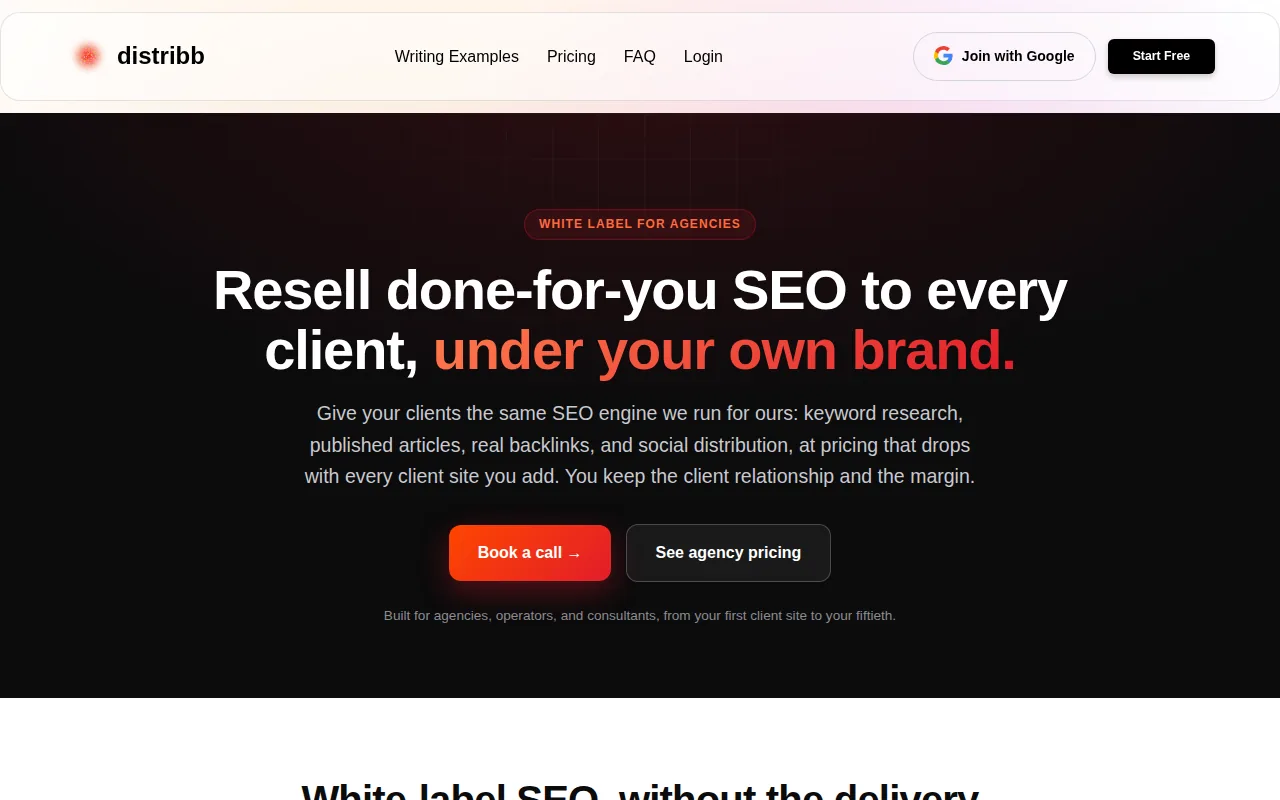
The risk in a reseller programme is not quality, it is dependency. Your cost of goods is somebody else's rate card, and when it moves your margin moves with it. Because most programmes price per article or per link, growth makes that exposure worse rather than better. Our breakdown of what white label link building costs shows how the per-link rates move as volume rises.
Distribb prices per project per month. Volume inside a project does not change the bill, and the backlink exchange is included rather than charged per placement, so scaling a client up does not scale your cost with it.
Delivery goes straight into the client's own CMS across WordPress, Webflow, Shopify, Ghost, Wix, Notion, GoHighLevel, Framer or any API webhook, so nothing routes through a middleman you would later have to unpick.
Pros:
- Flat per-project pricing: the bill does not move with article count, so your margin is set the day you sign the client
- Backlinks included: placements come through the exchange rather than being charged per link
- Publishes into the client's own CMS: the asset lives on their site from day one, with no supplier platform in between
- Per-client settings and reporting: separate tone, pillars, competitors and schedule per project
- Nothing to unpick on exit: the content and the links are already on the client's domain if you leave
Cons: There is no reseller margin programme here. No partner tier, no volume discount and no wholesale rate, so you pay what everyone else pays and set your own price on top. It is also SEO only, with no client calls and no technical consulting.
For who: Agencies that want predictable cost per client as the book grows.
Pricing: $97 per month per client project with a 7-day free trial, and Accelerator at $495 per month. Two prices, no free plan, no partner discount.
2. SEOReseller, the established full-service option

SEOReseller is one of the longest-running programmes in the category, and it is built around the reseller rather than the end client. Strategy through execution, with a partner portal and sales collateral behind it.
Pros:
- Sells with you, not just to you: pre-sale audits, proposals and pitch support come with the partnership
- Complete outsourcing: strategy, execution and reporting from one supplier, so you carry no fulfilment staff
- Partner portal: campaigns and client reporting in one branded place
- Long operating history: over a decade of agency fulfilment behind the process
Cons: Pricing is per client, so the margin compresses exactly when the book grows. It is also the least transparent programme here on cost, which makes it hard to model a rate card before you have committed to a call.
For who: Agencies that want fulfilment plus help closing the deal, and are comfortable with a quoted cost base.
Pricing: Not published. The pricing link resolves to an image rather than a live rate card, so plans are quoted on a partner call. Roundups commonly cite about $250 per client per month, which we could not verify on seoreseller.com on 6 August 2026.
3. The HOTH, the widest à la carte catalogue
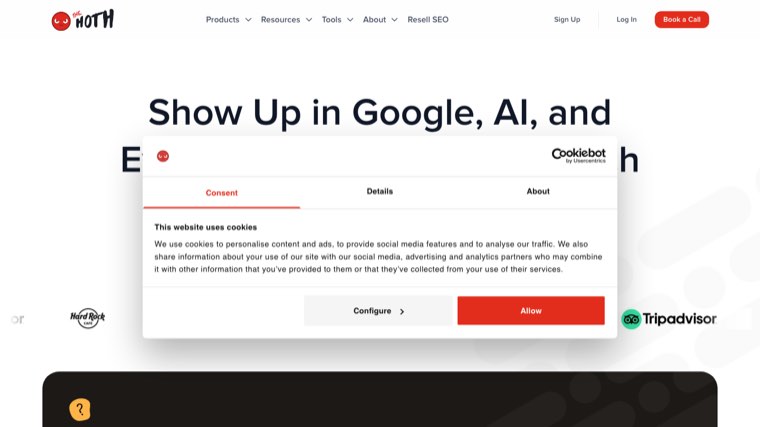
The HOTH is the programme to use when you do not want a retainer at all. Products are ordered one at a time at a published price, which makes the cost of goods knowable before you quote the client.
Pros:
- Published wholesale prices: you can build a client quote from real numbers instead of waiting on a sales call
- No monthly commitment: a quiet month costs nothing, which protects margin between client wins
- Order per client need: one client's link package does not force a plan on the rest of the book
- Established reseller programme: white label ordering and reporting that has run at scale for years
Cons: Per-unit pricing is the whole model, so cost rises in a straight line with volume and there is no point where scale improves your margin. Consistency also varies between service lines, so each one needs testing separately.
For who: Agencies that want a known unit cost per deliverable and no supplier commitment.
Pricing: Per product: blog content from $50, link outreach $150, link insertions $200, Google Business Profile management $275, and Managed SEO from $1,000 per month. Checked on thehoth.com on 6 August 2026.
4. AgencyPlatform, fulfilment plus a toolkit
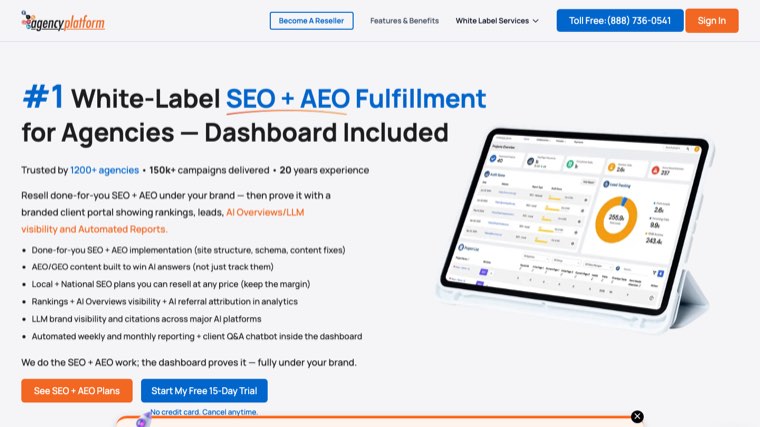
AgencyPlatform sells a membership first and fulfilment second. You pay for the platform and the sales tooling, then buy campaigns at member rates on top.
Pros:
- Membership unlocks lower service rates: the more you commit at platform level, the cheaper the fulfilment
- Sales audit tooling included: white label audit reports to generate leads, bundled into the membership
- Branded client dashboard: reporting comes with the programme rather than being bought separately
- Month to month: plans do not require a long lock-in before you can test the work
Cons: The published tier prices are heavily discounted promotional rates against much higher list prices, so model the cost at list before you build a rate card on it. You are also adopting their platform as well as their fulfilment.
For who: Agencies that want lead-generation tooling and fulfilment from the same supplier.
Pricing: Membership tiers listed at $5, $11, $21 and $42 per month on annual billing, discounted from $50, $125, $250 and $500 monthly. Services are quoted at member rates, with local SEO from $178 per month and national SEO from $355 per month at the Gold tier. Checked on agencyplatform.com on 6 August 2026.
5. Boostability, built for small local clients at volume
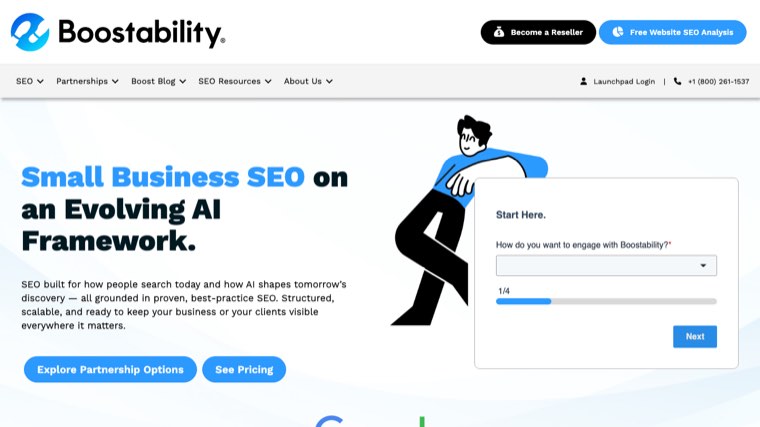
Boostability's partner channel exists to make small local clients profitable to serve. The process is standardised so that a low retainer still covers the work.
Pros:
- Viable at low retainers: the cost base is built for clients paying hundreds rather than thousands
- Designed for a long tail: the programme assumes many accounts, not a few flagship ones
- Partner-channel pricing: reseller rates are negotiated rather than taken off the public page
- Branded reporting: client-facing output carries your name
Cons: You inherit their playbook, and it is a local playbook. A client who moves into a competitive national space will stall inside it, and you will be the one explaining flat numbers.
For who: Agencies whose book is mostly single-location local businesses.
Pricing: Public small business packages start at $480 per month with tiers at $900 and $2,000. Partner and reseller rates are quoted on application rather than published. Checked on boostability.com on 6 August 2026.
6. Vendasta, the reseller marketplace
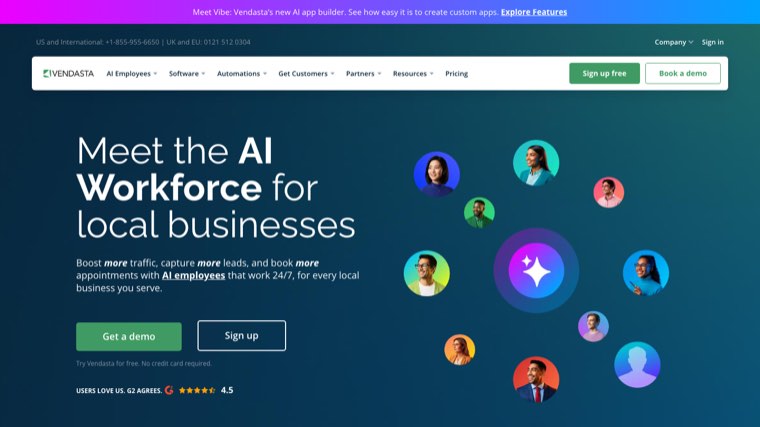
Vendasta is the closest thing here to a wholesale market. You buy at a published wholesale price, set your own retail, and the platform handles the commerce in between.
Pros:
- Explicit wholesale and retail split: the margin is a number you set rather than a rate you negotiate
- Billing and proposals built in: the platform runs the commercial side, not just the fulfilment
- Many categories beyond SEO: websites, ads, listings and reviews resold through the same storefront
- Low subscription floor: the entry tier is a spend commitment rather than a large fixed fee
Cons: Quality tracks whichever vendor fulfils the order, so consistency is something you manage rather than something you buy. The minimum wholesale spend also means a quiet month still costs you.
For who: Agencies reselling a bundle of services who want the commerce layer handled.
Pricing: Starter is a $0 subscription with a $99 per month minimum wholesale spend, with platform tiers above it at $499 and $999 per month. Checked on vendasta.com on 6 August 2026.
7. SEO.co, enterprise-grade fulfilment
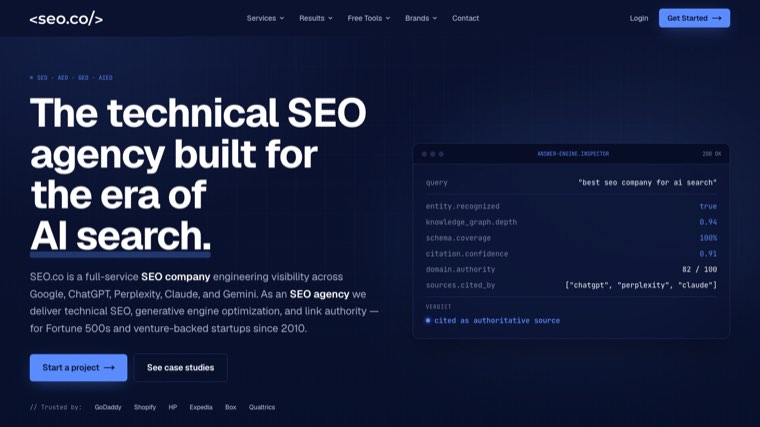
SEO.co fulfils at the top of the market, and its partner programme is priced accordingly. Content at scale, technical work on large sites, and links in genuinely competitive niches.
Pros:
- Handles hard verticals: campaigns aimed at competitive national and enterprise search, not local packages
- Published price bands: tiers by client type, which is unusual at this end of the market
- Depth on technical work: large-site audits and ongoing fixes rather than a checklist
- Partner programme for agencies: white label delivery under your brand at enterprise scope
Cons: The entry price is above what most resold clients will carry, so this only works on the top of your book. A long tail of small accounts is the wrong shape for it entirely.
For who: Agencies with enterprise or regional clients whose budgets start in the thousands.
Pricing: Starter local $750 to $2,500 per month, Growth $2,500 to $7,500 per month, and enterprise engagements quoted above that. Checked on seo.co on 6 August 2026.
8. DashClicks, software and services together
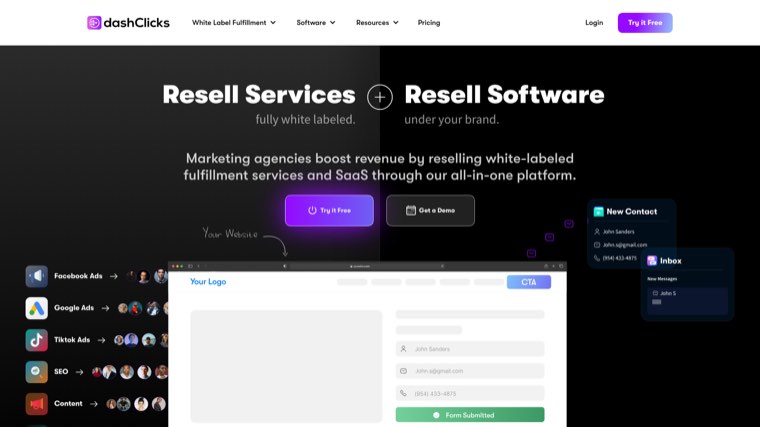
DashClicks bundles the agency software with the fulfilment, so the platform you sell from and the team delivering the work come from the same invoice.
Pros:
- Flat software cost: the platform price is fixed regardless of how many clients sit inside it
- Order fulfilment inside the tool: services are bought where you already manage the client
- White label reporting included: the client-facing layer comes with the subscription
- Annual option: paying yearly takes a quarter off the software cost
Cons: The fulfilment is priced per service on top of the subscription, so the flat software fee is only half the cost picture. Leaving means replacing your reporting and your supplier in the same month.
For who: Agencies that want one vendor behind both the software and the delivery.
Pricing: DashClicks Pro is $199 per month, or $1,788 billed annually, with fulfilment services priced separately per order. Checked on dashclicks.com on 6 August 2026.
9. FATJOE, productised and predictable
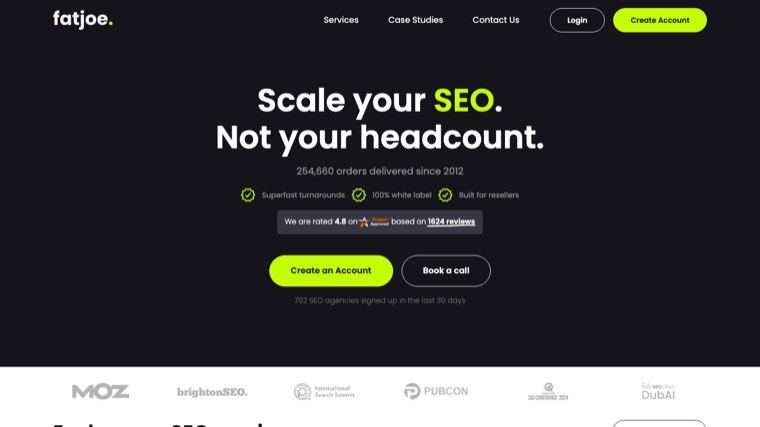
FATJOE is a reseller programme in the literal sense: a catalogue with wholesale prices and a delivery window, built to be sold on.
Pros:
- Known unit cost and turnaround: every service carries a price and a delivery time, so client promises are safe to make
- No commitment: order when a client pays, not on a schedule set by a supplier
- Genuinely unbranded: nothing that reaches the client carries their name
- Deep link catalogue: outreach, niche edits, digital PR and local, each ordered separately
Cons: Cost scales one to one with volume, and there is no strategy layer to stop you ordering the wrong thing well. Prices are quoted in pounds, so a dollar-billing agency carries currency risk on its cost of goods.
For who: Agencies with the strategy already decided who want reliable execution per order.
Pricing: Per deliverable in GBP: blogger outreach and niche edits from £60, international outreach from £200, and managed packages from £500. Checked on fatjoe.com on 6 August 2026.
10. Rankifyer, smaller and more attentive
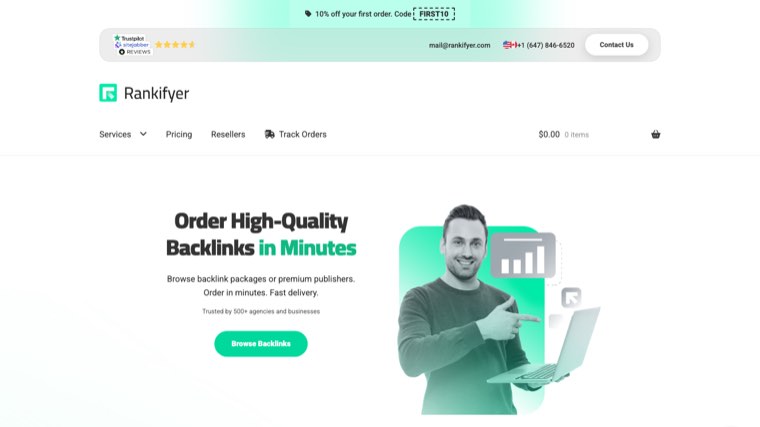
Rankifyer is a newer entrant aimed at agencies buying links in bundles. The reseller offer is a package list rather than a managed programme.
Pros:
- Bundle pricing published: package costs are visible in the shop rather than quoted privately
- Responsive: a smaller client base usually means shorter turnaround on questions
- Agency positioning: the programme is aimed at resellers rather than end clients
- Small test size: one package is a cheap way to check placement quality before a client sees it
Cons: A short track record and no monthly reseller plan, so there is nothing to forecast against beyond individual orders. Their pricing page returns a 404, which means the shop is the only rate card you can actually read.
For who: Agencies buying link packages who want quick answers and a low commitment.
Pricing: Per package: ten guest posts on DA 30 to DA 70 sites at $379, discounted from $890, and ten niche guest posts at $349. Checked on rankifyer.com on 6 August 2026.
What margin is realistic
Agencies reselling SEO typically hold 30% to 60% gross margin. Two things move you within that range.
Standardised fulfilment at volume sits at the top, because your cost per client falls while your retail price does not. Bespoke work sits at the bottom, because the provider's cost scales with effort.
The margin killer is account management nobody priced. A client on $1,500 a month who needs two calls can be less profitable than one on $800 who needs none. Price the meetings, not just the deliverables. To sanity-check your retail prices, compare them with what SEO costs end clients across retainers, hourly work and projects.
Typical reseller costs run $100 to $500 per client per month for standard packages, and $300 to $500 and up for full campaigns. Platform-based fulfilment prices per month rather than per client, which is the whole reason margin improves with scale. Reporting is a separate line again, which we priced across eleven white label SEO dashboards. Your own stack sits on top of that, which is what our list of white label SEO tools for agencies is for.
Before you sign
Ask for live examples. Published articles and live links from the last month, not a portfolio deck.
Check the reporting is genuinely unbranded. Open a sample PDF's properties and check the author field. Check image filenames. Both are common places a vendor's name survives. The reporting layer itself is a separate decision, covered in our comparison of white label SEO dashboards.
Confirm who talks to the client. You should. Any provider suggesting direct contact is a risk to the relationship you own.
Read three articles they produced for other resellers. Thin content under your client's domain becomes your problem.
Check the exit. Contract length, and whether you keep the content and links if you leave.
FAQ
What is an SEO reseller program? A partnership where a provider fulfils SEO work and you sell it under your own brand. The end client never learns the provider exists.
How much can you make reselling SEO? Typically 30% to 60% gross margin. Standardised, high-volume fulfilment sits at the top of that range.
Do I need to know SEO to resell it? Enough to qualify a client and sanity-check the work. You do not need to execute, but an agency that cannot tell good work from bad will eventually sell bad work. Vertical knowledge helps you qualify faster, and our walkthrough on hiring an SEO agency for accountants shows the questions a client in a regulated niche will ask. A white label SEO audit is the cheapest way to sanity-check a supplier before a client sees the work.
What is the difference between white label and drop-servicing? Very little in practice. White label usually implies an ongoing partner relationship and branded reporting; drop-servicing implies buying per order.
Are there risks with link building in reseller programs? Yes, and it is the main risk in the category. Ask where links are placed and check the host sites have real organic traffic before accepting placements.
How do I avoid a bad contract? Avoid twelve-month commitments up front, confirm you keep the deliverables on exit, and start with one client before moving the book.
How do I scale past ten clients? Standardise. Bespoke fulfilment stops scaling around ten clients without adding headcount. Platform-based fulfilment keeps going. That is the point where most agencies compare a reseller against an AI SEO agency model.
Where this usually breaks
Reselling works until it does not. You sign five clients, fulfilment slows, quality slips, and the margin you priced disappears into chasing your supplier.
Distribb's white label SEO handles the part that scales worst: keyword research, articles in each client's voice, publishing to their CMS, and contextual backlinks. Your branding, your client relationship, priced per month rather than per client. Seven-day free trial.