

Most SEO advice was written for businesses that sell one thing to one person in one visit. Software does not work like that. A buyer reads a comparison page in March, a docs page in April, and starts a trial in May after someone else on their team asks about it. If your SEO is built around a blog calendar and a traffic chart, you will miss almost all of that.
This is the version I would hand to a software company starting from scratch in 2026, in the order the work should actually happen.
Why SEO for software companies works differently
Three things change the playbook.
- The buying committee. An engineer finds you, a manager evaluates you, and finance approves you. Those are three different searches, three different pages, and often three different months.
- The product is the content. Your docs, changelog, and API reference rank and convert better than most marketing pages, and they are usually the pages nobody in marketing owns.
- Your competitors are your best keywords. Comparison and alternatives searches convert at rates a top-of-funnel guide never touches, and they are the searches people run when they already have budget.
There is also a trap specific to software. Terms like "API", "SDK", "integration", or the name of the problem you solve pull in students, job seekers, and people looking for free open-source tooling. Those searches produce excellent traffic charts and no revenue. Segmenting them out early is the single highest-use decision in the whole programme.
Start with the searches that come right before a purchase
Work backwards from the sale rather than forwards from your product. Four groups matter, roughly in order of how quickly they pay off.
- Competitor comparisons. "yourtool vs competitor", "competitor alternatives". Lowest volume, highest intent, and usually the fastest to rank because the pages that exist are thin.
- Category terms with a qualifier. Not "project management software" but "project management software for construction teams". The qualifier is where a small company can win.
- Integration and stack terms. "connect X to Y", "X integration". These bring people who already use a tool you plug into, which is the warmest audience there is.
- Problem searches. The symptom your buyer describes before they know a category exists. Slowest to convert, but this is where AI assistants pull their answers from.
Before you commit to a term, run it and look at who ranks. If the first page is all review directories and listicles, you are not going to outrank them with a product page, and your play is to get listed on those pages instead. If the first page is competitor blog posts, that is an opening.
Fix the technical foundation before you write anything
Software companies break SEO in a specific way: the marketing site and the app share a domain, and the app is a JavaScript shell that returns an empty page to a crawler. Publishing content on top of that is pouring water into a bucket with a hole in it.
The checks worth doing first:
- Rendering. Fetch your key pages with JavaScript disabled. If the content is not there, Google may still render it, but AI crawlers frequently will not.
- Indexation boundaries. Your app routes, staging subdomains, and customer subdomains should not be in the index. Your docs and changelog should be.
- Canonicals on generated pages. Any page built from a template and a dataset needs a self-canonical and genuinely distinct content, or the whole set gets treated as duplicates.
- Speed on the pages that convert. Not a site-wide score. The comparison page and the pricing page are the ones that matter.
If you want the full sequence rather than the summary, our technical SEO for SaaS guide walks through crawling, rendering, canonicals, and the order to fix them in.
The page types that actually convert software buyers
Blog posts are the least valuable thing most software companies publish. These five page types earn their keep.
- Comparison pages. One page per serious competitor. Be genuinely fair. A page that admits where the other tool is better outperforms a page that does not, because buyers can tell.
- Alternatives pages. For competitors whose customers are actively unhappy. These rank fast and convert hard.
- Integration pages. One per tool you connect to. This is the one page type where programmatic generation reliably works, because each page has real distinct data behind it.
- Use case pages. Your product framed for one role or one industry. This is where the qualifier keywords land.
- Docs and the changelog. Unglamorous, and often the strongest ranking pages on a software domain.
Integration pages are worth a note on scale. If you connect to 200 tools, that is 200 pages, and generating them badly is how sites get hit for thin content. The rule is that each page must contain something the others do not: the actual field mapping, the actual setup steps, a real screenshot. Our programmatic SEO for SaaS guide covers how to build the dataset so the pages survive.
Build authority that buyers and AI assistants trust
Software has an advantage here that most industries do not. You have data. Anonymised, aggregated product data makes original research, and original research is the one asset that still earns links without asking for them.
The routes that work, roughly in order of effort:
- Get listed where you are already being compared. Review directories and category listicles rank for your best keywords. Being on them is faster than outranking them.
- Integration partners. Every tool you connect to has a partner directory. Those links are relevant, permanent, and free.
- Original data. One honest statistic from your own product, published with the methodology, gets cited for years.
- Engineering content. A genuine write-up of a hard technical problem you solved reaches an audience that does not read marketing pages and links freely.
What to avoid is the bulk-link package. It was already a bad idea and it is now actively dangerous, because the sites that sell it get deindexed in batches and take their outbound links with them.
Show up in AI search, not just in Google
A growing share of software evaluation now starts with a question to an assistant. "What is the best X for a team of ten" gets answered directly, and the buyer may never see a search result page at all. Two consequences follow.
First, impressions without clicks are no longer a failure signal. A page can be doing its job by being the source an assistant quotes. Judge those pages on whether your brand appears in the answer, not on click-through rate.
Second, the content that gets quoted has a shape. Assistants pull from pages that answer a question directly near the top, use clear headings, state specifics rather than adjectives, and carry a date. A 3,000-word narrative with the answer in paragraph nine will lose to a page that says the thing plainly in the first hundred words.
The practical test is to ask ChatGPT, Perplexity, and Google what the best tool in your category is, once a month, and write down whether you appear. If you do not, look at which pages it does cite and work out what they have that you do not.
Measure against pipeline, not sessions
Organic sessions is the metric that keeps SEO programmes alive for three quarters and then gets them cancelled. The numbers worth reporting on a software business:
- Trials or demos from organic, attributed in your CRM rather than in analytics.
- Assisted pipeline. Deals where any organic page appeared anywhere in the touch history, which is where comparison pages show their value.
- Share of category terms. What percentage of your target keyword set you appear for at all, which moves before revenue does.
- AI citation rate. How often you turn up in assistant answers for your category.
Expect a lag. Comparison and alternatives pages can move in six to eight weeks. Category terms take six months or more. Anyone promising category rankings in ninety days is either targeting terms nobody searches or is about to disappoint you.
A 90-day sequence you can actually run
If you do nothing else, do this in this order.
- Weeks 1 to 2. Render check, indexation boundaries, and a keyword list split into the four groups above. Nothing gets written yet.
- Weeks 3 to 6. Every competitor comparison page and every alternatives page. This is the fastest revenue in the whole plan and almost everyone does it last.
- Weeks 7 to 10. Integration pages for your top connections, plus getting listed on the directories that already rank for your category.
- Weeks 11 to 13. Use case pages for your two strongest segments, and the first piece of original data from your own product.
Notice that no general blog post appears in the first ninety days. Blog content compounds, but it compounds slowly, and it is the wrong thing to start with when you need to show a result.
Running all of it without hiring an SEO team
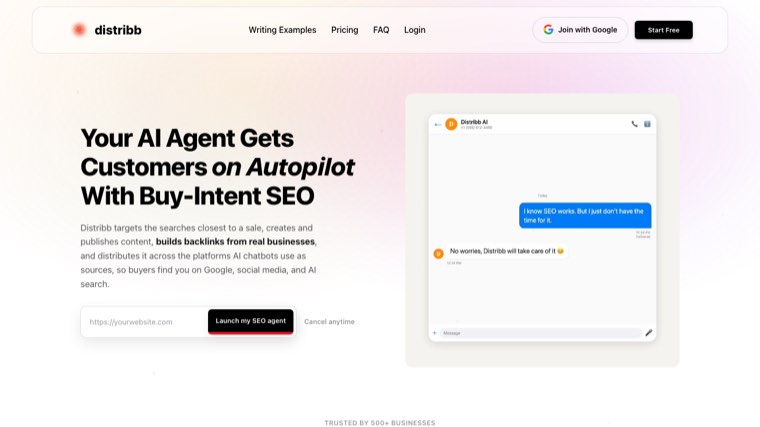
Everything above is a real amount of work, and the honest failure mode is not that software companies choose the wrong keywords. It is that week three arrives, a release slips, and nothing gets published for two months.
Distribb exists for that gap. You connect the site once and it runs the whole loop on its own: keyword research aimed at buy-intent terms, articles written and published straight into WordPress, Webflow, Shopify, Notion, Wix, or Framer, backlinks through an exchange network of real businesses, social repurposing, and tracking of whether ChatGPT, Perplexity, and Google AI Overviews are citing you. Nothing sits in a queue waiting for a person. You can review pieces before they publish if you want to, but the work does not stop when nobody logs in.
It is $97 a month on Pro. Accelerator is $495 a month and adds a human reviewing every piece before it goes out. The limitation worth stating plainly is that it is a platform rather than a bespoke creative agency, so a launch narrative or a hand-designed report is still a job for people.
If you sell software, see what Distribb runs for SaaS companies and compare it against what a retainer would cost you.
FAQ
How long does SEO take to work for a software company?
Comparison and alternatives pages can move within six to eight weeks because the competition on those terms is usually weak. Broader category keywords generally take six to twelve months. If your domain is new, add a few months to both. The order you publish in changes the timeline more than the budget does.
What are the best keywords for a software company?
The ones your buyer searches immediately before choosing: competitor comparisons, alternatives to a competitor, integration terms for tools they already use, and category terms narrowed by industry or team size. Broad category terms look attractive but are slow, expensive, and frequently owned by review directories rather than by vendors.
Should a software company do SEO in-house or outsource it?
In-house works when you have someone who can both decide and publish every week. Outsourcing works when you need capacity and can afford a retainer. Software works when the plan is clear and the problem is that execution keeps slipping, which is the most common situation. Distribb runs the recurring work on autopilot so no in-house SEO hire is needed to keep it moving.
Do docs and changelogs help SEO?
Considerably, and they are usually underused. Docs rank for the specific technical searches your buyers and their engineers run, and a changelog signals that the product is alive, which matters both to buyers and to the assistants summarising your category. Make sure they are indexable and internally linked to your marketing pages.
How do I get my software mentioned by ChatGPT and Perplexity?
Assistants assemble answers from pages they already trust, so two things matter: be present on the review directories and listicles that rank for your category, and structure your own pages so the answer is stated plainly near the top with specifics and a date. Then check monthly whether you appear, and look at what the cited pages have that yours does not.
Conclusion
SEO for software companies rewards a narrow start. Comparison pages, alternatives pages, and integration pages first, on a site a crawler can actually read, measured against trials rather than sessions. That sequence produces a result inside a quarter, which is what buys you the room to do the slower category work.
The part that decides whether it works is not the strategy. It is whether anything still gets published in month four. Pick a system that keeps going when your roadmap gets busy, because it will.