
Most HVAC companies are invisible on Google , not because their service is bad, but because their SEO is. Homeowners searching for "AC repair near me" at 11 PM will call whoever shows up first. This guide covers exactly what it takes to be that company: local keyword research, service page structure, Google Business Profile, content that actually ranks, and link building that doesn't get you penalized.
Why Local Keyword Research Is the Foundation of HVAC SEO
HVAC searches split into predictable buckets: emergency queries, service queries, seasonal queries, location-modified queries, and informational queries. Each one signals a different intent, and your site needs pages targeting all of them or you're leaving calls on the table.
The highest-converting bucket is emergency intent. Someone typing "AC not working" at 2 AM isn't browsing , they want the first business that loads fast and has a visible way to book. That's a completely different page than "HVAC maintenance checklist," which pulls in homeowners still in research mode.
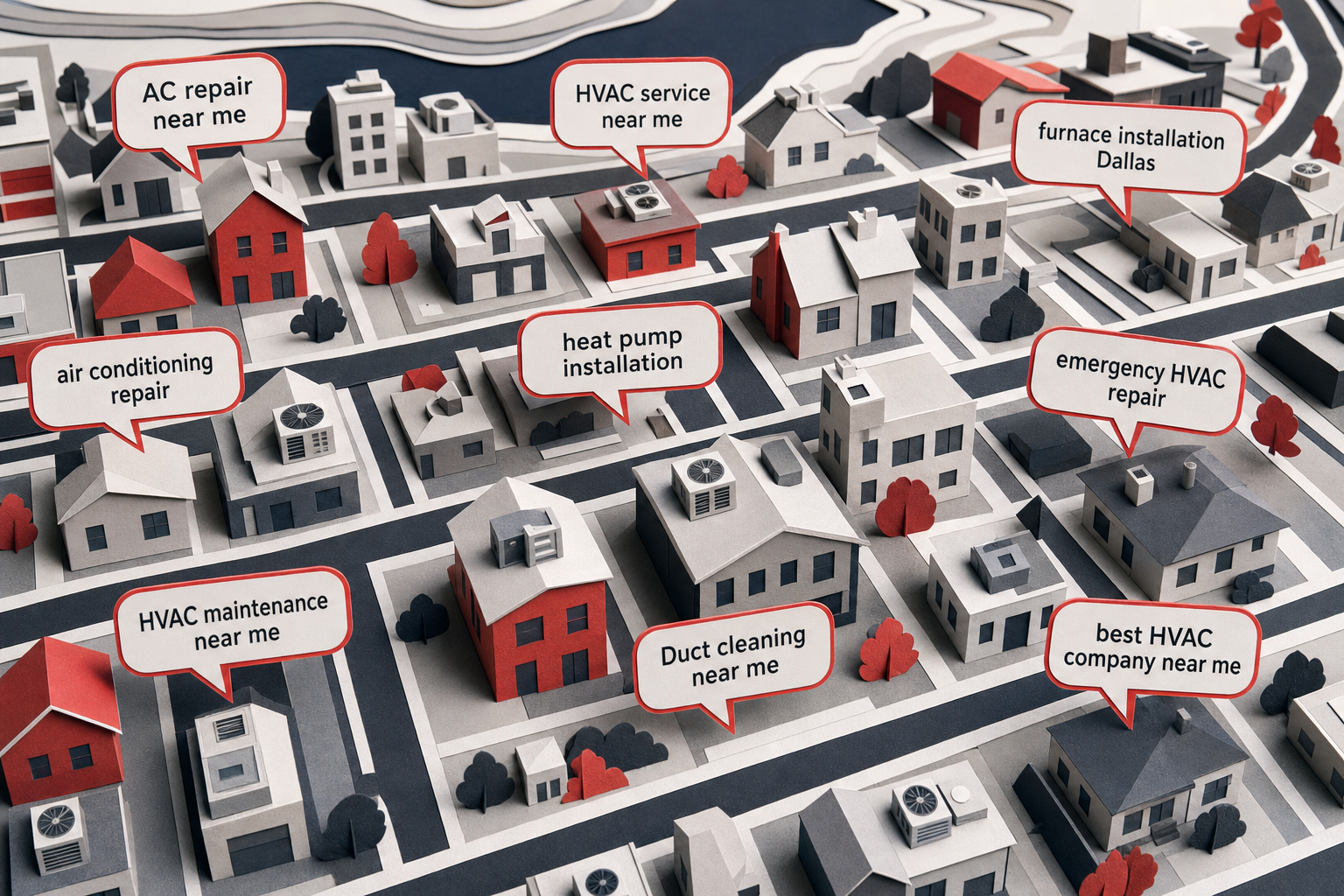
For location-modified keywords, the math adds up fast. If you serve 10 cities and target five services, that's 50 keyword combinations , each one pulling targeted local traffic. A Texas HVAC company might find "AC repair Houston" and "furnace installation Dallas" each pulling hundreds of monthly searches, but the suburbs around those cities (Katy, Plano, The Woodlands) have lower competition and are far easier to rank.
The decision between targeting major metros versus nearby suburbs is real. Major cities mean more volume but tougher competition. Suburbs often mean faster rankings and more qualified local traffic. That's not a guess , it's a data conversation you should have after pulling Google Search Console location data for your existing traffic.
Search Console is your first stop. Filter by organic traffic, sort queries by location, and look at which cities already send you clicks. Then group keywords by type: terms with "furnace" in them, terms with "AC" or "air conditioning," emergency terms like "AC not working" versus planned-purchase terms like "heat pump installation." Frequency data inside Search Console shows which keyword groups your site already has traction in , build on those first, then expand.
Google Keyword Planner adds one thing no other tool does: actual volume data broken down by city and county, not just country. That granularity matters when you're deciding whether to build a dedicated page for a suburb of 80,000 people or fold it into a broader city page.
Seasonal patterns matter too. HVAC search volume for cooling-related terms can double between March and June. Heating terms spike in September and October. Plan your content calendar around those curves , publish cooling content in February so it has time to index and rank before summer demand hits.
On-Page SEO: Structuring Your HVAC Service Pages to Rank
Service pages are the highest-converting pages on any HVAC website. Most companies treat them as afterthoughts , 150 words of generic copy that says "we do heating and cooling." That's not going to rank, and it's definitely not going to convert.
Each service needs its own dedicated page. Don't combine "AC installation" and "AC repair" on one URL , split them. Google picks which page to rank based on the query, and a combined page sends mixed signals for both. A focused page about AC repair in a specific city can target that exact search without cannibalizing your installation page.
The title tag formula that works: [Service] + [City] | [Company Name]. So, "AC Repair Denver | Summit HVAC Services" , under 60 characters, includes the keyword, signals local relevance. Your meta description should open with a benefit and include a call to action: "Same-day AC repair in Denver. Licensed technicians, upfront pricing. Book online now."
| Page Element | What to Include | Common Mistake |
|---|---|---|
| Title Tag | [Service] + [City] | [Brand], under 60 chars | Missing city name or brand truncated |
| H1 Heading | Lead with the city and service naturally | Generic "Our HVAC Services" with no location |
| Body Copy | What the service includes, what homeowners should expect, pricing context | Thin copy under 300 words with no specifics |
| Schema Markup | Service schema on each page + HVAC Business schema sitewide | No schema at all, or only homepage schema |
| CTA Placement | Above the fold and again after the main content block | Single CTA buried at the bottom |
| Internal Links | Link to related service pages and the nearest location page | No internal links: page is an island |
Schema markup is one of the more overlooked parts of HVAC on-page SEO. The setup that works is two layers: an HVAC Business schema applied sitewide (business name, address, service areas, hours), and a Service schema on each individual page. The Service schema names the specific service, links back to your business entity, and specifies the city served. This dual structure makes it easier for Google to connect your company to each specific service in local searches.
According to Google's official structured data documentation, adding structured data helps search engines understand your content and can enable rich results in search , which means more visual real estate on the results page compared to a plain blue link.
Page speed matters more for HVAC than most industries. An emergency searcher with a broken AC in July will leave a slow page immediately. Keep your service pages lean: compress images, use a caching plugin if you're on WordPress, and check Core Web Vitals regularly in Search Console.
Local SEO for HVAC: Google Business Profile and Citations
The map pack , those three business listings that show up above organic results for local searches , is often worth more than any organic position. An HVAC company in that pack gets phone calls without the homeowner even clicking through to a website. Getting there starts with your Google Business Profile.
Claim and verify your profile first. An unverified listing has no real presence in local search. Once verified, fill out every section: business category ("HVAC contractor" is your primary, with subcategories like "Air Conditioning Repair Service" added), service area, hours, and a description that works your most important service keywords in naturally.
Photos matter more than most HVAC companies realize. Listings with photos get more clicks. Upload photos of your team, your vehicles, completed jobs, and your office. Add new photos regularly , a stale profile with no updates reads as inactive to both Google and homeowners.
Google Posts are short updates that appear directly on your profile. Use them for seasonal promotions ("Summer AC tune-up special , book now"), new service announcements, or tips. They don't need to be long , a few sentences and a call to action is enough. Posting consistently keeps your profile looking active.
Reviews are the single biggest trust signal in local search. More reviews, higher average rating, and recent activity all influence whether you appear in the map pack. The simplest system: send every customer a follow-up text or email within 24 hours of a completed job, with a direct link to your Google review page. Don't ask for five stars , just ask for honest feedback. When a customer mentions a specific service in their review, respond and include that keyword naturally in your reply.
Citations are mentions of your business name, address, and phone number on other websites. The directories that matter most for HVAC are Yelp, Angi, HomeAdvisor, the Better Business Bureau, and your local Chamber of Commerce. Build listings on each one and keep the information consistent across all of them.
Distribb runs Google Business Profile management alongside its content and authority automation, so profile posts and review replies sit in the same system that handles your content calendar. That is the local SEO side of the product, and it is worth a look if keeping the profile active is the part that keeps slipping.
Content Marketing for HVAC: Blog Topics That Actually Drive Traffic
Blog content does two things for HVAC companies: it builds topical authority (which lifts your service pages in rankings), and it pulls in homeowners who are still in research mode. Those readers won't book immediately, but they remember who helped them , and they call when their AC breaks.
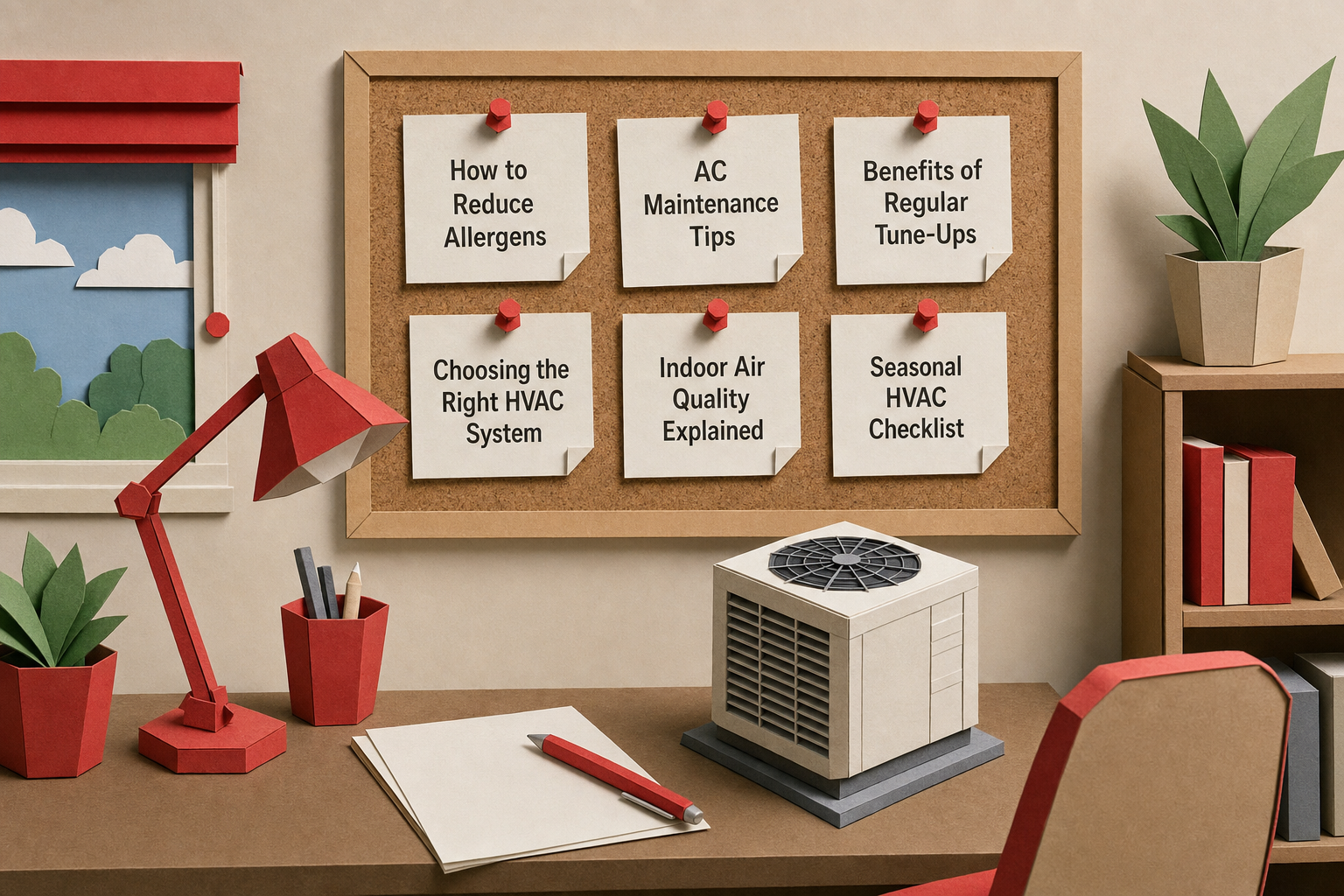
The topics that consistently drive traffic fall into a few clear patterns. Preventive maintenance posts work because homeowners don't think about their HVAC system until something breaks , a post explaining why annual tune-ups cost less than emergency repairs reaches them before they need you, and plants your brand in their memory. Energy efficiency posts tap into a universal homeowner concern: everyone wants a lower electricity bill.
Seasonal content is reliable. Publish cooling-related posts in February and March so they rank by the time June heat hits. Heating content in August and September. "What to do when your AC stops working" targets emergency searches and should link directly to your emergency repair service page.
Topics that pull consistent traffic for HVAC blogs:
- How to reduce allergens in your home with better HVAC filtration
- Why your AC is running but not cooling the house
- How often should you change your furnace filter?
- Signs your heat pump needs replacing vs. repair
- What to look for when choosing an HVAC contractor
- Energy-efficient heating units compared by annual operating cost
One rule: don't cannibalize your service pages. If you have a service page for "AC Repair in Dallas, TX," don't write a blog post with the same title. Blog posts should answer questions and explain concepts. Service pages should capture buying intent. Each blog post should link to the relevant service page , that internal link builds topical authority and creates a path to conversion.
The volume problem is real. Publishing one blog post a month isn't enough to build meaningful topical authority. Most successful HVAC companies need 8 to 12 posts published consistently to see rankings move , and that's where most business owners run out of time. That's the problem Distribb solves: it finds the keywords, builds the content calendar, writes the posts, and publishes them on your CMS automatically. You stay in control through the editor; the grind runs without you.
Link Building for HVAC Companies: What Actually Works
Backlinks are still one of the clearest signals Google uses to gauge a website's authority. For HVAC companies, the good news is you don't need hundreds of links , you need the right ones. A handful of high-quality, relevant links will outperform dozens of spammy directory submissions.
Local networking is the most natural link source for a local service business. Sponsoring a Little League team, partnering with a local real estate agent, or supplying a quote to a local news outlet about summer energy tips , any of these can produce a genuine editorial link from a trusted local domain. Those links carry real weight because they're earned, not manufactured.
Blog content earns links that service pages can't. Other websites will link to a useful post about common AC problems or how to extend the life of a heat pump. They won't link to your AC repair service page. That's why blog posts and link building are connected strategies, not separate ones. According to Wikipedia's definition of backlinks, an inbound link from an external site is one of the primary signals search engines use to evaluate page authority , which is exactly why earning them through useful content beats any shortcut.
Directory links from Yelp, Angi, and HomeAdvisor are nofollow, meaning they pass less equity than editorial links. They still matter for local SEO signals and referral traffic, but don't mistake them for the backbone of a link strategy. The links that move rankings are dofollow editorial links placed inside the body content of a relevant page , not sidebar widgets or footer credits.
Anchor text diversity matters. If every link pointing to your site uses the exact same phrase, that looks manipulative. A natural backlink profile mixes branded anchors (your company name), generic anchors ("this article," "read more"), and a smaller share of keyword-rich anchors. Don't manufacture anchor text , let it reflect how a real editor would naturally reference your content.
Distribb's optional Backlink Exchange lets you earn contextual links from real businesses inside the network, with every link tracked in your dashboard. For HVAC companies without an outreach team, that's a usable way to build authority without cold emailing strangers.
How Distribb Automates SEO for HVAC Companies
The biggest problem with HVAC SEO isn't knowing what to do , it's finding the time. Running a heating and cooling business means dispatching technicians, managing inventory, handling customer calls, and keeping up with seasonality. Writing SEO content consistently doesn't fit in that schedule.
Distribb is built for exactly this situation. You tell it what you sell and connect your site , WordPress, Webflow, Wix, Shopify, or via webhook , and it handles the SEO grind. It finds keywords with real search volume and achievable competition in your niche, builds a rolling 30-day content calendar, writes the articles, and publishes them on your CMS at whatever cadence you choose.
The content isn't generic filler. Distribb writes long-form, SEO-optimized articles with clean structure, internal and external links, FAQ blocks, and E-E-A-T-focused writing , the kind of content that gets indexed, ranked, and cited. Every piece goes through an editor before it goes live: use the AI editor for fast rewrites, or switch to the classic editor for full manual control.
For HVAC companies specifically, the workflow maps directly to what ranks. Distribb identifies seasonal keyword opportunities (cooling terms, heating terms), builds topic clusters around your service pages, and keeps the content pipeline stocked even during your busiest months. You're not scrambling to write a blog post between service calls , the calendar fills itself.
The optional Backlink Exchange adds another layer: contextual links from real businesses in the network, tracked in your dashboard. Combined with the content automation, it covers two of the three pillars that drive local SEO results , content authority and link authority , in one system.
FAQ
How long does SEO take to work for an HVAC company?
Most HVAC companies start seeing meaningful ranking movement within 3 to 6 months of consistent effort. Emergency and long-tail terms often rank faster , sometimes within 6 to 8 weeks. High-competition metro terms ("AC repair Chicago") take longer, typically 6 to 12 months. The timeline depends on how competitive your local market is, your site's existing authority, and how consistently you publish and build links.
What's the difference between local SEO and regular SEO for HVAC?
Regular SEO targets broad organic rankings. Local SEO targets the map pack and location-based searches in your service area. For HVAC companies, local SEO , which includes your Google Business Profile, NAP citations, and location-specific service pages , is usually the higher priority because most HVAC searches have strong local intent. Both matter, but local signals drive the calls.
How many service pages should an HVAC website have?
One page per service per location you serve. If you offer AC repair, furnace installation, heat pump service, and duct cleaning across five cities, that's 20 service pages minimum. Each page should target a specific service-plus-location keyword combination. Don't combine multiple services on one page , split them so each page can rank for its specific search intent without mixed signals.
Do HVAC companies need a blog?
Yes, but only if it's consistent. A few thin posts won't move rankings. A blog that publishes 8 to 12 relevant articles , covering maintenance tips, seasonal prep, common problems, and buying guides , builds topical authority that lifts your service pages in search. Blog posts also earn links that service pages can't, and they pull in homeowners who are researching before they're ready to buy.
What are the best keywords for HVAC companies to target?
Start with high-intent service terms like "AC repair [city]" and "furnace installation [city]," then add emergency terms like "AC not cooling" and "furnace not working." Layer in seasonal informational terms ("how to prepare AC for summer") to build topical authority. Use Google Search Console to find which keyword groups your site already has traction in, then build from there rather than starting from zero.
Conclusion
The fundamentals here , location-focused keywords, structured service pages, an active Google Business Profile, consistent blog content, and earned backlinks , don't require a big agency budget. They require consistency. If you're an HVAC company owner who wants those results without the time investment, sign up for Distribb and let the content pipeline run on autopilot while you run the business.