
Most car buyers finish 80% of their research before they ever walk into a showroom. If your dealership isn't showing up during that research phase, you're already out of the conversation. This guide covers what actually moves the needle for automotive SEO: local search, inventory pages, keyword strategy, and the content that keeps ranking month after month. Businesses selling to other businesses face a longer version of that research phase, covered in our guide to SEO for manufacturers.
Why Car Dealership SEO Is Different From Standard SEO
A plumbing company might manage 20 service pages. A dealership can have thousands of inventory URLs, hundreds of vehicle detail pages that change weekly, service pages, financing pages, and OEM compliance constraints on top of all that. Generic SEO advice doesn't account for any of it. Our guide to SEO for contractors covers how that smaller page count changes the approach.
There are four things that make dealership SEO genuinely different from what works for most local businesses. For the version of this written for a business people walk into, see our guide to SEO services for restaurants.
- Inventory turns over constantly. New vehicles arrive, used ones sell, prices change, model years roll over. That creates ongoing SEO problems around indexing, redirects, and duplicate content that most businesses never face.
- You compete with platforms that dwarf you. Large automotive marketplaces like Cars.com and CarGurus have enormous domain authority and fight for the same searches your VDPs target. A smart SEO strategy has to route around them.
- OEM rules limit what you can say. Franchise dealers operate under manufacturer guidelines on content, pricing language, and imagery. Your SEO strategy has to work inside those constraints.
- Each department needs its own strategy. Sales, service, parts, and F&I all generate different search demand. Treating the whole site as one unit leaves significant traffic on the table.
The result is that dealership SEO is measured differently too. Rankings are a signal, not the goal. The metrics that matter are organic leads, VDP views, service appointment requests, and cost per organic lead, which typically runs significantly lower than paid channels.
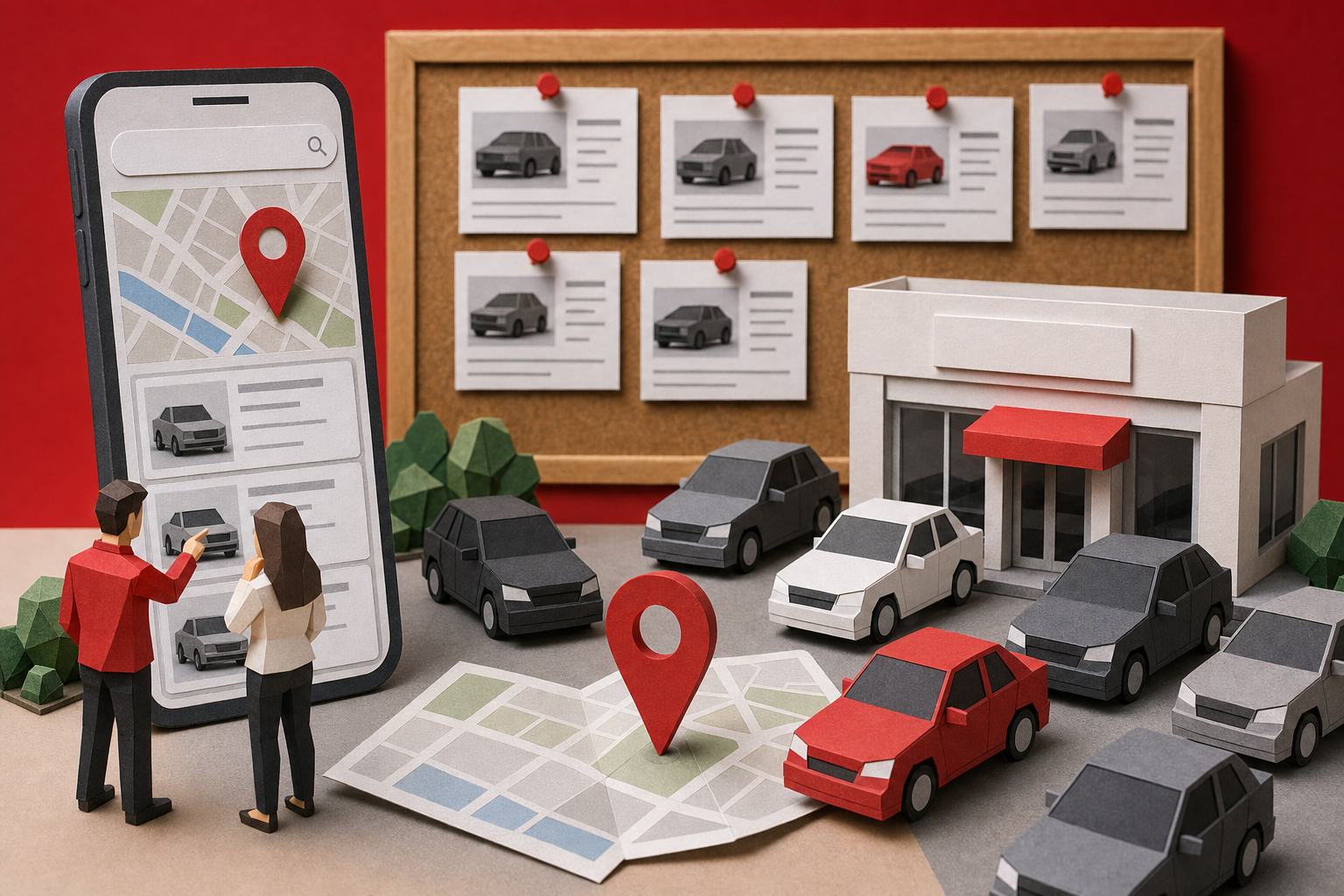
One structural mistake dealerships make is relying on their website provider's built-in SEO. Dealer website platforms are built for templated efficiency. They display inventory. They don't run a content strategy, build topical authority, or handle technical SEO at the level needed to beat dedicated automotive marketplaces. You need a dedicated strategy layer on top of whatever platform you're on.
Tools like Distribb address this gap directly. It connects to your CMS, finds keywords worth targeting in your niche, builds a rolling content calendar, writes and publishes the content, and repurposes it into social posts automatically. For a dealership managing multiple departments and a constantly shifting inventory, that kind of automation is the difference between SEO happening consistently and it stalling after the first month.
Local SEO: How Dealerships Win 'Near Me' Searches
Local search is where most dealership leads actually start. Buyers search "Toyota dealer near me" or "used trucks in [city]" and make a shortlist from what Google surfaces. Research consistently shows that local searches on smartphones frequently result in a business visit within 24 hours. For high-consideration purchases like cars, that's a huge signal about buyer intent. The same near-me pattern in a different trade is worked through in our guide to the best AI SEO tools for plumbers.
Your Google Business Profile (GBP) is the single biggest lever in local search. It controls how your dealership appears in Google Maps, the local 3-pack, and the knowledge panel. Keep it fully filled out: every service category, accurate hours, photos of your lot and showroom, and a description that mentions your location and the brands you carry. Another local trade where the profile does most of the work is covered in our guide to SEO for dentists.
What GBP optimization actually looks like
Don't just set it up once and forget it. Post regular updates when you have promotions or new inventory. Respond to every review, positive and negative. Use the Q&A section to pre-answer common questions about financing and trade-ins. Google rewards active profiles with better local ranking.
Reviews matter more than most dealers realize. They feed directly into local pack rankings and build the trust that pushes a buyer to choose your store over the one two miles away. Ask every satisfied customer for a Google review. Make it easy: send a follow-up text with a direct link. A steady flow of fresh reviews beats a high average rating that hasn't been updated in six months.
Location pages and NAP consistency
If you operate more than one rooftop, each location needs its own dedicated page with unique content. Swapping out only the city name on a copy-pasted template is a doorway page risk and won't rank. Write genuinely local content: mention nearby landmarks, local events you sponsor, the neighborhoods you serve.
NAP consistency, meaning your Name, Address, and Phone number matching exactly across every directory listing, matters for local ranking signals. Check Yelp, your manufacturer's dealer locator, local chamber of commerce listings, and any automotive directories you're listed on. One mismatched suite number or old phone number can drag down your local authority.
For dealerships thinking through a broader AI-powered local SEO optimization strategy, the same principles apply: consistent signals, active profiles, and content that matches what local buyers are actually searching for. Distribb's Google Business Profile management is live now, and it ties profile activity directly into the same content and authority automation pipeline.
Local Business schema markup
Adding LocalBusiness schema to your site gives search engines structured data about your dealership: address, hours, service areas, accepted payment methods. It improves your chances of showing up in local rich results and makes your data parseable by AI search tools and modern search assistants like ChatGPT. It's not optional anymore.
Keyword Strategy: Targeting Buyers at Every Stage
Most dealerships only go after bottom-funnel keywords: "[brand] dealer near me" and "[model] for sale [city]." Those are worth targeting, but they're also the most competitive. The dealerships pulling ahead are the ones building visibility across all five stages of the car buying journey.
The car buyer journey can involve up to 900 digital touchpoints before a purchase decision is made. Buyers compare models, read reviews, check pricing, and evaluate financing options weeks before visiting a showroom. If your content only appears at the end of that process, you're invisible during the part where brand preference actually forms.
A three-tier keyword framework
Think of your keyword targets in three tiers. Tier 1 is transactional: "2026 Toyota Camry for sale near me," "certified pre-owned BMW X3," "[model] lease deals." These have the strongest purchase intent. Every dealership should rank for its own version of these.
Tier 2 is commercial investigation: "[Model A] vs [Model B]," "best SUV for families," "hybrid vs plug-in hybrid." Buyers at this stage are comparing options and close to a decision. Dealerships that publish honest comparison pages build trust before competitors even enter the picture.
Tier 3 is informational and service-related: "how much does it cost to lease a car," "oil change near me," "brake repair [city]," "when should I rotate my tires." Service keywords are especially valuable because competition is significantly lower than inventory-related searches, and they drive recurring revenue from existing customers.
For AI-based keyword research automation, Distribb handles all three tiers automatically. It finds high-intent keywords with real search volume across your departments, maps them to content topics, and keeps the pipeline stocked as new opportunities emerge. That matters for dealerships because keyword demand shifts with model years, incentive cycles, and seasonal buying patterns.
Where to find keyword opportunities
You don't need expensive tools to start. Google Search Console shows what queries already drive impressions to your site. That's your most actionable starting point. Then use Google's autocomplete and the "People Also Ask" section to surface related questions. Talk to your sales and service teams. The questions customers ask in person are often the exact phrases they searched before arriving.
A typical franchise dealership should actively target 200, 500 keywords across departments. That breaks down roughly as 50, 100 brand and model terms, 50, 100 service keywords, 30, 50 location-modified terms, 30, 50 comparison queries, and 50, 100 informational keywords. The goal isn't one page per keyword. It's organizing them into topic clusters where one strong page captures multiple related searches.
On-Page SEO for Vehicle Detail Pages (VDPs) and Inventory
VDPs and SRPs typically make up 80, 90% of the pages on a dealer website. They're the pages shoppers land on from Google, and they're the pages that either convert or lose your next customer. Most of them are invisible to search engines, and the reason is almost always the same: templated descriptions.
When your website provider uses the same boilerplate copy across every vehicle listing, search engines see thousands of near-duplicate pages and devalue all of them. You can't rank a page that looks identical to 50 other pages on your own site and thousands more on competing dealer sites running the same platform.
What every VDP needs
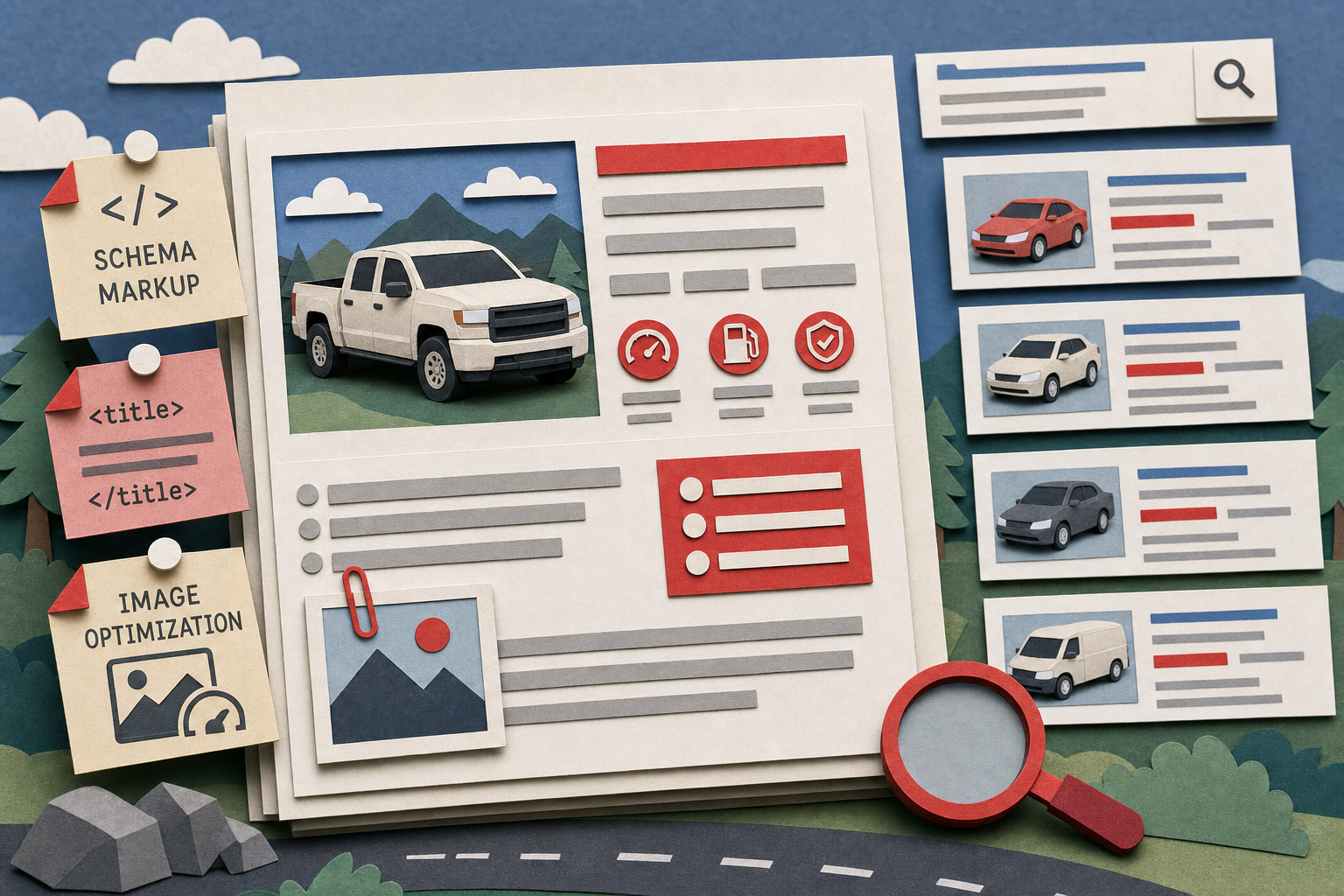
Each vehicle detail page should have a unique, keyword-rich description written for that specific vehicle, not a template. The title tag should follow this pattern: [Year] [Make] [Model] [Trim] for Sale in [City]. Add Vehicle schema markup with make, model, year, price, and VIN. Add Offer schema with price and availability. Include descriptive alt text on every vehicle photo and an internal link to the corresponding model landing page.
Google announced vehicle listing markup in 2023, making it possible for dealerships of all sizes to show for-sale inventory directly in Google Search results using structured data on their vehicle pages. Without that markup, your inventory pages are unstructured HTML that search engines have to guess at. With it, your pricing and availability can appear as rich results.
You can automate unique descriptions using templatized content that pulls in dynamic variables: year, make, model, trim, key features, city, and dealership name. Combine that with conditional logic for body style and drivetrain, and you get descriptions that are technically unique for every vehicle while scaling across thousands of listings.
Handling sold inventory the right way
| Situation | Recommended Action | Why |
|---|---|---|
| Matching vehicle in stock | 301 redirect to similar VDP | Preserves link equity, keeps user on-site |
| No similar vehicle available | 301 redirect to model SRP | Passes authority to the category page |
| High-volume turnover | Programmatic redirect rules | Scales without manual intervention |
| Temporary hold on URL | Soft 404 with similar inventory | Shows alternatives, avoids hard error |
Letting sold VDPs return 404 errors is one of the most common and costly mistakes in dealer SEO. Every backlink and internal link that page accumulated gets wasted. A 301 redirect to the closest matching in-stock vehicle, or to the relevant model SRP if nothing similar is available, keeps that link equity working for you.
SRP technical hygiene
Search results pages need clean pagination and proper canonical tags. If you allow filter combinations to generate new URLs, every unique combination of make, model, year, color, and price range can create a separate indexable page. That produces thousands of thin, near-duplicate pages that drag down your entire site. Use AJAX-based filtering or canonical tags pointing back to the unfiltered parent page to keep your index clean.
Core Web Vitals matter on inventory pages more than anywhere else on your site. Vehicle photos are heavy. Use WebP or AVIF format, serve images from a CDN, and preload the hero vehicle image because it's almost always your Largest Contentful Paint element. Reserve explicit dimensions for image galleries and pricing badges to prevent layout shifts after the initial page load.
Content Marketing for Dealerships: Blog Topics That Rank
The average automotive website draws a significant share of its total traffic from organic search. That's a huge share riding on whether or not your content is doing its job. VDPs and SRPs are your foundation, but the dealerships winning organic traffic are publishing content that captures buyers at every stage of their research.
Blog content builds topical authority over time. It's not about publishing anything to fill a calendar. It's about answering the specific questions buyers are asking before they're ready to visit a showroom. Here are the topic categories that consistently rank and convert for dealerships.
Model research and comparison pages
Head-to-head comparison pages ("2026 Honda CR-V vs Toyota RAV4") rank well and build trust because they give buyers something genuinely useful. Buyers searching these terms are close to a decision. A well-structured comparison page with honest pros and cons can earn a click over a manufacturer's spec sheet every time.
Trim-level explainers work the same way. "What's the difference between the Honda Civic EX and Sport" is a real search with clear commercial intent. If you sell that model, you should own that answer.
Service and ownership content
Service-related content is the most underused category in dealership SEO. "How often should you rotate your tires," "what does a check engine light mean," and "brake replacement cost in [city]" are all searches with local intent and lower competition than inventory terms. They drive service appointments and establish your dealership as the trusted resource for vehicle ownership questions.
Finance and F&I content builds authority with buyers who are nervous about the money side of the purchase. Posts explaining gap insurance, how leasing works, or what to know about extended warranties capture buyers earlier in the journey and reduce objections before they ever talk to your finance team.
Keeping the pipeline full
The challenge with content marketing isn't knowing what to write. It's writing it consistently, month after month, across every department, while also running a dealership. That's where automating SEO content creation becomes a real operational advantage rather than just a nice-to-have.
Distribb runs this entire process automatically. It finds keywords worth ranking for based on your specific inventory and market, builds a rolling 30-day content calendar, generates long-form SEO articles, and publishes them on the schedule you set. It also repurposes that content into social posts so the same material shows up across channels without any extra work on your end. For a dealership that doesn't have a dedicated content team, that's a meaningful shift in what's actually possible.
Google's E-E-A-T guidelines reward content that demonstrates real experience and expertise. For dealerships, that means writing about vehicles and service topics with specific, accurate detail, not thin keyword-stuffed posts. Each article should clearly answer one buyer question and link to relevant inventory or service pages on your site.
Frequently Asked Questions
How long does dealership SEO take to show results?
Most dealerships see ranking movement within 60, 90 days, with meaningful lead growth between months 3 and 6 as authority compounds. Technical fixes and Google Business Profile optimization can show impact in 30, 60 days. Content-driven traffic typically takes 3, 6 months to build momentum. SEO is a compounding investment: the stores that start now will have a measurable advantage over those that wait.
What's the most important SEO priority for a small dealership?
Local SEO and Google Business Profile optimization. A fully optimized GBP with consistent NAP data, active reviews, and regular posts directly improves your visibility in the local 3-pack, where most high-intent buyers start. After that, unique VDP descriptions and LocalBusiness schema markup are the fastest ways to improve organic search performance without a massive content investment.
Do dealerships need a separate SEO strategy for the service department?
Yes. Service keywords like "oil change near me" and "brake repair [city]" have lower competition than inventory terms and drive recurring revenue. Many dealers ignore this entirely and leave significant organic traffic to independent shops and chains. A service department SEO strategy with dedicated landing pages for each service category is one of the faster wins in automotive search.
How do I handle SEO when a vehicle sells and the page disappears?
Never let sold VDPs return 404 errors. Redirect them with a 301 to the most similar in-stock vehicle, or to the relevant model SRP if nothing matches. For high-volume inventory turnover, set up programmatic redirect rules that run automatically. This preserves the link equity those pages accumulated and keeps buyers on your site instead of hitting a dead end. Learn more about how to improve search engine rankings through solid on-page fundamentals like this.
Can AI tools really automate dealership SEO effectively?
Yes, for the repeatable parts of the work. AI SEO platforms can handle keyword research, content planning, article writing, publishing schedules, and schema generation at a scale no in-house team could match manually. The key is choosing a platform built for ongoing automation rather than one-off audits. Distribb covers keyword research through publishing and backlink building, making it well-suited for dealerships that need consistent output without a dedicated SEO team.
Where to Start
If your dealership isn't getting traction from organic search, the fastest fix is almost always the same: optimize your Google Business Profile, add Vehicle schema to your VDPs, and start publishing content that answers real buyer questions. Start with one department, get the process working, then expand. If you want to run all of this without building a content team from scratch, automating your SEO audits and content pipeline with AI is the most direct path to consistent results at dealership scale.
The map pack work described above is the same job in every local vertical, only the competition changes. For a worked comparison in a category with far lower budgets, see SEO for photographers.