
Enterprise SEO ROI Calculator: A Step-by-Step Guide

By on

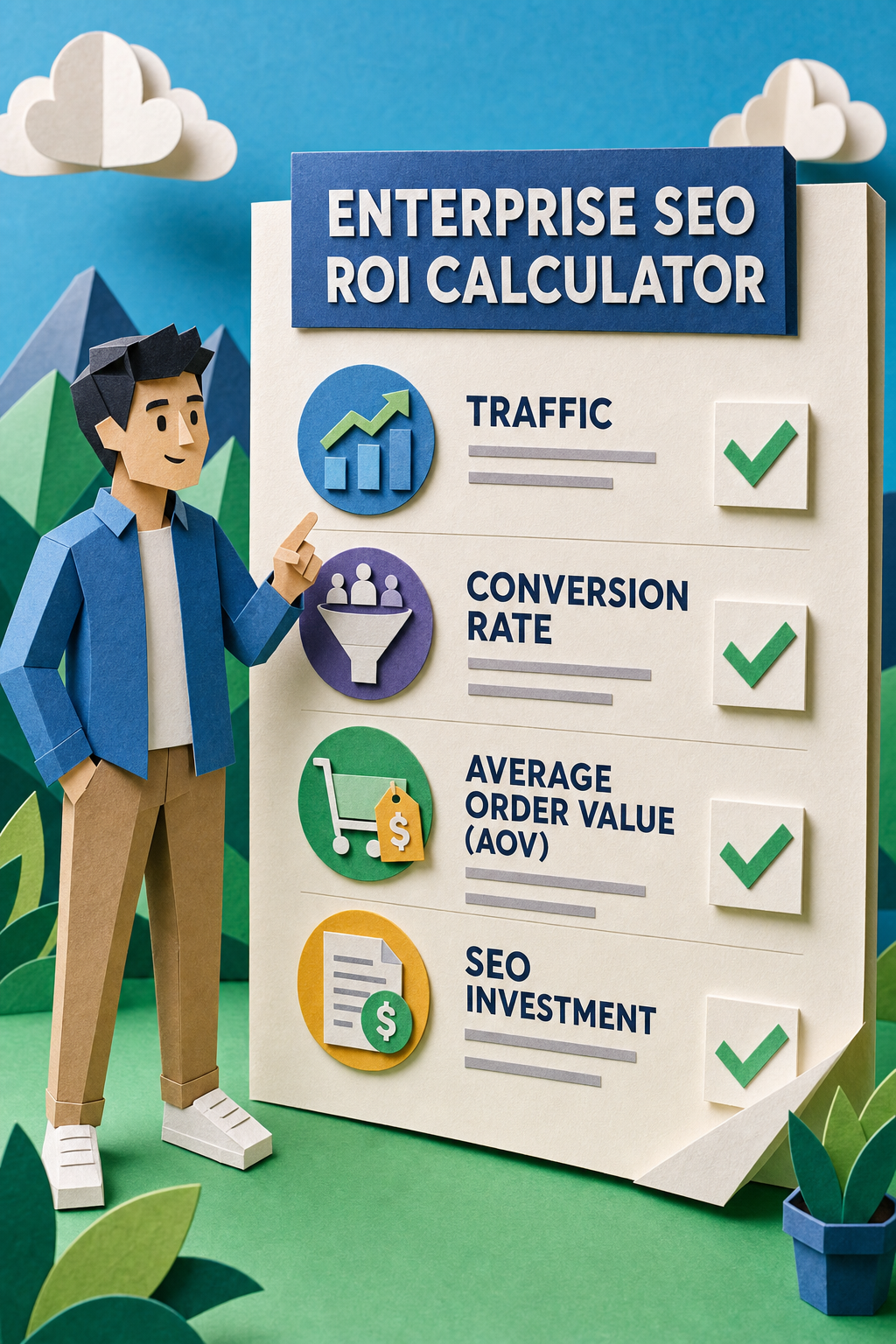
A papercraft scene of a person standing next to a giant checklist with icons representing traffic, conversion rate, AOV, and SEO spend. The style is colorful and slightly 3D with paper textures. Alt: A papercraft illustration of key metrics for enterprise SEO ROI calculator: traffic, conversion rate, average order value, and SEO investment.

Ever wonder if every dollar you pour into enterprise SEO actually pays you back? You're not alone. Most businesses track rankings and traffic, but they stop short of connecting those numbers to real revenue. That's a problem.

In this guide, we'll walk you through exactly how to build and use an enterprise SEO ROI calculator. You'll learn what metrics matter, how to set up the math, and how to turn the results into decisions that grow your business. No fluff. Just a clear, repeatable process.

We'll also show you how platforms like Distribb can automate the heavy lifting so you're not stuck in spreadsheets.

Let's get started.

Step 1: Understand What Enterprise SEO ROI Means

Enterprise SEO ROI is the return you get from your search engine optimization efforts compared to what you spend. It's not just about ranking on page one. It's about knowing that every dollar you put into content, links, and technical fixes actually brings in more than it costs.

Think of it like this. You run a business. You invest in a marketing channel. You expect that channel to generate profit. SEO is no different. But unlike paid ads, organic traffic doesn't come with a per-click price tag. That makes measuring return harder. Yet it's more important than ever.

According to Siteimprove's guide on SEO ROI, organic search accounts for over 50% of all site traffic. And 91.5% of all clicks go to results on the first page of Google. If you're not there, you're invisible. That's a huge missed opportunity.

So what does ROI really mean in an enterprise context? It's the ratio of net profit from organic search to the total cost of your SEO program. That includes salaries, agency fees, tools, content production, link building, and technical work. If you spend $50,000 a month on SEO and generate $200,000 in revenue from organic traffic, your ROI is 300%.

But here's where it gets tricky. SEO results don't happen overnight. You might invest for six months before seeing meaningful revenue. That's why time-to-rank matters. A good enterprise SEO ROI calculator accounts for that delay.

The key is to separate vanity metrics like traffic from real business metrics like conversions, average order value, and customer lifetime value. Traffic spikes mean nothing if they don't convert. As one SEO expert on YouTube put it, "The most valuable metric for SEO ROI is the visibility of your search results." Visibility leads to clicks, which lead to revenue. But you need to track all of it.

Key Takeaway: Enterprise SEO ROI is the financial return on your SEO investment, measured by net profit divided by cost, adjusted for the time it takes to rank.

Bottom line:Understanding the true meaning of enterprise SEO ROI is the foundation for building a calculator that actually guides business decisions, not just reports traffic numbers.

Step 2: Gather the Key Metrics Needed for Calculation

Now that you know what ROI means, it's time to collect the numbers. This is where most people get stuck. They either don't have the data or they use the wrong data. Let's fix that.

You'll need two categories of metrics: operational inputs and financial outcomes.

Operational inputs:

  • Monthly organic traffic, The number of visitors coming from search engines. Get this from Google Analytics or your SEO tool.
  • Conversion rate, The percentage of visitors who complete a desired action (purchase, sign-up, lead form, etc.). Track this through Google Analytics goals or e-commerce tracking.
  • Average order value (AOV) or customer value, How much revenue one conversion brings. For B2B, this might be average deal size.
  • Qualification percentage, The share of leads that become sales-qualified. Not all leads are equal.
  • Closing ratio, The percentage of qualified leads that actually close. This helps you move from traffic to revenue.
  • Cost per lead (CPL), Useful for comparing SEO to other channels.

Financial outcomes:

  • Average revenue per customer (ARPC), Total revenue divided by number of customers.
  • Customer lifetime value (LTV), How much a customer pays over their entire relationship with your business.
  • Discount rate, To account for the time value of money, especially if your SEO timeline is 12+ months.
  • SEO cost, Everything you spend on SEO: tools, content, links, people, agency fees.

Most enterprise SEO ROI calculators from sources like EnterpriseSEOROICalculator.pro ask for traffic, conversion rate, AOV, and SEO investment. But if you stop there, you miss the nuances of qualification, lead nurturing, and lifetime value.

A common mistake is using non-representative early-user data. If you just launched a new product, the first few months of traffic might not reflect your steady-state performance. Use at least six months of data for averages.

Another pitfall is ignoring time-to-rank. If you start SEO today, you won't see peak results for 6 to 12 months. Your calculator should project growth over time, not assume instant traffic.

A papercraft scene of a person standing next to a giant checklist with icons representing traffic, conversion rate, AOV, and SEO spend. The style is colorful and slightly 3D with paper textures. Alt: A papercraft illustration of key metrics for enterprise SEO ROI calculator: traffic, conversion rate, average order value, and SEO investment.

Pro Tip: Create a spreadsheet where you track each of these metrics monthly. Over time, you'll spot trends and seasonality that make your ROI projections more accurate.

Bottom line:Gathering the right metrics, both operational and financial, is the critical second step in building an enterprise SEO ROI calculator that reflects your actual business reality.

Step 3: Set Up Your Enterprise SEO ROI Calculator

You have your metrics. Now let's build the calculator. You can do this in a spreadsheet, or you can use a dedicated tool. We'll show you a simple Excel method first, then talk about automation.

Building a basic calculator in Excel

Create a new workbook with these columns:

  • Month, Jan, Feb, etc.
  • Organic Traffic, from analytics.
  • Conversion Rate, as a percentage.
  • AOV, average order value.
  • Revenue from SEO, formula: Traffic * Conversion Rate * AOV.
  • SEO Cost, total monthly spend.
  • Net Profit, Revenue minus Cost.
  • ROI %, (Net Profit / Cost) * 100.
  • LTV:CAC, if you have LTV data, compare to customer acquisition cost from SEO.

For example, if you have 100,000 monthly visitors, a 3% conversion rate, and $80 AOV, your revenue is $240,000. If you spend $10,000 on SEO, net profit is $230,000, and ROI is 2,300% for that month. But that's only one month. Over 12 months, your total ROI might be even higher if traffic grows.

Advanced: Using formulas

Excel's IF function can label months as profitable or not. Use conditional formatting to color-code high ROI in green, low in red. The SUM function can total your year's performance. The AVERAGE function gives you typical ROI per month.

Here's a sample table structure:

MonthTrafficConv. RateAOVRevenueSEO CostNet ProfitROI
Jan90,0002.8%$80$201,600$10,000$191,6001,916%
Feb95,0003.0%$82$233,700$10,500$223,2002,126%
Mar105,0003.1%$85$276,675$11,000$265,6752,415%

Notice the ROI is huge because we're using monthly revenue. But that's because we're not subtracting other business costs. This is a simplified view. For enterprise, you'll want to include overhead and time-to-rank.

Automating with a tool

Spreadsheets work, but they're manual. Platforms like Distribb can automate much of this. You connect your site, and the system tracks traffic, conversions, and ROI in real time. It also finds keywords and produces content that feeds the pipeline. This saves hours of data entry and reduces errors.

Here's a video walkthrough of setting up SEO ROI tracking:

One key insight from research: Only 60% of published SEO ROI calculators name a required data source. That means many calculators rely on assumptions. Be explicit. Write down where each number comes from. For example, traffic from Google Analytics, conversion rate from your CRM, AOV from your e-commerce backend. This transparency builds trust with stakeholders.

73%of marketers report higher ROI with automation s.

Bottom line:Setting up your enterprise SEO ROI calculator can be done in Excel or with automated tools like Distribb, but the key is to use real, documented data sources and project over a realistic timeframe.

Step 4: Interpret the Results , ROI, Payback Period, and Revenue

You've built the calculator. Now what do the numbers mean? Let's break down the three most important outputs: ROI percentage, payback period, and total revenue projection.

ROI Percentage

This is the headline number. A positive ROI means you're making money. But context matters. For enterprise SEO, a 200% to 500% ROI is considered solid according to benchmarks from First Page Sage's SEO statistics report. However, that's annualized. If your calculator shows 300% over 12 months, that's fantastic. If it shows 300% in one month, that's likely an anomaly.

ROI alone doesn't tell you if the investment is worth it compared to other channels. That's where LTV:CAC comes in. If your LTV:CAC ratio is above 3:1, your SEO program is healthy. Below 1:1, you're losing money on each customer.

Payback Period

How long until you recoup your initial SEO investment? If you spend $60,000 over six months and start generating $20,000 in monthly profit from organic traffic, your payback period might be three months after results kick in. But SEO has a lag. You might not see any profit for six months. The payback period includes that ramp-up time.

To calculate payback period: divide total SEO cost by the average monthly net profit from SEO. If you spent $60,000 and average $15,000 monthly profit, payback is 4 months. But only count months where you actually have positive net profit from SEO. The first few months might show negative.

Total Revenue Projection

Your calculator should project revenue over a chosen timeframe. If your traffic grows 25% over six months and conversion rate stays the same, you can estimate future revenue. This projection is key for budgeting and setting expectations with executives.

One common mistake is to rely only on traffic data. You must track conversions and value. A blog post that gets 10,000 visitors but zero conversions is worthless. A page with 1,000 visitors and a 5% conversion rate is gold. Your calculator needs to distinguish between awareness content and conversion-focused pages.

A papercraft scene of a dashboard with three large dials showing ROI percentage, payback period in months, and total revenue in dollars. The dials have paper-cut arrows pointing to green zones. Alt: A papercraft illustration of an enterprise SEO ROI dashboard with dials for ROI, payback period, and revenue projection.

Key Takeaway: Interpret your results by looking at ROI percentage, payback period, and total revenue, but always consider the time lag inherent in SEO and the quality of your conversions.

Bottom line:Proper interpretation of your enterprise SEO ROI calculator outputs requires understanding the difference between short-term spikes and long-term trends, and factoring in the delay before results appear.

Step 5: Use SEO ROI Insights for Business Decisions

You have the numbers. Now use them. The real value of an enterprise SEO ROI calculator isn't the calculation itself, it's the decisions it enables.

Justifying Budget

When you show a 300% ROI over 12 months, getting budget approval becomes easier. Executives understand percentages. They also understand that SEO costs less per acquisition than many paid channels. Compare your SEO cost per lead to PPC. If your SEO CPL is $20 and PPC is $50, that's a strong argument for increasing SEO spend.

But you need to be honest. Include all costs. Don't forget overhead. And don't claim a 5,000% ROI because you only counted content costs. A credible calculator includes everything.

Optimizing Campaigns

If your calculator shows that certain content pieces drive high ROI while others don't, shift resources. Double down on what works. For example, if comparison articles convert better than how-to guides, produce more comparisons. Use your calculator to test hypotheses: "If we improve conversion rate by 0.5%, what happens to ROI?" You can model different scenarios.

Forecasting Growth

Your calculator can project future revenue based on current trends. If you're growing traffic 10% month over month, you can estimate where you'll be in 12 months. This helps with capacity planning, hiring, and setting revenue targets. But be conservative. SEO growth isn't linear. Algorithm updates, competition, and seasonality can change the curve.

One gap in many calculators is ignoring domain authority and keyword difficulty. A high-difficulty keyword might take 9 months to rank. A low-difficulty one might rank in 3. A good calculator factors in estimated time-to-rank for each keyword group. Platforms like Distribb integrate keyword difficulty into their projections, making forecasts more accurate.

Another often-missed factor is soft conversions. Not every visitor will buy immediately. Newsletter sign-ups, content downloads, and click-to-call events also have value. Assign a monetary value to these leads based on historical conversion rates. For example, if 10% of newsletter subscribers eventually become customers, each subscription is worth 10% of your AOV.

Pro Tip: Use your enterprise SEO ROI calculator to run "what-if" scenarios. Change one variable at a time, traffic growth, conversion rate, AOV, and see how ROI shifts. This helps you identify the highest-use improvements.

Bottom line:Use insights from your enterprise SEO ROI calculator to justify budgets, optimize strategies, and forecast growth, while incorporating both hard and soft conversions and realistic time-to-rank estimates.

Frequently Asked Questions

What is the formula for enterprise SEO ROI?

The formula is SEO ROI = ((Revenue from SEO , SEO Cost) / SEO Cost) × 100. Revenue from SEO includes conversions driven by organic traffic. SEO Cost includes all expenses: tools, content, links, agency fees, and internal labor. This gives you a percentage that represents your return on investment. For example, if you spend $10,000 and generate $50,000 in revenue, your ROI is 400%.

How long does it take to see positive ROI from enterprise SEO?

Most enterprise SEO programs take 6 to 12 months to show positive ROI. This is because building authority, creating content, and earning backlinks takes time. The first few months often have negative ROI as you invest without immediate returns. Once you start ranking for key terms, ROI can climb quickly. Patience is critical. Using an enterprise SEO ROI calculator with a timeline projection helps set realistic expectations.

What is a good ROI percentage for enterprise SEO?

A solid ROI for enterprise SEO is between 200% and 500% annually, depending on your industry, competition, and starting point. Some sources claim ROI can exceed 300% within 12-18 months. However, these figures vary widely. A more conservative benchmark is that your LTV:CAC ratio should be at least 3:1. If your ROI is above 200% and your LTV:CAC is healthy, you're in good shape.

How do I account for time-to-rank in my SEO ROI calculator?

Time-to-rank is often ignored, but it's crucial. Use average time estimates based on keyword difficulty and domain authority. For example, low-difficulty keywords might rank in 3 months, medium in 6, high in 12+. In your calculator, apply a delay before traffic starts flowing. You can model this by forecasting traffic in stages: 0 for months 1-3, then gradual increase from month 4 onward. This gives a more accurate picture of cumulative ROI.

Should I include soft conversions in my ROI calculation?

Yes, absolutely. Soft conversions like newsletter sign-ups, content downloads, and free trial registrations are valuable. They represent the top of your funnel. Assign a monetary value based on how many eventually convert to paying customers. For example, if 5% of trial users become customers and your AOV is $100, each trial is worth $5. Including these gives a fuller picture of SEO's impact, especially for B2B companies with long sales cycles.

What are common mistakes when calculating enterprise SEO ROI?

The four most common mistakes are: using non-representative early-user data, tracking only traffic (not conversions), ignoring time-to-rank, and not factoring in domain authority. These appear in only 8% of step-by-step guides, meaning most resources overlook them. Avoid these by using at least six months of data, setting up conversion tracking, accounting for ranking delays, and understanding your site's authority level before projecting unrealistic growth.

Can I automate the ROI calculation process?

Yes. Tools like Distribb automate data collection, calculation, and reporting. They connect to your analytics and CRM, pull metrics automatically, and update ROI dashboards in real time. This eliminates manual spreadsheet work and reduces errors. Automation also allows you to run scenario analyses quickly. For enterprises managing multiple sites or campaigns, automation is almost essential for accurate, timely ROI tracking.

How do I present SEO ROI to executives?

Focus on three numbers: ROI percentage, payback period, and total revenue generated. Use charts to show the trend over time. Compare SEO to other channels like paid search or social media. Highlight that organic traffic costs nothing per click once you've earned the ranking. Use the language of business: profit, cost savings, and growth. A clear, concise dashboard with an enterprise SEO ROI calculator output is more effective than a detailed technical report.

Conclusion

Measuring enterprise SEO ROI isn't just a nice-to-have. It's how you prove the value of your work, make smart decisions, and secure the budget you need to grow. In this guide, we walked through five steps: understand what ROI means, gather key metrics, set up your calculator, interpret results, and use insights for decisions.

Remember, a good calculator goes beyond simple traffic numbers. It includes conversion rates, customer value, time-to-rank, and both hard and soft conversions. It's honest about costs and realistic about timelines. And it gives you a number you can take to the board.

Whether you build your own in Excel or use an automated platform like Distribb, the important thing is to start measuring. Stop guessing. Use data to drive your SEO strategy. The ROI you calculate today will guide your investments tomorrow.

Ready to take control of your SEO ROI? Try Distribb free and see how automation can simplify your entire process, from keyword discovery to ROI tracking. Your future self will thank you.